The Math Is Simple: Nine Companies, Two Sanctions, Zero Accountability
By Louis ‘Barok’ C. Biraogo — September 29, 2026
LET’S begin with a brief moment of silence for the collective intelligence of the Filipino taxpayer.
The Department of Public Works and Highways (DPWH) has done it again. In a move that screams “decisive action” while whispering “we hope you don’t look too closely,” Secretary Vince Dizon has blacklisted two more construction firms linked to the Discaya family—YPR General Contractor and Way Maker General Contractor OPC—for contract defaults totaling ₱203.8 million.
The press release practically writes itself. “DPWH cracks down on erring contractors.” “Accountability in action.” “Flood control cleanup continues.”
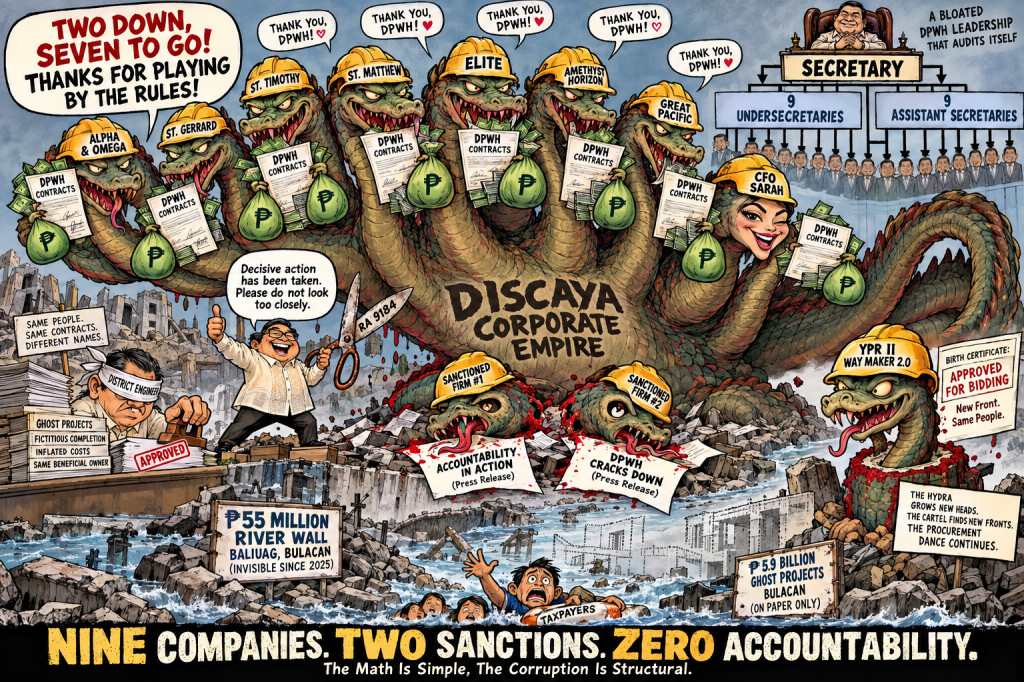
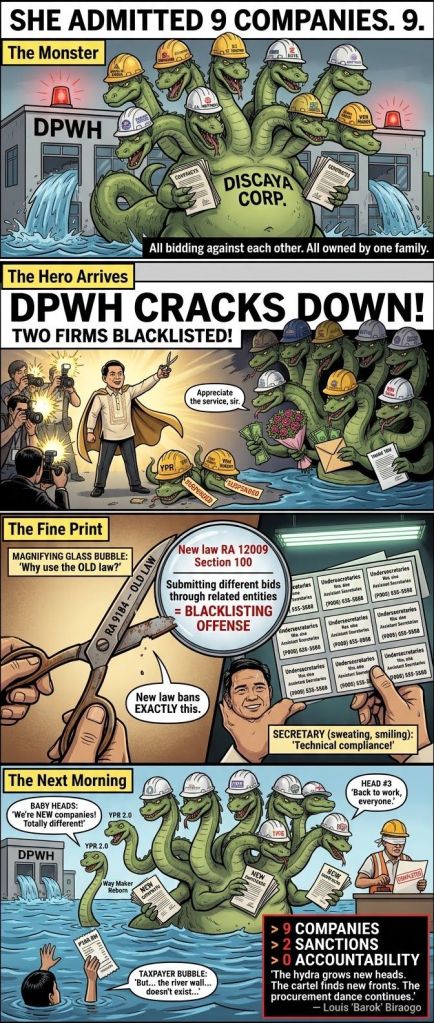
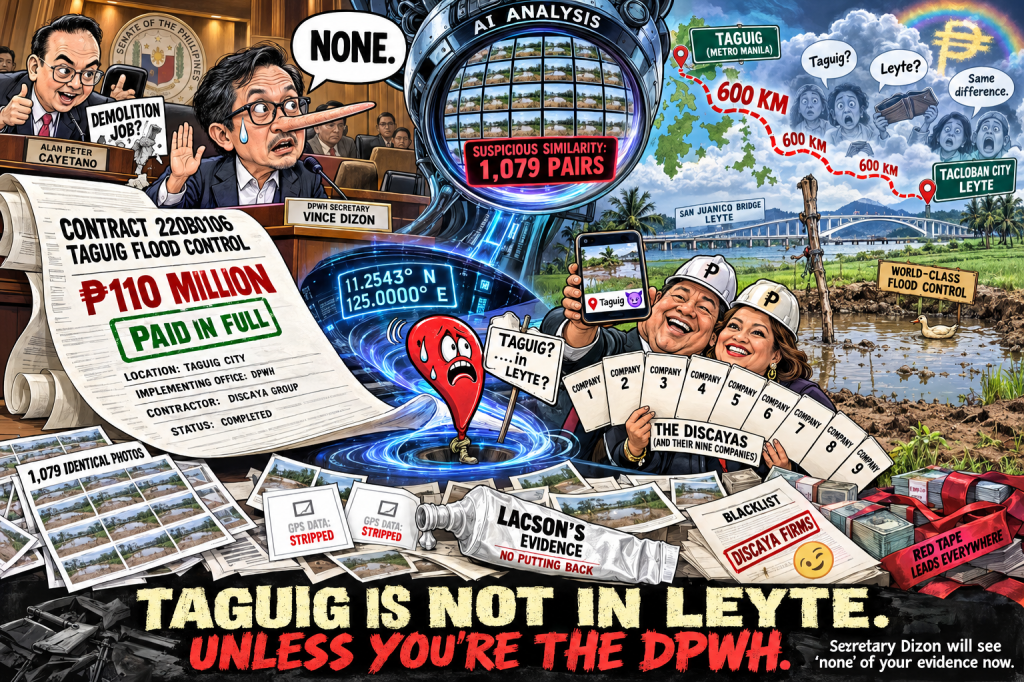
Here’s what the press release conveniently omits: the Discayas admitted under oath to owning nine construction companies. Nine. A family that somehow found it economically rational to incorporate an entire bidding ecosystem under one roof—Alpha and Omega, St. Gerrard, St. Timothy, St. Matthew, Elite, Amethyst Horizon, Great Pacific, plus the two now enjoying their government-mandated timeout.
And the DPWH blacklisted exactly two of them.
Let that sink in. The agency tasked with cleaning up a procurement system so rotten that fifteen contractors managed to corner 20% of the entire flood control budget—roughly ₱100 billion, according to President Marcos himself—has decided that the appropriate response to a nine-company cartel is to suspend the two firms that happened to default on their contracts.
This is like discovering a nine-headed hydra and proudly announcing you’ve managed to cut off two of the heads. The remaining seven are presumably sending thank-you notes.
The Legal Fiction of “Separate Entities”
Let’s talk about the legal framework, because the DPWH certainly wants us to believe this is all very technical and boring.
YPR got a two-year suspension for a second offense. Way Maker got one year for one project and two years for another. Under Republic Act No. 9184 (Government Procurement Reform Act), the penalties are technically correct. First offense, one year. Second offense, two years. The math checks out.
But here’s the thing about technical compliance: it’s often the last refuge of the institutionally complicit.
The Discayas didn’t operate nine companies because they were confused about corporate structure. They operated nine companies because procurement rules are designed to evaluate bidders, not beneficial ownership networks. If you control nine separate legal entities, you can submit nine separate bids. To the Procurement Monitoring System, that looks like nine independent competitors. To the Discayas’ bank account, it looks like a guaranteed win.
Sarah Discaya herself admitted this under oath. She initially denied her companies competed against each other—a denial that lasted about as long as it took for senators to produce the bidding records. Then she acknowledged “instances where the entities participated in the same bidding process”.
That’s not a confession. That’s a confession disguised as an evasion.
Republic Act No. 12009 (New Government Procurement Act) actually anticipated this exact scenario. Section 100 explicitly identifies as blacklisting offenses the act of “submitting different bids through entities in which the bidder has an interest to create an appearance of competition that does not actually exist”. It’s almost as if someone in the legislative drafting process looked at the Philippine contracting industry and thought, “Hmm, this might happen.”
But the DPWH orders cite RA 9184, the old law. The old law that didn’t explicitly address beneficial ownership. The old law under which nine nominally independent corporations are, for procurement purposes, nine nominally independent corporations.
Convenient, isn’t it?
The Bloat You’re Not Supposed to Notice
While the DPWH was busy demonstrating its commitment to accountability by blacklisting two of the nine companies in a family cartel, it was also quietly doing something far more revealing.
Secretary Dizon’s “top-to-bottom” cleanup has produced a DPWH leadership structure featuring nine undersecretaries and nine assistant secretaries. That’s eighteen senior officials. A department that was supposed to be streamlining its operations has instead doubled down on the executive layer.
Now, defenders will argue that a larger leadership structure means more specialized oversight, better monitoring, faster decision-making. They will point to the complexity of managing an agency with a budget in the hundreds of billions and projects scattered across an archipelago of 7,000 islands.
But here’s a question that doesn’t require a consultant’s report to answer: if adding undersecretaries and assistant secretaries solved procurement corruption, why does the DPWH still have a procurement corruption problem?
The Internal Audit Service has been placed directly under the Office of the Secretary. The official rationale is “direct access” and “rapid escalation.” The unofficial rationale is that an audit service under the Secretary’s “supervision and control” is an audit service that audits what the Secretary wants audited.
There’s a reason internal audit standards emphasize independence. There’s a reason the Commission on Audit (COA) exists as a constitutional body rather than a line bureau. The entire architecture of government accountability assumes that the auditor should not be organizationally subordinate to the auditee.
But sure, let’s trust the process.
The Ghost Projects That Keep Haunting
Meanwhile, the actual substance of the scandal—the reason anyone cares about Discaya construction companies in the first place—remains largely unresolved.
President Marcos personally inspected a ₱55-million “river wall” in Baliuag, Bulacan, and found… nothing. No wall. No river structure. Just paperwork and payments. The district engineer later admitted certifying the structure based on documents alone, without visiting the site.
A ₱5.9-billion cluster of “ghost” flood control projects was allegedly concentrated in Bulacan under Wawao Builders. The Discayas face graft and malversation charges over a ₱53.9-million project in Calumpit where payments were released without approved disbursement vouchers, and full payment for dredging and embankment was made without any computation basis or supporting documents.
These are not allegations of technical non-compliance. These are allegations that government money was paid for work that was not done, and that the paperwork was fabricated to make it look done.
Blacklisting YPR and Way Maker prevents them from bidding on future contracts. It does not recover a single peso of the money already paid. It does not identify which officials approved the payments. It does not explain how a nine-company family cartel operated undetected through multiple administrations.
The DPWH has filed cases. The Ombudsman has filed cases. The Senate has held hearings. The COA has issued reports. And yet the fundamental question remains unanswered: who actually benefited from the money, and why did the system allow it to happen?
The Accountability Theater Production
The Discaya blacklisting is a microcosm of how anti-corruption works in the Philippines. There is a scandal. There is public outrage. There are hearings. There are charges. There are blacklistings. And then, slowly, the machinery of accountability grinds to a halt somewhere between the filing of the complaint and the actual conviction.
The Discayas are in custody, which is more than can be said for many accused in similar scandals. But custody is not conviction. Charges are not restitution. Blacklisting is not reform.
The deeper problem is structural. The Philippines has a procurement system that, for all its rules and regulations and blacklisting guidelines and beneficial ownership provisions, still allowed one family to accumulate nine construction companies, admit under oath to competing against itself, and continue operating until it defaulted on enough contracts to attract attention.
And the response? Blacklist the two that failed.
Not the nine. Not the network. Not the officials who certified the ghost projects. Not the procurement officers who failed to notice that nine “independent” bidders shared a last name.
Just the two. Because that’s manageable. That’s containable. That’s a press release.
The Question No One Is Asking
Here’s the question that should be on every senator’s lips, every journalist’s notebook, and every taxpayer’s mind:
If the Discaya network was built to manufacture artificial competition in government bidding, and if that network operated for years across multiple agencies and administrations, how many other families are doing the same thing?
The DPWH has over 2,000 accredited contractors. Fifteen of them cornered 20% of the flood control budget. That’s not a market. That’s an oligopoly with better branding.
The Discayas got caught because they became too visible. They testified before the Senate. Their projects failed spectacularly enough to attract presidential attention. Their name became a liability.
But the system that allowed them to operate—the system that treats nine corporations as nine bidders, that relies on self-reported beneficial ownership, that audits after the money is gone—that system is still in place.
Blacklisting YPR and Way Maker doesn’t fix that system. It just removes two participants from it.
The hydra grows new heads. The cartel finds new fronts. The procurement dance continues.
And somewhere, a district engineer is certifying a river wall that doesn’t exist, confident that the paperwork will pass and the payment will clear, because that’s how the system works.
Until the next scandal. Until the next hearing. Until the next press release announcing that accountability has been served.
It hasn’t.
Key Citations
A. Legal & Official Sources
- The 1987 Constitution of the Republic of the Philippines. Official Gazette of the Republic of the Philippines, 1987, http://www.officialgazette.gov.ph/constitutions/1987-constitution/.
- The 1987 Constitution of the Republic of the Philippines. Article IX, Constitutional Commissions, D. The Commission on Audit. Official Gazette of the Republic of the Philippines, http://www.officialgazette.gov.ph/constitutions/the-1987-constitution-of-the-republic-of-the-philippines/the-1987-constitution-of-the-republic-of-the-philippines-article-ix/.
- Republic Act No. 9184. An Act Providing for the Modernization, Standardization and Regulation of the Procurement Activities of the Government and for Other Purposes (Government Procurement Reform Act). 10 Jan. 2003, http://www.officialgazette.gov.ph/2003/01/10/republic-act-no-9184/.
- Republic Act No. 12009. An Act Revising Republic Act No. 9184, Otherwise Known as the “Government Procurement Reform Act”, and for Other Purposes (New Government Procurement Act). 20 July 2024, lawphil.net/statutes/repacts/ra2024/ra_12009_2024.html.
- Commission on Audit. “Constitutional Mandate.” Commission on Audit, http://www.coa.gov.ph/about-us/constitutional-mandate/.
- Department of Public Works and Highways. Official Website, http://www.dpwh.gov.ph/.
- Office of the Ombudsman. Official Website, http://www.ombudsman.gov.ph/.
B. News Reports
- Ferreras, Vince Angelo. “Sarah Discaya Admits Owning 9 Construction Firms That Bid for Same Projects.” GMA News Online, GMA Network, 1 Sept. 2025, http://www.gmanetwork.com/news/topstories/nation/957675/sara-discaya-9-construction-firms-bidding-for-same-project/story/.
- Cruz, James Patrick. “These 15 Contractors Cornered 1 of 5 Flood Control Projects Nationwide.” Rappler, 11 Aug. 2025, http://www.rappler.com/philippines/list-top-contractors-flood-control-projects-marcos-administration/.
- Presidential Communications Office. “Economic Sabotage Charges Eyed vs Bulacan Contractor; PBBM Orders Probe on P55 M Ghost Flood Control Project.” 20 Aug. 2025, pco.gov.ph/news_releases/economic-sabotage-charges-eyed-vs-bulacan-contractor-pbbm-orders-probe-on-p55-m-ghost-flood-control-project/.
- “DPWH Chief Confirms Suspected ‘Ghost’ Flood Control Projects in Bulacan.” Manila Bulletin, 19 Aug. 2025, mb.com.ph/2025/08/19/dpwh-chief-confirms-suspected-ghost-flood-control-projects-in-bulacan.
- Mendoza, J. E. “Ombudsman Files Charges vs Discaya over P53.9-M Bulacan Project.” Philippine Daily Inquirer, 4 June 2026, newsinfo.inquirer.net/2240314/ombudsman-files-charges-vs-discaya-over-p53-9-m-bulacan-project.
- “DPWH Blacklists 2 More Discaya Firms.” Philstar.com, The Philippine Star, 28 Sept. 2026, http://www.philstar.com/headlines/2026/09/28/2559390/dpwh-blacklists-2-more-discaya-firms.
- ₱8B BBM Pork: CCTV for Every Captain’s Kumpare?
- ₱8.9 Billion, 331 Ghost Police Stations: The TIKAS Scandal Explained

- ₱8.4 Billion, 42,000 Barangays, 1 Election: The “Bawat Barangay Makikinabang” Vote-Buying Masterclass

- ₱75 Million Heist: Cops Gone Full Bandit

- ₱6.77B Ghost Haunts Duterte: RTC Dismisses Mans Carpio’s Desperate Plea
- ₱6.7-Trillion Temptation: The Great Pork Zombie Revival and the “Collegial” Vote-Buying Circus

- ₱53 Million Man Tells ₱695-a-Day Workers to Stop Being ‘Mayabang’: The Audacity of BSP’s Remolona
- ₱3.06 Billion for Evacuation Centers—But Nobody Knows Where They’ll Stand (Or If They’ll Exist)
- ₱10B Ghost in New Clark City: Matibag’s Haunted Séance for Cayetano

- ₱1.9 Billion for 382 Units and a Rooftop Pool: Poverty Solved, Next Problem Please

- ₱1.35 Trillion for Education: Bigger Budget, Same Old Thieves’ Banquet

- ₱1 Billion Congressional Seat? Sorry, Sold Out Na Raw — Si Bello Raw Ang Hindi Bumili




Leave a comment