Three Former Chief Justices Backed the Senate’s Ruling. Panelo Says They’re All Criminals Now. One of These Arguments Is Serious
By Louis ‘Barok’ C. Biraogo — September 28, 2026
THERE are moments in Philippine legal discourse when the absurdity is so exquisitely layered that you need a thesaurus and a therapist to properly process it.
Thursday, September 17, 2026, delivered one such moment.
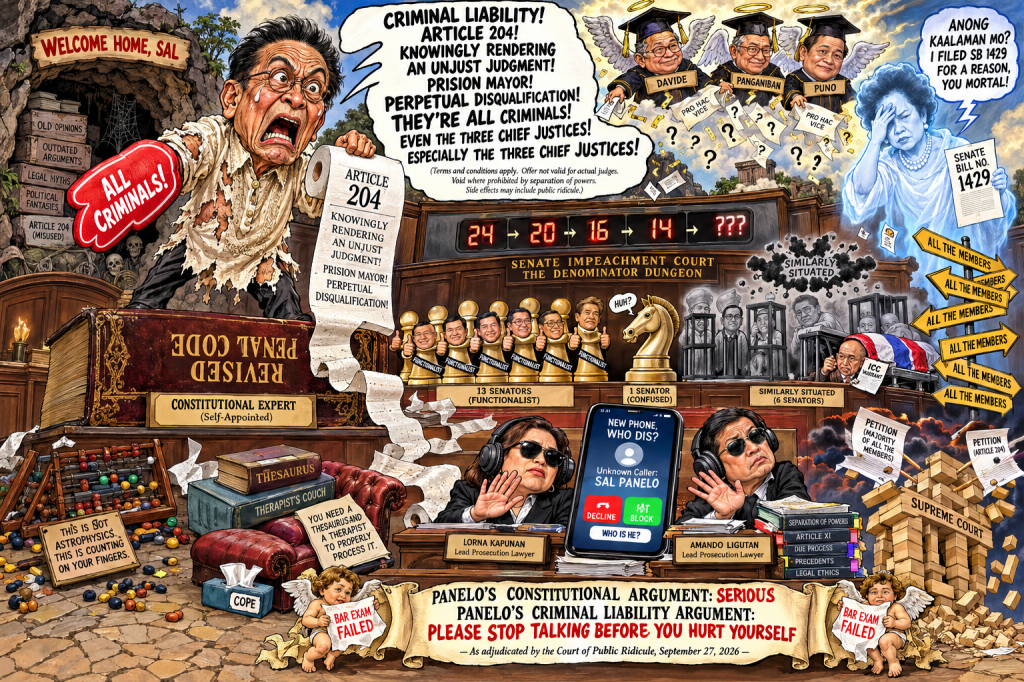
Salvador Panelo—yes, that Salvador Panelo, the man who once told the nation that Rodrigo Duterte’s “I will kill you” was a mere expression of fatherly concern—emerged from whatever cave he currently inhabits to declare that the Senate impeachment court had just committed a “tragedy” of constitutional proportions. He warned that senator-judges who voted to reinterpret the two-thirds conviction threshold could face criminal liability under Article 204 of Act No. 3815 (Revised Penal Code) for “knowingly rendering an unjust judgment.”
The House prosecution’s response?
“Who is he? Don’t know him,” said private prosecutor Lorna Kapunan.
“Not familiar, sorry,” added Amando Ligutan.
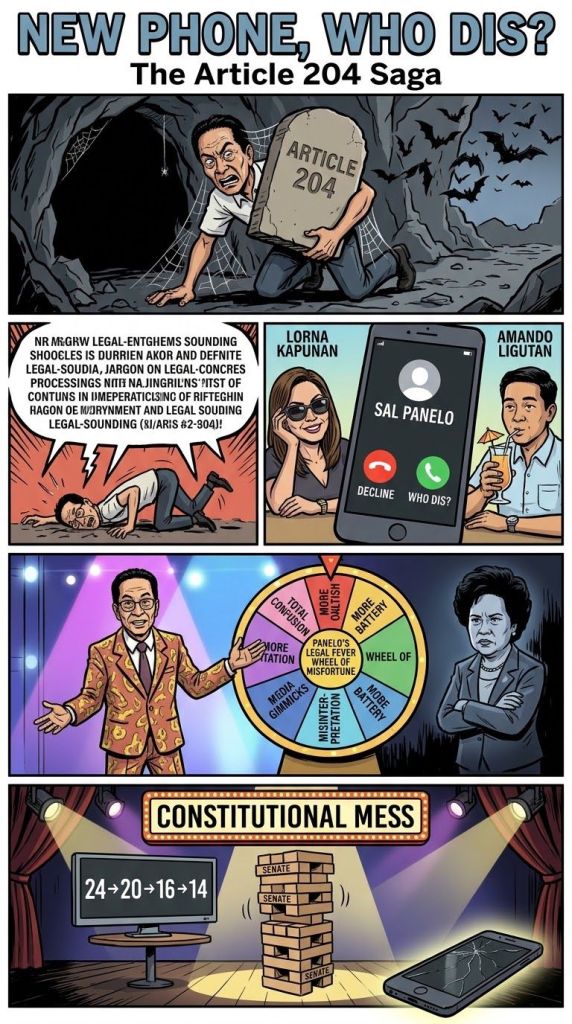
Ladies and gentlemen, we have reached peak Philippine politics: a former Chief Presidential Legal Counsel threatening senators with prison time, only to be met with the legal equivalent of “new phone, who dis?”
But let’s not let the comedy obscure the constitutional catastrophe lurking beneath. Because buried under Panelo’s theatrical warnings and the prosecution’s equally theatrical dismissals lies a genuinely unsettling question: Can the Senate change the rules of conviction mid-trial, and if it does, should anyone go to jail for it?
The answer, dear readers, is far messier than either side wants you to believe.
The Textualist Trap Panelo Built (And Fell Into)
Let’s start with Panelo’s strongest card: the Constitution itself.
Article XI, Section 3(6) of the 1987 Constitution states, with all the clarity of a traffic sign:
“No person shall be convicted without the concurrence of two-thirds of all the Members of the Senate.”
“All the Members.” Not “all present.” Not “all capable of participating.” Not “all who didn’t flee to Davao because an international warrant is pending against them.”
All. The. Members.
The Senate has 24 members. Two-thirds of 24 is 16. This is not astrophysics. This is not even algebra. This is counting on your fingers.
Panelo’s argument is that this textual clarity means the Senate cannot simply decide to exclude four senators from the denominator because they happen to be detained, hiding from the International Criminal Court (ICC), or recuperating abroad. The Constitution doesn’t say “all Members minus the ones who can’t show up.” It says all.
And he’s not alone. Former Associate Justice Adolfo Azcuna, one of four amici curiae invited to weigh in, took exactly this position: “As long as they are members of the Senate, they constitute the denominator.”
This is the textualist position. It is clean, logical, and has the virtue of being consistent with the actual words on the page.
It is also, as we shall see, a position that has real textual force—but one that must ultimately confront the possibility that the framers did not intend for absent senators to make conviction impossible.
The Senate’s Counter-Move: We Didn’t Change the Fraction, We Changed Who Counts
Here’s where the Senate’s defenders—including three former Chief Justices—roll their eyes at the textualists and say, “You’re being pedantic.”
The Senate’s September 23 ruling, passed 13-1-6, held that the two-thirds threshold should be computed based on senators who are “legally and factually capable of participating” in the trial. Four senators were excluded: Jinggoy Estrada (detained on plunder charges), Rodante Marcoleta (same), Ronald “Bato” dela Rosa (ICC fugitive), and Loren Legarda (extended medical leave abroad).
With 20 senators in the denominator, two-thirds is 13.33, which rounds up to 14.
Now, the Senate’s argument—supported by retired Chief Justices Hilario Davide Jr., Artemio Panganiban, and Reynato Puno—is not that they’re lowering the threshold. It’s that they’re redefining the base.
“The Constitution chose a fraction, not a fixed number,” Puno reportedly argued.
This is not a stupid argument. It’s actually quite clever.
Consider: If the Senate had 23 members because one died in office, would the Constitution require 16 votes to convict? Two-thirds of 23 is 15.33, which rounds up to 16. Fine. What if the Senate had 22 members? Two-thirds is 14.67, rounding to 15. Now what if the Senate had 20 members? Two-thirds is 13.33, rounding to 14.
The Constitution says “two-thirds of all the Members.” It does not say “two-thirds of 24.” If membership changes, the fraction produces a different number.
The Senate’s position is essentially: We’re not changing the fraction. We’re just saying that senators who are legally incapable of functioning as senators shouldn’t count as “Members” for purposes of a voting threshold they cannot possibly meet.
It’s a functionalist argument. It asks not “what do the words say?” but “what makes sense in this extraordinary circumstance?”
And you know what? It’s not crazy.
The Avelino Problem: When Precedent Bites Back
Here’s where things get deliciously complicated.
Both sides are citing Avelino v. Cuenco (G.R. No. L-2821, 1949), the landmark case where the Supreme Court held that “the House” doesn’t mean “all the members” when determining quorum.
In that case, Senator Tomas Confesor was abroad and beyond the Senate’s coercive jurisdiction. With only 23 senators available, the Court held that 12 senators—a majority of 23—constituted a valid quorum.
The Senate’s defenders point to Avelino v. Cuenco and say: See? “All” doesn’t always mean “all.”
But the three former Chief Justices themselves reportedly cautioned that Avelino v. Cuenco concerned quorum, not the conviction threshold. And that distinction matters.
Quorum asks: “How many members are needed for the body to transact business?” Conviction threshold asks: “How many votes are needed to remove an impeached official?”
These are different questions with different constitutional weights. Quorum is about functionality. Conviction threshold is about protection—specifically, protecting an impeachable officer from conviction by a simple majority.
If you can shrink the denominator by declaring senators “incapable,” you’ve effectively given the Senate a tool to manipulate the threshold. And that’s a genuinely dangerous precedent.
The Phrase That Could Break the Whole Thing: “Similarly Situated”
Here’s where the Senate’s ruling becomes legally vulnerable in ways its defenders don’t want to acknowledge.
The September 23 ruling doesn’t just exclude detained senators, fugitives, and the medically incapacitated. It reportedly includes senators who are “similarly situated”.
Similarly situated.
What does that mean? Who decides? What qualifies?
Is a senator on a diplomatic trip “similarly situated” to one hiding from an ICC warrant? Is a senator with a bad flu “similarly situated” to one with a chronic illness? Is a senator who deliberately boycotts the trial “similarly situated” to one who is legally detained?
The phrase is a blank check. And in constitutional law, blank checks are usually how you get constitutional crises.
If the Supreme Court reviews this ruling—and two petitions have already been filed by former Executive Secretary Victor Rodriguez and lawyer Ernesto Francisco Jr.—the justices will almost certainly zero in on this indeterminacy. A standard that cannot be objectively applied is not a standard. It’s a discretion.
And discretion in impeachment thresholds is exactly what the framers were trying to avoid.
The Article 204 Gambit: Panelo’s Legal Fever Dream
Now we come to the part where Panelo’s argument goes from “aggressive but arguable” to “please stop talking before you hurt yourself.”
Article 204 of Act 3815, the Revised Penal Code provides:
“Any judge who shall knowingly render an unjust judgment in any case submitted to him for decision, shall be punished by prision mayor and perpetual absolute disqualification.”
Panelo claims senator-judges who vote under the new threshold could be prosecuted under this provision.
There are approximately seven problems with this theory. Let me count the ways.
Problem One: The word “judge.”
Article 204 says “judge.” Not “public officer.” Not “senator-judge.” Not “anyone exercising quasi-judicial functions.”
The Revised Penal Code separately defines “public officers” in Article 203. If the drafters wanted Article 204 to apply to non-judges, they would have said so.
In fact, Senator Miriam Defensor Santiago once filed Senate Bill No. 1429 (Amending Articles 204, 205 and 207 of the Revised Penal Code) to amend Article 204 to include “officers exercising quasi-judicial functions.” The very existence of that bill proves that the current Article 204 does not cover such officers.
Panelo is citing a law that doesn’t apply to the people he’s threatening to prosecute.
Problem Two: The “collegiate court” problem.
The Supreme Court, in In Re: Joaquin T. Borromeo (A.M. No. 93-7-696-0, February 21, 1995), explicitly held that Article 204 “has no application to the members of a collegiate court… who reach their conclusions in consultation and accordingly render their collective judgment after due deliberation,” a doctrine subsequently reaffirmed in Sacmar v. Reyes-Carpio (A.M. No. RTJ-03-1766, March 28, 2003).
The Senate impeachment court is a collegiate tribunal. The senators don’t each render individual judgments. They deliberate, they vote, and the tribunal renders a collective determination.
Under the Court’s existing jurisprudence, Article 204 is a non-starter.
Problem Three: The “good faith” problem.
Article 204 requires that the judge knowingly render an unjust judgment. This requires conscious, deliberate bad faith.
The senator-judges who voted for the new threshold heard arguments from both sides. They consulted four former Supreme Court justices. They deliberated.
Three former Chief Justices supported the functional approach. One former Associate Justice opposed it.
That’s not “knowing” commission of injustice. That’s a contested constitutional question resolved after extensive deliberation.
If disagreement with a legal interpretation were sufficient for criminal liability, every dissenting opinion in Philippine jurisprudence would be a crime.
Problem Four: The “unjust judgment” problem.
For Article 204 to apply, there must be a judgment that is “unjust.” But the threshold ruling is not a judgment of conviction or acquittal. It’s an interlocutory ruling on a procedural question.
You can’t “knowingly render an unjust judgment” if you haven’t rendered a judgment at all.
Problem Five: The “separation of powers” problem.
Criminalizing legislative interpretation of constitutional provisions would destroy the Senate’s ability to function as an impeachment court. It would make every senator personally liable for every vote on a contested legal question.
The Supreme Court has warned that subjecting judges to criminal investigation for good-faith judicial acts undermines institutional independence. The same logic applies, even more forcefully, to senators exercising their explicit constitutional impeachment authority.
Problem Six: The “no controlling precedent” problem.
The Supreme Court has not ruled on whether the Senate’s interpretation is constitutional. Until it does, senators cannot “knowingly” violate a standard that has not been authoritatively established.
Problem Seven: The “politics” problem.
Panelo is not a neutral legal commentator. He was Rodrigo Duterte’s Chief Presidential Legal Counsel. He is deeply embedded in the Duterte political project. His warning is not disinterested legal analysis; it’s partisan advocacy dressed in penal code clothing.
The prosecution’s response—“Who is he?”—is rude, but it’s not entirely unjustified.
The Real Issue: What Happens When the Rules Change Mid-Game
Buried beneath Panelo’s theatrical threats and the prosecution’s dismissive snark is a genuinely serious procedural question: Can the Senate change the conviction threshold in the middle of a trial?
Senator Alan Peter Cayetano objected that the issue should have been resolved before the trial began. Presiding Officer Francis Escudero had initially ruled on July 6 that 16 votes were required. The trial proceeded on that basis. Evidence was presented. Witnesses were examined.
Then, on September 23—weeks into the proceedings—the court reversed itself.
Cayetano’s objection has force. Changing the rules mid-trial creates procedural instability. It alters the strategic calculations of both sides. It raises questions about whether the defense prepared its case under a different set of assumptions.
But the Senate’s counter is equally strong: If an earlier ruling was constitutionally erroneous, must the court perpetuate the error simply because the trial has progressed?
There’s no easy answer. But the fact that the ruling was declared pro hac vice—for this occasion only, with no stare decisis effect—suggests that even the senators who voted for it understood they were doing something extraordinary.
The Bottom Line: A Constitutional Mess With No Clean Exit
So where does this leave us?
Panelo’s constitutional argument is serious. The text says “all the Members.” It does not say “all the Members who can show up.” The Senate’s ruling creates a movable threshold that could be manipulated in future impeachments. That’s a genuine concern.
Panelo’s criminal liability argument is not serious. Article 204 applies to judges, not senators. It requires knowing bad faith, not contested legal interpretation. And it has never been applied to collegiate bodies acting after deliberation. The Supreme Court has effectively already foreclosed this theory.
The Senate’s interpretation is defensible but vulnerable. Excluding legally incapacitated senators may make functional sense. But the phrase “similarly situated” is dangerously vague. And the mid-trial timing raises procedural fairness concerns that the Supreme Court may find troubling.
The Supreme Court now has two petitions before it. It will have to decide whether to intervene in an impeachment proceeding—a question the Court has historically approached with caution—and if it does, whether the Senate’s interpretation crosses a constitutional line.
Whatever the Court decides, one thing is certain: Panelo’s warning about criminal liability is legal theater, not legal analysis. The senators who voted for the new threshold may be wrong. They may have violated the Constitution. But they are not criminals.
And the prosecution’s “Who is he?” response, while satisfying, misses the point. Panelo may be a partisan operative, but his constitutional argument deserves a serious answer. The fact that he’s the one making it doesn’t make it wrong.
In Philippine politics, sometimes the most ridiculous messenger delivers the most inconvenient message.
And sometimes the most inconvenient message is the one everyone would prefer to ignore.
Louis ‘Barok’ C. Biraogo is the author of the Kweba ni Barok blog. He has been described as “not familiar” by at least one impeachment prosecutor, which he considers a personal achievement.
Key Citations
A. Legal & Official Sources
- The 1987 Constitution of the Republic of the Philippines. Official Gazette of the Republic of the Philippines, 1987, http://www.officialgazette.gov.ph/constitutions/1987-constitution/.
- “The 1987 Constitution of the Republic of the Philippines – Article XI.” Official Gazette of the Republic of the Philippines, http://www.officialgazette.gov.ph/constitutions/the-1987-constitution-of-the-republic-of-the-philippines/the-1987-constitution-of-the-republic-of-the-philippines-article-xi/.
- Act No. 3815. Revised Penal Code of the Philippines. 8 Dec. 1930, lawphil.net/statutes/acts/act1930/act_3815_1930.html.
- Avelino v. Cuenco. G.R. No. L-2821, 4 Mar. 1949, Supreme Court of the Philippines, lawphil.net/judjuris/juri1949/mar1949/gr_l-2821_1949.html.
- In Re: Joaquin T. Borromeo, Ex Rel. Cebu City Chapter of the Integrated Bar of the Philippines. A.M. No. 93-7-696-0, 21 Feb. 1995, Supreme Court of the Philippines, lawphil.net/judjuris/juri1995/feb1995/am_93-7-696-0_1995.html.
- Sacmar v. Reyes-Carpio. A.M. No. RTJ-03-1766, 28 Mar. 2003, Supreme Court of the Philippines, http://www.lawphil.net/judjuris/juri2003/mar2003/am_rtj-03-1766_2003.html.
- Defensor Santiago, Miriam. Senate Bill No. 1429. An Act Amending the Penal Code, Articles 204, 205 and 207. 13th Congress of the Republic of the Philippines, ldr.senate.gov.ph/subject/revised-penal-code-art-204205207.
- Rome Statute of the International Criminal Court. International Criminal Court, http://www.icc-cpi.int/.
B. News Reports
- Villeza, Mark Ernest. “Senate Warned over Revising Impeachment Vote Threshold.” Philstar.com, 18 Sept. 2026, https://www.philstar.com/headlines/2026/09/18/2557092/senate-warned-over-revising-impeachment-vote-threshold
- Ferreras, Vince Angelo. “Prosecution Dismisses Sal Panelo’s Warning on Impeachment Vote Threshold.” GMA News Online, GMA Network, 23 Sept. 2026, http://www.gmanetwork.com/news/topstories/nation/1003452/prosecution-dismisses-sal-panelo-s-warning-on-impeachment-vote-threshold/story/.
- Mirabuna, Mc Vincent. “‘Who Is He?… Not Familiar!’ Kapunan, Ligutan Inisnab si Sal Panelo.” Balita, Manila Bulletin, 24 Sept. 2026, balita.mb.com.ph/2026/09/24/who-is-he-not-familiar-kapunan-ligutan-inisnab-si-sal-panelo/.
- Bacelonia, Wilnard. “Senate Court Drops Fixed 16-Vote Threshold in VP Trial.” Philippine News Agency, 23 Sept. 2026, http://www.pna.gov.ph/articles/1284670.
- Chi, Cristina. “Voting 13-1, Senate Court Lowers Threshold to Convict VP Sara Duterte.” Philstar.com, 22 Sept. 2026, http://www.philstar.com/headlines/2026/09/22/2558345/senate-scraps-fixed-16-vote-threshold-sara-duterte-impeachment.
- Chi, Cristina. “Sara Duterte Trial’s Two-Thirds Ruling Won’t Bind Future Impeachment Courts.” Philstar.com, 24 Sept. 2026, http://www.philstar.com/headlines/2026/09/24/2558653/future-impeachment-courts-can-decide-differently-threshold-question.
- Mangaluz, Jean. “SC Asked to Void Impeachment Court Ruling on Vote Threshold for Sara Duterte’s Conviction.” GMA News Online, GMA Network, 24 Sept. 2026, http://www.gmanetwork.com/news/topstories/nation/1003607/sc-asked-to-void-impeachment-court-ruling-on-vote-threshold-for-sara-duterte-s-conviction/story/.
- Calalo, Arlie O. “Second Petition vs Senate Impeachment Vote Threshold Filed at SC.” The Manila Times, 25 Sept. 2026, http://www.manilatimes.net/2026/09/25/news/second-petition-vs-senate-impeachment-vote-threshold-filed-at-sc/2432999.
- “Ang Hirap Maging Mahirap”: The PAO Scandal That Proves Government Contempt Is Nothing New

- “Far-Off” My Axx: Malacañang’s Claire Castro Drowns in Her Own Legal Gaslighting

- “Forthwith” to Farce: How the Senate is Killing Impeachment—And Why Enrile’s Right (Even If You Can’t Trust Him)

- “HINDI AKO NAG-RESIGN!”

- “I Know Nothing”: Baste Duterte’s Amnesia Defense Meets ₱33M in GenCorp Contracts

- “I’m calling you from my new Globe SIM. Send load!”

- “Mahiya Naman Kayo!” Marcos’ Anti-Corruption Vow Faces a Flood of Doubt

- “Manageable” Debt, Unmanageable Lies: DBM’s ₱21 Trillion Fairy Tale

- “Meow, I’m calling you from my new Globe SIM!”

- “Natrabaho”: One Word, One Ombudsman, and a Judiciary on Trial

- “No Special Jail for Crooks!” Boying Remulla Slams VIP Perks for Flood Scammers

- “Philippine-Controlled” or Yankee Gas Station? The Davao Fuel Depot Farce Exposed





Leave a comment