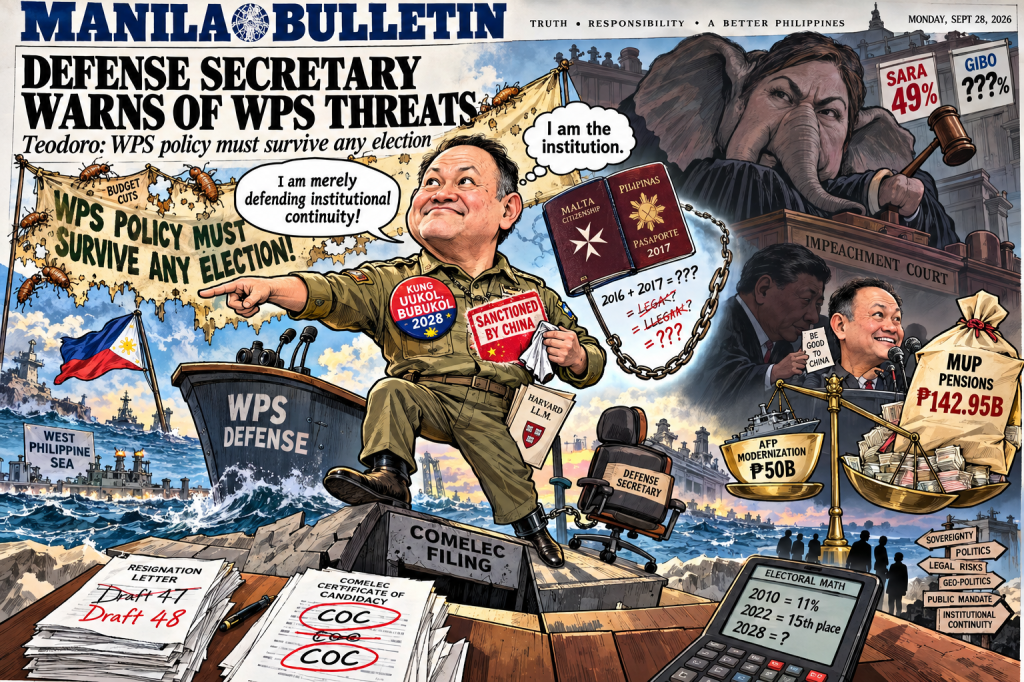
He Renounced Malta in 2021. He Renewed His Philippine Passport in 2017. The Math Doesn’t Add Up—and Neither Does His ‘Non-Candidacy.’
By Louis ‘Barok’ C. Biraogo — September 27, 2026
Let me tell you something about the art of the non-answer. It’s not a Filipino invention—Machiavelli wrote the playbook—but Gibo Teodoro has elevated it to something approaching religious practice.
“Kung uukol, bubukol.” If it’s meant to be, it will happen. That’s what the Defense Secretary told reporters in Albay last July when asked about 2028. It sounds like fatalism. It functions as plausible deniability. And if you squint hard enough, it looks exactly like a man who has already decided to run but wants you to think the universe is doing the deciding.
Fast forward to September 26, 2026. Teodoro is on the Manila Bulletin’s front page warning that the Philippines’ gains in the West Philippine Sea (WPS) could be “undermined” if the country fails to sustain its resistance to Chinese influence after the 2028 elections. The statement is framed as defense of institutional continuity. Read it again. It’s a campaign speech that hasn’t yet filed its certificate of candidacy (COC).
Here’s the thing about Gibo Teodoro: he’s the smartest man in any room he enters, and he knows it. University of the Philippines College of Law (UP Law). Harvard Master of Laws (LLM). Two tours as Defense Secretary. A 2010 presidential run that went nowhere but taught him exactly how the game is played. When he says “I’m keeping my options open,” what he means is: I’ve already weighed them, and I’m waiting for the right moment to pretend I haven’t.
But let’s not get ahead of ourselves. Let’s do what Barok does best: follow the money, follow the law, and follow the smell.
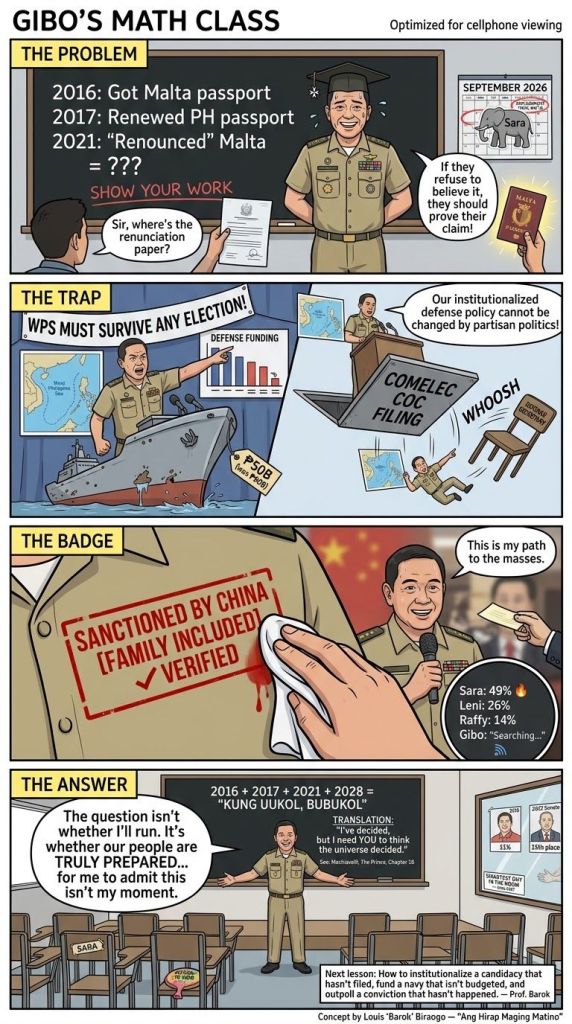
The Maltese Falcon That Won’t Fly Away
You cannot discuss Gibo Teodoro’s political future without confronting the Maltese passport. This is the skeleton that refuses to stay in the closet, no matter how many times the Department of National Defense (DND) issues press releases insisting it’s been properly buried.
The timeline, as best as public reporting can establish: Teodoro acquired Maltese citizenship through the country’s citizenship-by-investment program in December 2016. He renewed his Philippine passport in March 2017. He surrendered and renounced the Maltese passport in 2021, shortly before filing for his 2022 Senate bid. A complaint was filed in June 2026 before the Pasay City prosecutor’s office seeking an investigation. As of late September, it remains unresolved.
The DND calls it a “fishing expedition.” Teodoro calls it a “smear campaign.” He told reporters: “If they refuse to believe it, then they should prove their claim.”
That’s a curious burden-shifting for a man who once held the nation’s second-most-powerful security post. If the complaint is baseless, why not simply produce the renunciation documents? Why let the cloud linger? The answer is that the cloud serves a purpose. It keeps his name in the headlines, keeps his nationalist credentials sharpened by the friction of persecution, and keeps his critics looking like conspiracy theorists.
But here’s what the DND’s damage control doesn’t address: the timing. Why did it take until 2025 for this to become public? If Teodoro was transparent with the Commission on Appointments in 2023, why did the story break through investigative journalism rather than voluntary disclosure? And what exactly was the nature of the “investment” that secured Maltese citizenship? These are not idle questions. They are the kind of questions that, in a properly functioning democracy, a presidential candidate should have to answer under oath, in public, before an electorate that deserves to know whether its potential commander-in-chief ever swore allegiance to a Mediterranean tax haven.
The legal framework is murky enough to be weaponized. Commonwealth Act No. 63 (An Act Providing for the Ways in Which Philippine Citizenship May Be Lost or Reacquired) establishes that naturalization in a foreign country is grounds for loss of Philippine citizenship. Republic Act No. 9225 (Citizenship Retention and Re-acquisition Act of 2003) allows natural-born Filipinos who naturalize abroad to reacquire Philippine citizenship by taking an oath of allegiance—and explicitly preserves their natural-born status. The Supreme Court’s Bengson III v. HRET precedent supports this reading. Mercado v. Manzano establishes that dual citizenship (as opposed to dual allegiance) isn’t per se disqualifying.
So Teodoro is probably legally qualified. Probably. But “probably qualified” is not the same as “unassailable.” And in a presidential campaign, the difference matters enormously. Ask Fernando Poe Jr. Ask Grace Poe. Ask anyone who has ever had to defend their citizenship before the Commission on Elections (COMELEC) while a nation watches.
The Resign-to-Run Trap
Here’s where Teodoro’s carefully constructed argument about “institutionalization” collides with the harsh reality of Philippine election law.
Under Section 66 of Batas Pambansa Blg. 881 (Omnibus Election Code), any appointive public official is deemed ipso facto resigned upon filing a certificate of candidacy. This isn’t a technicality. It’s the law. And it was upheld by the Supreme Court in Quinto v. COMELEC (G.R. No. 189698), where the Court reversed its earlier ruling and confirmed that appointive officials—unlike their elective counterparts—cannot cling to their posts while campaigning.
The practical implication is brutal. The moment Teodoro files his COC, he ceases to be Defense Secretary. He loses his platform, his security detail, his institutional access, and his ability to shape the very WPS policy he claims must be preserved. The man who argues that defense policy must outlast individuals will be legally compelled to abandon his post at the precise moment his personal advocacy is most needed.
There’s a certain irony here that Teodoro, with his Harvard-trained legal mind, surely appreciates. His own thesis—that the mechanisms are “institutionalized” enough to survive him—will be tested by his own resignation. If the Comprehensive Archipelagic Defense Concept and the Maritime Zones Act really are embedded in doctrine and statute, then his departure shouldn’t matter. If they aren’t, then his argument for continuity collapses into an argument for his own indispensability.
Which, conveniently, is also an argument for his candidacy.
The Budget That Betrays the Rhetoric
Now let’s talk about the money, because that’s where the institutionalization narrative starts to smell.
The 2027 National Expenditure Program allocates P50 billion for the Revised AFP Modernization Program. That sounds like a lot until you realize the 2026 allocation was P90 billion. That’s a 44.4% cut. And Teodoro himself told Congress the program actually needs P126.97 billion—leaving a funding gap of roughly P77 billion.
Meanwhile, the Military and Uniformed Personnel pension budget for 2027 is P142.95 billion. That’s nearly triple the proposed modernization allocation. Teodoro has had to publicly argue that pensions shouldn’t be pitted against modernization funding—a sign that the fiscal politics around sustaining the defense buildup are already strained under an administration that ostensibly supports it.
Here’s the uncomfortable question: if the Marcos administration is cutting Armed Forces of the Philippines (AFP) modernization by nearly half, what exactly is being “institutionalized”? Doctrine without funding is just paperwork. Statutes without appropriations are just words. The Comprehensive Archipelagic Defense Concept may be the AFP’s animating doctrine, but it cannot float on doctrine alone. It needs ships. It needs radar. It needs the “whole ecosystem” that AFP spokesperson Rear Admiral Roy Vincent Trinidad described—bases, ports, fuel tankers, air control systems, the unglamorous infrastructure that never makes headlines but makes deterrence possible.
A future administration less inclined toward confrontation with China wouldn’t need to repeal a single law to gut the WPS posture. It could simply decline to fight for the appropriations. It could let the funding gap widen. It could let the modernization program wither on the vine while maintaining the rhetorical commitment to sovereignty. Teodoro knows this. His own arguments about “building blocks” that “cannot be changed by partisan politics” are undermined by the reality that his own administration is underfunding those blocks.
The Sara Problem
You cannot analyze Teodoro’s 2028 prospects without confronting the elephant in the impeachment courtroom: Sara Duterte.
As of late September, the Vice President’s impeachment trial is in its tenth week. On September 23, the Senate impeachment court voted 13-1 to lower the conviction threshold to two-thirds of senators “legally and factually capable of participating”—effectively reducing the votes needed to convict from 16 to 14, given the absence of four senator-judges. Duterte’s camp has called it a “twisting of the law” and signaled a Supreme Court challenge.
If convicted, Duterte faces lifetime disqualification from public office under Article XI, Section 3(7) of the 1987 Constitution. If acquitted—or if the trial stalls into 2027—she remains the prohibitive frontrunner for 2028, polling at 49% in a six-way race, with Leni Robredo at 26% and Raffy Tulfo at 14%.
Teodoro doesn’t appear in those surveys at all.
That absence is not an accident. It’s a reflection of the fundamental gap between elite respect and electoral viability. Teodoro has the résumé. He has the security credentials. He has the intellectual heft. What he doesn’t have is a mass political base, a party machinery capable of national mobilization, or any demonstrated ability to translate policy expertise into votes.
His 2010 presidential run is instructive. He received roughly 11% of the vote—a respectable showing for a first-time candidate, but hardly a mandate. His 2022 Senate bid was worse: 15th place with 12.7 million votes, despite near-universal name recognition. The man has lost two national elections. The third time, as they say, is not always the charm.
The China Sanctions as Unlikely Asset
There’s one factor that could theoretically change Teodoro’s electoral calculus: China’s decision to sanction him and his immediate family in June 2026, barring them from mainland China, Hong Kong, and Macau, and prohibiting Chinese entities from doing business with them.
On its face, this is a diplomatic liability. A president needs to manage relationships with all foreign powers, including adversaries. Being personally sanctioned by Beijing complicates any future engagement, even the transactional kind.
But in Philippine domestic politics, it’s a badge of honor. It signals that Teodoro is not a China-friendly accommodationist. It positions him as the candidate who has personally borne the cost of standing up to Beijing. It transforms him from a technocrat into a symbol.
The September Seoul incident reinforced this. A Chinese delegate handed him a note mid-panel insisting the 2016 arbitral award is “illegal, null, and void.” Teodoro read it aloud and rebuked it publicly. This is not the behavior of a man preparing for quiet diplomacy. It’s the behavior of a man who understands that his electoral value lies precisely in his willingness to confront.
But here’s the trap: what wins primary-season applause can lose general-election votes. The Philippines is not a single-issue electorate. Voters care about inflation, employment, food prices, corruption, education, healthcare. A campaign built entirely on WPS resistance may rally the nationalist base, but it may not be enough to overcome the structural advantages of a Sara Duterte candidacy—if Duterte survives impeachment—or the appeal of a more broadly positioned alternative.
The Institutionalization Paradox
Teodoro’s central argument—that WPS policy must be “institutionalized” to survive electoral transitions—is substantively serious and politically convenient.
The substantive case is strong. The 2016 arbitral award, the Maritime Zones Act (RA 12064), the Archipelagic Sea Lanes Act (RA 12065), the Comprehensive Archipelagic Defense Concept—these are real achievements that deserve preservation. National security policy should not swing wildly with every six-year administration. There’s a reason the United States maintains its alliance commitments across party changes: predictability is a strategic asset.
But the political case is equally transparent. By framing WPS continuity as an existential imperative, Teodoro positions himself as the necessary guardian of that continuity. His argument becomes: “This policy must survive. I am the person who can ensure it survives. Therefore, I should be the one to lead.” The logic is circular but seductive.
The problem is that democracy doesn’t work that way. Sovereignty resides in the people, not in a policy doctrine. The Constitution grants the electorate the right to choose a different direction—even a different China policy—if that’s what they decide. Teodoro’s warning that gains “could be undermined” if the wrong candidate wins is, stripped of its diplomatic veneer, an argument that voters shouldn’t be trusted with the decision.
He would deny this, of course. His public statements emphasize that the public must be “prepared” to defend sovereignty, that the question is whether “our people are truly prepared.” This frames the issue as one of popular will rather than elite preference. But the effect is the same: if Teodoro loses, it’s because Filipinos weren’t ready. If he wins, it’s because they were. The people are either with him or they’re insufficiently patriotic.
The Bottom Line
Gilberto Teodoro Jr. is legally qualified to run for president. He is intellectually qualified. He is, by any measure, one of the most substantive figures in Philippine public life.
But presidential elections are not won on qualifications alone. They are won on coalition-building, on party machinery, on retail politics, on the ability to connect with voters who have never heard of Harvard or the Comprehensive Archipelagic Defense Concept. They are won by candidates who can speak to the price of rice as fluently as the rules of the United Nations Convention on the Law of the Sea (UNCLOS).
Teodoro has not demonstrated that ability. His 2010 and 2022 defeats are not accidents. They are data points. They suggest a ceiling on his electoral appeal that no amount of WPS advocacy will raise.
The Maltese citizenship issue remains unresolved—a legal and political vulnerability that opponents will exploit. The resign-to-run rule means he must surrender his platform the moment he declares. The AFP modernization budget is being cut, not expanded. And Sara Duterte, unless convicted and disqualified, remains the dominant force in the 2028 field.
So why does Teodoro keep the door open? Why the strategic ambiguity? Why “kung uukol, bubukol”?
Because the alternative is to admit that this is not his moment. And for a man who has spent his entire career being the smartest person in the room, that admission may be the hardest one of all.
Key Citations
A. Legal & Official Sources
- The 1987 Constitution of the Republic of the Philippines. Official Gazette of the Republic of the Philippines, 1987, http://www.officialgazette.gov.ph/constitutions/1987-constitution/.
- The 1987 Constitution of the Republic of the Philippines, art. XI, sec. 3. Official Gazette of the Republic of the Philippines, http://www.officialgazette.gov.ph/constitutions/the-1987-constitution-of-the-republic-of-the-philippines/the-1987-constitution-of-the-republic-of-the-philippines-article-xi/.
- Commonwealth Act No. 63. An Act Providing for the Ways in Which Philippine Citizenship May Be Lost or Reacquired. 1936, http://www.officialgazette.gov.ph/1936/10/21/commonwealth-act-no-63/.
- Republic Act No. 9225. Citizenship Retention and Re-acquisition Act of 2003. 2003, http://www.officialgazette.gov.ph/2003/08/29/republic-act-no-9225/.
- Batas Pambansa Blg. 881. Omnibus Election Code of the Philippines. 1985, http://www.officialgazette.gov.ph/1985/12/03/batas-pambansa-blg-881-s-1985/.
- Republic Act No. 12064. Philippine Maritime Zones Act. 2024, http://www.officialgazette.gov.ph/2024/11/07/republic-act-no-12064/.
- Republic Act No. 12065. Philippine Archipelagic Sea Lanes Act. 2024, http://www.officialgazette.gov.ph/2024/11/07/republic-act-no-12065/.
- United Nations Convention on the Law of the Sea. United Nations, 1982, http://www.un.org/depts/los/convention_agreements/texts/unclos/unclos_e.pdf.
- The South China Sea Arbitration (The Republic of Philippines v. The People’s Republic of China). Award, Permanent Court of Arbitration, 12 July 2016, sites.google.com/dfa.gov.ph/notoneinch/2016-arbitral-award.
- Bengson III v. House of Representatives Electoral Tribunal, G.R. No. 142840, 7 May 2001, http://www.lawphil.net/judjuris/juri2001/may2001/gr_142840_2001.html.
- Mercado v. Manzano, G.R. No. 135083, 26 May 1999, lawphil.net/judjuris/juri1999/may1999/gr_135083_1999.html.
- Quinto v. Commission on Elections, G.R. No. 189698, 22 Feb. 2010, lawphil.net/judjuris/juri2010/feb2010/gr_189698_2010.html.
B. News Reports
- Dava, Bianca. “‘Kung Uukol, Bubukol’: Teodoro Says Focus Remains on Defense, Not 2028 Race.” ABS-CBN News, 13 July 2026, https://www.abs-cbn.com/news/nation/2026/7/13/-kung-uukol-bubukol-teodoro-says-focus-remains-on-defense-not-2028-presidential-race-2149.
- Mangaluz, Jean. “Teodoro on Plans for 2028 Polls: Who Knows What Will Happen?” GMA News Online, GMA Network, 26 Sept. 2026, http://www.gmanetwork.com/news/topstories/nation/1003809/teodoro-on-plans-for-2028-polls-who-knows-what-will-happen/story/.
- Cupin, Bea. “Complaint vs Teodoro Seeks Answers to ‘Lingering Questions’ on Past Maltese Citizenship.” Rappler, 18 June 2026, http://www.rappler.com/philippines/complaint-gibo-teodoro-maltese-citizenship/.
- “DND: P126.9 B Needed for AFP Modernization Program for 2027.” GMA News Online, GMA Network, 25 Aug. 2026, http://www.gmanetwork.com/news/topstories/nation/999733/dnd-p126-9-b-needed-for-afp-modernization-program-for-2027/story/.
- “Impeachment Court Overturns Ruling, Reduces Voting Threshold to Convict VP Duterte.” Manila Bulletin, 23 Sept. 2026, mb.com.ph/2026/09/23/impeachment-court-overturns-ruling-reduces-voting-threshold-to-convict-duterte.
- De Vera-Ruiz, Ellalyn. “VP Duterte Leads 2028 Presidential Preference Poll, Followed by Robredo.” Manila Bulletin, 22 July 2026, mb.com.ph/2026/07/22/vp-sara-leads-2028-presidential-preference-survey-followed-by-robredo.
- “China Sanctions Philippine Defence Chief over ‘Erroneous Remarks.’” Reuters, 11 June 2026, http://www.reuters.com/world/china/china-sanctions-philippine-defence-secretary-over-erroneous-remarks-2026-06-11/.
- Robles, Raissa. “Teodoro for President? Philippine Defence Chief Draws 2028 Election Buzz after China Clash.” South China Morning Post, 17 Sept. 2026, http://www.scmp.com/week-asia/politics/article/3367820/teodoro-president-philippine-defence-chief-draws-2028-election-buzz-after-china-clash.

- “Ang Hirap Maging Mahirap”: The PAO Scandal That Proves Government Contempt Is Nothing New

- “Far-Off” My Axx: Malacañang’s Claire Castro Drowns in Her Own Legal Gaslighting
- “Forthwith” to Farce: How the Senate is Killing Impeachment—And Why Enrile’s Right (Even If You Can’t Trust Him)

- “HINDI AKO NAG-RESIGN!”

- “I Know Nothing”: Baste Duterte’s Amnesia Defense Meets ₱33M in GenCorp Contracts

- “I’m calling you from my new Globe SIM. Send load!”

- “Mahiya Naman Kayo!” Marcos’ Anti-Corruption Vow Faces a Flood of Doubt

- “Manageable” Debt, Unmanageable Lies: DBM’s ₱21 Trillion Fairy Tale

- “Meow, I’m calling you from my new Globe SIM!”

- “Natrabaho”: One Word, One Ombudsman, and a Judiciary on Trial

- “No Special Jail for Crooks!” Boying Remulla Slams VIP Perks for Flood Scammers

- “Philippine-Controlled” or Yankee Gas Station? The Davao Fuel Depot Farce Exposed






Leave a Reply