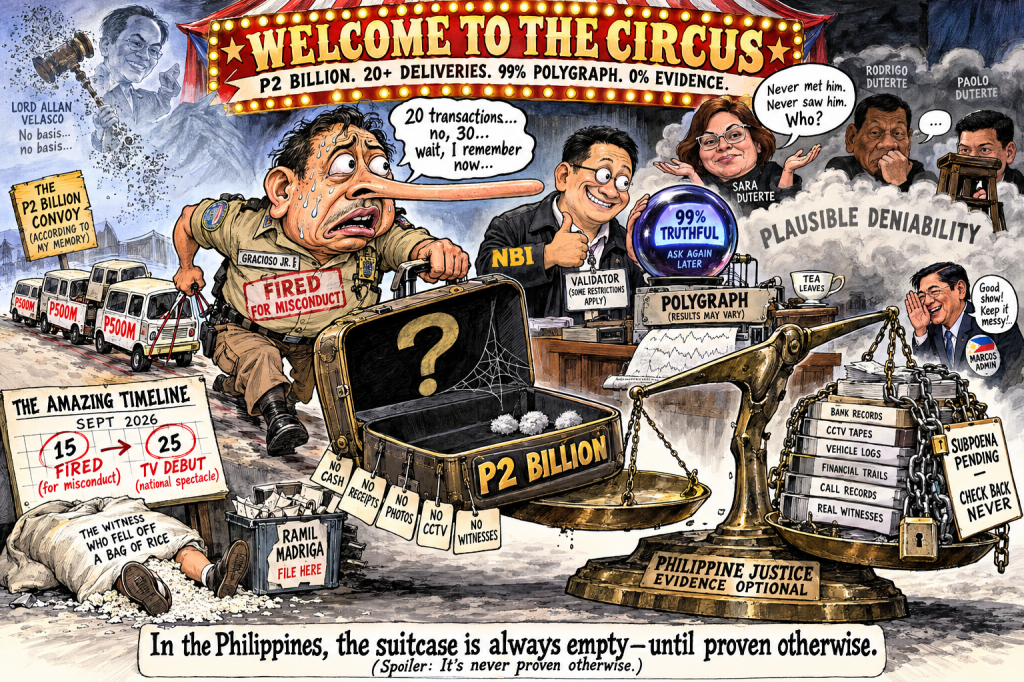
He says he hauled billions in suitcases. She says she’s never met him. The truth is somewhere in the unverified gap.
By Louis ‘Barok’ C. Biraogo | September 27, 2026
CALL me old-fashioned, but the Philippine government’s case for removing a sitting Vice President now hinges—at least in the court of public opinion—on a dismissed police corporal who claims he spent four years hauling suitcases of cash around the archipelago like some cut-rate armored car service, and the best the National Bureau of Investigation (NBI) can say is that he passed a polygraph and “some statements” were “independently validated.”
If this were an episode of Law & Order, the detectives would have laughed the guy out of the precinct. But this is the Philippines, where the bar for credibility is apparently so low that a man fired for “grave misconduct” two weeks before going public is now being treated as a potential game-changer in a constitutional impeachment trial.
Welcome to the circus. Grab some popcorn.
The Witness Who Fell Off a Bag of Rice
Rodulfo Gracioso Jr. is the kind of witness prosecutors dream about—if their dreams are fever-induced nightmares. A former police corporal who says he served as Lord Allan Velasco’s “head of security” from 2018 to 2022, Gracioso now claims he personally delivered over P2 billion in cash to Vice President Sara Duterte across more than 20 transactions, plus roughly P1 billion to former President Rodrigo Duterte and an indeterminate sum to Rep. Paolo Duterte.
His biggest alleged delivery? P500 million in three vans. Because nothing says “legitimate government transaction” quite like a three-van cash convoy.
The money supposedly came from “collections” from government agencies and infrastructure projects. Gracioso says he was told this. By whom? Unclear. When? Unspecified. How does he know? He doesn’t. He just heard it. That’s not evidence. That’s a rumor with a gym membership.
But here’s the part that really makes you want to stand up and applaud the sheer audacity of this narrative: Gracioso was dismissed from the Philippine National Police (PNP) on September 15, 2026—just ten days before his television debut—for three counts of grave misconduct and conduct unbecoming of a police officer.
So let’s recap. The star witness against the Vice President is a man who:
- Was fired for misconduct days before coming forward
- Has no documentary evidence of any delivery
- Admits his knowledge of the money’s source is secondhand
- Says he remembered 20+ transactions spanning four years—with dates, amounts, and locations—without apparently keeping any records
And the NBI’s response? “He passed a polygraph.”
Let that sink in.
The Polygraph: Science’s Answer to a Question Nobody Asked
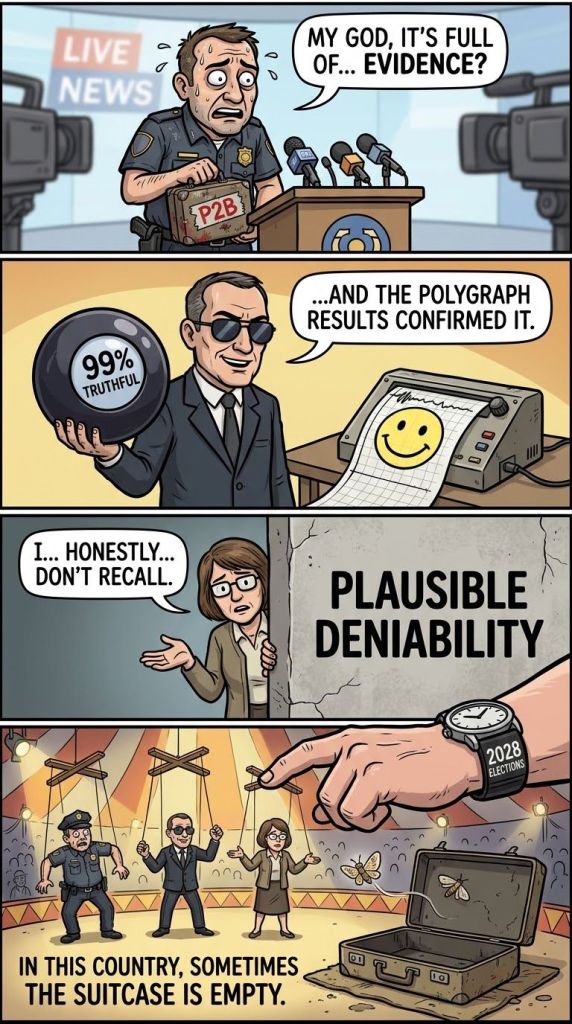
The polygraph examination has roughly the same scientific validity as reading tea leaves, except tea leaves don’t require a government budget. The NBI breathlessly reported that Gracioso’s polygraph indicated “approximately 99% truthfulness.”
This is the evidentiary equivalent of saying “the Magic 8-Ball said ‘It is decidedly so.’” The Philippine Supreme Court has repeatedly held that polygraph results are not reliable indicators of truth or deception and cannot be treated as conclusive evidence of anything. But in the court of public opinion, “99%” sounds scientific. It sounds definitive. It sounds like something a headline can run with.
What the NBI has actually said is that it “validated some of his statements through other means.” Which statements? How? With what evidence? The NBI isn’t saying. This is the investigative equivalent of a restaurant claiming “some of our ingredients are organic” and refusing to elaborate.
If the NBI validated that Gracioso worked for Velasco, congratulations. That proves he had a job. If it validated that specific cash deliveries occurred on specific dates with specific vehicles and specific recipients, that would be something. But the public doesn’t know, and the NBI isn’t telling. In the absence of specifics, “validated” is just a word that sounds reassuring in press conferences.
Sara Duterte and the Art of the Non-Denial Denial
Sara Duterte’s response to all of this has been… instructive.
“I do not know Rodulfo Gracioso Jr., nor have I ever received any money from him.”
Notice what she didn’t say. She didn’t say “the transactions he describes are impossible because I can account for every peso in my possession during those years.” She didn’t produce a single bank record, a single receipt, a single piece of evidence disproving any specific alleged delivery. She said she doesn’t know him.
That’s a defense that works only if you assume the money couldn’t have been delivered through intermediaries. But Gracioso’s own account says the money went to staff—Jeff Tupas, Ramil Madriaga, Bong Go. If the deliveries were structured to insulate the principal, then “I don’t know him” is not a defense. It’s a description of the very plausible deniability the scheme was designed to create.
Duterte also wheeled out her now-standard rhetorical device: comparing Gracioso to Ramil Madriaga, her former alleged bagman whose perjury complaint she filed was dismissed by Taguig prosecutors for insufficient evidence. She predicted Gracioso’s testimony would end up “in the trash bin—just like the one from Ramil Madriaga.”
But here’s what she conveniently omitted: the dismissal of her perjury complaint against Madriaga did not establish that Madriaga was lying. The prosecutors explicitly said the evidence did not establish that he knowingly and willfully made false statements—a much higher bar than simply being wrong. The dismissal was not a vindication. It was a procedural ruling that the Vice President failed to meet the elements of perjury.
And now she’s promising to file cases against Gracioso the moment she gets his affidavit. Because nothing says “I’m innocent” quite like threatening to sue your accuser for perjury before you’ve even read his sworn statement.
Velasco’s Vanishing Act
Lord Allan Velasco, the man Gracioso says gave the orders, has responded to the allegations with the time-honored tactic of loudly saying nothing useful.
His spokesperson, lawyer Rowell Ilagan, called the allegations “fabricated” and noted that Velasco’s record is “untainted with corruption.” Ilagan also pointed out that Gracioso’s timeline is “inconsistent” with verifiable events like the COVID-19 pandemic and Velasco’s speakership.
That’s a legitimate point—if it can be substantiated. But “the timeline is inconsistent” is not the same as “here are the records proving no such delivery occurred.” If Velasco wants to clear his name, he could produce his security detail logs, his travel records, his communications with Gracioso. Instead, his camp is doing what every embattled politician does: attacking the messenger and hoping the story dies.
The math here is interesting. If Gracioso is telling the truth, Velasco is potentially at the center of one of the largest cash-based corruption schemes in recent Philippine history—P3 billion or more allegedly funneled through his security apparatus to the Duterte family. If Gracioso is lying, Velasco is the victim of a bizarre fabrication by a man he employed for four years. Either way, the former Speaker has some explaining to do.
He’s not doing it.
The Madriaga Precedent: A Warning, Not a Shield
Sara Duterte wants the public to believe Gracioso is just another Madriaga—a disgruntled former aide who fabricated allegations for personal or political reasons.
But the Madriaga comparison cuts both ways.
The Taguig prosecutor’s dismissal of Duterte’s perjury complaint against Madriaga was not a finding that Madriaga told the truth. It was a finding that Duterte failed to prove he lied knowingly and willfully. That’s a distinction that matters legally, even if it’s inconvenient politically.
More importantly, the dismissal doesn’t address the substance of Madriaga’s allegations. He claimed he handled P125 million in confidential funds that were disposed of in 24 hours. The Commission on Audit (COA) has already found irregularities in the Office of the Vice President’s (OVP) confidential fund spending during Duterte’s tenure. Madriaga’s allegations may be uncorroborated, but they’re not occurring in a vacuum.
Now Gracioso comes along with a similar story—cash, intermediaries, government sources—and Duterte’s response is to point at Madriaga and say “see, that guy lied too.”
This is not a legal argument. It’s a PR strategy. And it’s wearing thin.
The Arithmetic Problem Nobody Wants to Discuss
Gracioso’s numbers don’t quite add up—literally.
He says he made more than 20 deliveries to Sara Duterte, generally ranging from P20 million to P50 million, totaling over P2 billion. Let’s do the math: 20 transactions at an average of P35 million equals P700 million. To reach P2 billion, he’d need either far more transactions or far larger individual amounts.
The P500 million single delivery helps, but that still leaves over P1.5 billion unaccounted for by the stated range. Either the “P20-50 million” range is incomplete, or the “more than 20” figure is an undercount, or the P2 billion total is inflated.
This is the kind of arithmetic discrepancy that a competent cross-examination would demolish. But in the media cycle, “P2 billion” is the headline, and nobody’s doing the math.
Gracioso also says he delivered P1 billion to Rodrigo Duterte and P100 million to Paolo Duterte. That’s P3.1 billion total. The idea that a police corporal serving as a security aide was personally involved in moving over P3 billion in cash—without any documentary trail, without anyone else corroborating the specific transactions, without a single bank record, vehicle log, or communication—requires a leap of faith that would make a televangelist blush.
The Impeachment Context: Politics Wearing a Legal Costume
The timing of Gracioso’s emergence is not subtle.
Sara Duterte is currently on trial in the Senate impeachment court. The House prosecution has already presented evidence on confidential fund misuse and is now working on the unexplained wealth article. Gracioso’s allegations—if taken at face value—would directly support the unexplained wealth narrative.
This is either extraordinarily convenient or extraordinarily suspicious. The answer depends entirely on evidence that doesn’t yet exist in the public record.
The Senate impeachment rules allow for witnesses, cross-examination, and subpoenas. If Gracioso becomes a formal witness, the defense will have every opportunity to dismantle him. They’ll ask about his dismissal, his motives, his communications with political actors, his relationship with Father Flavie Villanueva (who reportedly connected him to advocates), and the precise timeline of when he first disclosed these allegations versus when he was fired.
If his story holds up under that scrutiny, it’s devastating. If it doesn’t, the prosecution has handed the defense a gift: a witness so compromised that his testimony could taint the entire impeachment case.
The prosecution knows this. Which is why they’re being careful—letting the NBI do the talking, letting Gracioso do the television interview, keeping their own fingerprints off the affidavit for as long as possible.
The Velasco Question: What’s the Motive?
Here’s the question nobody in the prosecution seems eager to answer: Why would Lord Allan Velasco give billions of pesos to the Dutertes?
Velasco was Speaker from 2020 to 2022, a period of intense political maneuvering. He owed his speakership to a coalition that included Duterte allies. But billions in cash? That’s not political gratitude. That’s either extortion, a payoff for something enormous, or a fabrication.
If Velasco was funneling money to the Dutertes, what was he getting in return? Legislative priorities? Budget insertions? Protection from investigation? The prosecution hasn’t articulated a theory of the case beyond “cash went from here to there.” Motive matters. Without it, the story is just a logistics problem.
What Would Actual Evidence Look Like?
If Gracioso’s story is true, the evidence should exist somewhere. Not in his memory—in the real world.
A P500 million cash movement in three vans would leave traces. Vehicle registration records. Toll transactions. Fuel purchases. CCTV footage. Security logs at destinations. Communications between Gracioso and Velasco. Communications between Gracioso and the recipients’ staff. Bank withdrawals on the source end. Property acquisitions on the destination end.
The NBI says it has “validated some statements.” If those validations include any of the above, the case is real. If they include only Gracioso’s employment history and his possession of a police clearance, the case is theater.
The Senate has already authorized subpoenas for Duterte-related bank, tax, and AMLC records. If Gracioso’s allegations are true, those records should show corresponding financial movements—deposits, property purchases, investments. If they don’t, Gracioso has a problem. If they do, Duterte has a much bigger one.
The Due Process Problem
Sara Duterte is entitled to a fair impeachment trial. That means the right to confront witnesses, to cross-examine Gracioso, to test his credibility, to demand corroboration.
If the Senate impeachment court treats Gracioso’s television interview and NBI affidavit as sufficient proof—without cross-examination, without documentary corroboration, without the defense having a meaningful opportunity to challenge him—it will have failed its constitutional duty. Impeachment is political, but it’s not supposed to be a lynch mob.
The prosecution’s job is to prove the transaction, not just repeat the allegation. “Gracioso said so” is not a case. It’s a claim. The difference matters.
The Bottom Line
Rodulfo Gracioso Jr. may be telling the truth. Stranger things have happened in Philippine politics.
But right now, what the public has is this: a dismissed policeman with no documentary evidence, an NBI investigation that has validated unspecified “some statements,” a polygraph result that courts have repeatedly rejected as unreliable, and a political context in which the allegations are extraordinarily useful to one side and devastating to the other.
That’s not proof. That’s a testable hypothesis.
The test is whether independent evidence—bank records, communications, vehicle logs, witness testimony, financial traces—corroborates Gracioso’s account in ways he could not have fabricated. If it does, the Duterte family has a very serious problem. If it doesn’t, Gracioso is just the latest in a long line of Philippine witnesses whose credibility collapsed under scrutiny, and the impeachment prosecution has damaged its own case by elevating him.
The NBI should stop saying “validated” and start showing what it validated. The Senate should ensure Gracioso faces cross-examination. And the public should remember the cardinal rule of Philippine politics: the louder the accusation, the more carefully you should examine the evidence.
Because in this country, sometimes the suitcase is empty.
Key Citations
A. Legal & Official Sources
- People of the Philippines v. Pablo Adoviso. G.R. Nos. 116196-97. Supreme Court of the Philippines, 23 June 1999. Lawphil.
B. News Articles
- “Ex-Security Aide Claims He Delivered over P2B in Cash to Sara Duterte.” GMA News Online, 25 Sept. 2026, https://www.gmanetwork.com/news/topstories/nation/1003720/ex-security-aide-claims-he-delivered-over-p2b-in-cash-to-sara-duterte/story/.
- Daguno-Bersamina, Kristine. “Sara Duterte Denies Ex-Velasco Aide’s Claim He Delivered over P2 Billion to Her.” Philstar.com, 26 Sept. 2026, https://www.philstar.com/headlines/2026/09/26/2559064/sara-duterte-denies-ex-velasco-aides-claim-he-delivered-over-p2-billion-her.
- “VP Sara Denies Receiving P2 Billion from Ex-Velasco Aide.” Philstar.com, 27 Sept. 2026, https://www.philstar.com/headlines/2026/09/27/2559230/vp-sara-denies-receiving-p2-billion-ex-velasco-aide.
- Danio, James Daniel. “VP Denies Getting P2B from Bagman.” The Manila Times, 27 Sept. 2026, https://www.manilatimes.net/2026/09/27/news/vp-denies-getting-p2b-from-bagman/2433520.
- “Velasco Camp: Reports of Illegal Activities Have ‘No Basis.’” GMA News Online, 26 Sept. 2026, https://www.gmanetwork.com/news/topstories/nation/1003789/velasco-camp-reports-of-illegal-activities-has-no-basis/story/.
- “VP Sara Duterte’s Perjury Case vs Ex-Aide Dismissed.” Philippine News Agency, 10 Sept. 2026, https://www.pna.gov.ph/articles/1283804.
- Macababbad, EJ. “Duterte’s Perjury Case vs Madriaga Junked.” Philstar.com, 11 Sept. 2026, https://www.philstar.com/headlines/2026/09/11/2555533/dutertes-perjury-case-vs-madriaga-junked.
- “Senate Impeachment Court Formally Receives Sara Duterte Bank, Tax Records.” GMA News Online, 30 July 2026, https://www.gmanetwork.com/news/topstories/nation/996750/senate-impeachment-sara-duterte-mans-carpio-bank-records/story/.
- Bermudo, Ludy. “NBI: Gracioso 99 Percent Pasado sa Lie Detector Test.” Pilipino Star Ngayon, 27 Sept. 2026, https://www.philstar.com/pilipino-star-ngayon/bansa/2026/09/27/2559198/nbi-gracioso-99-percent-pasado-sa-lie-detector-test.
- “COA Orders P448.3M in VP Sara Confi Funds Returned to Gov’t over Irregular Spending.” Journal News Online, 11 Aug. 2026, https://journalnews.com.ph/coa-orders-p448-3m-in-vp-sara-confi-funds-returned-to-govt-over-irregular-spending/.
C. Official Websites
- National Bureau of Investigation. Official Website, https://nbi.gov.ph/.
- Philippine National Police. Official Website, https://pnp.gov.ph/.
- Commission on Audit. Official Website, https://www.coa.gov.ph/.
- Senate of the Philippines. Official Website, https://www.senate.gov.ph/.
- Supreme Court of the Philippines. Official Website, https://sc.judiciary.gov.ph/.
- “Flavie Villanueva.” Wikipedia, https://en.wikipedia.org/wiki/Flavie_Villanueva.

- “Ang Hirap Maging Mahirap”: The PAO Scandal That Proves Government Contempt Is Nothing New
- “Far-Off” My Axx: Malacañang’s Claire Castro Drowns in Her Own Legal Gaslighting
- “Forthwith” to Farce: How the Senate is Killing Impeachment—And Why Enrile’s Right (Even If You Can’t Trust Him)
- “HINDI AKO NAG-RESIGN!”

- “I Know Nothing”: Baste Duterte’s Amnesia Defense Meets ₱33M in GenCorp Contracts

- “I’m calling you from my new Globe SIM. Send load!”

- “Mahiya Naman Kayo!” Marcos’ Anti-Corruption Vow Faces a Flood of Doubt

- “Manageable” Debt, Unmanageable Lies: DBM’s ₱21 Trillion Fairy Tale
- “Meow, I’m calling you from my new Globe SIM!”

- “Natrabaho”: One Word, One Ombudsman, and a Judiciary on Trial
- “No Special Jail for Crooks!” Boying Remulla Slams VIP Perks for Flood Scammers

- “Philippine-Controlled” or Yankee Gas Station? The Davao Fuel Depot Farce Exposed





Leave a comment