
He Admitted He Doesn’t Want the Job. The Constitution Says He Can’t Keep It Anyway.
By Louis ‘Barok‘ C. Biraogo — September 27, 2026
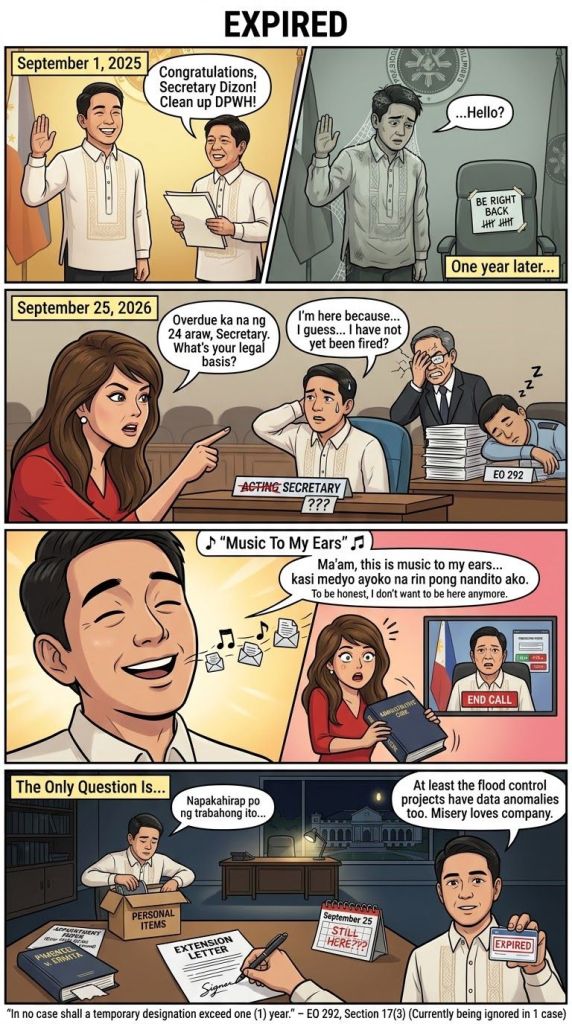
LET’S dispense with the legal fiction, shall we? Vince Dizon is either the Secretary of Public Works and Highways(DPWH) or he is a very well-dressed trespasser. There is no third option. And based on the evidence presented during the September 25, 2026 Senate budget hearing, the answer appears to be the latter.
The exchange between Senator Imee Marcos and Secretary Dizon was not a policy debate. It was not a budget deliberation. It was the public unraveling of a constitutional fiction that Malacañang has been maintaining for twenty-four days—and possibly longer. And the most damning part? Dizon himself seemed almost relieved to be caught.
The Law Is Not Ambiguous. Dizon’s Status Is.
Section 17(3), Chapter 5, Title I, Book III of Executive Order No. 292 (Administrative Code of 1987) contains nine words that should end this controversy immediately:
“In no case shall a temporary designation exceed one (1) year.”
Not “generally.” Not “unless the President decides otherwise.” Not “until Congress adjourns.” “In no case.”
Vince Dizon was appointed acting Department of Public Works and Highways (DPWH) Secretary on September 1, 2025. One year later, on September 1, 2026, that appointment expired. By operation of law. Automatically. Without need for a presidential proclamation or a senatorial inquiry or a strongly worded letter.
Yet there Dizon was, on September 25, 2026, sitting before the Senate, defending the DPWH budget as if nothing had happened. Twenty-four days past his expiration date. Twenty-four days of signing documents, approving contracts, and exercising the powers of a Cabinet secretary without any legal authority to do so.
When Marcos asked him what his legal basis was for continuing to head the DPWH, Dizon’s answer was, and I quote, “I’m here because, I guess, I have not yet been fired.”
That is not a legal argument. That is a cry for help.
Pimentel v. Ermita Is Not Your Friend, Vince
The administration’s defense—to the extent one exists—seems to rest on the idea that the President has broad discretion in making acting appointments, and that Dizon’s continued service is somehow “continuing” or a “holdover.”
Let’s address the holdover nonsense first. Dizon himself offered this explanation: “I think the term po is continuing po ‘yung appointment as Acting Secretary. Holdover, holdover, sorry po.” Senator Marcos’s response was devastating in its simplicity: “I have never heard of a continuing appointment. There is no such animal.”
She’s right. There isn’t.
The holdover doctrine applies to permanent appointees who continue serving until a successor is appointed and qualified. It does not—and cannot—apply to an acting appointment under Section 17, because reading it that way would make the one-year limit utterly meaningless. If every acting secretary could simply declare themselves a “holdover” and serve indefinitely, Congress might as well repeal Section 17(3) and save everyone the trouble of pretending.
Now, the administration might try to invoke Pimentel, Jr. v. Ermita (G.R. No. 164978), the 2005 Supreme Court case that upheld the President’s power to make acting appointments. But here’s the thing: Pimentel is not a shield for the Executive. It is a warning.
The Court in Pimentel explicitly held that “acting appointments cannot exceed one year as expressly provided in Section 17(3)” and that this limit was incorporated “to prevent abuses, like the use of acting appointments as a way to circumvent confirmation by the Commission on Appointments (CA).”
The Court further noted that it found no abuse in that specific case because President Arroyo issued ad interim appointments immediately upon the recess of Congress, well before the one-year limit expired. In other words, the Arroyo administration complied with the law. The Marcos administration has not.
Pimentel doesn’t save Dizon. Pimentel condemns him.
The Paper That Doesn’t Exist
Here’s the part that should terrify anyone who cares about the rule of law: nobody can produce the actual appointment paper that would resolve this mess.
The Palace’s September 1, 2025 press release described Dizon as the “new Secretary of DPWH.” Not “acting.” Not “temporary.” The word “Secretary” was used without qualification. Yet by March 2026, the CA was treating Dizon as one of several Cabinet officials serving in an acting capacity.
So which is it?
If Dizon received an ad interim appointment—a permanent appointment made during a congressional recess—then the one-year limit under Section 17 wouldn’t apply, and the controversy would shift to why the CA hasn’t confirmed him. But Dizon himself confirmed he received no reappointment and that Congress was in session when the alleged July 27, 2026 appointment was supposedly made. An ad interim appointment during a congressional session would be constitutionally problematic, to put it mildly.
If Dizon received a permanent appointment, the CA should have been involved. It wasn’t.
If Dizon received an acting appointment—which is what everyone from Senator Marcos to the CA to Dizon’s own chief of staff seems to believe—then Section 17(3) applies, and his time ran out on September 1, 2026.
The administration’s inability to produce a clear answer is not a technicality. It is the entire ballgame.
The “I’m Not A Lawyer” Defense
Perhaps the most infuriating moment of the hearing came when Dizon repeatedly deflected questions about his legal status by saying he needed to consult the Office of the President.
“Madame Senator, unfortunately, I am not the appointing authority. If you don’t mind, I will confer with the Office of the President and ask.”
This is a Cabinet secretary. The DPWH has a legal department. It presumably has lawyers on staff. Dizon himself acknowledged that his lawyers told him his continued service was “possible.”
But here’s the thing: Dizon is not some mid-level bureaucrat who can plausibly claim ignorance of his own appointment status. He is running a department that manages hundreds of billions of pesos in infrastructure spending. He was appointed specifically to clean up a massive corruption scandal. And he cannot tell the Senate whether he has the legal authority to be doing his job?
That is not an explanation. That is an indictment.
The Real Scandal Behind The Scandal
The timing here is not accidental. Dizon was appointed to the DPWH after the flood control scandal forced his predecessor, Manuel Bonoan, to resign. He was tasked with conducting a “full organizational sweep” and rooting out corruption. He has since overseen the removal of dozens of DPWH officials and the blacklisting of contractors.
And now, during a budget hearing where Senator Marcos also flagged 7,107 infrastructure projects worth P251 billion for data anomalies, Dizon’s legal authority to even be in the room is being questioned.
This is not a coincidence. This is a convergence of two separate but related crises: the flood control corruption scandal that brought Dizon to power, and the constitutional crisis of his expired appointment.
The administration needed a “clean-up guy” at DPWH. Dizon was that guy. But the clean-up guy’s papers were never properly processed, and now the entire anti-corruption narrative is at risk of collapsing under the weight of its own procedural illegitimacy.
The “Music To My Ears” Confession
Perhaps the most revealing moment came when Dizon, visibly exhausted, told the Senate: “Permission to speak frankly. Ma’am, this is music to my ears kasi medyo ayoko na rin pong nandito ako eh, so gusto ko na pong wala ako dito.”
Translation: “I don’t want to be here anymore.”
This is not the statement of a public servant clinging to power. This is the statement of a man who knows he’s in an untenable position and would rather walk away than continue pretending everything is fine.
Dizon also said: “To be quite frank, it would be very welcome kung totoo po ‘yung sinasabi ninyo na hindi na ako secretary ng DPWH. I will be more than happy to accept that kasi napakahirap po ng trabahong ito.”
If Dizon believes his appointment has expired, and Senator Marcos believes his appointment has expired, and the Administrative Code clearly states that acting appointments cannot exceed one year, then why is he still showing up for work?
Because Malacañang hasn’t told him to stop.
The De Facto Officer Escape Hatch
The administration’s only viable legal defense is the de facto officer doctrine, which holds that the acts of someone who occupies an office under color of authority are valid even if their title is defective.
This doctrine exists to protect the public and third parties who deal with government officials in good faith. It prevents the chaos that would result if every contract, order, and decision made by an improperly appointed official was automatically void.
If the Supreme Court ultimately rules that Dizon’s appointment expired, the de facto doctrine might save many of his official acts from invalidation. That is a pragmatic outcome that protects the public interest.
But the de facto doctrine does not confer tenure. It does not give Dizon a right to remain in office. It does not excuse the administration’s failure to properly appoint him. And it does not resolve the underlying constitutional violation.
The Question Nobody Is Asking
Here’s what I want to know: If Dizon’s appointment expired on September 1, 2026, and he has continued to serve for twenty-four days past that date, what else has the administration been hiding about its appointment practices?
Senator Marcos noted during the hearing that several other Cabinet officials—including Ralph Recto, Dave Gomez, Giovanni Lopez, and others—are also serving in acting capacities. Is the Marcos administration systematically using acting appointments to circumvent the Commission on Appointments? Is this a pattern, not an isolated incident?
Pimentel warned that acting appointments can be “a way of circumventing the need for confirmation by the Commission on Appointments.” The Court found no abuse in 2005 because President Arroyo promptly submitted ad interim appointments. But in 2026, with the Marcos administration, the abuse appears to be the entire strategy.
The Bottom Line
Vince Dizon’s appointment as acting DPWH Secretary expired on September 1, 2026. He has served twenty-four days past that date without legal authority. The administration cannot produce the appointment paper that would prove otherwise. Dizon himself doesn’t know what his legal status is. And the man tasked with cleaning up corruption at the DPWH is now himself at the center of a constitutional controversy.
If you’re keeping score at home, the administration that promised to uphold the rule of law is now relying on the “we haven’t fired him yet” theory of executive authority.
“In no case shall a temporary designation exceed one (1) year.”
That’s not a suggestion. That’s not a guideline. That’s the law.
And Vince Dizon is breaking it.
The only question is whether anyone in Malacañang cares enough to do something about it—or whether they’re content to let a man who says he doesn’t want the job keep doing it anyway, because admitting he can’t would mean admitting they got it wrong.
Louis ‘Barok’ C. Biraogo is the author of the Kweba ni Barok blog, where he writes about law, politics, and the increasingly blurred line between the two.
Key Citations
A. Legal & Official Sources
- The 1987 Constitution of the Republic of the Philippines. Official Gazette of the Republic of the Philippines, 1987, http://www.officialgazette.gov.ph/constitutions/1987-constitution/.
- The 1987 Constitution of the Republic of the Philippines, art. VII, sec. 16. Official Gazette of the Republic of the Philippines, http://www.officialgazette.gov.ph/constitutions/the-1987-constitution-of-the-republic-of-the-philippines/the-1987-constitution-of-the-republic-of-the-philippines-article-vii/.
- Executive Order No. 292. Instituting the Administrative Code of 1987. 25 July 1987, http://www.officialgazette.gov.ph/1987/07/25/executive-order-no-292-s-1987/.
- Executive Order No. 292, Book III, Title I, Chapter 5 (Power of Appointment), sec. 17(3). Official Gazette of the Republic of the Philippines, 25 July 1987, http://www.officialgazette.gov.ph/1987/07/25/executive-order-no-292-book-iiititle-ichapter-5-power-of-appointment/.
- Pimentel, Jr. v. Ermita, G.R. No. 164978, 13 Oct. 2005, lawphil.net/judjuris/juri2005/oct2005/gr_164978_2005.html.
- Commission on Appointments. “Mandate.” Commission on Appointments, comappt.gov.ph/mandate/.
B. News Reports
- Presidential Communications Office. “PBBM Accepts Resignation of Bonoan, Appoints Vince Dizon as DPWH Secretary to Lead Anti-Corruption Drive.” Presidential Communications Office, 31 Aug. 2025, pco.gov.ph/news_releases/pbbm-accepts-resignation-of-bonoan-appoints-vince-dizon-as-dpwh-secretary-to-lead-anti-corruption-drive/.
- Presidential Communications Office. “PBBM Inducts into Office New DPWH Secretary Dizon and DOTr Acting Secretary Lopez.” Presidential Communications Office, 1 Sept. 2025, pco.gov.ph/news_releases/pbbm-inducts-into-office-new-dpwh-secretary-dizon-and-dotr-acting-secretary-lopez/.
- Bonzo, Lyjah Tiffany. “‘Ayoko Na Rin Pong Andito Ako’: Vince Dizon Asked about Lapsed Appointment as DPWH Chief.” GMA News Online, GMA Network, 25 Sept. 2026, http://www.gmanetwork.com/news/topstories/nation/1003723/ayoko-na-rin-pong-andito-ako-vince-dizon-asked-about-lapsed-appointment-as-dpwh-chief/story/.
- Cruz, James Patrick. “Is Vince Dizon Still In — or Out — as DPWH Chief?” Rappler, 25 Sept. 2026, http://www.rappler.com/newsbreak/inside-track/dpwh-secretary-vince-dizon-status-confirmation/.
- Servallos, Neil Jayson. “Senate Flags over 7,000 Projects Due to Data Anomalies.” Philstar.com, The Philippine Star, 26 Sept. 2026, http://www.philstar.com/headlines/2026/09/26/2558957/senate-flags-over-7000-projects-due-data-anomalies.

- “Ang Hirap Maging Mahirap”: The PAO Scandal That Proves Government Contempt Is Nothing New
- “Far-Off” My Axx: Malacañang’s Claire Castro Drowns in Her Own Legal Gaslighting

- “Forthwith” to Farce: How the Senate is Killing Impeachment—And Why Enrile’s Right (Even If You Can’t Trust Him)
- “HINDI AKO NAG-RESIGN!”

- “I Know Nothing”: Baste Duterte’s Amnesia Defense Meets ₱33M in GenCorp Contracts

- “I’m calling you from my new Globe SIM. Send load!”

- “Mahiya Naman Kayo!” Marcos’ Anti-Corruption Vow Faces a Flood of Doubt

- “Manageable” Debt, Unmanageable Lies: DBM’s ₱21 Trillion Fairy Tale

- “Meow, I’m calling you from my new Globe SIM!”

- “Natrabaho”: One Word, One Ombudsman, and a Judiciary on Trial
- “No Special Jail for Crooks!” Boying Remulla Slams VIP Perks for Flood Scammers

- “Philippine-Controlled” or Yankee Gas Station? The Davao Fuel Depot Farce Exposed







Leave a Reply