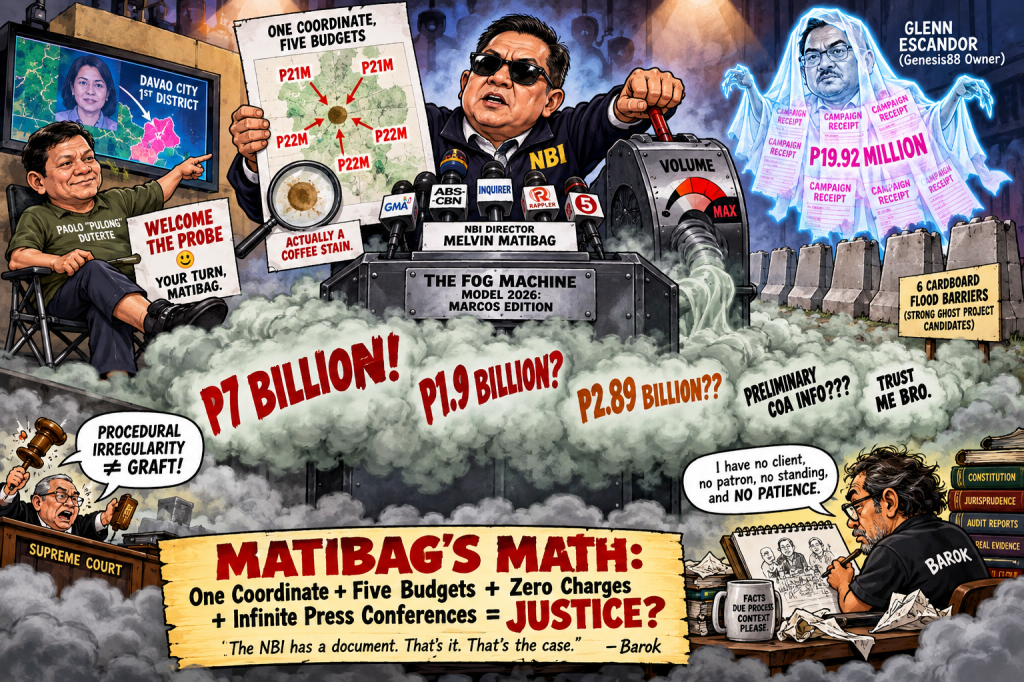
Paolo Duterte Hasn’t Been Subpoenaed. Genesis88 Hasn’t Been Charged. The NBI Hasn’t Stopped Talking.
By Louis ‘Barok’ C. Biraogo — September 26, 2026
THERE is a moment in every investigative drama when the detective says, “I can’t prove it yet, but I know it’s there.” That moment is fine for television. It is a disaster for constitutional government.
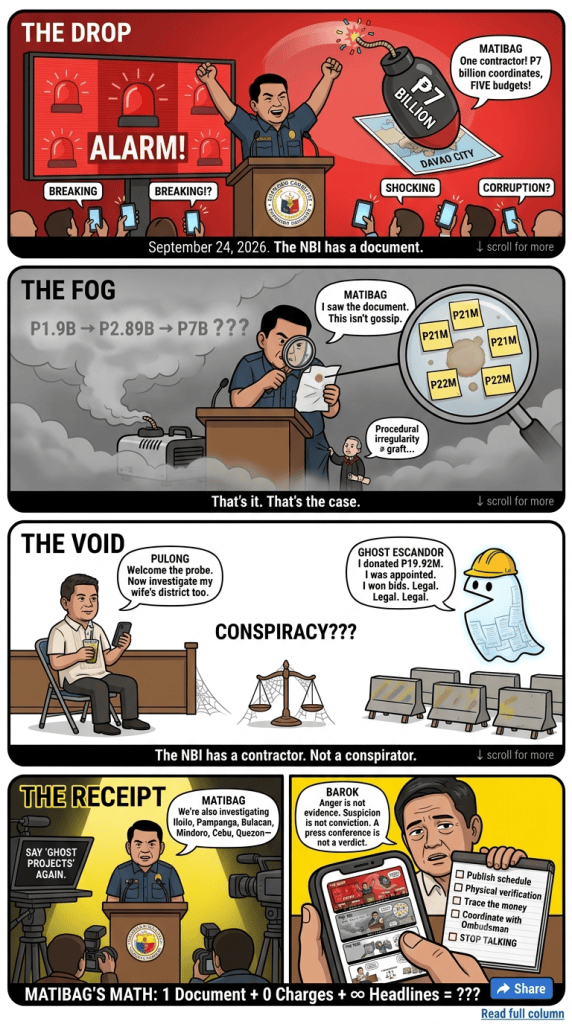
This week, National Bureau of Investigation (NBI) Director Melvin Matibag told the nation that a single contractor—Genesis88 Construction—bagged approximately P7 billion in Davao City flood control projects from 2018 to 2024. The number ballooned from an initial P1.9 billion. The investigation expanded from 47 red-flagged projects to 51.
And Matibag dropped the kind of phrase that makes prosecutors salivate and defense lawyers break out the popcorn:
Let me translate that for the non-lawyers: The NBI has a document. That’s it. That’s the case.
The Arithmetic of Suspicion
Let’s do the math the NBI has not done for us. The P7 billion figure was allegedly drawn from “preliminary COA information.” But the earlier figure—P2.89 billion—came from the “Sumbong sa Pangulo” website, which is not a constitutional audit body. And the original P1.9 billion covered 47 projects in Paolo Duterte’s first congressional district.
Now we have P7 billion covering 51 projects across Davao City from 2018 to 2024. That is a 268% increase in value and a 400% expansion in geographic scope. Matibag has not explained this discrepancy. He has not published the reconciliation schedule. He has not told us whether the P7 billion includes roads, bridges, drainage, and flood control, or just flood control. He has not distinguished between awarded, obligated, paid, and lost.
In the legal profession, we call this the fog of preliminary figures. In politics, we call it a talking point.
The “Same Coordinates” Trap
Matibag’s most explosive allegation is that one project has five separate budget allocations—two at P21 million and three at P22 million—under different titles but the same coordinates.
This sounds damning. It might be damning. But it is not automatically damning.
Flood control systems are not monolithic. A single river basin can contain upstream and downstream components, left and right bank structures, drainage outfalls, retarding basins, and bank protection works. Two projects can share a coordinate and be completely distinct. The NBI must prove that the physical work was duplicated, not merely that the paperwork overlapped.
The legal standard is not “same coordinate, suspicious.” The legal standard is “same structure, same scope, separate appropriations, separate payments.” Matibag has given us the first two. He has not given us the second two.
The Supreme Court’s Warning That Everyone Ignored
Here is the part that should terrify anyone who believes in the rule of law: The Supreme Court has already ruled on this exact issue.
In multiple decisions, the High Court has held that a violation of procurement laws by public officers does not automatically result in a conviction under Republic Act No. 3019 (RA 3019). The prosecution must prove manifest partiality, evident bad faith, or gross inexcusable negligence—and that the irregularity caused undue injury or gave unwarranted benefit.
The NBI has not even named a public official. Paolo Duterte has not been subpoenaed. Matibag himself has said that “receiving projects in a congressional district does not by itself establish wrongdoing by the lawmaker.” So the NBI is investigating contracts, not conspiracies. It is examining patterns, not participants.
This is backwards. In a corruption case, you identify the public officer who took the bribe, the private actor who paid it, and the money that changed hands. Then you follow the paper. The NBI is doing the opposite: It found the paper, and now it is looking for a crime.
The Contractor Who Knew Too Much
Genesis88’s owner, Glenn Escandor, is described as a “longtime friend” of the Dutertes. He was appointed presidential assistant for sports by Rodrigo Duterte in 2016. His other company, Escandor Development Corp., contributed P19.92 million to Sara Duterte’s 2022 campaign.
These are facts. They are also not crimes. Campaign contributions are legal. Friendship is legal. Being appointed to a government position is legal. Winning government contracts through competitive bidding is legal.
The NBI’s theory appears to be: Escandor is close to the Dutertes, therefore his contracts are suspicious. That is not a legal theory. That is a vibe.
The correct question is not “Who is Escandor friends with?” The correct question is: “Did Genesis88 win these contracts through genuine competition, or did public officials manipulate the process to ensure its victory?”
The NBI has not answered that question. It has only asked it.
The Political Timing Problem
Matibag was appointed NBI chief by Marcos in February 2026. He testified in Sara Duterte’s impeachment trial in July 2026. His wife, Ann Matibag, is a Laguna congresswoman allied with the Marcos administration. And now, in September 2026, he is investigating Paolo Duterte’s district.
This does not prove bias. But it creates an appearance that a first-year law student would flag in a mock trial.
The Duterte camp’s counter-allegation—that Matibag should investigate his own wife’s district—may be political theater. But it is also a legitimate demand for equal treatment. If the NBI’s methodology is sound, it should apply it everywhere. If it is not, it should apply it nowhere.
Matibag says Davao is not being singled out. He says the NBI is also investigating Iloilo, Pampanga, Bulacan, Mindoro, Cebu, and Quezon. If true, that is a defense. But saying it is not the same as proving it. The NBI should publish its selection criteria. It should show us the other districts. It should demonstrate that this is a national probe, not a political strike.
What the NBI Should Do Next
If the NBI wants to be taken seriously—and not just by the Marcos faithful—it needs to do five things:
- Publish the 51-project reconciliation schedule. Project ID, General Appropriations Act (GAA) year, Approved Budget for the Contract (ABC), winning bid, contractor, joint venture partners, date of award, completion date, amount paid, Commission on Audit (COA) finding, physical accomplishment, coordinates. Until we see this, “P7 billion” is a press release, not evidence.
- Conduct physical verification. Satellite imagery. Drone footage. Engineering measurements. Actual structures. If the NBI cannot show us the ghost projects, it should stop using the word “ghost.”
- Trace the money. Government disbursement to contractor account. Contractor account to subcontractors. Subcontractors to suppliers. Suppliers to intermediaries. Intermediaries to officials. This is the only path to a graft conviction, and the NBI has not even started it.
- Coordinate with the Philippine Competition Commission (PCC) and Ombudsman. The Competition Commission has jurisdiction over bid-rigging. The Ombudsman has primary jurisdiction over graft cases. The NBI is an investigating body. It is not a prosecutor. It is not a court. It needs to know its place.
- Stop talking. Every interview Matibag gives before filing a case is a defense exhibit waiting to happen. If Genesis88 is charged, its lawyers will argue that the NBI prejudged the case. If Paolo Duterte is eventually implicated, his lawyers will argue selective prosecution. Every public statement makes the eventual prosecution harder.
The Bottom Line
The P7 billion figure is alarming. The 47 red-flagged projects are suspicious. The “one coordinate, five budgets” allegation, if proven, could be explosive.
But “could be” is not “is.”
The NBI has a document. It does not yet have a case. It has a contractor, not a conspirator. It has patterns, not proof.
In the Philippines, where the Corruption Perceptions Index score has fallen to 32 out of 100—the lowest since 2012—the public is right to be angry. But anger is not evidence. Suspicion is not conviction. And a press conference is not a verdict.
If the NBI has the goods, let it show them. If it doesn’t, let it stop pretending.
The Supreme Court has already told us: procedural irregularity is not graft. The NBI would do well to listen.
Louis ‘Barok’ C. Biraogo runs the Kweba ni Barok blog. He has no client in this case, no political patron, no legal standing to sue anyone, and no patience for investigators who mistake headlines for evidence.
Key Citations
A. Reports & Studies
- Supreme Court of the Philippines. “SC: Violation of Procurement Law Not an Automatic Conviction for Graft.” Supreme Court Public Information Office, 8 Nov. 2024, https://sc.judiciary.gov.ph/sc-violation-of-procurement-law-not-an-automatic-conviction-for-graft/.
- Martel v. People, G.R. Nos. 224720-23. Supreme Court of the Philippines, 2 Feb. 2021, https://lawphil.net/judjuris/juri2021/feb2021/gr_224720-23_2021.html.
- Transparency International. “Corruption Perceptions Index: Philippines.” Transparency International, https://www.transparency.org/en/countries/philippines.
- Bolledo, Jairo. “Dutertes’ Longtime Friend Is Davao’s Top Contractor for Flood Control Projects.” Rappler, 19 Sept. 2025, https://www.rappler.com/newsbreak/investigative/glenn-escandor-davao-region-top-contractor-flood-control-projects/.
- “Marcos and Duterte Received Millions in Contributions from Contractors.” Philippine Center for Investigative Journalism, 18 Sept. 2025, https://pcij.org/2025/09/18/marcos-and-duterte-contractors/.
B. News Articles
- Ferreras, Vince Angelo. “Flood Control Projects Worth P7B in Davao District Awarded to One Contractor, Says NBI.” GMA News Online, 24 Sept. 2026, https://www.gmanetwork.com/news/topstories/nation/1003587/flood-control-projects-worth-p7b-in-davao-district-awarded-to-one-contractor-says-nbi/story/.
- Salcedo, Mary Joy. “NBI: P7B Flood Projects in Paolo Duterte District Went to 1 Contractor.” Philippine Daily Inquirer, 24 Sept. 2026, https://newsinfo.inquirer.net/2311013/matibag-p7b-flood-projects-in-duterte-district-went-to-1-contractor.
- Salcedo, Mary Joy. “Red Flags Seen in 47 Flood Control Projects in Paolo Duterte’s District.” Philippine Daily Inquirer, 17 Sept. 2026, https://newsinfo.inquirer.net/2306920/nbi-sees-red-flags-in-47-flood-control-in-paolo-dutertes-district.
- Villeza, Mark Ernest. “NBI: 1 Contractor Bagged P7 Billion Davao Flood Projects.” The Philippine Star, 25 Sept. 2026, https://www.philstar.com/headlines/2026/09/25/2558778/nbi-1-contractor-bagged-p7-billion-davao-flood-projects.
- “NBI Sees 6 Potential Ghost Flood Control Projects in Davao City.” GMA News Online, 25 Sept. 2026, https://www.gmanetwork.com/news/topstories/nation/1003653/nbi-sees-6-potential-ghost-flood-control-projects-in-davao-city/story/.
- San Juan, Joel R. “No Particular Target in Flood Control Investigations–NBI.” BusinessMirror, 18 Sept. 2026, https://businessmirror.com.ph/2026/09/18/no-particular-target-in-flood-control-investigations-nbi/.
- “Philippines Sinks to New Low in Corruption Perceptions Index.” BusinessWorld, 11 Feb. 2026, https://bworldonline.com/top-stories/2026/02/11/729700/philippines-sinks-to-new-low-in-corruption-perceptions-index/.
- Ombay, Giselle, and Joahna Lei Casilao. “NBI’s Matibag Admits Wife Endorsed Articles of Impeachment vs. Sara Duterte.” GMA News Online, 21 July 2026, https://www.gmanetwork.com/news/topstories/nation/995648/nbi-director-matibag-wife-ann-impeachment-duterte/story/.
- “Marcos Names Ex-Duterte Cabinet Secretary as NBI Chief.” Malaya Business Insight, 20 Feb. 2026, https://malaya.com.ph/news/national-news/marcos-names-ex-duterte-cabinet-secretary-as-nbi-chief/.
- “Duterte Names Escandor Presidential Aide on Sports.” Philippine Daily Inquirer, 27 Sept. 2016, https://sports.inquirer.net/223830/duterte-names-escandor-presidential-aide-on-sports.
- “WHO’S WHO: The Top Campaign Donors of Sara Duterte, Lakas-CMD.” Rappler, 3 Sept. 2022, https://www.rappler.com/philippines/sara-duterte-top-campaign-donors-elections-2022/.
C. Official Websites
- Republic of the Philippines. “Republic Act No. 3019: Anti-Graft and Corrupt Practices Act.” Official Gazette, 17 Aug. 1960, https://www.officialgazette.gov.ph/1960/08/17/republic-act-no-3019/.
- Republic of the Philippines. “The 1987 Constitution of the Republic of the Philippines.” Official Gazette, https://www.officialgazette.gov.ph/constitutions/1987-constitution/.
- National Bureau of Investigation. Official Website. https://nbi.gov.ph/.
- Commission on Audit. Official Website. https://www.coa.gov.ph/.
- Office of the Ombudsman. Official Website. https://www.ombudsman.gov.ph/.
- Philippine Competition Commission. Official Website. https://www.phcc.gov.ph/.
- Presidential Communications Office. “PBBM Launches ‘Sumbong sa Pangulo’ Website.” 11 Aug. 2025, https://pco.gov.ph/news_releases/pbbm-launches-sumbong-sa-pangulo-website-for-citizen-reports-on-anomalous-flood-control-projects/.
- Sumbong sa Pangulo. sumbongsapangulo.ph, https://sumbongsapangulo.ph/.




Leave a comment