
Lacson brought receipts. Cayetano brought denials. Dizon brought a dictionary
By Louis ‘Barok’ C Biraogo — September 26, 2026
THERE are lies, damned lies, and then there are technically accurate statements delivered with the precision of a lawyer who knows exactly where the bodies are buried—and exactly which definition of “body” he’s using.
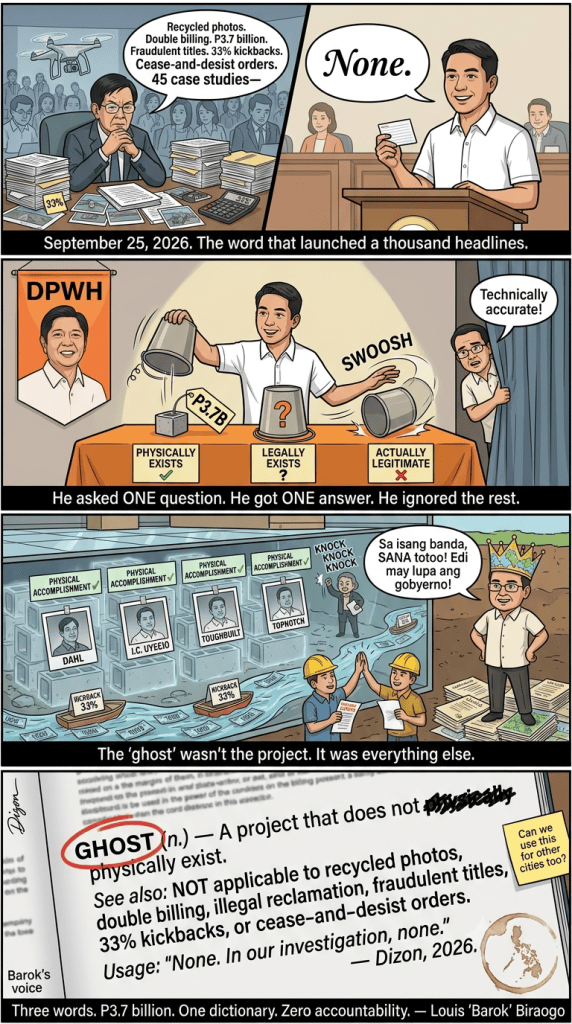
Enter Department of Public Works and Highways (DPWH) Secretary Vivencio “Vince” Dizon, the man President Marcos tapped to clean up the institutional cesspool that is the DPWH. On September 25, 2026, Dizon stood before a Senate finance subcommittee and delivered what he presumably hoped would be the definitive word on the Taguig ghost project controversy: “None. In our investigation, none.”
Three words. Clean. Simple. Reassuring—if you don’t think too hard about what he actually said, what he didn’t say, and what the evidence assembled by Senator Panfilo “Ping” Lacson suggests about the difference between a project that doesn’t exist and a project that shouldn’t.
Let’s be clear about what Dizon’s statement accomplishes: it refutes the narrowest possible version of Lacson’s allegations—that Taguig is littered with infrastructure that exists only on paper. Congratulations, Mr. Secretary. You’ve established that there are structures. The bar for “not a ghost” is apparently “there’s something physically there.” That’s not a defense. That’s a confession that you’re measuring success by the lowest possible standard.
Because here’s what Dizon’s “none” does not address:
- Recycled photographs used to bill four different slope protection projects by four different contractors
- Double appropriations—the same project funded twice, possibly three times, in the General Appropriations Act (GAA)
- Overlapping linear measurements where completed sections were billed again in subsequent contracts
- P3.713 billion in public funds spent on projects in areas now subject to cease-and-desist orders for illegal reclamation
- Five contractors cornering P2.372 billion in Taguig projects, a concentration pattern that screams “rigged bidding”
- Allegedly fraudulent land titles covering nearly 40 hectares of reclaimed land
Dizon’s investigation, by his own framing, asked one question: “Does the project physically exist?” The answer was yes for 107 projects. Case closed, allegedly.
But Lacson’s investigation asked a much more dangerous set of questions:
- Was the project properly procured? Was it billed honestly?
- Was it built where it was supposed to be built?
- Was the underlying land legally available for construction?
- Did the project serve its stated purpose, or was it a reclamation scheme dressed up in flood-control drag?
To those questions, Dizon offered nothing. Not because he was hiding something—though we’ll get to that—but because his investigation apparently wasn’t designed to ask them.
The Institutional Blind Spot That Looks a Lot Like a Choice
Dizon arrived at DPWH in September 2025 with a mandate from President Marcos to clean house. His first acts were bold: he suspended bidding for locally funded projects, requested lookout orders against 27 individuals linked to anomalous flood control works, and—most tellingly—abolished the DPWH’s internal investigating body with the declaration that “a department can’t investigate itself.”
That last part deserves emphasis. Dizon explicitly acknowledged that DPWH cannot credibly investigate itself. He said it. He acted on it. He disbanded the internal probe team precisely because he understood that institutional self-investigation is an oxymoron.
So why, nine months later, are we being asked to accept a DPWH internal investigation as the definitive word on Taguig?
The answer might be charitable: perhaps Dizon genuinely believes his department’s physical verification process was sufficient. Perhaps he’s right that the structures exist, that contractors delivered something, and that the “ghost project” label is technically inapplicable.
But charity has its limits, and Dizon’s own words strain against them. In July 2026, Cayetano claimed Dizon had told him “three separate occasions” that Taguig had no ghost projects. By August, Dizon was guaranteeing Lacson that he would issue cease-and-desist orders the moment the Philippine Reclamation Authority (PRA) requested them. Then PRA issued those orders, DPWH complied, and Cayetano—in a moment of accidental honesty that his media team probably regrets—pointed out the absurdity: Dizon ordered DPWH to cease and desist from a project that DPWH itself was implementing.
Read that again. The Secretary of Public Works issued a cease-and-desist order against his own department. “Inorderan niya ang sarili niyang tao,” Cayetano said. He ordered his own people.
If Dizon’s investigation was as thorough as his “none” suggests, why did his own department need to be ordered to stop work on projects PRA deemed illegal? If the 107 projects were clean, why did any of them fall under the scope of reclamation-related cease-and-desist orders?
The answer, as with most things in Philippine governance, is that “clean” depends entirely on which question you’re asking.
The Semantic Shell Game
Dizon’s defenders will argue—and have argued—that “no ghost projects” is a narrow, technical finding. It means no projects were paid for that don’t physically exist. It doesn’t mean no anomalies, no irregularities, no waste.
Fine. But then why say it at all? Why march into a Senate hearing, under oath, and deliver a categorical “none” that you know will be reported as vindication for Cayetano? Why not say, “Our physical verification found that all 107 projects have physical accomplishments, but we are continuing to investigate procurement, billing, and land-use compliance”? Why not acknowledge the Ombudsman’s ongoing fact-finding, the PRA’s cease-and-desist orders, the Land Registration Authority (LRA) title review?
Because that wouldn’t make headlines. “DPWH finds no ghost projects” does.
And that’s the problem. Dizon is a technocrat—a Bases Conversion and Development Authority (BCDA) veteran, a Build Build Build alumnus, a man People Asia once named a Person of the Year. He knows how the media works. He knows how Senate hearings work. He knows that a three-word answer in response to a leading question will be clipped, shared, and weaponized.
If he didn’t intend for “none” to serve as a shield for Taguig, he should have been more careful with his language. If he did intend it, he should be asked why he’s providing political cover to a senator who is simultaneously a subject of investigation.
The Cayetano Problem
Speaking of which: let’s talk about the elephant in the reclamation site.
Alan Peter Cayetano is not just any senator. He is the Senate Minority Leader, the former Speaker, the scion of a political dynasty that has dominated Taguig for decades, and the husband of the city’s current mayor. He is also the man Lacson alleges “virtually controlled” DPWH operations in Taguig, with district engineers acting as “puppets.”
Cayetano has denied everything. He has called Lacson’s probe a “demolition job,” a “witch hunt,” and—my personal favorite—“a striptease with no real evidence.” He has challenged Lacson to investigate other cities. He has argued that focusing on Taguig is “selective justice.”
And then, in what may be the most inadvertently revealing statement of this entire saga, Cayetano responded to allegations of illegally titled reclaimed land by saying: “Sa isang banda po, nagho-hope din kami na totoo iyon. Bakit? Kasi kung totoong ilegal iyon, sa gobyerno iyon. Edi may 18 hectares tayo ngayon para sa gobyerno.”
Translation: “On one hand, we hope it’s true. Because if it’s really illegal, it goes to the government. Then we’d have 18 hectares for the government.”
A senator accused of benefiting from illegal land titles is expressing hope that the titles are invalid so the government can seize them. That’s not a denial. That’s a man who knows the titles are dirty and is already repositioning for the inevitable.
The Real Investigation
Here’s what we know for certain:
The Ombudsman has issued subpoenas for DPWH records in Taguig. PRA has submitted drone images of eight reclamation sites. The LRA is tracing the history of titles covering 38.83 hectares. Taguig City Hall personnel have been arrested for obstructing Ombudsman investigators. Lacson has submitted 45 case studies documenting “systemic anomalies.”
The evidence exists. It’s just not in Dizon’s hands—and maybe that’s the point.
Dizon’s investigation was internal. It asked whether structures exist. It answered that question. But the questions that matter—questions of procurement, billing, land use, and criminal intent—are being asked by the Ombudsman, the PRA, the LRA, and the Senate. Those are the investigations that will determine whether Taguig’s projects are merely present or actually legitimate.
Dizon’s “none” doesn’t answer those questions. It doesn’t even address them. It’s a data point, not a verdict. And anyone treating it as vindication is either not paying attention or has something to gain from the confusion.
The Bottom Line
Vince Dizon was hired to clean up DPWH. He has done some of that work—identifying 421 ghost projects nationwide, suspending bidding, requesting lookout orders, disbanding the internal probe body that couldn’t credibly investigate anything. He deserves credit for those actions.
But cleaning up an institution requires more than identifying the mess in other people’s backyards. It requires the willingness to look in the backyard of the Senate Minority Leader and say, “There’s something wrong here too.”
Dizon hasn’t done that. He’s said “none,” and in doing so, he’s either been misled by his own investigators, pressured by political realities, or—most charitably—technically accurate about a question nobody was actually asking.
The real question isn’t whether Taguig has ghost projects. It’s whether Taguig has ghost accountability—projects that exist physically but not legally, expenditures that were made but not justified, land that was reclaimed but not authorized.
To that question, Dizon’s “none” is not an answer. It’s an evasion.
And the Ombudsman, unlike the DPWH, doesn’t have the luxury of defining “ghost” narrowly enough to make the problem disappear.
Key Citations
A. News Articles
- Pilapil, Kevin. “Dizon Clears Taguig of ‘Ghost’ Flood Control Projects.” Bilyonaryo News Channel, 25 Sept. 2026.
- “P3.7-B Spent on Projects in ‘Illegal’ Taguig Reclamation – Lacson.” Philippine News Agency, https://www.pna.gov.ph/articles/1282974.
- “Lacson Bares ‘Fraudulently’ Titled Parcels of Reclaimed Land in Taguig.” GMA News Online, 29 Aug. 2026, https://www.gmanetwork.com/news/topstories/nation/1000345/lacson-bares-fraudulently-titled-parcels-of-reclaimed-land-in-taguig/story/.
- “Lacson: P3.7B ‘Wasted’ on ‘Illegal’ Taguig Reclamation Projects.” GMA News Online, 31 Aug. 2026, https://www.gmanetwork.com/news/topstories/nation/1000548/lacson-p3-7b-wasted-on-illegal-taguig-reclamation-projects/story/.
- Cruz, James Patrick. “At Least 421 Ghost Flood Control Projects Uncovered Nationwide – Dizon.” Rappler, 9 Oct. 2025.
- Servallos, Neil Jayson. “Ombudsman Subpoenas Agencies over Taguig Projects.” The Philippine Star, 20 Aug. 2026.
- Ong, Ghio. “Taguig ‘Meddling’ on Reclamation Inspection Hit.” The Philippine Star, 7 Sept. 2026.
- Ronda, Rainier Allan. “DPWH Summons Taguig Contractors for CDO Violation.” The Philippine Star, 21 Sept. 2026.
- “Cayetano on Lacson’s Alleged Slow Release of Charges: It’s Like Striptease.” Philippine Daily Inquirer, 5 Sept. 2026, https://newsinfo.inquirer.net/2299559/cayetano-on-lacsons-alleged-slow-release-of-charges-its-like-striptease.
- “Cayetano Tells Dizon to Resist ‘Pressure’ in Taguig Project Probe.” Philippine Daily Inquirer, 20 July 2026, https://newsinfo.inquirer.net/2266937/cayetano-tells-dizon-to-resist-pressure-in-taguig-project-probe.
- “Kickbacks from DPWH Projects in Taguig up to 33% — Lacson.” GMA News Online, 2 Aug. 2026, https://www.gmanetwork.com/news/topstories/nation/997046/kickbacks-from-dpwh-projects-in-taguig-up-to-33-lacson/story/.
- Rita, Joviland. “Dizon: DPWH Internal Probe Team for Flood Control Projects to Be Abolished.” GMA News Online, 2 Sept. 2025.
- “Flood Probe ‘Lookout Order’ List Gets Longer.” Inquirer Plus, 4 Sept. 2025, https://plus.inquirer.net/news/flood-probe-lookout-order-list-gets-longer/.
- “Lacson Bares Taguig ‘Ghost’ Project Photos, Claims Cayetano Ran a 33% Kickback Scheme.” NewsWatch Plus, 31 July 2026, https://www.newswatchplus.ph/2026/07/31/lacson-bares-taguig-ghost-project-photos-claims-cayetano-ran-a-33-kickback-scheme/.
B. Official Websites
- “PBBM Inducts into Office New DPWH Secretary Dizon and DOTr Acting Secretary Lopez.” Presidential Communications Office, 1 Sept. 2025.
- “LRA Checking Titles on 39-ha ‘Illegal’ Laguna Lake Reclamation.” Philippine News Agency, https://www.pna.gov.ph/articles/1282878.
- Office of Sen. Ping Lacson. “Lacson Bares Double Appropriations for Same Slope Protection Project in Taguig.” 23 July 2026.
C. Profiles and Recognition
- “‘People of the Year’ 2026 Awards Night Marks a New Chapter for PeopleAsia.” PeopleAsia, 18 Feb. 2026.

- ₱9 Billion in ‘Savings’? DILG’s Fire Truck Deal Smells Like Smoke

- ₱8B BBM Pork: CCTV for Every Captain’s Kumpare?

- ₱8.9 Billion, 331 Ghost Police Stations: The TIKAS Scandal Explained

- ₱8.4 Billion, 42,000 Barangays, 1 Election: The “Bawat Barangay Makikinabang” Vote-Buying Masterclass

- ₱75 Million Heist: Cops Gone Full Bandit

- ₱6.77B Ghost Haunts Duterte: RTC Dismisses Mans Carpio’s Desperate Plea

- ₱6.77 Billion and Zero Cash: The Sara Duterte SALN Math That Doesn’t Add Up

- ₱6.7-Trillion Temptation: The Great Pork Zombie Revival and the “Collegial” Vote-Buying Circus

- ₱58.53B, Zero Receipts: The LGSF Pork Barrel Nobody Wants to Name
- ₱53 Million Man Tells ₱695-a-Day Workers to Stop Being ‘Mayabang’: The Audacity of BSP’s Remolona

- ₱4.4 Billion and a Witness Who Can’t Explain It: The Duterte Impeachment’s Most Expensive Non-Answer
- ₱3.06 Billion for Evacuation Centers—But Nobody Knows Where They’ll Stand (Or If They’ll Exist)







Leave a Reply