
He Lost His Job, Switched Sides, and Filed the One Petition That Might Actually Matter. You Should Probably Read This.
By Louis ‘Barok‘ C. Biraogo — September 25, 2026
ALRIGHT, mga ka-kweba, gather ‘round the cave because I have something absolutely delicious to serve you today. You know that feeling when you watch someone do something so brazen, so audacious, so constitutionally unhinged that you don’t know whether to laugh, cry, or file a petition for certiorari?
Welcome to the Philippine Senate Impeachment Tribunal, September 2026 edition.
On September 23, thirteen senator-judges—thirteen!—decided that the phrase “two-thirds of all the Members of the Senate” actually means “two-thirds of whoever we decide is capable of showing up.” In a 13-1 vote, with six senator-judges conveniently not participating (more on that delightful irony later), the tribunal reversed Presiding Officer Chiz Escudero’s July 6 ruling and created what can only be described as a variable constitutional threshold.
Former Executive Secretary Victor Rodriguez, a man who knows a thing or two about political survival, filed a 23-page petition for certiorari and prohibition before the Supreme Court the very next day. His argument, in essence: you cannot amend the Constitution through a procedural ruling, and you certainly cannot do it sub silentio or pro hac vice.
And you know what? He might just have a point. But let’s not get ahead of ourselves. Let’s dissect this constitutional Frankenstein like the legal surgeons we are.
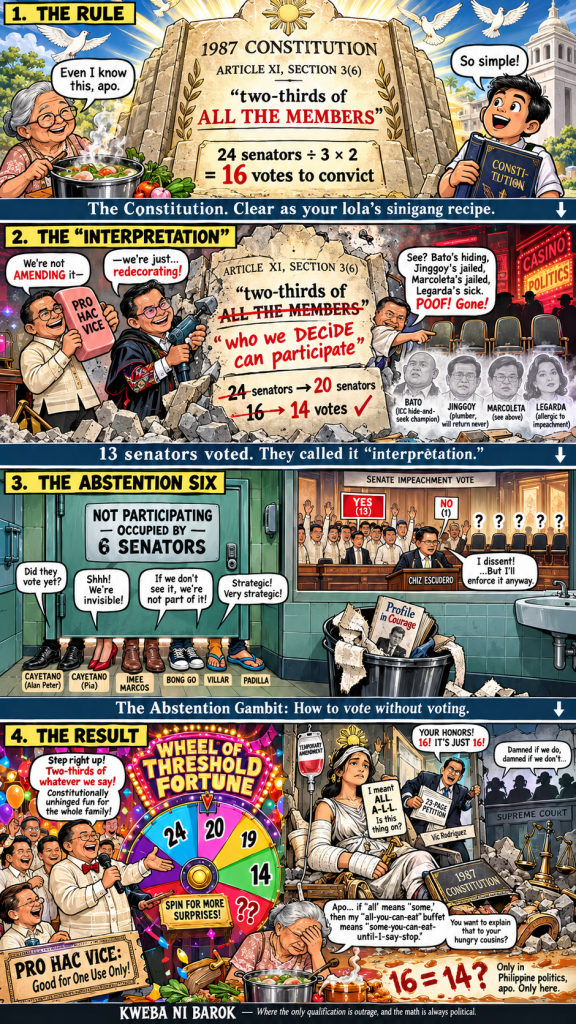
The Mathematical Wizardry of Subtraction
Here’s the deal, folks. Article XI, Section 3(6) of the 1987 Constitution of the Republic of the Philippines says, in language that even a first-year law student could parse:
“No person shall be convicted without the concurrence of two-thirds of all the Members of the Senate.”
“All the Members.” Not “all the Members present.” Not “all the Members who feel like showing up.” Not “all the Members who haven’t fled the jurisdiction to avoid an International Criminal Court (ICC) arrest warrant.” All. The. Members.
The Senate of the Philippines is composed of twenty-four senators. Two-thirds of twenty-four is sixteen. Basic arithmetic. Your lola could do this calculation while cooking sinigang.
But on September 23, the impeachment tribunal decided that four senators—Ronald “Bato” dela Rosa (in hiding from the ICC), Jinggoy Estrada (detained), Rodante Marcoleta (detained), and Loren Legarda (medical leave)—should be excluded from the denominator entirely.
Suddenly, two-thirds of twenty equals 13.33, which rounds up to fourteen. Fourteen votes to convict. Not sixteen. Fourteen.
The prosecution, to their credit, didn’t even pretend this was about fairness. House prosecutor Chel Diokno, with the kind of straight-faced chutzpah that deserves its own award, said the prosecution would “present the same evidence regardless of the court’s decision.” Translation: We didn’t need the threshold lowered, but we’ll take it.
And House spokesperson Zia Alonto Adiong insisted, “Wala naman pong iniiba as to the two-thirds. What is important is the two-thirds. It remains to be two-thirds.”
Technically true. Also technically true: if I owe you sixteen million pesos, and I convince you that four of my creditors should be excluded from the “all creditors” count, I now owe you fourteen million. The percentage is the same! The debt is just… different.
The “Pro Hac Vice” Fantasy
Now, here’s where it gets truly delicious. The Senate tribunal, perhaps sensing that “we just rewrote the Constitution” might not play well on the evening news, declared that its ruling would apply pro hac vice—for this case only.
Chiz Escudero, displaying the kind of reluctant compliance that suggests he’s already drafting his memoirs, said: “This is a ruling, not an amendment of the rules.”
Excuse me while I choke on my coffee.
A constitution is, by definition, a document of general and enduring norms. It doesn’t have a “for this occasion only” clause. You cannot have a temporary constitutional amendment any more than you can have a temporary pregnancy or a temporary death. Either the Constitution says sixteen, or it doesn’t. Either “all the Members” means twenty-four, or it means something else.
Rodriguez nailed this in his petition: “The Constitution cannot be amended sub silentio, nor can it be amended pro hac vice.”
The Senate’s response, essentially: We’re not amending the Constitution, we’re just interpreting it in a way that produces a completely different numerical outcome based on circumstances we ourselves determine.
That’s not interpretation. That’s legislation wearing a judicial robe.
The Abstention Gambit: A Masterclass in Political Cowardice
Let’s talk about the six senators who didn’t participate in the threshold vote: Alan Peter Cayetano, Pia Cayetano, Imee Marcos, Bong Go, Camille Villar, and Robinhood Padilla.
Not participating. In a vote about whether to change the constitutional threshold for convicting the Vice President. A vote where thirteen senators decided the outcome and one dissented.
This is the political equivalent of watching a bar fight and deciding to “not participate” by hiding in the bathroom. These six senators—all Duterte-aligned or Duterte-sympathetic—managed the remarkable feat of neither supporting nor opposing a ruling that could determine whether Sara Duterte gets convicted.
If they thought the threshold change was unconstitutional, they could have voted against it. If they thought it was correct, they could have voted for it. Instead, they chose strategic invisibility, allowing the thirteen Marcos-aligned senators to do the dirty work while preserving their own deniability.
This is what passes for courage in Philippine politics: abstaining from a vote so you can later claim you were never really part of the decision.
Meanwhile, Chiz Escudero—the lone dissenter—voted against the ruling and then announced he would enforce it anyway. “The presiding officer, after all, is not the court,” he said. “He is merely the custodian of the process, not the proprietor of its outcome.”
Translation: I think this is wrong, but I’m not going to actually do anything about it. I’ll just make a speech and then comply.
Somewhere, a profile in courage is weeping.
The Amici Curiae Theater
The Senate, to its credit, did consult retired Supreme Court justices Artemio Panganiban, Reynato Puno, Adolfo Azcuna, and Hilario Davide Jr. as amici curiae before making its ruling.
This is what legal scholars call due process theater. You gather the wise elders, you listen to their wisdom, you nod thoughtfully, and then you do whatever you were going to do anyway. The presence of distinguished jurists doesn’t make an unconstitutional act constitutional any more than having a doctor watch you smoke makes the smoking healthy.
The amici may have provided cover. They may have genuinely influenced the deliberations. But at the end of the day, the Senate did what the Senate wanted to do, and the Constitution’s clear text became a casualty of political arithmetic.
The Coming Supreme Court Showdown
So now we wait for the Supreme Court. And oh, what a delicious dilemma the justices face.
On one hand, they have the 2025 Duterte v. House of Representatives (G.R. Nos. 278353 and 278359) decision, where the Court itself held that impeachment is “a primarily legal and constitutional procedure with political characteristics” and that legal issues arising from impeachment proceedings are subject to judicial review. The Court has already opened the door to reviewing impeachment procedures.
On the other hand, they have the political question doctrine, the Senate’s “sole power to try and decide,” and the practical reality that if they intervene, they will be accused of protecting Sara Duterte or undermining the Senate or both.
Rodriguez’s petition asks the Court to do something it has historically been reluctant to do: interfere with an ongoing impeachment trial. He wants a Temporary Restraining Order (TRO). He wants the September 23 ruling nullified. He wants the July 6 sixteen-vote threshold restored.
The ripeness problem is real. The House prosecution argues that until the Senate actually convicts with fewer than sixteen votes, there’s no concrete injury. This is not a frivolous argument. Courts don’t like advisory opinions.
But Rodriguez counters: the rule is already operative. The Senate has already established the methodology. The constitutional injury occurs when the rule is announced, not when it’s applied.
It’s a compelling argument. If the Senate can change the threshold mid-trial, what’s to stop them from changing it after the votes are cast? What’s to stop them from excluding senators who are “factually incapable” of voting the right way?
The Nuclear Option: What This Means for the Future
Here’s the thing that should terrify every constitutionalist in this country: if the Supreme Court allows this ruling to stand, it establishes a principle. And principles, unlike pro hac vice rulings, tend to stick around.
The principle would be: the Senate can modify constitutional voting requirements in impeachment cases by determining which senators are “capable of participating.”
Apply that principle to the future. Suppose a future impeachment trial has 22 senators capable of participating. Two-thirds of 22 is 14.67, so 15 votes to convict. Now suppose three senators suddenly become “medically incapacitated” the week before the vote. Two-thirds of 19 is 12.67, so 13 votes to convict. The threshold just dropped by two votes because of convenient medical emergencies.
Rodriguez’s petition warns of exactly this: a “variable constitutional threshold” where the number of votes needed for conviction depends on “the Tribunal’s case-by-case determination of which Senators are capable of participating.”
This is not constitutional interpretation. This is constitutional demolition, one procedural ruling at a time.
The Bottom Line, Mga Kababayan
Victor Rodriguez may or may not be a saint. He was Marcos’s executive secretary, then became a critic, then ran under the Duterte slate. His motives are as mixed as anyone’s in this political carnival.
But here’s the thing about constitutional violations: they don’t become less unconstitutional because the person pointing them out has imperfect motives.
The Senate has done something unprecedented. It has taken a clear constitutional text—“two-thirds of all the Members”—and transformed it into a variable formula that depends on the tribunal’s own factual determinations about who counts.
If the Supreme Court upholds this, it will have ratified a principle that the Constitution can be amended by procedure, that “all” can mean “some,” and that the Senate’s “sole power to try and decide” includes the power to decide what the Constitution means.
If the Supreme Court strikes this down, it will be accused of judicial overreach, of protecting Sara Duterte, of interfering with the Senate’s constitutional prerogatives.
Either way, the Court is damned. And either way, the Constitution has already been damaged.
The only question is how much more damage we’re willing to accept before we admit that the text means what it says.
Sixteen votes. From all twenty-four senators. That’s what the Constitution says.
Anything else is just arithmetic by another name.
Louis ‘Barok’ C. Biraogo writes from the Kweba ni Barok, where the only qualification is outrage. He accepts no responsibility for constitutional crises induced by reading this column.
Key Citations
A. Legal & Official Sources
- The 1987 Constitution of the Republic of the Philippines. Official Gazette of the Republic of the Philippines, 1987, http://www.officialgazette.gov.ph/constitutions/1987-constitution/.
- The 1987 Constitution of the Republic of the Philippines, art. XI, sec. 3(6). Official Gazette of the Republic of the Philippines, http://www.officialgazette.gov.ph/constitutions/the-1987-constitution-of-the-republic-of-the-philippines/the-1987-constitution-of-the-republic-of-the-philippines-article-xi/.
- Duterte v. House of Representatives, G.R. Nos. 278353 and 278359 (Supreme Court of the Philippines 25 July 2025). Supreme Court of the Philippines, sc.judiciary.gov.ph/278353-278359-sara-z-duterte-vs-house-of-representatives-et-al-atty-israelito-p-torreon-et-al-vs-house-of-representatives-et-al/.
- Rome Statute of the International Criminal Court. International Criminal Court, 17 July 1998, http://www.icc-cpi.int/.
B. News Reports
- Bacelonia, Wilnard. “Senate Court Drops Fixed 16-Vote Threshold in VP Trial.” Philippine News Agency, 23 Sept. 2026, http://www.pna.gov.ph/articles/1284670.
- “Impeachment Court Overturns Ruling, Reduces Voting Threshold to Convict VP Duterte.” Manila Bulletin, 23 Sept. 2026, mb.com.ph/2026/09/23/impeachment-court-overturns-ruling-reduces-voting-threshold-to-convict-duterte.
- De Leon, Dwight. “Escudero Settles Threshold: 16 Votes to Convict Sara Duterte.” Rappler, 6 July 2026, http://www.rappler.com/philippines/escudero-settles-conviction-threshold-debate-16-needed-remove-sara-duterte/.
- Murcia, Alvin. “Vic Rodriguez Petitions SC on Legality of VP Sara Impeachment Threshold.” Daily Tribune, 24 Sept. 2026, tribune.net.ph/2026/09/24/vic-rodriguez-petitions-sc-on-the-legality-of-vp-saras-impeachment-threshold.
- Chi, Cristina. “Sara Duterte Trial’s Two-Thirds Ruling Won’t Bind Future Impeachment Courts.” Philstar.com, 24 Sept. 2026, http://www.philstar.com/headlines/2026/09/24/2558653/future-impeachment-courts-can-decide-differently-threshold-question.
- Panti, Llanesca T. “Chiz Escudero after Casting ‘No’ Vote: Chair Takes Exception to Decision But…” GMA News Online, 24 Sept. 2026, http://www.gmanetwork.com/news/topstories/nation/1003536/chiz-escudero-after-casting-no-vote-chair-takes-exception-to-decision-but/story/.
- Mitra, Elijah Gaven. “Diokno: Prosecution Confident in Case Regardless of Voting Threshold.” DZRH, 23 Sept. 2026, http://www.dzrh.com.ph/post/diokno-prosecution-confident-in-case-regardless-of-voting-threshold.
- “Diokno: Conviction Needed before SC Can Review Impeachment Voting.” Philippine Daily Inquirer, 23 Sept. 2026, newsinfo.inquirer.net/2310564/diokno-conviction-needed-before-sc-can-review-impeachment-voting.
- Reganit, Jose Cielito. “3 Ex-CJs View 16-Vote Conviction Threshold Not Fixed; Azcuna Differs.” Philippine News Agency, 16 Sept. 2026, http://www.pna.gov.ph/articles/1284174.
- “Philippine Senate Lowers Threshold for Conviction in VP Duterte’s Impeachment Trial.” Reuters, 23 Sept. 2026, http://www.reuters.com/world/asia-pacific/philippine-senate-lowers-number-votes-needed-convict-vp-sara-duterte-2026-09-23/.
- ₱8B BBM Pork: CCTV for Every Captain’s Kumpare?

- ₱8.9 Billion, 331 Ghost Police Stations: The TIKAS Scandal Explained

- ₱8.4 Billion, 42,000 Barangays, 1 Election: The “Bawat Barangay Makikinabang” Vote-Buying Masterclass

- ₱75 Million Heist: Cops Gone Full Bandit

- ₱6.77B Ghost Haunts Duterte: RTC Dismisses Mans Carpio’s Desperate Plea

- ₱6.7-Trillion Temptation: The Great Pork Zombie Revival and the “Collegial” Vote-Buying Circus

- ₱53 Million Man Tells ₱695-a-Day Workers to Stop Being ‘Mayabang’: The Audacity of BSP’s Remolona

- ₱3.06 Billion for Evacuation Centers—But Nobody Knows Where They’ll Stand (Or If They’ll Exist)

- ₱10B Ghost in New Clark City: Matibag’s Haunted Séance for Cayetano

- ₱1.9 Billion for 382 Units and a Rooftop Pool: Poverty Solved, Next Problem Please

- ₱1.35 Trillion for Education: Bigger Budget, Same Old Thieves’ Banquet

- ₱1 Billion Congressional Seat? Sorry, Sold Out Na Raw — Si Bello Raw Ang Hindi Bumili









Leave a comment