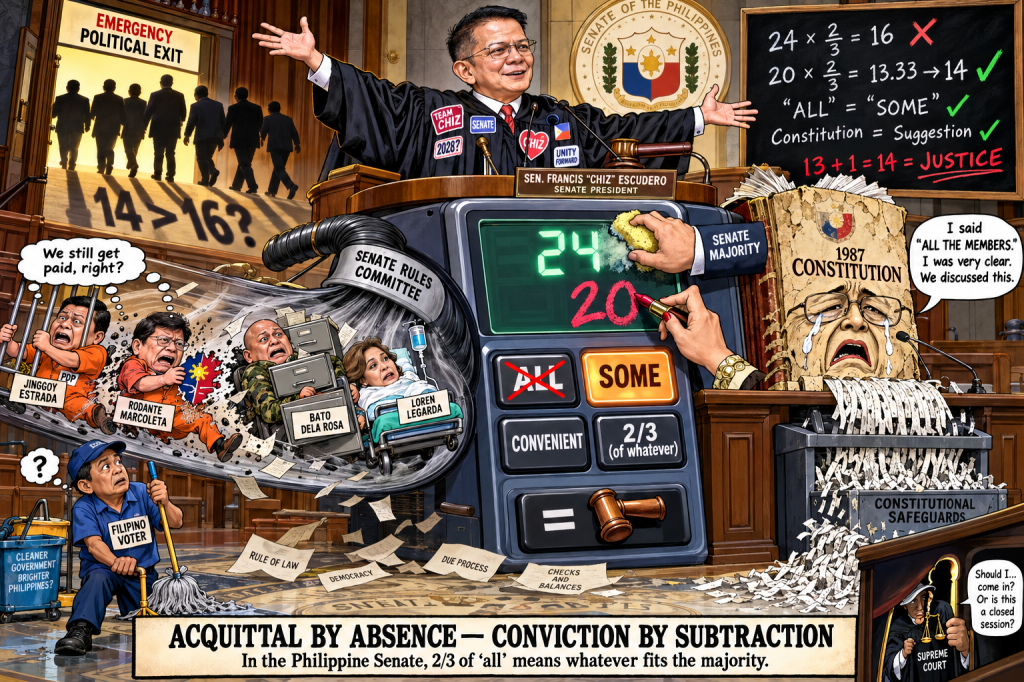
When Four Senators Disappear, the Constitution Apparently Disappears With Them
By Louis ‘Barok’ C Biraogo — September 25, 2026
LET me get this straight—because the Senate clearly didn’t.
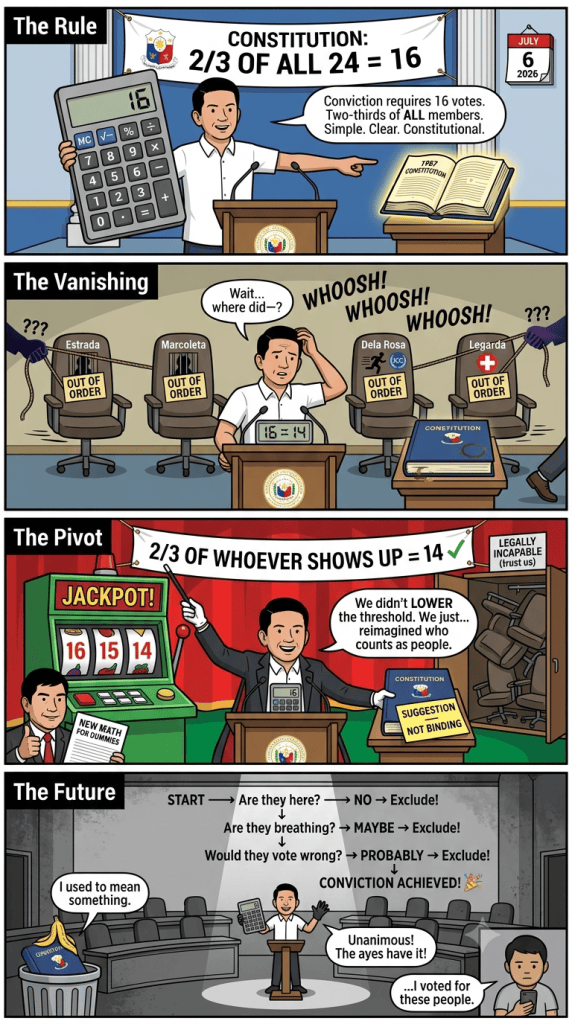
On July 6, 2026, Senate Impeachment Court Presiding Officer Francis “Chiz” Escudero stood before the chamber and declared, with the confidence of a man who had actually read the Constitution, that convicting Vice President Sara Duterte required sixteen votes. Two-thirds of twenty-four. Simple arithmetic. Constitutional text. The kind of thing you learn in fourth grade and then spend the rest of your legal career pretending is more complicated than it is.
On September 23, 2026, the same Senate impeachment court—minus six senators who mysteriously vanished during lunch break—voted 13-1 to overturn that ruling. The new formula: count only senators “legally and factually capable of participating,” exclude the four who aren’t, divide by whatever number remains, multiply by two-thirds, and round up if you get a decimal.
The math now yields fourteen votes.
The Constitution still says two-thirds. The Constitution still says “all the Members.” The Constitution, apparently, is now whatever thirteen senators say it is on a Wednesday afternoon.
Welcome to the Philippine Senate, where the Constitution is a suggestion, arithmetic is negotiable, and the definition of the word “all” depends entirely on who showed up for work that day.
The “All Members” Problem: A Masterclass in Interpretive Gymnastics
Let’s start with the text. Article XI, Section 3(6) of the 1987 Constitution of the Republic of the Philippines (1987 Constitution) is not ambiguous. It does not whisper. It does not hedge. It states:
“No person shall be convicted without the concurrence of two-thirds of all the Members of the Senate.”
Not “two-thirds of senators present.” Not “two-thirds of senators voting.” Not “two-thirds of senator-judges who bothered to take the oath and show up.” All the Members.
The Constitution uses different language when it wants to be flexible. Article VI, Section 16(2) talks about a “majority of each House” for quorum—a provision the Senate itself knows how to manipulate when it suits its purposes. The Framers understood the difference between “all” and “present.” They chose “all” for impeachment.
Why? Because convicting a constitutionally elected official should be hard. Not easy. Not convenient. Not subject to the whims of who happens to be detained, hiding, or on medical leave. The two-thirds requirement is a supermajority safeguard designed precisely for moments of political passion—the kind of moment we’re living through right now.
Senator Erwin Tulfo, the architect of this constitutional reinterpretation, insists the court “has not lowered two-thirds.” It has merely “reinterpreted the word ‘Members’.” This is like saying you didn’t burn down the house, you just reinterpreted the word “fire.”
The Senate is not interpreting the Constitution. It is rewriting it. The word “Members” now means “Members we deem capable of participating.” The word “all” now means “some.” The phrase “two-thirds” now means “whatever integer we can mathematically justify after excluding the people we don’t want in the denominator.”
And they did it with a straight face.
The Vanishing Senators: Coincidence or Choreography?
Let’s talk about who got excluded.
Four senators are currently unable to participate in the trial:
- Jinggoy Estrada — detained on plunder charges
- Rodante Marcoleta — detained on plunder charges
- Ronald “Bato” dela Rosa — in hiding from an International Criminal Court (ICC) arrest warrant for crimes against humanity
- Loren Legarda — on medical leave abroad while the Ombudsman investigates her
Now, I’m not a conspiracy theorist. I don’t believe the Marcos administration orchestrated the ICC warrant for dela Rosa, or timed the plunder detentions, or arranged Legarda’s medical leave. These things have their own independent legal and factual trajectories.
But I am a pattern recognizer.
And the pattern here is striking: every single senator excluded from the denominator is either a Duterte ally or from a camp politically hostile to the Marcos administration. Estrada’s family has been anti-Marcos since 1986. Marcoleta is a Duterte loyalist. Dela Rosa was Duterte’s police chief during the drug war. Legarda is an independent whose exclusion helps the prosecution.
The prosecution needs fourteen votes now instead of sixteen. The four excluded senators would have been, at best, unpredictable votes for conviction and, at worst, reliable acquittals. Their removal from the denominator doesn’t just lower the threshold—it removes four potential “not guilty” votes from the equation entirely.
House Prosecutor Chel Diokno, to his credit, has argued that absent senators cannot logically be counted as obstacles because they never heard the evidence, never deliberated, never voted. This is a legitimate functional argument. A senator who is in jail, in hiding, or in a hospital cannot meaningfully function as a senator-judge.
But the Constitution does not condition membership on functionality. It does not say “all Members capable of participating.” It says “all Members.” Period. Full stop.
The moment you introduce a capacity test, you introduce discretion. Who decides who is “capable”? What evidence? What standard? What happens when a senator is temporarily ill but could recover? What happens when a senator is abroad but could return? What happens when a senator is in hiding but could surrender?
The Senate’s new rule lists five categories of exclusion: detained or suspended, unknown whereabouts, medically incapacitated, beyond coercive processes, or “similarly situated.” That last phrase is a constitutional blank check. “Similarly situated” to what? To whom? Determined by whom?
This is not a rule. This is a framework for future manipulation.
Bayan v. Zamora: The Precedent That Doesn’t Say What They Think It Says
Escudero, to his credit, cited Bayan v. Zamora, G.R. No. 138570 in his July ruling. In that 2000 case, the Supreme Court held that even though only 23 senators were incumbent at the time, 16 votes still satisfied the two-thirds requirement for treaty concurrence. The Court treated the Senate as constitutionally composed of 24 members, regardless of temporary vacancies.
The defense has latched onto this precedent like a drowning man onto a life raft.
But here’s the problem: Bayan v. Zamora doesn’t actually resolve the current dispute.
In Bayan v. Zamora, the question was whether 16 votes out of 23 incumbents satisfied two-thirds. The Court said yes. But 2/3 of 23 is 15.33, which rounds to 16. So the math worked either way. The case didn’t have to confront the situation where the effective membership drops low enough that the denominator actually changes the threshold.
Let me illustrate: Effective Members 2/3 Threshold Minimum Whole Votes 24 16.00 16 23 15.33 16 22 14.67 15 21 14.00 14 20 13.33 14
With 23 senators, the threshold is still 16. The math doesn’t change. Bayan v. Zamora tells us nothing about what happens at 20 or 21.
The defense also cites the Corona impeachment in 2012, when the Senate had only 23 members after Benigno Aquino III became president. The Senate still required 16 votes to convict. But again—2/3 of 23 rounds to 16. The math is identical.
The Corona case is evidence of historical practice, not constitutional doctrine. It shows what the Senate did when the denominator was 23. It says nothing about what the Senate should do when the denominator is 20.
And here’s the uncomfortable question the defense keeps dodging: if the Senate had 20 members during Corona, would it have required 16 votes or 14? We don’t know. The Senate never confronted that question. Now it has, and it chose 14.
That’s not precedent. That’s new law.
Avelino v. Cuenco: The Dangerous Analogy
The prosecution and its amici—former Chief Justices Davide, Panganiban, and Puno—lean heavily on Avelino v. Cuenco, G.R. No. L-2821 (Avelino v. Cuenco) (1949), where the Supreme Court treated the Senate’s effective membership as 23 for quorum purposes because one senator was abroad and beyond the Senate’s coercive jurisdiction.
The analogy is tempting. If the Court can exclude senators beyond coercive jurisdiction for quorum, why can’t the Senate exclude them for conviction?
But there’s a critical distinction: quorum and conviction are not the same constitutional animal.
Quorum determines whether the body can conduct business. It is a procedural threshold designed to ensure that decisions are made by a sufficient number of members to be legitimate. Conviction, by contrast, determines whether a specific person is removed from office—a fundamentally different constitutional act with different stakes and different safeguards.
The Supreme Court itself has cautioned against overreading Avelino v. Cuenco. In a recent petition, the Court noted that Avelino v. Cuenco was decided based on “peculiar circumstances” and should not be treated as an “all-purpose magic spell” for lowering constitutional denominators. The Court emphasized that applying Avelino v. Cuenco requires not just counting who is present, but determining whether circumstances justify lowering the membership denominator in the first place.
That’s the question the Senate never seriously asked. It simply assumed that because four senators couldn’t participate, the denominator must shrink. But why must it shrink? What constitutional principle requires that the threshold for conviction be calculated based on availability rather than membership?
The prosecution says: because a senator who can’t participate can’t function as a judge. Fair enough. But the Constitution doesn’t say “two-thirds of functioning judges.” It says “two-thirds of all Members.” The Framers could have written “two-thirds of Members present” if they wanted the threshold to fluctuate with attendance. They didn’t.
The Senate is not applying the Constitution. It is rewriting it to achieve a desired outcome.
The “Acquittal by Default” Canard
The prosecution’s favorite rhetorical weapon is the specter of “acquittal by default”—the supposedly absurd scenario where an impeached official escapes conviction not because a majority found the charges unproven, but because enough senators were unavailable to reach the threshold.
Diokno put it bluntly: “A situation where a senator cannot hear the evidence, deliberate, and vote… Their inability to participate is beyond dispute. And yet, if the denominator is fixed at 24, conviction would always require 16 votes. Absurd.”
Is it absurd? Or is it the constitutional design?
The two-thirds requirement is deliberately difficult. It is meant to prevent conviction by a bare majority, or even a strong majority. It is meant to ensure that removal from office—a drastic remedy—commands overwhelming consensus.
If the Senate cannot muster 16 votes, the constitutional result is acquittal. That is not a bug. It is a feature. It is the same logic that allows a criminal defendant to go free because the prosecution failed to meet its burden, even if the defendant is probably guilty.
The “acquittal by default” argument assumes that the purpose of impeachment is conviction. But the Constitution’s purpose is legitimacy. A conviction that occurs because the threshold was lowered by excluding senators who would have voted against it is not a legitimate conviction. It is a procedural coup.
And here’s the uncomfortable corollary: if absence can lower the threshold, then absence becomes a tool. A party that wants to convict could theoretically engineer the absence of opposition senators to reduce the denominator. A party that wants to acquit could engineer the absence of pro-conviction senators to… wait, that would raise the effective threshold, not lower it.
Actually, let’s think this through.
Under the fixed 24 rule: absence has no effect on the threshold. Sixteen votes are always needed. Whether senators are present or absent, guilty or abstaining, the bar is 16. This is predictable. It is stable. It is immune to manipulation.
Under the variable rule: absence lowers the threshold. If four senators are absent, the bar drops to 14. If eight are absent, it drops to 11. If twelve are absent, it drops to 8.
Now, who benefits from a lower threshold? The prosecution. The side seeking conviction. The side that wants to remove the official.
This creates a perverse incentive: if you want to convict, you want senators to be absent. If you want to acquit, you want senators to be present.
Can you see the problem?
The Senate’s new rule says only senators “legally and factually incapable” of participating are excluded. But “incapable” is a contested category. Is a senator who is “in hiding” incapable? Dela Rosa could surrender. Is a senator on “medical leave” incapable? Legarda could return. Is a senator who is “detained” incapable? Estrada and Marcoleta could be released.
The line between “incapable” and “unwilling” is not as clear as the Senate pretends. And once you start drawing that line, you invite strategic behavior—from the prosecution, from the defense, from the senators themselves.
The fixed 24 rule avoids this entirely. It treats absence as what it is: absence. It does not reward it. It does not punish it. It simply ignores it.
That is the constitutional design.
The Six Who Walked Out
Let me say something about the six senators who didn’t participate in the threshold vote: Alan Peter Cayetano, Pia Cayetano, Bong Go, Imee Marcos, Robinhood Padilla, and Camille Villar.
They walked out during lunch break and didn’t return.
This is not a legal argument. It is a political statement. And it deserves to be named as such.
These are not obscure backbenchers. They are senators from the minority bloc—the faction aligned with the Duterte camp. Their absence from the vote is a signal: they do not accept the legitimacy of the proceeding. They do not want to be associated with the outcome. They are protesting, and their protest takes the form of non-participation.
Fine. That’s their prerogative.
But here’s the thing: their absence from the threshold vote is exactly the kind of absence that the new rule normalizes. If six senators can skip a vote on the threshold, why can’t they skip the final vote? And if they skip the final vote, does the denominator shrink again? Does the threshold drop to 12? To 10?
The Senate is creating a system where participation is optional and absence is rewarded. That is not a recipe for legitimate constitutional adjudication. That is a recipe for institutional collapse.
The Due Process Problem
The defense has raised a due process argument that deserves serious attention: changing the threshold mid-trial violates Vice President Duterte’s right to fair notice and a consistent legal framework.
The trial began in July. Escudero ruled on Day 1 that the threshold was 16. The defense prepared its case, examined witnesses, and built its strategy on the assumption that 16 votes were needed for conviction. Then, on Day 29, the Senate changed the rule.
The Senate says it didn’t change the Constitution—it merely clarified what “all Members” means. This is lawyerly sophistry. If the interpretation changes the practical burden on the defense—if it means the prosecution needs only 14 votes instead of 16—then it is a material change in the rules of the game.
The Supreme Court has already recognized that due process applies to impeachment proceedings. In Duterte v. House of Representatives, G.R. No. 278353 (Duterte v. House of Representatives) (2025), the Court held that impeachment is a “legal, political, and constitutional process” and that due process, fairness, and non-arbitrariness are required. The Court emphasized that the process must follow the “strict framework and procedure outlined in the Constitution.”
Changing the threshold mid-trial does not obviously violate the Constitution. But it does raise serious questions about fairness. The defense has relied on the 16-vote rule for two months. The Senate has now told them that reliance was misplaced.
If the Supreme Court reviews this—and the defense has signaled it will try—the justices will have to decide whether the Senate’s “clarification” is a permissible interpretation or a retroactive rule change that violates due process.
That is not an easy question. But it is a real question, and the Senate’s dismissive attitude toward it is not reassuring.
The Bottom Line: This Is Not About Math
The threshold dispute is not really about arithmetic. It is about power.
The Senate has the “sole power to try and decide all cases of impeachment.” That power is vast. But it is not unlimited. The Constitution imposes limits—including the two-thirds requirement—and the Supreme Court has the power to determine whether those limits have been exceeded.
By adopting a variable denominator, the Senate has expanded its own power. It has given itself the authority to decide, on a case-by-case basis, who counts as a “Member” for purposes of conviction. It has created a mechanism by which the threshold can be adjusted based on circumstances that the Senate itself evaluates.
That is not constitutional interpretation. That is constitutional amendment by majority vote.
And here’s the deepest irony: the senators who voted for this rule did so in the name of fairness—fairness to the prosecution, fairness to the process, fairness to the Filipino people who deserve a functioning impeachment court. But the rule they adopted is profoundly unfair to the respondent, who now faces a lower conviction threshold than the one announced at the start of her trial.
The Constitution does not guarantee a convenient process. It guarantees a lawful one. And lawful process means following the rules as written—not rewriting them when the math becomes inconvenient.
The Senate has chosen convenience over constitutional fidelity.
It has chosen outcome over procedure.
It has chosen politics over law.
And it has done so with the solemn self-assurance of a body that believes it is above question.
The Supreme Court may yet disagree.
Louis ‘Barok’ C. Biraogo is a professional spectator of constitutional disasters. He has been wrong before, but never this entertaining.
Key Citations
A. Legal & Official Sources
- The 1987 Constitution of the Republic of the Philippines. Official Gazette of the Republic of the Philippines, 1987, http://www.officialgazette.gov.ph/constitutions/1987-constitution/.
- The 1987 Constitution of the Republic of the Philippines, art. XI, sec. 3(6). Official Gazette of the Republic of the Philippines, http://www.officialgazette.gov.ph/constitutions/the-1987-constitution-of-the-republic-of-the-philippines/the-1987-constitution-of-the-republic-of-the-philippines-article-xi/.
- The 1987 Constitution of the Republic of the Philippines, art. VI, sec. 16(2). Official Gazette of the Republic of the Philippines, http://www.officialgazette.gov.ph/constitutions/the-1987-constitution-of-the-republic-of-the-philippines/the-1987-constitution-of-the-republic-of-the-philippines-article-vi/.
- Bayan v. Zamora, G.R. No. 138570. Supreme Court of the Philippines, 10 Oct. 2000, http://www.lawphil.net/judjuris/juri2000/oct2000/gr_138570_2000.html.
- Avelino v. Cuenco, G.R. No. L-2821. Supreme Court of the Philippines, 4 Mar. 1949, lawphil.net/judjuris/juri1949/mar1949/gr_l-2821_1949.html.
- Duterte v. House of Representatives, G.R. No. 278353. Supreme Court of the Philippines, 25 July 2025, sc.judiciary.gov.ph/278353-278359-sara-z-duterte-vs-house-of-representatives-et-al-atty-israelito-p-torreon-et-al-vs-house-of-representatives-et-al/.
- International Criminal Court. Home page, http://www.icc-cpi.int/.
B. News Reports
- “Impeachment Court Overturns Ruling, Reduces Voting Threshold to Convict VP Duterte.” Manila Bulletin, 23 Sept. 2026, mb.com.ph/2026/09/23/impeachment-court-overturns-ruling-reduces-voting-threshold-to-convict-duterte.
- Bacelonia, Wilnard. “Senate Court Drops Fixed 16-Vote Threshold in VP Trial.” Philippine News Agency, 23 Sept. 2026, http://www.pna.gov.ph/articles/1284670.
- Tan, Kimberly Jane. “Corona Convicted.” GMA News Online, GMA Network, 29 May 2012, http://www.gmanetwork.com/news/topstories/nation/259801/corona-convicted/story/.
- “Full Text: ICC Warrant of Arrest for Ronald ‘Bato’ dela Rosa.” Philstar.com, 12 May 2026, http://www.philstar.com/headlines/2026/05/12/2527309/full-text-icc-warrant-arrest-ronald-bato-dela-rosa.
- Casilao, Joahna Lei. “SC Declares Articles of Impeachment vs. Sara Duterte Unconstitutional.” GMA News Online, GMA Network, 25 July 2025, http://www.gmanetwork.com/news/topstories/nation/953766/sc-declares-articles-of-impeachment-vs-sara-duterte-unconstitutional/story/.
- “Ang Hirap Maging Mahirap”: The PAO Scandal That Proves Government Contempt Is Nothing New

- “Far-Off” My Axx: Malacañang’s Claire Castro Drowns in Her Own Legal Gaslighting

- “Forthwith” to Farce: How the Senate is Killing Impeachment—And Why Enrile’s Right (Even If You Can’t Trust Him)

- “HINDI AKO NAG-RESIGN!”

- “I Know Nothing”: Baste Duterte’s Amnesia Defense Meets ₱33M in GenCorp Contracts

- “I’m calling you from my new Globe SIM. Send load!”

- “Mahiya Naman Kayo!” Marcos’ Anti-Corruption Vow Faces a Flood of Doubt

- “Manageable” Debt, Unmanageable Lies: DBM’s ₱21 Trillion Fairy Tale

- “Meow, I’m calling you from my new Globe SIM!”

- “Natrabaho”: One Word, One Ombudsman, and a Judiciary on Trial

- “No Special Jail for Crooks!” Boying Remulla Slams VIP Perks for Flood Scammers

- “Philippine-Controlled” or Yankee Gas Station? The Davao Fuel Depot Farce Exposed










Leave a Reply