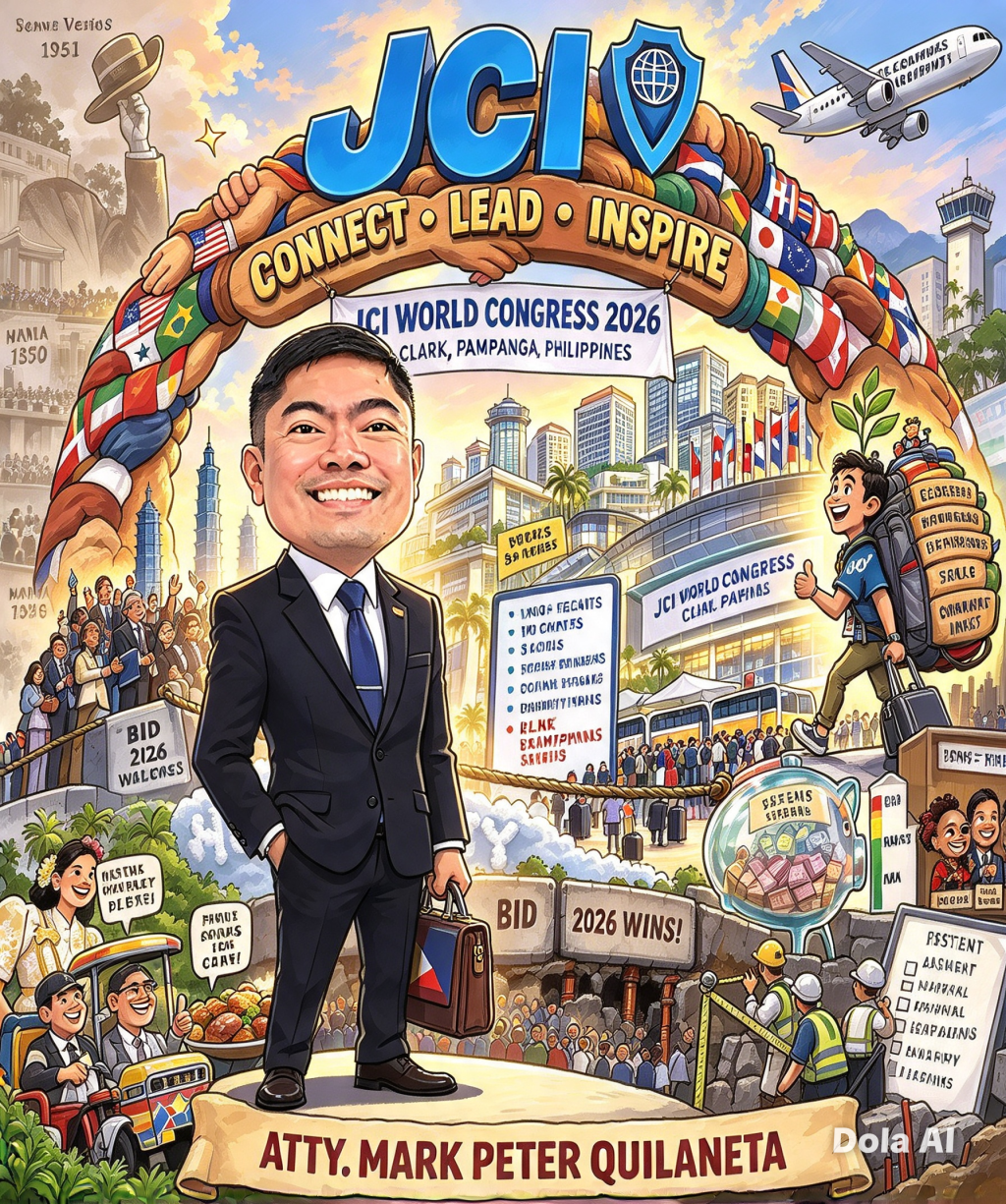
Four Congresses. Seven Decades. One Organization that Never Stopped Believing.
By Louis “Barok” C. Biraogo | October 14, 2026
WHEN the world gathers in Clark, Pampanga, for the JCI World Congress 2026, the Philippines will have an opportunity to demonstrate something more enduring than its capacity to host an international event: its capacity to cultivate leaders, build bridges, and inspire a new generation to serve.
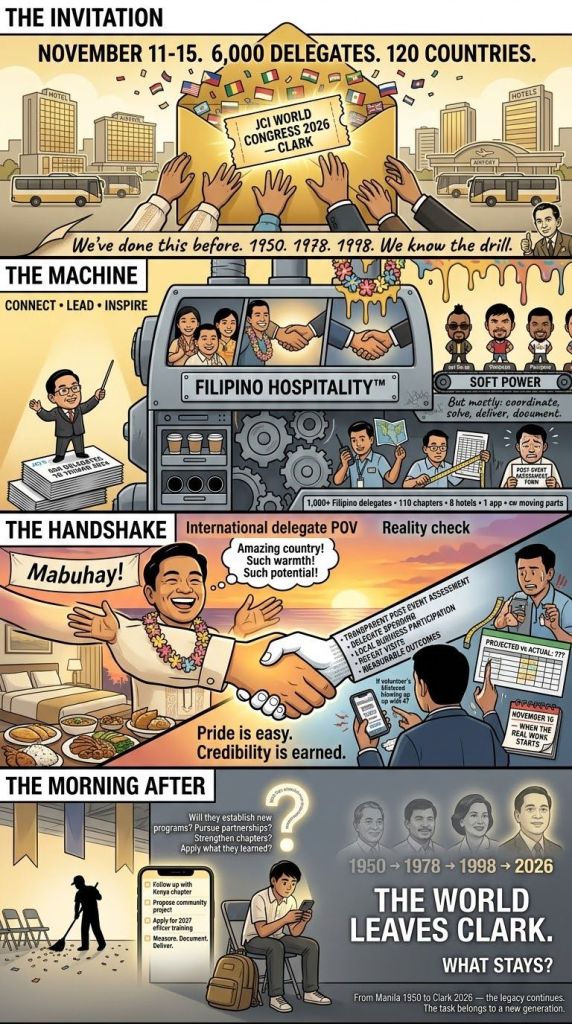
From November 11 to 15, more than 6,000 delegates from over 120 countries are expected to converge in Clark. For JCI Philippines, this is both a homecoming and a responsibility—the return of a global community after 28 years and an opportunity to show what Filipino vision, discipline, and cooperation can accomplish.
The significance of this gathering, however, begins long before 2026.
A legacy worth carrying forward
The Philippines hosted the JCI World Congress in 1950, 1978, and 1998. Clark now joins Manila in that distinguished history.
The first milestone remains especially meaningful. According to JCI’s institutional history, Ramon V. del Rosario Sr. became JCI World President for 1951, the first Filipino and the first Asian to hold the position. His achievement demonstrated that leadership in an international movement could transcend geography and challenge assumptions about who belonged at its highest levels.
That legacy is not simply a source of national pride. It is a reminder that barriers can be crossed and possibilities expanded.
After the Congresses of 1978 and 1998, the world returns to the Philippines at a time when young people face formidable challenges—from economic uncertainty to declining trust in institutions. The question is whether today’s generation can carry forward the initiative of those who came before them.
Clark offers an opportunity to answer that question through action.
Excellence is built, not proclaimed
Under the leadership of then-JCI Philippines National President Atty. Mark Peter M. Quilaneta, the Philippine bid to host the 2026 JCI World Congress became a defining exercise in vision, persuasion, and national mobilization. Bringing more than 600 Filipino delegates to the 2024 World Congress in Taiwan, Quilaneta led the national organization in making the case for the Philippines as the next home of the global JCI community. The successful bid was more than a victory at the ballot; it was a testament to the power of uniting chapters, rallying a nationwide movement, and earning international confidence in Filipino leadership. Quilaneta helped turn the ambition of hosting the world into a concrete opportunity for the Philippines—laying the foundation for a new generation of Filipino leaders to welcome the global community to Clark.
The preparations for Clark tell a similarly important story. More than 1,000 Filipino delegates are expected, representing a network of 110 Philippine chapters. Eight partner hotels, dedicated shuttle buses, a digital Congress application, and multiple venues form part of the arrangements for welcoming thousands of international visitors.
These details may lack the glamour of a grand opening ceremony, but they reveal something essential: successful leadership depends on execution.
A conference of this scale requires people who can coordinate competing demands, solve practical problems, and work together toward a common objective. The volunteer who handles an overlooked task and the organizer who ensures that a visitor reaches the right venue contribute to the country’s reputation just as surely as those who stand onstage.
The Philippines does not need to pretend that its institutions are flawless. It needs to demonstrate that Filipinos can organize effectively, meet demanding standards, and deliver on their commitments.
That is a more persuasive form of national pride.
Clark and the promise of regional development
The Congress also offers an opportunity to broaden the geography of Philippine ambition.
For too long, international attention has gravitated toward Metro Manila. Clark, with its airport access, hotel capacity, and developing meetings, incentives, conferences, and exhibitions sector, can help establish that major international gatherings need not be confined to the capital.
Hotels, restaurants, transport operators, retailers, and tourism enterprises stand to benefit from the expected influx of delegates. Equally important, Clark can strengthen its profile among international organizations considering future conferences and business gatherings.
These benefits are opportunities, not guarantees. The tourism figures cited in the Congress research describe the wider Clark visitor economy; they should not be mistaken for spending generated by the event itself. The Congress’s actual economic contribution will depend on delegate expenditures, local business participation, and measurable outcomes.
A credible legacy should therefore include a transparent post-event assessment.
The measure of success will not simply be how many people arrive in November, but how many business relationships, repeat visits, and future opportunities follow.
More than a convention: a school of leadership
Perhaps the strongest argument for the Congress lies in its program.
Governance sessions, entrepreneurship activities, public-speaking and debating championships, women’s leadership initiatives, trainer certification, international networking, and preparations for future JCI officers make this more than a ceremonial gathering.
They offer opportunities to develop skills that extend far beyond the conference hall: communicating ideas, debating differences, organizing institutions, building enterprises, and preparing others to lead.
These capabilities matter in a democracy that needs citizens willing to examine arguments, listen to opposing views, and hold institutions accountable. They matter in communities confronting difficult public problems and in economies where innovation depends on initiative and collaboration.
The inclusion of training for 2027 officer candidates is particularly significant. It suggests that the Congress is looking beyond immediate celebration toward institutional succession.
Organizations endure when they prepare the next generation not merely to inherit titles, but to assume responsibility.
Under the national theme “Sustain the Future” and the Congress framework “Connect · Lead · Inspire,” the challenge is straightforward: build relationships, develop the capacity to act, and turn inspiration into service.
The real test will come after delegates return home. Will they establish new programs, pursue business partnerships, strengthen their organizations, and apply what they have learned?
That is how a gathering becomes a legacy.
The soft power of Filipino hospitality
International influence is not measured by economic or military strength alone. Countries also earn respect through the relationships they build and the experiences they offer.
Thousands of delegates encountering Filipino hospitality, competent organization, and opportunities for meaningful collaboration can carry those impressions into their own communities and countries.
The Congress’s association with Filipino personalities, including ambassador apl.de.ap and figures such as Manny Pacquiao, Alex Eala, and Lea Salonga, can amplify the country’s cultural presence. But celebrity is not the substance of the event. Its deeper strength lies in the organizers, volunteers, business owners, and young leaders who make international cooperation possible.
The Philippines has an opportunity to present a fuller national story—not one that denies our difficulties, but one that refuses to let those difficulties define us entirely.
It is a story of citizens who organize, serve, innovate, and welcome the world despite the challenges confronting their country.
That is soft power at its most human: not demanding admiration, but giving others reasons to understand and respect us.
Pride grounded in accountability
Major events invite extravagant promises. The temptation is to describe every gathering as historic, every preparation as world-class, and every projected benefit as an accomplished fact.
We should resist it.
The expected scale of the Congress, its historical significance, its leadership program, and its logistical preparations provide ample grounds for an enthusiastic endorsement. There is no need to exaggerate what they establish.
JCI Philippines and its partners should document the results: delegate spending, local business participation, new partnerships, subsequent tourism, and the leadership initiatives that emerge. They should also assess whether training produces measurable improvements in the capabilities of participants and their organizations.
Accountability does not diminish national pride. It gives pride credibility.
The Congress should be both a celebration of what generations have achieved and a commitment to what the next generation must deliver.
The work begins after the applause
When the delegates leave Clark, the banners will come down and the venues will return to their ordinary routines. The most important outcomes, however, may be those that remain invisible to the cameras.
A young Filipino gains the confidence to lead a community project. An entrepreneur establishes a lasting international partnership. A volunteer discovers that public service is a discipline, not merely an aspiration. A future officer learns to treat leadership as a responsibility rather than a privilege.
These are the beginnings of a durable legacy.
They require follow-through: sustained networks, accessible training resources, stronger local chapters, and opportunities for young people to translate new skills into practical service.
Inspiration matters. Opportunity gives it direction. Responsibility turns it into action.
From the 1950 World Congress to the gathering in Clark, the JCI Philippines story has crossed generations. The places have changed, but the underlying promise remains: people who learn to work together can accomplish more than those who work alone.
That lesson extends beyond JCI—to our schools, communities, businesses, and public institutions. Nation-building requires people willing to cooperate across differences, develop their capabilities, and accept responsibility for the common good.
The Philippines should welcome this Congress with pride, but also with ambition. Let Clark demonstrate that regional destinations can host the world. Let Filipino delegates show that leadership is measured by competence and service, not titles alone. Let visitors encounter a country whose warmth is matched by professionalism and whose aspirations are backed by hard work.
The world is coming to Clark. Our responsibility is to ensure that it leaves having seen not merely a successful Congress, but a glimpse of the Philippines we are determined to build.
Congratulations to JCI Philippines, its leaders, host chapters, volunteers, and partners. From Manila in 1950 to Clark in 2026, the legacy continues. The task now belongs to a new generation—not simply to preserve that legacy, but to enlarge it through integrity, service, and cooperation.
That is how nations earn respect. That is how young leaders build the future. And that is how Filipinos make great things happen.
About the Author
Louis “Barok” C. Biraogo, President of Davao Jaycees, Inc. in 2000, carries with him a deep and abiding faith in the Jaycee movement. The friendships forged, lessons learned, and memories made remain an enduring part of his life. Through Kweba ni Barok, he celebrates the Jaycee spirit of leadership, service, and fellowship—and the timeless belief that ordinary people, united by purpose, can make great things happen.

- “Ang Hirap Maging Mahirap”: The PAO Scandal That Proves Government Contempt Is Nothing New

- “Far-Off” My Axx: Malacañang’s Claire Castro Drowns in Her Own Legal Gaslighting
- “Forthwith” to Farce: How the Senate is Killing Impeachment—And Why Enrile’s Right (Even If You Can’t Trust Him)

- “HINDI AKO NAG-RESIGN!”

- “I Know Nothing”: Baste Duterte’s Amnesia Defense Meets ₱33M in GenCorp Contracts

- “I’m calling you from my new Globe SIM. Send load!”

- “Mahiya Naman Kayo!” Marcos’ Anti-Corruption Vow Faces a Flood of Doubt

- “Manageable” Debt, Unmanageable Lies: DBM’s ₱21 Trillion Fairy Tale
- “Meow, I’m calling you from my new Globe SIM!”

- “Natrabaho”: One Word, One Ombudsman, and a Judiciary on Trial

- “No Special Jail for Crooks!” Boying Remulla Slams VIP Perks for Flood Scammers

- “Philippine-Controlled” or Yankee Gas Station? The Davao Fuel Depot Farce Exposed









Leave a Reply