The Ombudsman Prosecutes Transactions, Not Taglines
By Louis “Barok” C. Biraogo — October 14,2026
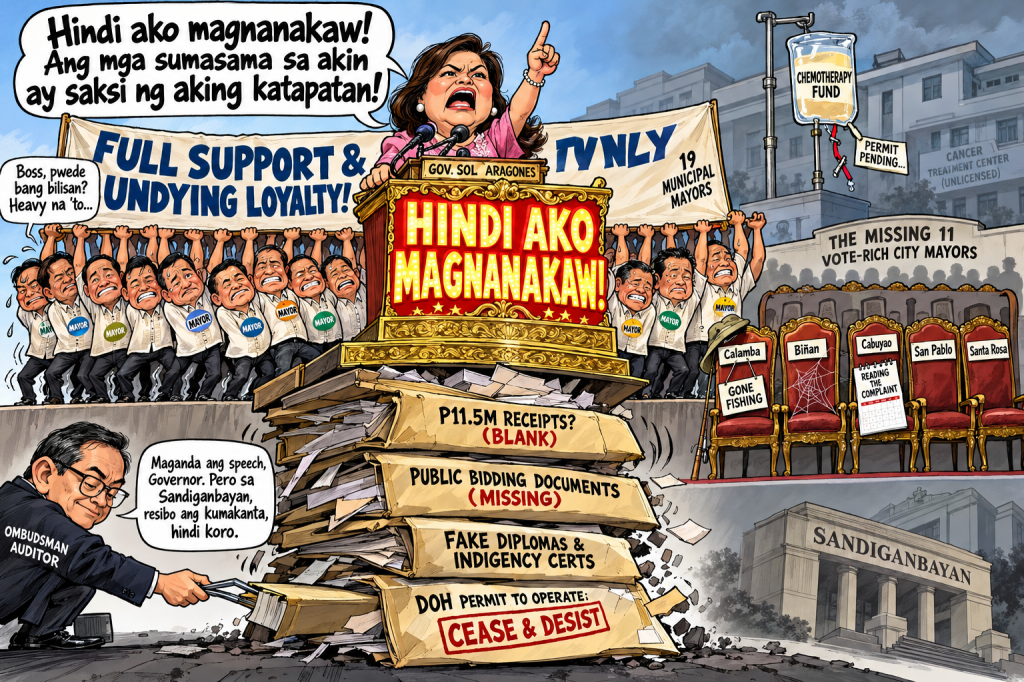
SANTA CRUZ, Laguna — Nothing says “I have absolutely nothing to hide” quite like summoning nineteen municipal mayors to the provincial capitol for a photo-op solidarity rally two weeks after a graft complaint lands on your desk.
That’s not damage control. That’s a hostage video with better catering.
On October 12, 2026, the League of Municipalities of the Philippines (LMP)–Laguna Chapter, led by Rizal Mayor Vener Muñoz, gathered at the Provincial Capitol to declare their undying loyalty to Governor Sol Aragones, who is currently facing not one, not two, but at least three graft complaints before the Office of the Ombudsman. The complaints involve a P11.5 million civil service review program with some accounting that would make a casino auditor weep, and a chemotherapy facility that apparently forgot to secure a Permit to Operate before treating cancer patients.
But hey — nineteen mayors showed up. That’s nineteen more character witnesses than most defendants get.
The Arithmetic of Absolution: How Many Mayors Does It Take to Clear a Governor?
Let’s start with the math, because the math is always where these stories get delicious.
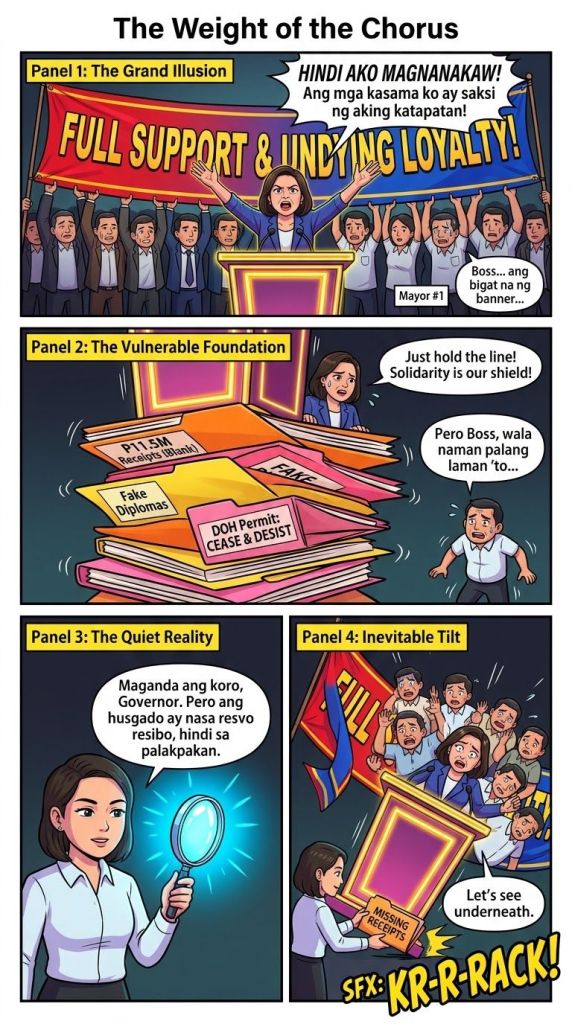
Laguna has 24 municipalities and 6 cities. That’s 30 local government units. Mayor Muñoz, speaking on behalf of “all” the mayors, managed to wrangle nineteen of them into the capitol. That’s not a quorum. That’s barely a majority in a barangay council.
Where were the other eleven? Perhaps they were busy doing something radical like, I don’t know, reading the complaint? Or maybe they just didn’t want their names attached to a defense that might age like milk in a Manila summer.
And notice what’s missing: the city mayors. Biñan. Cabuyao. Calamba. San Pablo. San Pedro. Santa Rosa. These aren’t just municipalities with better tax bases — they’re the vote-rich urban centers where actual electoral power resides. Their absence speaks volumes, and what it says is probably not “We fully support you, Governor.”
Mayor Muñoz, to his credit, acknowledged this: “Kahit na hindi lahat ay pisikal na naroroon ngayon, nagsasalita ako para sa lahat” — “Even though not all are physically present now, I speak for all.”
Ah yes. The classic “I speak for the people who didn’t show up” maneuver. It’s the political equivalent of saying “Some of my best friends are lawyers” while your lawyer is frantically googling “how to flee the country.”
The Complaint That Launched a Thousand Loyalties
Let’s review what these mayors are rallying against, shall we?
On September 28, 2026, Laguna Board Member Lorenzo Zuñiga Jr., along with Board Members Karla Adajar and Princess Lajara, and Calamba City Councilor Niño Lajara, filed a graft complaint alleging violations of Sections 3(e) and 3(g) of Republic Act No. 3019 (Anti-Graft and Corrupt Practices Act). The allegations are not exactly subtle:
The provincial government allegedly allocated P15,500 per beneficiary for a civil service review program. That’s already a curious number — not because it’s high, but because the complainants claim other review centers offer comparable services for P6,000. That’s a price difference of P9,500 per student. Across roughly 742 beneficiaries (the arithmetic implied by the P11.5 million budget), that’s over P7 million in potential discrepancy. Not exactly loose change.
But wait, there’s more. The complaint alleges that beneficiaries were instructed to hand over their full P15,500 allocations directly to a single private review center. Some allegedly submitted fake diplomas and indigency certificates. Some received funds without actually attending review programs.
And the kicker: the program allegedly proceeded without public bidding, despite guidance from the Provincial Legal Services Office and conditions imposed by the Sangguniang Panlalawigan.
The response from the governor’s camp? “We haven’t received the official copy yet, but we strongly condemn the circulation on social media.” Translation: We don’t know what’s in it, but we know we don’t like it.
Then, on October 13, a second complaint landed — this one about the provincial chemotherapy facility allegedly operating without a Permit to Operate. The Department of Health (DOH) apparently issued a cease and desist order. The complainants include Jonel Osio, a dismissed supervising administrative officer of Laguna Medical Center — because nothing says “credible whistleblower” like someone who was fired.
Governor Aragones called it “political harassment.” The complainants called it accountability. The Ombudsman called it Tuesday.
The Coalition of the Unwell
Now, let’s talk about the coalition that showed up. The mayors who attended represent Rizal, Paete, Santa Cruz, Pagsanjan, Lumban, Pila, Magdalena, Pakil, Kalayaan, Liliw, Majayjay, Siniloan, Nagcarlan, Bay, Mabitac, Pangil, Los Baños, and Cavinti. Plus the Laguna Muslim Consultative Council and its 65 presidents.
That’s a geographically diverse group. What could possibly unite them?
Let’s consult the Kweba ni Barok Encyclopedia of Obvious Political Incentives, shall we?
- Theory One: Resource Dependency. Municipalities depend on the provincial government for internal revenue allotment releases, development funds, infrastructure projects, and disaster relief. Supporting the governor who controls those purse strings is not patriotism. It’s survival. It’s the political equivalent of laughing at your boss’s joke about how the office coffee is actually good.
- Theory Two: Patron-Client Politics. This is the Philippines, where political loyalty has been a currency since before Magellan got himself impaled. Mayors supporting a governor under investigation is not about innocence or guilt. It’s about future favors. It’s about not being on the wrong side when the budget allocations get divvied up.
- Theory Three: Genuine Belief. It’s possible — possible — that some mayors actually believe the allegations are politically motivated. Aragones won a historic victory in 2025, defeating the wife of the outgoing governor and breaking a dynastic succession plan. She ran on health, education, and anti-dynasty sentiment. Maybe these mayors genuinely think she’s being targeted for being an outsider who disrupted the old order.
But here’s the thing about genuine belief: it doesn’t pay for chemotherapy licenses. It doesn’t explain P15,500 when P6,000 will do. And it certainly doesn’t answer why the program allegedly skipped public bidding.
The Audacity of “Hindi Ako Magnanakaw”
Let’s pause to appreciate the governor’s chosen defense: “Hindi ako nagnakaw at hindi kailanman magnanakaw ng pera ng bayan” — “I did not steal and will never steal public money.”
It’s a bold statement. It’s also legally meaningless. The presumption of innocence is a constitutional right, not a character reference. You can be innocent of theft and still be guilty of gross inexcusable negligence. You can be personally honest and still preside over a procurement process that violated Republic Act No. 9184 (Government Procurement Reform Act).
The Supreme Court has been crystal clear on this: procurement irregularities alone do not automatically establish probable cause for graft. But they also don’t automatically establish innocence. The Ombudsman doesn’t operate on vibes. It operates on documents, receipts, disbursement records, and the kind of paper trail that makes politicians nervous.
And speaking of paper trails — where are the documents? The complainants asked for “billing logs and disbursement records.” The governor’s camp says they haven’t received the complaint yet. The Ombudsman has yet to publicly confirm any finding.
Meanwhile, the chemotherapy complaint includes an alleged DOH cease and desist order. That’s not a rumor. That’s a document with a signature. If it exists, it’s checkable. If it doesn’t, the complainants have some explaining to do.
The Innocence-Presumption Paradox
Here’s what makes this whole spectacle so quintessentially Filipino: everyone is simultaneously demanding due process while trampling all over it.
The mayors say Aragones deserves the presumption of innocence. Fair enough. But a political rally is not a judicial proceeding. Nineteen mayors expressing “full support” doesn’t establish innocence any more than nineteen mayors expressing doubt would establish guilt. It’s political theater, and like all political theater, it’s designed to shape public perception, not legal reality.
The complainants say they’re seeking accountability. Also fair enough. But filing multiple complaints in rapid succession — review program on September 28, chemotherapy facility on October 13 — starts to look less like a methodical pursuit of justice and more like a strategy of death by a thousand paper cuts.
And the governor says she’s being politically harassed. That might even be true. But “I’m being harassed” is not a defense against specific allegations of financial irregularity. It’s a rhetorical shield, and rhetorical shields don’t stop Ombudsman subpoenas.
The Real Question Nobody’s Asking
Amid all the rally coverage and the dueling press statements, there’s a question that keeps getting buried: What actually happened to the P11.5 million?
Not “Did the governor steal it?” Not “Are the complainants politically motivated?” But: Where is the money, and can anyone account for it?
The complainants allege that beneficiaries received P15,500 each but were told to give it all to a private review center. If true, that’s not assistance. That’s a pass-through. And pass-throughs that bypass procurement law are exactly the kind of thing RA 9184 was designed to prevent.
The complainants also allege fake diplomas and indigency certificates. If true, that’s fraud, and it raises the question: who was checking? Who was verifying? Was anyone doing their job, or was the entire program just a money-laundering scheme with a civil service exam as cover?
These are answerable questions. They require documents, audits, and the kind of forensic accounting that doesn’t care about political affiliations. They do not require nineteen mayors standing in a room saying nice things about the governor.
The Coalition’s Fatal Flaw
Here’s the problem with the mayors’ rally, and it’s not just that it’s optically questionable: it conflates political support with factual exoneration.
When Mayor Muñoz says the LMP “fully supports” Aragones, what does that mean? Does it mean the mayors have reviewed the disbursement records and found them compliant? Does it mean they’ve verified that the chemotherapy facility had a license? Does it mean they’ve audited the P15,500 per beneficiary and determined it was reasonable?
Of course not. They haven’t done any of that. They’re mayors, not auditors. Their support is political, not evidentiary. And treating political support as if it settles factual questions is exactly how corruption flourishes in this country: not through outright denial, but through collective willful ignorance dressed up as loyalty.
The strongest position the mayors could have taken was: “We support the governor’s right to due process, and we demand a full and transparent investigation.” That would have been statesmanship. Instead, they chose unconditional solidarity, which is just partisanship with a press release.
What Happens Next (According to the Kweba Crystal Ball)
The Ombudsman will investigate. The complainants will submit documents. The governor’s legal team will submit counter-affidavits. At some point, there will be a finding — probable cause or dismissal.
If probable cause: the case goes to the Sandiganbayan. Preventive suspension becomes a possibility. The mayors who rallied will suddenly remember they have “scheduling conflicts” for any future solidarity events. The political calculus will shift faster than you can say “I never said I was certain she was innocent.”
If dismissed: the governor declares vindication. The complainants cry foul. The cycle repeats with the next complaint. Because in Philippine politics, there’s always a next complaint.
Either way, the P15,500 question remains unanswered until someone actually audits the books. And the chemotherapy facility remains a question of whether cancer patients were treated in an unlicensed facility — which, if true, is not a political issue. It’s a public health crisis.
The Final Verdict (Before the Ombudsman’s Verdict)
The Laguna mayors’ rally is not evidence of guilt. It’s not evidence of innocence. It’s evidence that Philippine politics remains a game of personal alliances, where institutional accountability is treated as an inconvenience and collective loyalty as a substitute for individual responsibility.
Governor Aragones may be entirely innocent. The complainants may be entirely sincere. The mayors may be entirely well-intentioned. But none of that matters if the money can’t be accounted for and the licenses can’t be produced.
“Hindi ako magnanakaw” is a powerful statement. But the Ombudsman doesn’t prosecute adjectives. It prosecutes transactions. And the transactions in question — P11.5 million for a review program, a chemotherapy facility without a Permit to Operate — are transactions that demand documentation, not declarations.
The mayors showed up for the governor. The question is whether the governor will show up for the audit.
Louis “Barok” C. Biraogo is the author of Kweba ni Barok, where he has been documenting Philippine corruption and governance failures since before it was cool. He accepts no campaign contributions, no free lunches, and no invitations to solidarity rallies.
Key Citations
A. Legal & Official Sources
- The 1987 Constitution of the Republic of the Philippines. Official Gazette of the Republic of the Philippines, 1987, http://www.officialgazette.gov.ph/constitutions/1987-constitution/.
- Republic Act No. 3019. Anti-Graft and Corrupt Practices Act. Official Gazette of the Republic of the Philippines, 17 Aug. 1960, http://www.officialgazette.gov.ph/1960/08/17/republic-act-no-3019/.
- Republic Act No. 9184. Government Procurement Reform Act. Official Gazette of the Republic of the Philippines, 10 Jan. 2003, http://www.officialgazette.gov.ph/2003/01/10/republic-act-no-9184/.
- Republic Act No. 6770. The Ombudsman Act of 1989. Official Gazette of the Republic of the Philippines, 17 Nov. 1989, http://www.officialgazette.gov.ph/1989/11/17/republic-act-no-6770/.
- Republic Act No. 7160. Local Government Code of 1991. Official Gazette of the Republic of the Philippines, 10 Oct. 1991, http://www.officialgazette.gov.ph/1991/10/10/republic-act-no-7160/.
B. News Reports
- Escovidal, Josephine O. “19 Laguna Mayors Express Support for Gov. Sol Aragones.” Daily Tribune, 13 Oct. 2026, https://tribune.net.ph/2026/10/12/laguna-mayors-back-aragones-amid-graft-complaint.
- Manila Bulletin. “Graft Complaint Filed vs Laguna Governor, 5 Others over Review Aid Program.” Manila Bulletin, 28 Sept. 2026, mb.com.ph/2026/09/28/graft-complaint-filed-vs-laguna-governor-5-others-over-review-aid-program.
- Provincial Government of Laguna. “Official Statement on the Filing of Graft Complaints.” Laguna Provincial Government News Page, Oct. 2026.
- “Ang Hirap Maging Mahirap”: The PAO Scandal That Proves Government Contempt Is Nothing New
- “Far-Off” My Axx: Malacañang’s Claire Castro Drowns in Her Own Legal Gaslighting
- “Forthwith” to Farce: How the Senate is Killing Impeachment—And Why Enrile’s Right (Even If You Can’t Trust Him)
- “HINDI AKO NAG-RESIGN!”

- “I Know Nothing”: Baste Duterte’s Amnesia Defense Meets ₱33M in GenCorp Contracts
- “I’m calling you from my new Globe SIM. Send load!”

- “Mahiya Naman Kayo!” Marcos’ Anti-Corruption Vow Faces a Flood of Doubt

- “Manageable” Debt, Unmanageable Lies: DBM’s ₱21 Trillion Fairy Tale
- “Meow, I’m calling you from my new Globe SIM!”

- “Natrabaho”: One Word, One Ombudsman, and a Judiciary on Trial

- “No Special Jail for Crooks!” Boying Remulla Slams VIP Perks for Flood Scammers

- “Philippine-Controlled” or Yankee Gas Station? The Davao Fuel Depot Farce Exposed






Leave a Reply