How Refinancing, Rollovers, and Record Debt Became the Administration’s Favorite Magic Trick
By Louis “Barok” C. Biraogo — October 15,2026
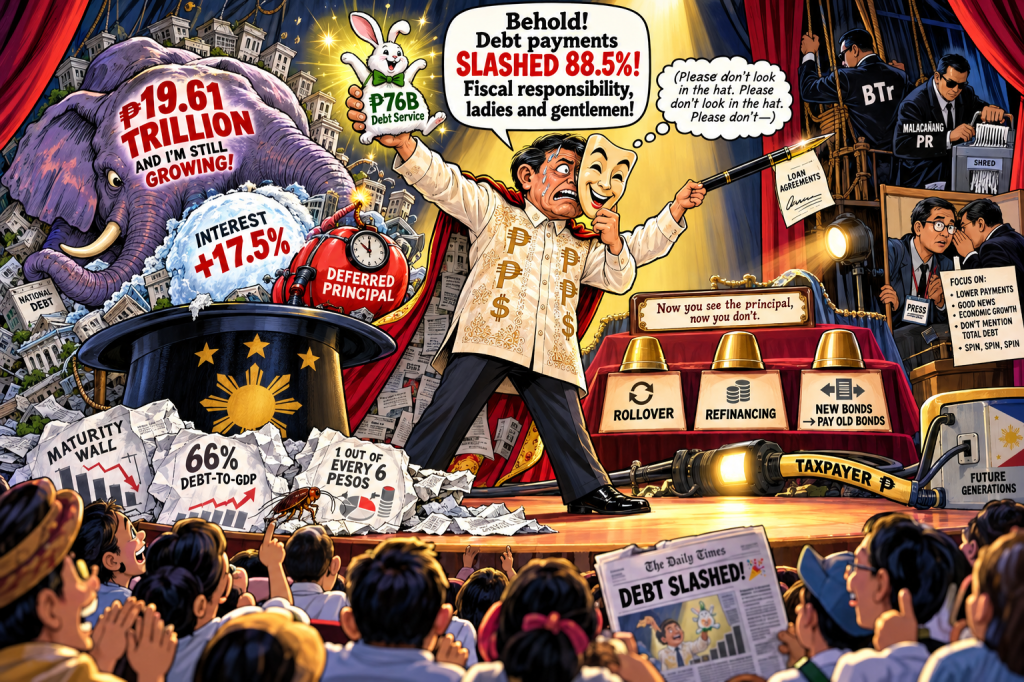
HERE’S a secret the Bureau of the Treasury (BTr) would prefer stays between them and their spreadsheets: the Philippine government has mastered the art of borrowing more while looking like it’s paying less. It’s not a fiscal strategy. It’s a sleight of hand. And the only thing disappearing faster than the principal is your ability to see where the money went.
On October 12, 2026, the Philippine Star ran a headline that must have had Malacañang popping champagne: “Debt payments slashed to P76 billion”. The story was simple, clean, and utterly misleading. Debt service dropped 88.5% year-on-year, from P664.72 billion in August 2025 to a paltry P76.12 billion in August 2026. The administration, the article implied, was getting its fiscal house in order.
Here’s what the headline didn’t say: the national debt hit a record P19.61 trillion that same month. Interest payments rose 17.5% year-to-date. And the entire “savings” came from a 98.3% collapse in principal amortization—the part where you actually pay back what you borrowed.
So let’s get this straight. The government borrowed more, owed more, and paid more in interest than ever before. But because it didn’t have to write a big check for principal that month, we’re supposed to believe it’s fiscally responsible.
That’s not debt management. That’s debt theater.
The Art of Not Paying Your Bills (And Calling It Progress)
Let’s do the math they’re hoping you won’t do.
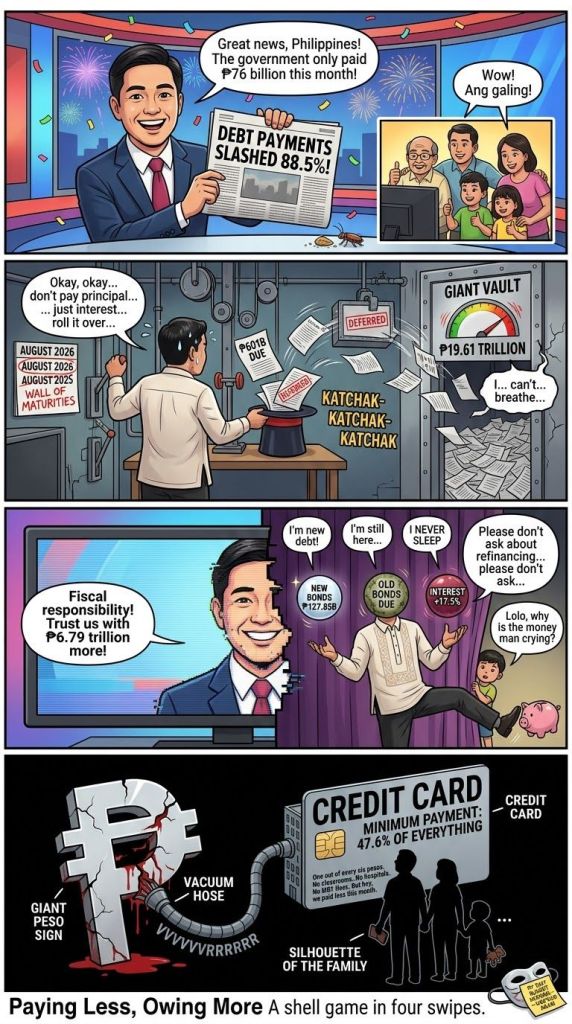
In August 2025, the government paid P601.62 billion in principal amortization. In August 2026, it paid P10.5 billion. That’s a difference of P591.12 billion. Nearly all of that drop—P597.89 billion, to be precise—was domestic principal payments that simply didn’t come due this year.
The Treasury would have you believe this is normal. Debt maturities are lumpy, they say. August 2025 was an anomaly, a “wall of maturities” that inflated the base. This year, the calendar was kinder.
Fine. That’s technically true. Maturity schedules are uneven.
But here’s what the Treasury doesn’t say: when you don’t pay principal, you still owe it. And when you owe P19.61 trillion, those principal payments don’t disappear. They get pushed forward. They compound. They become someone else’s problem—probably yours, in a few years, when you’re wondering why the government can’t afford to fix the MRT or build that hospital your barangay has been begging for.
The August number isn’t a victory. It’s a deferral. And deferrals are how debt traps are built.
Interest: The Cost of Borrowing That Never Sleeps
While principal payments collapsed, interest payments did something far more instructive: they grew.
For the first eight months of 2026, interest payments hit P686.48 billion—up 17.5% from P584.15 billion the year before. Domestic interest alone jumped 20% to P515.69 billion. Fixed-rate Treasury bonds alone consumed P359.85 billion in interest.
This is the quiet killer. Principal payments are visible, dramatic, headline-worthy. Interest payments are the slow bleed—the monthly subscription fee on a debt you can never cancel.
Here’s the ratio that should terrify you: by 2026, interest payments represented roughly 47.6% of total debt service, up from 37.9% in 2025. The government is increasingly paying the cost of borrowing rather than the borrowing itself. That’s not progress. That’s the fiscal equivalent of paying minimum on your credit card while the balance balloons.
Former Budget Secretary Florencio “Butch” Abad put it bluntly in a Vera Files analysis: “Interest payments alone now absorb roughly one out of every six pesos collected by the government. These are funds that can no longer go to classrooms, health facilities, climate resilience, or disaster preparedness”.
One out of every six pesos. Think about that the next time you see a pothole that hasn’t been fixed since the Aquino administration.
The Debt Stock: Where the Bodies Are Buried
The Treasury’s August report is a masterclass in selective disclosure. It highlights the declining debt service while burying the debt stock in a single line: P19.61 trillion, an all-time high.
That’s a 10.72% increase year-to-date—nearly P1.9 trillion in new obligations added in just eight months. The government had already surpassed its entire 2026 debt target by midyear. The peso’s depreciation didn’t help: external debt rose P90.32 billion in August alone simply because the local currency weakened against the dollar.
But the debt stock isn’t just a number. It’s a claim on future revenues. And when debt-to-GDP sits at 66%—the highest since 2004—that claim is getting harder to service.
The Marcos administration loves to point out that the Philippines isn’t in crisis. They cite long maturities and low rollover risk. And technically, they’re right. More than 80% of the debt is long-term; short-term obligations are minimal. The Philippines isn’t Greece, not yet.
But “not yet” is doing a lot of work in that sentence.
The Refinancing Shell Game
Here’s the question nobody in the Treasury wants to answer: if the government isn’t paying down principal, what is it doing?
The answer is refinancing. Rolling over. Issuing new bonds to pay off old ones. The August figures show P127.85 billion in net domestic securities issuances. That’s new borrowing, even as the government celebrates “slashed” debt payments.
This is the shell game. The Treasury pays off a maturing bond with proceeds from a new bond. The old liability disappears; a new one takes its place. The debt service line item goes down; the debt stock goes up. And the public is told to celebrate because the government “paid less” this month.
It’s not lying, exactly. It’s just not telling you the whole truth. And in fiscal policy, the whole truth is the only truth that matters.
What the Treasury Doesn’t Want You to Ask
The Bureau of the Treasury publishes monthly debt service figures. It publishes outstanding debt stock. What it does not publish—at least not in any format a normal Filipino can find—is the full picture.
It doesn’t publish the refinancing operations: how much old debt was rolled into new debt, at what cost, with what fees. It doesn’t publish the weighted-average maturity of the debt portfolio, or how it’s changing. It doesn’t publish the effective interest cost of new borrowings versus retired obligations. It doesn’t publish a forward maturity profile showing when the next “wall” hits.
This isn’t a conspiracy. It’s just opacity. And opacity is how fiscal mismanagement hides.
The Freedom from Debt Coalition (FDC) has been screaming about this for years. “Debt accountability is really important,” said FDC Secretary General Rovik Obanil. “There are policies that should be implemented to ensure that the borrowed money is used to improve the economy”. The group has called for an independent debt audit—a demand that successive administrations have ignored with practiced ease.
Why? Because an audit would force the government to answer a simple question: What did we get for all this borrowing?
The Metro Manila Subway. The North-South Commuter Railway. These are the projects the administration cites when defending its borrowing. But for every flagship infrastructure project, there are dozens of programs, activities, and projects that never make the press release. Where did that money go? Was it well spent? Did it produce returns that justify the debt?
The Treasury doesn’t want you asking. Because the answer, in all likelihood, is: we don’t know. And we’d rather you didn’t find out.
The Political Timing Is Not an Accident
The August debt service report dropped on October 12, 2026. That’s not random. The FY 2027 budget—P6.793 trillion, the largest in Philippine history—is under congressional deliberation. The administration needs to project fiscal discipline. It needs to convince legislators that the borrowing is under control.
The “slashed” debt payment headline serves that narrative perfectly. It says: Look, we’re managing the debt. Trust us with another trillion.
But the same report, read carefully, says something else entirely: We’re borrowing more, owing more, and paying more in interest than ever. But this month, we didn’t have a big principal payment. Please don’t notice.
The political economy of debt reporting is not complicated. Favorable numbers get leaked to friendly journalists. Unfavorable numbers get buried in appendices. And the public, distracted by inflation and traffic and whatever celebrity scandal is trending, moves on.
That’s not governance. That’s marketing.
The Real Question
Let me be fair to the Bureau of the Treasury. They are not, technically, lying. The August debt service did decline. The amortization did collapse. The figures are accurate, as far as they go.
But accuracy without completeness is just another form of deception. And the Treasury’s August report is a textbook example of what I’ll call selective fiscal transparency: the deliberate highlighting of favorable data points while obscuring the structural picture.
The structural picture is this: the Philippines is borrowing more than it can sustainably repay, paying more in interest than ever before, and using refinancing to mask the deterioration. The debt stock is growing faster than the economy. Interest payments are eating an ever-larger share of revenues. And the government’s response is to celebrate a single month’s low cash outflow while ignoring the P19.61 trillion elephant in the room.
That’s not fiscal management. That’s fiscal gaslighting.
And the Filipino people—who will ultimately bear the cost through higher taxes, lower services, or both—deserve better than a magic trick.
Louis “Barok” C. Biraogo is the author of Kweba ni Barok, a blog dedicated to the proposition that if you can’t explain the numbers in plain language, you’re probably hiding something. He has been wrong before, but never on purpose.
Key Citations
A. Legal & Official Sources
- The 1987 Constitution of the Republic of the Philippines. Official Gazette of the Republic of the Philippines, 1987, http://www.officialgazette.gov.ph/constitutions/1987-constitution/.
- Republic Act No. 245. An Act Authorizing the Secretary of Finance to Borrow to Meet Public Expenditures Authorized by Law, and for Other Purposes. 1948, http://www.lawphil.net/statutes/repacts/ra1948/ra_245_1948.html.
- Republic Act No. 4860. An Act Authorizing the President of the Philippines to Obtain Such Foreign Loans and Credits, or to Incur Such Foreign Indebtedness, as May Be Necessary to Finance Approved Economic Development Purposes or Projects, and to Guarantee, in Behalf of the Republic of the Philippines, Foreign Loans Obtained or Bonds Issued by Corporations Owned or Controlled by the Government of the Philippines for Economic Development Purposes Including Those Incurred for Purposes of Re-Lending to the Private Sector, Appropriating the Necessary Funds Therefor, and for Other Purposes. 1966, http://www.lawphil.net/statutes/repacts/ra1966/ra_4860_1966.html.
- Presidential Decree No. 1177. Revising the Budget Process in Order to Institutionalize the Budgetary Innovations of the New Society. 1977, http://www.lawphil.net/statutes/presdecs/pd1977/pd_1177_1977.html.
- Presidential Decree No. 1967. An Act Strengthening the Guarantee and Payment Positions of the Republic of the Philippines on Its Contingent Liabilities Arising Out of Relent and Guaranteed Loans by Appropriating Funds for the Purpose. 1985, http://www.officialgazette.gov.ph/1985/01/11/presidential-decree-no-1967-s-1985/.
- Guingona, Jr. v. Carague. G.R. No. 94571, Supreme Court of the Philippines, 22 Apr. 1991, http://www.lawphil.net/judjuris/juri1991/apr1991/gr_94571_1991.html.
B. News Reports
- Inosante, Aubrey Rose. “Debt Payments Slashed to P76 Billion.” Philstar.com, The Philippine Star, 12 Oct. 2026, http://www.philstar.com/business/2026/10/12/2562500/debt-payments-slashed-p76-billion.
- “Peso Weakness Drives PH Debt to Record P19.61 Trillion.” GMA News Online, GMA Network, 30 Sept. 2026, http://www.gmanetwork.com/news/money/economy/1004291/peso-weakness-drives-ph-debt-to-record-p19-61-trillion/story/.
- “PH Debt Balloons to Record P19.39 Trillion as of End-July 2026.” GMA News Online, GMA Network, 2 Sept. 2026, http://www.gmanetwork.com/news/money/economy/1001014/ph-debt-balloons-to-record-p19-39-trillion-as-of-end-july-2026/story/.
- Abad, Florencio “Butch.” “When Debt Quietly Eats the Budget.” Vera Files, 9 Jan. 2026, verafiles.org/articles/when-debt-quietly-eats-the-budget.
- “Freedom from Debt Coalition – FOI Practice Report: Towards Transparency and Accountability in Public Sector Debt.” Philippine Center for Investigative Journalism, Mar. 2017, pcij.org/wp-content/uploads/2017/03/FDC-FOI-Practice-Report-march-2017.pdf.
- Inosante, Aubrey Rose. “Government Proposes P7.2 Trillion National Budget for 2027.” Philstar.com, The Philippine Star, 27 June 2026, http://www.philstar.com/headlines/2026/06/27/2538083/government-proposes-p72-trillion-national-budget-2027.
- Cordero, Ted. “Philippines’ Debt Burden Balloons to Pre-Asian Financial Crisis Levels at 66% in H1 2026.” GMA News Online, GMA Network, 7 Aug. 2026, http://www.gmanetwork.com/news/money/economy/997697/philippines-debt-burden-balloons-to-33-year-high-at-66-in-h1-2026/story/.

- Remulla’s New Anti-Corruption Channel Has Everything Except a Launch Date

- Paying Less, Owing More: The Philippine Debt Shell Game Nobody Wants You to See

- Hindi Ako Magnanakaw: Aragones, the Mayors, and the Missing Receipts
- When the Jaycees Bring the World to Clark: A Filipino Homecoming 76 Years in the Making

- The Prosecution Just Blinked: Sara Duterte’s Impeachment Trial Is Now a One-Charge Circus

- The Visayas Is Dark, Coal Is King, Garin Has a Plan—Trust Her, 35% by 2030

- Kiko Pangilinan Wants to Save the Pigs. His Plan Might Just Save the Big Integrators Instead

- Boying Remulla vs. the Supreme Court: The Ombudsman Who Asked the Uncomfortable Question

- Cebu City’s P13.7 Billion Garbage Fire: 36 Dead, Zero Bidders, One Hell of a Cover-Up

- 50% of Nothing: The Pulse Asia Survey That Proves the Philippines Has Stopped Paying Attention
- Pangilinan to Legarda: ‘We’ll See’ — The Three Words That Could Convict Sara Duterte

- The P319 Million Question: Marcos Discovers National Security Only When It’s His Rival’s Bank Account







Leave a Reply