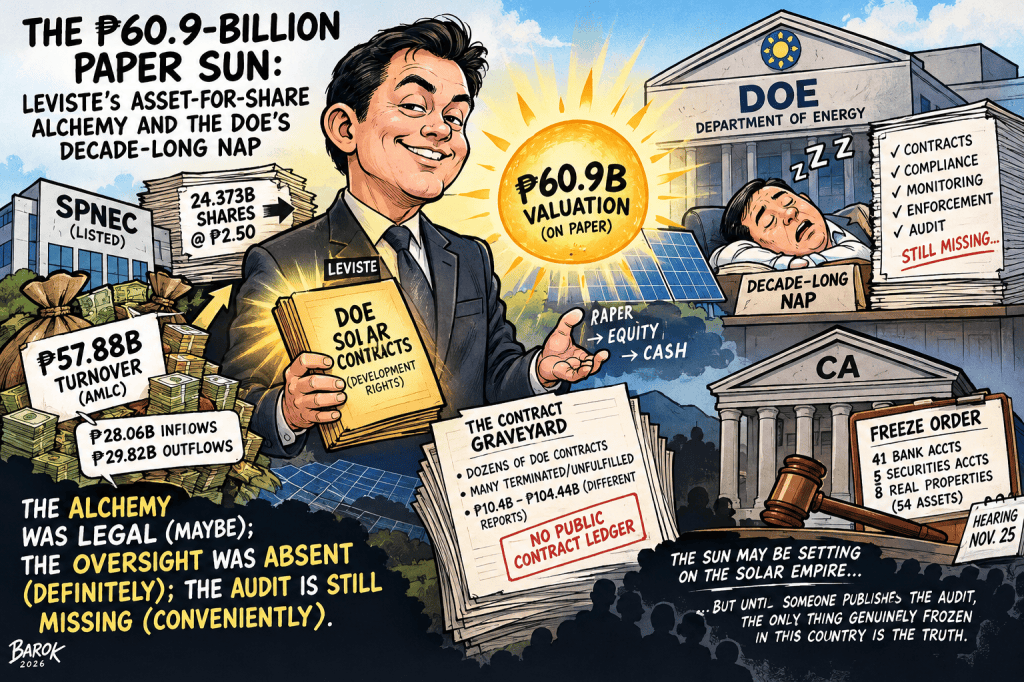
The Alchemy Was Legal (Maybe); The Oversight Was Absent (Definitely); The Audit Is Still Missing (Conveniently)
By Louis ‘Barok‘ C. Biraogo | November 24, 2026
ALLOW me to hold the calculator upright, because the numbers in this scandal have been doing gymnastics all week: ₱57.88 billion is not a pot of money. It is the combined turnover—money in, money out—of accounts linked to Batangas Rep. Leandro Leviste, as traced by the Anti-Money Laundering Council (AMLC) and frozen (for now) by the Court of Appeals (CA).
By Tuesday morning, half of Manila had already spent it. Politiko ran “Power Prodigy Nagpayaman!” Bilyonaryo counted the assets. The Philippine Star ran “freeze” next to “plunder” and let the reader’s imagination do the punching. By noon, the internet had convicted a congressman of being rich.
I decline to join the mob. Not because Leviste is a saint—I don’t know, and neither do you—but because the case rests on a category error my sari-sari store tita could spot: transaction volume is not wealth. A corporation that receives ₱5 billion, buys assets, transfers them for shares, raises equity, and repays loans can generate ₱20 billion in “transactions” while its owner’s net worth is a rounding error. The AMLC’s ₱28.06-billion inflows and ₱29.82-billion outflows are a cash-flow autopsy, not a bank balance. Treating them as stolen loot is like reading a jeepney’s odometer and concluding the driver owns the road.
That is not a defense of Leviste. It is a demand that we read the Excel sheet before we write the plunder complaint.
The Freeze Frame
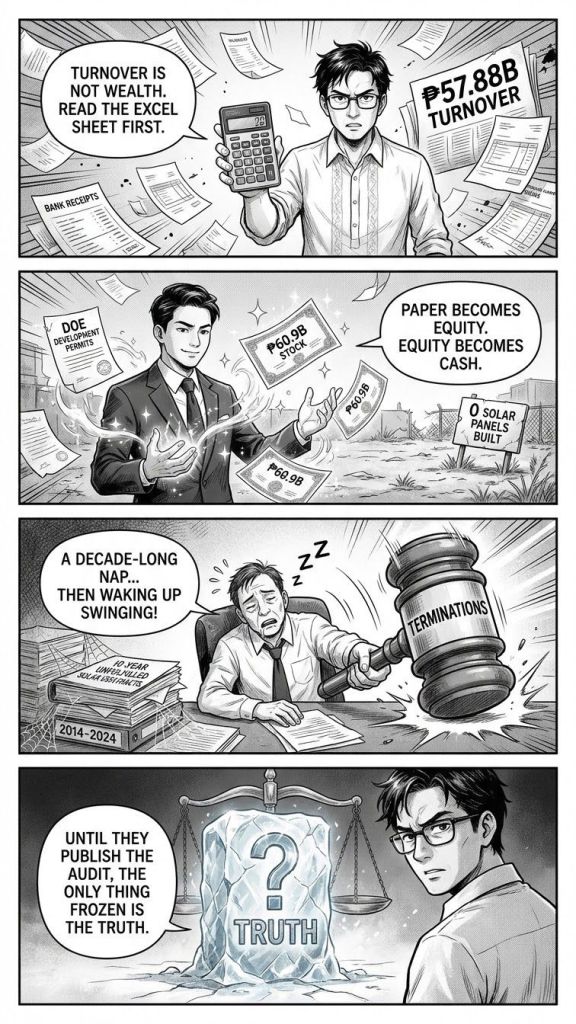
On November 11, the AMLC announced a CA freeze order covering 41 bank accounts, 5 securities accounts, and 8 real properties—54 identified assets, or 46 accounts plus 8 properties depending on which reporter’s arithmetic you trust. The order was initially effective for 20 days, with a summary hearing set for November 25. Under Republic Act No. 9160 (Anti-Money Laundering Act of 2001) as amended by Republic Act No. 11521 (Act Further Strengthening the Anti-Money Laundering Law), the CA can lift, modify, or extend it; the statutory ceiling is generally six months, and if no case is filed within the period the CA sets, the freeze is deemed lifted.
Read that again. Deemed lifted. The freeze is a preservation measure, not a verdict. The CA does not have to find that Leviste committed plunder; it only has to find probable cause that the assets are in some way related to an unlawful activity—the standard in Republic v. Ligot (G.R. No. 176944, 2013) and sharpened in Sema v. Republic (G.R. No. 198083, 2022), where the Court stressed that the asset connection—not the person’s reputation, not his mother’s Senate seat—is the central question. In the Manganip/Powerlink/Codeworks cluster (G.R. Nos. 222312–222315, May 2025), the Court reminded everyone that related accounts cannot simply be swept in; each must be materially linked, independently assessed, and particularly described.
So when the CA froze 46 accounts—including joint accounts—it did not certify that every peso is dirty. The real fight, starting November 25, is about scope, particularity, and proportionality: which account, which transaction, which predicate offense, and why? If the AMLC cannot answer that account by account, the freeze deserves to be trimmed like a balete tree.
The ₱14.99-Billion Check Question
The part that genuinely smells: the AMLC reportedly traced approximately ₱14.99 billion in company checks issued to Leviste personally, ₱447 million in direct company-to-personal transfers, ₱1.12 billion from Leviste to associated companies, and ₱6.25 billion in Leviste-issued checks to related companies. On its face, that is a corporate governance horror show: an owner treating company treasuries like an ATM with a legal department.
But intercompany and shareholder transactions happen for a hundred boring reasons: shareholder loans, capital contributions, repayment of advances, dividends, reimbursements, asset sales, management fees, treasury management, corporate reorganizations. The evidentiary question is not whether money moved—in a corporate group, money moves the way blood moves—but why it moved, who approved it, how it was booked, and whether it was disclosed. Produce the board resolutions, loan agreements, tax declarations, and audited financial statements, and the ₱14.99 billion shrinks to whatever it actually is. Fail to produce them, and you have handed the AMLC a gift.
The defense’s smartest move is a bank-to-bank reconciliation. The dumbest is calling the allegations “baseless” and hoping the hearing goes away.
The 2022 Asset-for-Share Trick
Then there is the transaction that should be the center of the entire inquiry: SP New Energy Corporation’s (SPNEC) 2022 issuance of roughly 24.373 billion shares to Solar Philippines Power Project Holdings, Inc. (SPPPHI) at ₱2.50 apiece—an implied ₱60.9-billion valuation—in exchange for interests in 20 solar project companies.
Stop and admire the alchemy. A developer holds development rights—pieces of paper from the Department of Energy (DOE) saying “you may build solar here, if you get around to it.” Those rights are consolidated into a listed vehicle.
Shares are issued at a price that assumes the rights are worth building. Strategic investors arrive. Shares are sold. The paper becomes equity; the equity becomes cash.
This is not inherently illegal—asset-for-share exchanges are as old as the corporation itself. But it is also the precise mechanism by which a regulatory privilege can be monetized without a single solar panel being bolted to a single roof. If the assets were independently appraised, if the rights were real and mature, if disclosures were complete—fine. If not, then we have a ₱60.9-billion valuation resting on paperwork, and the Securities and Exchange Commission (SEC) should be asking who signed off and on what basis.
The public deserves a valuation audit, not a press release.
The Contract Graveyard
The true scandal—the one that will outlive the freeze order whichever way the CA rules—is the contract record. Reports describe dozens of DOE renewable-energy service contracts awarded to Leviste-linked corporations, many allegedly terminated or unfulfilled, with government obligations variously reported at ₱10.4 billion and ₱104.44 billion depending on which article you read. That discrepancy is not a typo; it is a confession that nobody—not the DOE, not the Ombudsman, not the reporters—has published a reconciled, contract-by-contract schedule of what was awarded, what was built, what was terminated, what is disputed, and what is final and demandable.
And here the DOE’s institutional amnesia becomes the story. If the contracts were problematic for years—if demand letters were going out since 2024, as BusinessMirror reported—then the uncomfortable question is not “Why did Leviste’s companies fail?” It is “Why did the regulator keep awarding contracts to companies it was already chasing for compliance?” The Philippine Star’s January headline—“No Politics in Canceled Contracts of Leviste Firms – DOE”—is either reassuring or damning, depending on whether you believe an agency that cannot produce a coherent liability schedule.
This is where the prosecution’s theory has to do real work. Under Republic Act No. 3019 (Anti-Graft and Corrupt Practices Act), Section 3(e), you need manifest partiality, evident bad faith, or gross inexcusable negligence resulting in undue injury or unwarranted benefit. Under Republic Act No. 7080 (Plunder Law), plunder requires a combination or series of acts amassing at least ₱75 million in ill-gotten wealth through specified means. And as the Supreme Court reminded everyone in Navales v. People (G.R. Nos. 219598 and 220108, August 2024), a procurement violation is not automatically graft; you must prove the elements, the mental state, and the injury.
A failed solar project is not plunder. A terminated contract is not plunder. A big check is not plunder. The government must prove the scheme, not just the mess.
The Mother of All Optics Problems
Then there is Senator Loren Legarda. The Ombudsman has reportedly investigated allegations involving her, Leviste, and former Energy Secretary Alfonso Cusi—conspiracy, preferential contract awards, undeveloped projects. Legarda has denied everything, calling the accusations “utterly false” and noting that no public funds were involved. Fair enough.
A mother-son relationship is not a conspiracy. A legislator’s climate advocacy is not a contract award. Republic Act No. 9513 (Renewable Energy Act of 2008) deliberately invites private capital to take risks; the fact that the son of an environmental champion took those risks is not, by itself, evidence of capture.
But optics have a way of becoming evidence when disclosure records are thin. Under Republic Act No. 6713 (Code of Conduct and Ethical Standards for Public Officials and Employees), Sections 7 and 8, public officials must disclose business and financial interests and avoid prohibited transactions. If there was no intervention, no recusal issue, no undisclosed interest—then produce the chronology.
“Utterly false” is a denial. A documentary timeline is a defense. One of these survives a hearing; the other survives a press cycle.
The Three Scandals, and the One Nobody Wants to Name
This controversy is three scandals wearing one trench coat.
Scandal One: financial opacity. If corporate and personal funds were commingled without documentation, that is a governance catastrophe regardless of whether a single peso came from a government contract.
Scandal Two: contract capture. If exclusive energy rights were warehoused, concentrated, and monetized through corporate structures while the promised electrification never arrived, then the public was deprived twice—once of the electricity, and once of the competition that might have delivered it.
Scandal Three: selective enforcement. Leviste has reportedly compared his treatment to the termination or relinquishment of ACEN’s contracts. The DOE counters that voluntary surrender is not forced termination. Fine—then prove it. Publish the comparative record.
If other developers were given extensions and gentle exits while Leviste’s contracts were terminated with fanfare, the investigation itself becomes a governance scandal. Selective enforcement is not a defense to corruption; it is corruption’s alibi.
What the Numbers Owe the Public
Before anyone repeats a figure, the following must be reconciled: 54 assets versus 46-plus-8; ₱57.88 billion in turnover versus any actual frozen balance; ₱10.4 billion versus ₱104.44 billion in obligations; ₱447 million in direct transfers versus ₱14.99 billion in checks. These are not competing opinions. They are competing facts, and a serious investigation cannot proceed until they are harmonized against the CA resolution, the DOE contract schedules, and the audited financial statements.
The Verdict Before the Verdict
So no, I will not tell you Leandro Leviste is guilty. The freeze order is probable cause, not proof; the turnover is volume, not loot; the terminated contracts are regulatory findings, not criminal convictions. The CA hearing on November 25 is where the AMLC must show its work—account by account, transaction by transaction—or watch the freeze get trimmed.
But I will tell you this: the most damning document in this entire affair may not be an AMLC trace. It may be the DOE’s own contract ledger—the one that shows years of awards to a company it was already chasing, followed by years of silence, followed by a sudden flurry of terminations timed to a congressional investigation. A regulator that sleeps for a decade and then wakes up swinging does not inspire confidence. It inspires subpoenas.
The real question is not whether ₱58 billion moved. Money moves; that is what money does. The real question is whether government privilege moved with it—and whether the institutions that granted that privilege, monitored it, and now prosecute it are capable of telling the difference between entrepreneurship and extraction.
The sun may be setting on the solar empire. But until someone publishes the audit, the only thing genuinely frozen in this country is the truth.
Key Citations
A. Legal & Official Sources
- Anti-Money Laundering Council. “AMLC Secures Freeze Order, Advances Recovery of Assets Linked to Alleged Corruption.” Anti-Money Laundering Council, 11 Nov. 2026, http://www.amlc.gov.ph/news-and-announcements/101-amlc-secures-freeze-order-advances-recovery-of-assets-linked-to-alleged-corruption.
- Republic of the Philippines. Republic Act No. 3019: Anti-Graft and Corrupt Practices Act. 17 Aug. 1960, lawphil.net/statutes/repacts/ra1960/ra_3019_1960.html.
- Republic of the Philippines. Republic Act No. 6713: Code of Conduct and Ethical Standards for Public Officials and Employees. 20 Feb. 1989, officialgazette.gov.ph/1989/02/20/republic-act-no-06713/.
- Republic of the Philippines. Republic Act No. 7080: An Act Defining and Penalizing the Crime of Plunder. 12 July 1991, lawphil.net/statutes/repacts/ra1991/ra_7080_1991.html.
- Republic of the Philippines. Republic Act No. 9160: Anti-Money Laundering Act of 2001, as Amended. 29 Sept. 2001, lawphil.net/statutes/repacts/ra2001/ra_9160_2001.html.
- Republic of the Philippines. Republic Act No. 9513: Renewable Energy Act of 2008. 16 Dec. 2008, lawphil.net/statutes/repacts/ra2008/ra_9513_2008.html.
- Republic of the Philippines. Republic Act No. 11521: An Act Further Strengthening the Anti-Money Laundering Law. 29 Jan. 2021, lawphil.net/statutes/repacts/ra2021/ra_11521_2021.html.
- Republic of the Philippines, Supreme Court. Manganip v. Republic of the Philippines; Powerlink.com Corp. v. Republic of the Philippines; Codeworks.ph, Inc. v. Republic of the Philippines; Omni Security Investigation, Inc., et al. v. Republic of the Philippines. G.R. Nos. 222312–222315, 20 May 2025. Supreme Court E-Library, elibrary.judiciary.gov.ph/thebookshelf/showdocs/1/70172.
- Republic of the Philippines, Supreme Court. Navales v. People of the Philippines. G.R. Nos. 219598 and 220108, 7 Aug. 2024. Supreme Court E-Library, elibrary.judiciary.gov.ph/thebookshelf/showdocs/1/69609.
- Republic of the Philippines, Supreme Court. Republic v. Retired Lt. Gen. Jacinto C. Ligot, et al. G.R. No. 176944, 6 Mar. 2013. Supreme Court E-Library, elibrary.judiciary.gov.ph/thebookshelf/showdocs/1/55737.
- Republic of the Philippines, Supreme Court. Sema v. Republic of the Philippines, Represented by the Anti-Money Laundering Council. G.R. No. 198083, 10 Oct. 2022. Supreme Court E-Library, elibrary.judiciary.gov.ph/thebookshelf/showdocs/1/69280.
- Supreme Court of the Philippines. “SC: Freeze Orders in Money Laundering May Include Related Accounts, Sets Safeguards for Account Holders.” Supreme Court of the Philippines, 2025, sc.judiciary.gov.ph/sc-freeze-orders-in-money-laundering-may-include-related-accounts-sets-safeguards-for-account-holders/.
- Supreme Court of the Philippines. “SC: Violation of Procurement Law Not an Automatic Conviction for Graft.” Supreme Court of the Philippines, 8 Nov. 2024, sc.judiciary.gov.ph/sc-violation-of-procurement-law-not-an-automatic-conviction-for-graft/.
B. News Reports
- Bilyonaryo Business. “From Solar Empire to Frozen Assets: CA Acts on Leviste’s ₱58B Money Trail.” Bilyonaryo.com, 23 Nov. 2026, bilyonaryo.com/from-solar-empire-to-frozen-assets-ca-acts-on-levistes-p58b-money-trail/.
- Bilyonaryo News Channel. “Leviste Defends Solar Deals as Lawful amid Freeze of Assets, Warns Investors Could Suffer.” Bilyonaryo News Channel, bnc.bilyonaryo.com/leviste-defends-solar-deals-as-lawful-amid-freeze-of-assets-warns-investors-could-suffer/news/.
- BusinessMirror. “DOE Firm: We Sent Demand Letters to Leviste since 2024.” BusinessMirror, 22 Sept. 2026, businessmirror.com.ph/2026/09/22/doe-firm-we-sent-demand-letters-to-leviste-since-2024/.
- BusinessMirror. “Ombudsman Sets Probe of Plunder, Graft Complaints vs Levistes, Cusi.” BusinessMirror, 31 July 2026, businessmirror.com.ph/2026/07/31/ombudsman-sets-probe-of-plunder-graft-complaints-vs-levistes-cusi/.
- Malimban, Joash. “Nearly P60B in Bank Transactions: CA Freezes Leviste’s 54 Assets amid AMLC Probe.” Bilyonaryo News Channel, bnc.bilyonaryo.com/nearly-p60b-in-bank-transactions-ca-freezes-levistes-54-assets-amid-amlc-probe/news/.
- Philippine News Agency. “AMLC Secures Another Freeze Order vs Lawmaker over Possible Plunder Case.” Philippine News Agency, 12 Nov. 2026, http://www.pna.gov.ph/article/amlc-secures-another-freeze-order-vs-lawmaker-over-possible-plunder-case.
- Philippine Star. “AMLC Gets CA Asset Freeze Order Covering Lawmaker, Ex-Official.” Philstar.com, 13 Nov. 2026, http://www.philstar.com/headlines/2026/11/13/2569838/amlc-gets-ca-asset-freeze-order-covering-lawmaker-ex-official.
- Philippine Star. “Legarda, Son Face Probe over P10 Billion Solar Franchise.” Philstar.com, 1 Aug. 2026, http://www.philstar.com/headlines/2026/08/01/2546158/legarda-son-face-probe-over-p10-billion-solar-franchise/.
- Philippine Star. “Leviste Faces Raps for Solar Business Violations.” Philstar.com, 8 May 2026, http://www.philstar.com/headlines/2026/05/08/2526443/leviste-faces-raps-solar-business-violations.
- Philippine Star. “No Politics in Canceled Contracts of Leviste Firms – DOE.” Philstar.com, 16 Jan. 2026, http://www.philstar.com/headlines/2026/01/16/2501289/no-politics-canceled-contracts-leviste-firms-doe.
- Philippine Star. “Ombudsman to Seek Plunder, Graft Charges vs Leviste, Legarda over Solar Deals.” Philstar.com, 31 July 2026, http://www.philstar.com/headlines/2026/07/31/2546062/ombudsman-graft-plunder-charges-vs-leviste-now-under-investigation/.
- Philippine Star. “‘Utterly False’: Loren Legarda Denies Ombudsman Solar Contract Allegations.” Philstar.com, 31 July 2026, http://www.philstar.com/headlines/2026/07/31/2546117/utterly-false-loren-legarda-denies-ombudsman-solar-contract-allegations/.
- Politiko. “Power Prodigy Nagpayaman! CA Freezes Leandro Leviste’s Accounts as AMLC Traces ₱58B in Transactions.” Politiko, 23 Nov. 2026, politiko.com.ph/power-prodigy-nagpayaman-ca-freezes-leandro-levistes-accounts-as-amlc-traces-p58b-in-transactions/.
Louis “Barok” C. Biraogo is the proprietor of Kweba ni Barok. He accepts no campaign contributions, no retainers, and no invitations to solar-plant groundbreakings—though he will accept a receipt, notarized, for every peso.

- ₱9 Billion in ‘Savings’? DILG’s Fire Truck Deal Smells Like Smoke

- ₱8B BBM Pork: CCTV for Every Captain’s Kumpare?

- ₱8.9 Billion, 331 Ghost Police Stations: The TIKAS Scandal Explained

- ₱8.4 Billion, 42,000 Barangays, 1 Election: The “Bawat Barangay Makikinabang” Vote-Buying Masterclass

- ₱75 Million Heist: Cops Gone Full Bandit

- ₱63 to the Dollar: The Only Thing Falling Faster Than the Peso Is the Government’s Credibility

- ₱6.77B Ghost Haunts Duterte: RTC Dismisses Mans Carpio’s Desperate Plea
- ₱6.77 Billion and Zero Cash: The Sara Duterte SALN Math That Doesn’t Add Up

- ₱6.7-Trillion Temptation: The Great Pork Zombie Revival and the “Collegial” Vote-Buying Circus

- ₱58.53B, Zero Receipts: The LGSF Pork Barrel Nobody Wants to Name
- ₱53 Million Man Tells ₱695-a-Day Workers to Stop Being ‘Mayabang’: The Audacity of BSP’s Remolona

- ₱491-M Right-of-Way Scam: DPWH Paid for Ghost Land, Ombudsman Finally Notices






Leave a Reply