A Record Low, a Corruption Scandal, and a Central Bank Governor Who Called It ‘Okay
By Louis ‘Barok’ C Biraogo | October 21, 2026
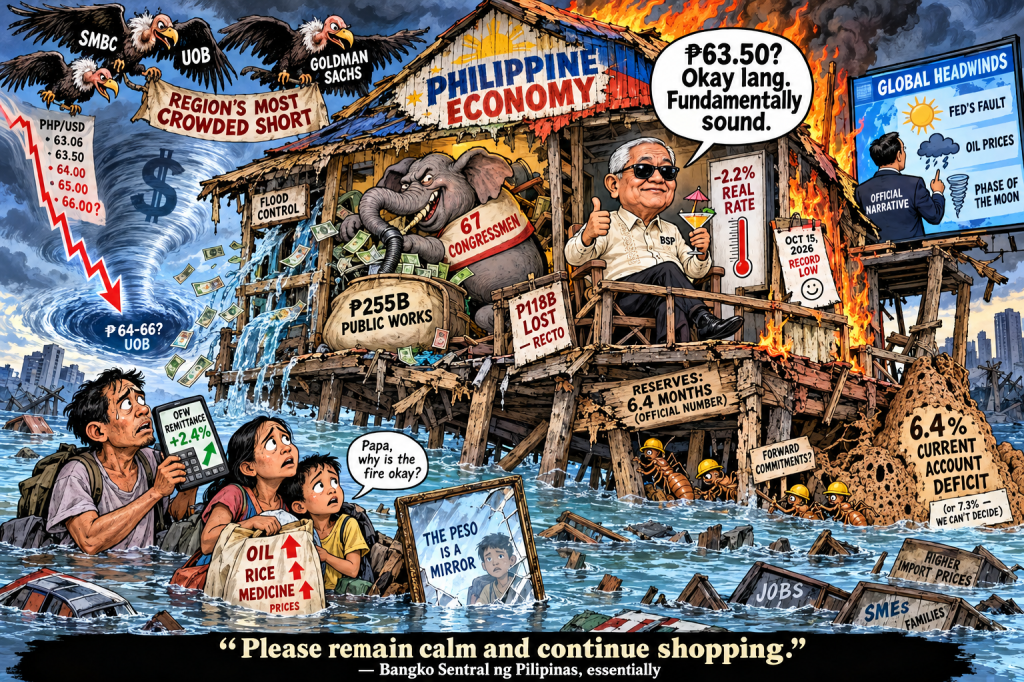
SOMETHING curious happened on October 15, 2026. The Philippine peso slid to ₱63.06 against the dollar—a record low—and the guardians of our economic destiny responded with the studied calm of homeowners watching their foundation crack while insisting the house is “fundamentally sound.”
The Bangko Sentral ng Pilipinas (BSP) tells us not to panic. The peso’s weakness, they suggest, reflects “global headwinds”—that convenient euphemism for everything from Federal Reserve tightening to oil prices to the phase of the moon. It is never, ever about us.
It is never about the ₱255 billion sliced from the public works budget because lawmakers apparently confused infrastructure funding with their personal ATM. It is never about the 67 congressmen who allegedly served as contractors for their own state-funded projects—a scheme so brazen it would make a kleptocrat blush. It is never about the fact that our real policy rate is negative—meaning investors lose money holding peso assets—while the Federal Reserve sits at 5.50% and counting.
No, dear reader. The peso’s plunge is a force majeure. An act of God. An unfortunate meteorological event in the global financial atmosphere. Please remain calm and continue shopping.
The Corruption Variable Nobody Wants to Solve For
Let us begin with the elephant in the room—or rather, the elephant that was the room. The flood control corruption scandal of 2025-2026 is not a footnote to this currency crisis. It is the prologue.
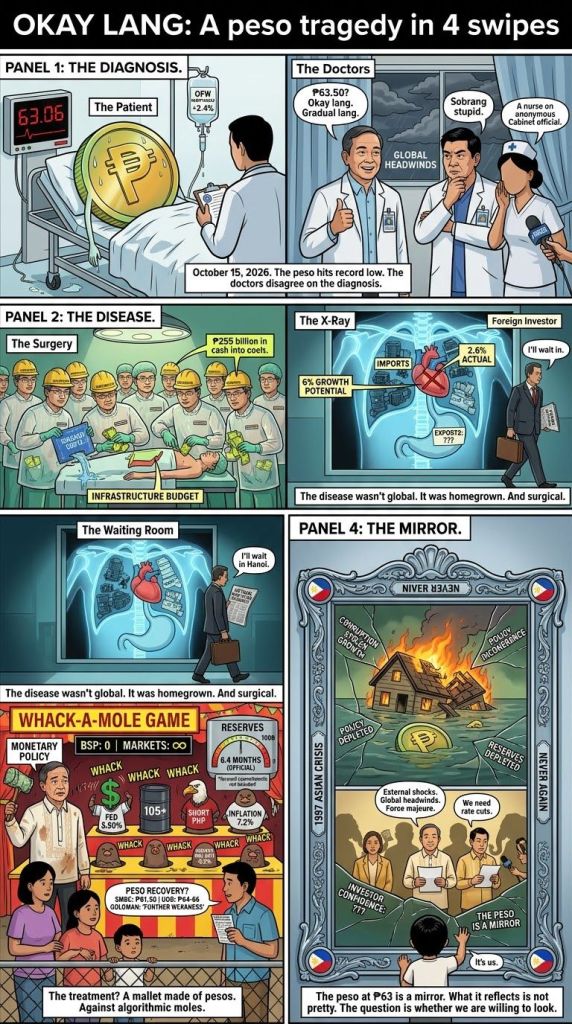
Finance Secretary Ralph Recto himself admitted that without corruption, the economy might have grown by 6-6.2% instead of the actual 2.6% in the first half of 2026. Let that sink in. Corruption didn’t just steal money; it stole growth.
It stole the foreign investment that never arrived because investors looked at ₱118.5 billion in annual infrastructure losses and decided to park their capital in Vietnam instead. It stole the jobs that never materialized. It stole the productivity that would have earned the dollars now desperately needed to defend the peso.
And yet, the official narrative treats the corruption scandal and the currency crisis as separate news stories. One is a “political issue.” The other is an “economic challenge.” This is like treating a gunshot wound and the resulting blood loss as unrelated medical conditions.
The 6.4% current account deficit—or 7.3% depending on which official data series you consult, because apparently even our statistics have commitment issues—did not emerge from nowhere. It emerged from an economy that cannot generate enough foreign exchange because its productive capacity has been systematically looted.
The trade deficit widened to $34.7 billion in the first half of 2026 because we import oil, machinery, and electronics components while exporting… what, exactly? Our best and brightest workers, who send home remittances that mask the underlying rot.
The Governor’s “Sobrang Stupid” Moment
Then there is the curious case of BSP Governor Eli Remolona Jr., who in May 2026 suggested that ₱63.50 to the dollar would be “okay” if the depreciation were gradual. An anonymous senior Cabinet official reportedly called the remark “sobrang stupid”—which, while diplomatically undiplomatic, was not entirely wrong.
Consider what the Governor was saying: that a weaker peso is fine because it helps exports. This is the economic equivalent of arguing that a house fire is fine because it provides free heating.
Yes, a weaker currency makes exports cheaper. It also makes imports more expensive—including the oil that powers our economy, the food that feeds our people, and the raw materials that our factories need to produce those exports in the first place.
The Governor’s remark was not merely a gaffe. It was a signal—to markets, to investors, to every hedge fund manager looking for the next “most crowded short”—that the central bank would not aggressively defend the currency. The peso duly obliged, sliding toward the Governor’s apparently acceptable threshold.
The BSP then raised rates to 5.0% in September, but with inflation at 7.2%, the real rate remains at approximately negative 2.2%. Investors are being asked to hold peso assets that lose purchasing power while dollar assets yield positive real returns. This is not a recipe for capital inflow. It is a recipe for capital flight, garnished with a side of accelerated depreciation.
The Impossible Trinity Becomes the Impossible Quadrilateral
Textbook economics tells us about the “impossible trinity”—a country cannot simultaneously maintain a fixed exchange rate, free capital movement, and independent monetary policy. The Philippines has managed to add a fourth impossibility: maintaining investor confidence while running a corruption-riddled government that cannot execute infrastructure projects without losing billions to graft.
The BSP faces an unenviable choice:
- Raise rates further to defend the peso? That crushes growth already languishing at 2.6% and makes debt servicing more expensive for a government that posted a record ₱1.58 trillion budget deficit in 2025.
- Cut rates to stimulate growth? That accelerates capital flight and sends the peso into freefall.
- Intervene in foreign exchange markets? Gross international reserves have already fallen from 9 months of import cover to 6.4 months—and that’s using the official numbers, which may not capture the full extent of forward commitments and valuation losses.
The central bank is playing whack-a-mole with a mallet made of peso-denominated bonds while the moles are dollar-denominated and moving at algorithmic speed. It is not a fair fight.
The “Most Crowded Short” and Other Market Realities
Sumitomo Mitsui Banking Corporation (SMBC) noted that the peso is “the region’s most crowded short on dollar and oil costs.” Translation: everyone and their hedge fund manager is betting against the Philippine currency. This is not a conspiracy. It is a consensus.
When the real interest rate is negative, when the current account deficit is widening, when foreign direct investment (FDI) is declining, when corruption has gutted public investment, and when the central bank governor casually suggests that further depreciation is acceptable—what exactly would you expect sophisticated investors to do? Buy peso-denominated assets out of patriotic solidarity?
The government’s response has been to blame external factors: Federal Reserve tightening, oil prices above $105 per barrel, geopolitical tensions. All of these are real. None of them are unique to the Philippines.
Indonesia faces the same Fed. Thailand faces the same oil prices. Yet the peso has depreciated 6.3% year-to-date, among Asia’s worst performers. The common denominator is not global conditions. It is domestic vulnerability.
The Remittance Trap
Overseas Filipino Workers (OFWs) sent home $19.1 billion in the first half of 2026, a 2.4% increase. Government officials cite this as evidence of resilience. But remittances are not a development strategy; they are a coping mechanism.
They mask the absence of productive investment, the failure to create competitive export industries, the inability to generate sufficient foreign exchange through legitimate economic activity.
And here is the uncomfortable arithmetic: a weaker peso means OFW families get more pesos per dollar. But it also means the imported food, fuel, and medicines they buy cost more pesos.
The net benefit is illusory—a short-term nominal gain offset by real purchasing power losses. The government celebrates remittances while ignoring that they represent the export of human capital that could have built domestic industries.
The Scenarios Nobody Wants to Discuss
The official forecasts project stabilization. SMBC suggests the peso could recover to ₱61.50-62.00. United Overseas Bank (UOB) warns of ₱64-66.
Goldman Sachs offers “further weakness” without a number, which is the analytical equivalent of a doctor saying “you might get sicker” without specifying the disease.
But the scenarios that matter are the ones not being modeled. What happens if oil prices spike to $120? What happens if the Fed raises rates two more times? What happens if foreign portfolio investors—already net sellers—accelerate their exit?
What happens if reserves fall below the psychological threshold of $100 billion and markets realize that the BSP’s intervention capacity is more limited than advertised?
The official response is that reserves remain adequate, that external debt is manageable, that the banking system is stable. All of these may be true in isolation. But they interact in ways that stress tests may not capture.
A currency crisis is not a linear event; it is a phase transition. Markets can be calm for months and then panic in hours. The conditions for panic—negative real rates, rising external debt, depleted reserves, policy incoherence—are already present. What is missing is the trigger.
The Political Economy of Denial
Why does the government downplay the crisis? Because admitting its severity would require admitting culpability. The corruption scandal that gutted public investment is not an external shock; it is a self-inflicted wound.
The policy incoherence—the Finance Secretary wanting rate cuts while the BSP Governor tightens—is not a global phenomenon; it is a failure of coordination. The decision to allow the peso to depreciate rather than defend it reflects not strategic wisdom but fiscal exhaustion: the government cannot afford the high interest rates that defending the currency would require.
So the narrative becomes: external forces beyond our control. Global headwinds. The Fed’s fault. Oil’s fault. Anything but us.
This is not unique to the Philippines, of course. Every government facing a currency crisis blames exogenous factors. But the credibility of that narrative depends on the government’s track record.
When you have just been exposed for losing billions to corruption, when your infrastructure program is in shambles, when your economic team is publicly feuding—you lose the benefit of the doubt. Markets do not believe your reassurances because they have seen how you handle public funds.
What Would an Honest Response Look Like?
It would start with acknowledgment. The peso’s weakness is not merely a global phenomenon; it reflects domestic vulnerabilities. The corruption scandal is not a political distraction; it is an economic catastrophe that has direct consequences for the currency. The policy incoherence is not a minor disagreement; it is a signal to markets that the government does not have a coherent strategy.
It would continue with accountability. The officials responsible for the corruption scandal should face consequences—not the theatrical hearings and selective prosecutions that characterize Philippine politics, but genuine accountability. The economic team should present a unified front rather than leaking anonymous insults to the press. The BSP should communicate a clear reaction function rather than casually accepting further depreciation.
It would culminate in structural reform. Energy diversification to reduce oil import dependence. Export competitiveness strategies that go beyond cheap labor. Investment climate reforms that address the regulatory uncertainty and infrastructure deficits that deter FDI. Fiscal consolidation that does not sacrifice productive spending but eliminates waste and corruption.
The Warning We Are Ignoring
The peso at ₱63 is not a crisis. It is a warning. It is the market’s way of saying: we are losing confidence in your ability to manage your economy.
The warning can be heeded—through credible reforms, through genuine accountability, through policies that address root causes rather than symptoms. Or it can be ignored—through reassuring statements, blame-shifting, and the hope that external conditions will improve before domestic vulnerabilities become catastrophic.
The BSP Governor warned in October 2026 about the risk of another Asian financial crisis. This is rich coming from someone whose own policies have contributed to the current vulnerability. But the warning is not wrong.
The 1997 crisis was triggered by currency depreciation interacting with excessive foreign-currency borrowing, short-term funding dependence, and weak financial institutions. The Philippines today has lower foreign-currency debt than in 1997, stronger banking supervision, and larger reserves.
But it also has something the 1997 crisis did not: a government whose economic managers are publicly feuding, whose corruption scandal has gutted public investment, and whose central bank governor has signaled that further depreciation is acceptable.
The warning is real. The question is whether anyone in power is listening—or whether they are too busy managing perceptions to manage the economy.
The Bottom Line
The Philippine peso’s descent to ₱63 is a symptom of a deeper disease. It is not a disease that can be cured by waiting for the Fed to pivot or oil prices to fall. It is a disease of corruption, policy incoherence, and structural weakness that has been allowed to fester for years.
The government’s response has been to deny, deflect, and delay. This is not a strategy; it is a hope. And hope is not a policy instrument—especially when markets are already pricing in the consequences of your failures.
The peso may stabilize. It may even recover. But unless the underlying causes are addressed—the corruption, the policy incoherence, the structural vulnerabilities—the next crisis is already being scheduled. The only question is when, not if.
And when it comes, the official statements will tell us once again that it is not our fault. It is global headwinds. It is external shocks. It is anything but the choices we made and the accountability we avoided.
The peso at ₱63 is a mirror. What it reflects is not pretty. The question is whether we are willing to look.
Louis ‘Barok’ C Biraogo is the author of the Kweba ni Barok blog, where he writes about Philippine politics, economics, and the intersection of the two. He has been described as “excessively critical” by people who prefer their journalism pre-approved.
Key Citations
A. Reports & Studies
- Bangko Sentral ng Pilipinas. “BSP Forecasts BOP Deficit for 2026, 2027.” Philippine Information Agency, 13 Oct. 2026, pia.gov.ph/news/bsp-forecasts-bop-deficit-for-2026-2027/.
- Bangko Sentral ng Pilipinas. Media Release on Target Reverse Repurchase Rate. Bangko Sentral ng Pilipinas, 25 Sept. 2026, www.bsp.gov.ph.
- Department of Economy, Planning, and Development. “Gov’t Steps Up Supply-Side Measures Amid Inflation Uptick.” DEPDev, 6 Oct. 2026, depdev.gov.ph/september2026inflation/.
- “Accountability Washed Away in Philippine Flood Control Corruption.” East Asia Forum, 2 Dec. 2025, eastasiaforum.org/2025/12/02/accountability-washed-away-in-philippine-flood-control-corruption/.
B. News Articles
- “Dollar Reserves Fall Below $100 Billion.” BusinessWorld Online, 8 Oct. 2026, bworldonline.com/top-stories/2026/10/08/785626/dollar-reserves-fall-below-100-billion/.
- “H1 Current Account Gap Up 51.7% to $15.4B.” BusinessMirror, 14 Sept. 2026, businessmirror.com.ph/2026/09/14/h1-current-account-gap-up-51-7-to-15-4b/.
- “P118B Lost to Flood Control Anomalies – Recto.” Daily Tribune, 16 Oct. 2025, tribune.net.ph/2025/10/16/p118b-lost-to-flood-control-anomalies-recto.
- “Peso Could Slide to ₱66:$1 in 2027 as US Fed Tightening Boosts Dollar—UOB.” Manila Bulletin, 28 Sept. 2026, mb.com.ph/2026/09/28/peso-could-slide-to-661-in-2027-as-us-fed-tightening-boosts-dollaruob.
- “Peso Weakness Seen Persisting as Foreign Inflows Fade, US Dollar Strengthens.” Manila Bulletin, 19 Oct. 2026, mb.com.ph/2026/10/19/peso-weakness-seen-persisting-as-foreign-inflows-fade-us-dollar-strengthens.
- “Philippine Peso at 63.5 Per Dollar Might Be Okay, Governor Says.” Bloomberg, 22 May 2026, bloomberg.com/news/articles/2026-05-22/usd-php-philippine-peso-at-63-5-per-dollar-might-be-okay-governor-says.
- “PSEi Recovers, Peso Dips to Record-Low Due to Geopolitical Risks.” Philippine News Agency, 15 Oct. 2026, pna.gov.ph/article/psei-recovers-peso-dips-to-record-low-due-to-geopolitical-risks.
- “‘Sobrang Stupid’: Cabinet Exec Slams Remolona for Remarks Suggesting BSP Okay with Peso Sliding to 63.50 vs Dollar.” Bilyonaryo, bilyonaryo.com/sobrang-stupid-cabinet-exec-slams-remolona-for-remarks-suggesting-bsp-okay-with-peso-sliding-to-63-50-vs-dollar/.
C. Official Websites & Reference Sources
- Bangko Sentral ng Pilipinas. www.bsp.gov.ph.
- Board of Governors of the Federal Reserve System. www.federalreserve.gov.
- Goldman Sachs. www.goldmansachs.com.
- Sumitomo Mitsui Financial Group. www.smfg.co.jp/english.
- United Overseas Bank. www.uob.com.sg.
- “Asian Financial Crisis.” Encyclopaedia Britannica, www.britannica.com/event/Asian-financial-crisis.
- “Force Majeure.” Investopedia, www.investopedia.com/terms/f/forcemajeure.asp.
- “Trilemma.” Investopedia, www.investopedia.com/terms/t/trilemma.asp.



Leave a Reply