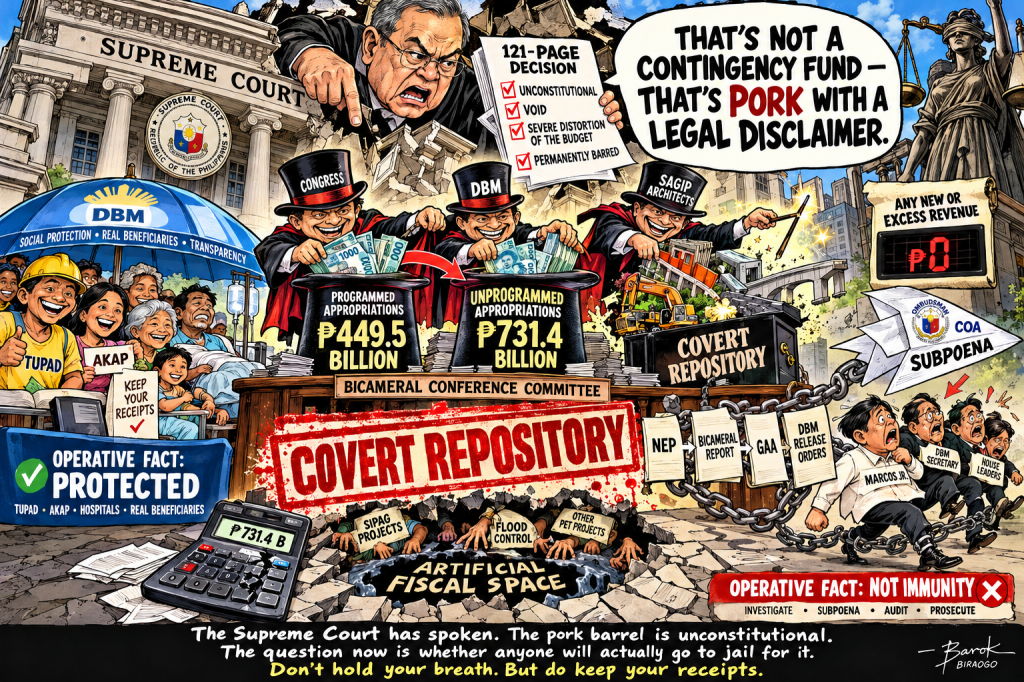
The High Court Just Declared Your ‘Unprogrammed Appropriations’ a Slush Fund With a Legal Disclaimer
By Louis ‘Barok’ C. Biraogo — October 21, 2026
MGA ka-kweba, gather ’round. Bring your calculators, your reading glasses, and a strong stomach—because the Supreme Court just dropped a 121-page judicial bomb on the Philippine budget process, and the blast radius is measured in hundreds of billions of pesos that nobody can fully account for.
On October 20, 2026, the High Court finally confirmed what fiscal watchdogs have been screaming into the void for years: Congress cannot simply conjure spending authority out of thin air by relabeling pork as “unprogrammed appropriations.” The Court declared Republic Act No. 11975 (2024 General Appropriations Act) and Republic Act No. 12116 (2025 General Appropriations Act) unconstitutional, voided key provisions of the 2026 budget, and—in a deliciously bureaucratic phrase that should terrify every official who touched these funds—ruled that the doctrine of operative fact “does not automatically shield those who authored, proposed or implemented the invalid provisions.”
Translation for the non-lawyers: the money may be gone, but the liability is just getting started.
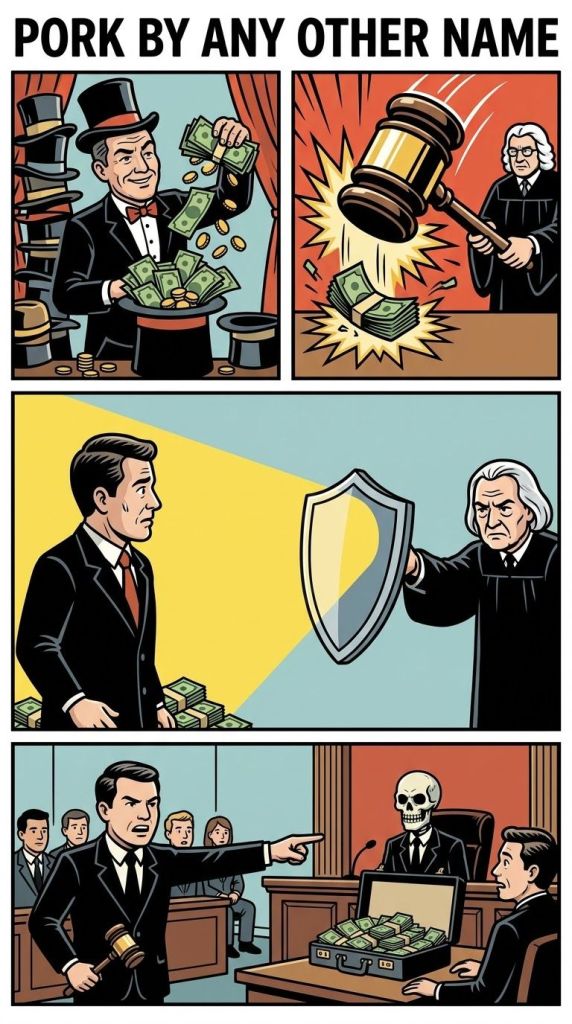
The Numbers Behind the “Contingent” Disguise
Let’s start with the numbers, because the numbers are obscene. The President proposed ₱281.9 billion in unprogrammed appropriations for 2024. Congress, through the magical black box known as the Bicameral Conference Committee, inflated that to ₱731.4 billion. That’s a ₱449.5 billion increase—executed through “transfers of programs, activities and projects from programmed to unprogrammed appropriations.”
In plain English: they took money that was supposed to go to specific, identifiable projects, moved it into a slush fund, and then used the resulting “fiscal space” to insert their own priorities.
The Supreme Court called this what it was: a “severe distortion” of the budget that “created artificial fiscal space in the programmed appropriations.” The beneficiaries of this fiscal sleight-of-hand? A familiar roll call of congressional favorites: the Department of Public Works and Highways’ (DPWH) basic infrastructure programs, the Sustainable Infrastructure Projects Alleviating Gap (SIPAG), the Department of Health’s (DOH) medical assistance to indigents, Department of Social Welfare and Development’s (DSWD) Ayuda sa Kapos ang Kita Program (AKAP), and Department of Labor and Employment’s (DOLE) Tulong Panghanapbuhay sa Ating Disadvantaged or Displaced Workers Program (TUPAD). These are the programs that generate the most photo opportunities, the most ribbon-cuttings, and the most grateful constituents. Funny how that works.
SAGIP: The “Covert Repository”
But the real star of this judicial horror show is SAGIP—the Strengthening Assistance for Government Infrastructure and Social Programs. The Court found that SAGIP was a “prohibited lump sum appropriation” because it gave the Executive “post-enactment identification/allocative powers” that properly belong to Congress. In language that should be carved into the wall of every legislator’s office, the Court said SAGIP “became the covert repository of lump sum allocations for DPWH infrastructure like flood control projects.”
Covert repository. Let that sink in. The Supreme Court of the Philippines, the final arbiter of constitutional truth, used the phrase “covert repository” to describe how public money was being handled. If that doesn’t make you want to check your tax withholding, nothing will.
Now, the Court was careful to note that unprogrammed appropriations are not unconstitutional per se. They can serve legitimate purposes—foreign-assisted projects, unforeseen contingencies, and the like. But the Court laid down four conditions that must be met:
- no lump sums,
- clear differentiation between new income for programmed versus unprogrammed spending,
- sufficient prioritization standards, and
- consistency with the national fiscal program.
These are not optional suggestions. They are constitutional requirements. And the fact that they had to be spelled out in such detail tells you everything you need to know about how the previous budgets were constructed.
The 2026 Provisions and the Bicameral Black Box
The 2026 provisions were even more brazen. Special Provisions 1(a) and (b) of Chapter XLIII allowed unprogrammed funds to be released based on “any new or excess revenue” without requiring that the government actually hit its overall revenue target. The Court called this “overly broad,” lacking prioritization standards, and—once again—“partly functioned as prohibited lump sum appropriations.” The Senate, House, Executive Secretary, and Department of Budget and Management (DBM) Acting Secretary are now permanently barred from implementing these provisions. Permanently. As in, don’t even think about it.
Here’s where the satire writes itself. The Bicameral Conference Committee—that august body of legislative reconciliation—was criticized by the Court for having “no records” of its discussions and for producing a report that “did not explain the increases and decreases in budget items.” The committee also “did not submit any documents supporting the changes in the budget.” This is not a clerical oversight. This is a system designed to leave no fingerprints.
The Court noted that this violates the rules of both the House and the Senate. So the very body tasked with reconciling the people’s budget was operating in a manner that made accountability structurally impossible. How convenient.
Operative Fact, Not Immunity
But here’s the plot twist even the petitioners didn’t see coming: the Court didn’t nuke the whole budget—it just handed out immunity cards to the beneficiaries and subpoenas to everyone else. The doctrine of operative fact applies to the 2024 and 2025 budgets, meaning that “irreversible programs whose beneficiaries acted in good faith” retain their effects. Hospitals that received medical assistance funds, workers who received TUPAD wages, communities that benefited from completed infrastructure—these are protected. The Court is not asking the poor to return the ayuda they received because Congress played games with the budget.
But the authors, proponents, and implementors? They get no such blanket protection. The Court explicitly stated that the operative fact doctrine “does not automatically shield those who authored, proposed or implemented the invalid provisions from criminal, civil or administrative liability.” Good faith must be “determined by the proper tribunals.”
This is an invitation—a judicial summons, really—to the Ombudsman and the Commission on Audit (COA) to start digging. The Supreme Court has handed them a map, a flashlight, and a legal mandate. What they do with it will determine whether this ruling becomes a genuine reckoning or just another press release.
The political implications are as delicious as they are dangerous. President Marcos Jr. signed these budgets. His DBM implemented these releases. His allies in the House and Senate crafted these provisions. The Court’s ruling does not name names, but it doesn’t have to. The documentary trail from the National Expenditure Program (NEP) to the bicameral report to the enacted General Appropriations Act (GAA) to the DBM release orders is a chain of custody for accountability. If the Ombudsman wants to investigate, the evidence is sitting in filing cabinets and server rooms across Metro Manila.
Meanwhile, the petitioners—Lagman (posthumously vindicated), Pimentel, Erice, de Lima, and the civil society groups—have won a victory that is both sweeping and incomplete. The budgets are unconstitutional, but the money has largely been spent. The provisions are void, but the officials who crafted them are still in office. The Court has drawn a line in the sand, but the tide of impunity has been rising for decades. One decision, no matter how emphatic, cannot reverse that alone.
What Happens Next
So what happens next? Congress must pass a 2027 budget that complies with these new standards. The DBM must submit an NEP that respects the constitutional ceiling. The bicameral committee must keep records, explain its changes, and limit itself to actual disagreements between the chambers. And the Ombudsman must decide whether “covert repository” is a phrase that warrants criminal investigation or merely a stern lecture.
Mga ka-kweba, the Supreme Court has done its job. It has told the truth about what happened to our money. It has named the mechanisms—the transfers, the lump sums, the covert repositories, the undocumented bicameral magic—that allowed billions to flow into discretionary pools with minimal oversight. It has preserved the safety net for the innocent while leaving the guilty to twist in the wind of future prosecutions.
But a ruling is not a recovery. A declaration is not a conviction. The Court has opened a door. Whether anyone walks through it—whether the Ombudsman investigates, whether COA disallows, whether prosecutors file cases, whether voters remember—is now a political question, not a legal one. And in this country, political questions have a way of being answered by the same people who created the problem in the first place.
The Supreme Court has spoken. The pork barrel is unconstitutional. The question now is whether anyone will actually go to jail for it.
Don’t hold your breath. But do keep your receipts.
Key Citations
A. Legal & Official Sources
- The 1987 Constitution of the Republic of the Philippines. Official Gazette of the Republic of the Philippines, 1987, http://www.officialgazette.gov.ph/constitutions/1987-constitution/.
- Republic Act No. 11975. An Act Appropriating Funds for the Operation of the Government of the Republic of the Philippines from January One to December Thirty One, Two Thousand and Twenty Four. 2023, Department of Budget and Management, https://www.google.com/url?opi=89978449&q=https://www.dbm.gov.ph/index.php/2024/general-appropriations-act-gaa-fy-2024&sa=U&ved=2ahUKEwjao6zw3cmXAxXG3TgGHS0CK_wQFnoECA4QAQ&usg=AOvVaw3K0sxwCoNgBSs4BLPTVG2o.
- Republic Act No. 12116. An Act Appropriating Funds for the Operation of the Government of the Republic of the Philippines from January 1 to December 31, 2025. 2024, Department of Budget and Management, http://www.dbm.gov.ph/index.php/2025/general-appropriations-act-gaa-fy-2025.
- 2026 People’s Enacted Budget: Agenda for Prosperity: Nurturing Future-Ready Generations to Achieve the Full Potential of the Nation. Department of Budget and Management, Mar. 2026, https://www.dbm.gov.ph/wp-content/uploads/Our%20Budget/2026/2026-People’s-Enacted-Budget.pdf.
- Lagman v. Congress of the Philippines. G.R. Nos. 271059, 271347, E-02472, and E-04036, Supreme Court of the Philippines, 2026, sc.judiciary.gov.ph/g-r-no-271059-g-r-no-271347-g-r-no-e-02472-g-r-no-e-04036/.
B. News Reports
- Bolledo, Jairo “Supreme Court Declares 2024-2025 Budgets Unconstitutional.” Rappler, https://www.rappler.com/philippines/supreme-court-declares-2024-2025-budgets-unconstitutional/.
- Murcia, Alvin. “High Court Voids Spending Hikes.” Daily Tribune, 21 Oct. 2026, tribune.net.ph/2026/10/20/high-court-voids-spending-hikes.
- Ong, Ghio. “SC Declares 2024, 2025 Budgets Unconstitutional.” Philstar.com, The Philippine Star, 21 Oct. 2026, http://www.philstar.com/headlines/2026/10/21/2564745/sc-declares-2024-2025-budgets-unconstitutional.
- Torres-Tupas, Tetch. “SC: Congress Can’t Bloat President’s Budget.” INQUIRER.net, 21 Oct. 2026, newsinfo.inquirer.net/2327363/sc-congress-cant-bloat-presidents-budget.

- ₱9 Billion in ‘Savings’? DILG’s Fire Truck Deal Smells Like Smoke
- ₱8B BBM Pork: CCTV for Every Captain’s Kumpare?
- ₱8.9 Billion, 331 Ghost Police Stations: The TIKAS Scandal Explained

- ₱8.4 Billion, 42,000 Barangays, 1 Election: The “Bawat Barangay Makikinabang” Vote-Buying Masterclass
- ₱75 Million Heist: Cops Gone Full Bandit

- ₱63 to the Dollar: The Only Thing Falling Faster Than the Peso Is the Government’s Credibility
- ₱6.77B Ghost Haunts Duterte: RTC Dismisses Mans Carpio’s Desperate Plea
- ₱6.77 Billion and Zero Cash: The Sara Duterte SALN Math That Doesn’t Add Up

- ₱6.7-Trillion Temptation: The Great Pork Zombie Revival and the “Collegial” Vote-Buying Circus

- ₱58.53B, Zero Receipts: The LGSF Pork Barrel Nobody Wants to Name
- ₱53 Million Man Tells ₱695-a-Day Workers to Stop Being ‘Mayabang’: The Audacity of BSP’s Remolona
- ₱4.4 Billion and a Witness Who Can’t Explain It: The Duterte Impeachment’s Most Expensive Non-Answer



Leave a Reply