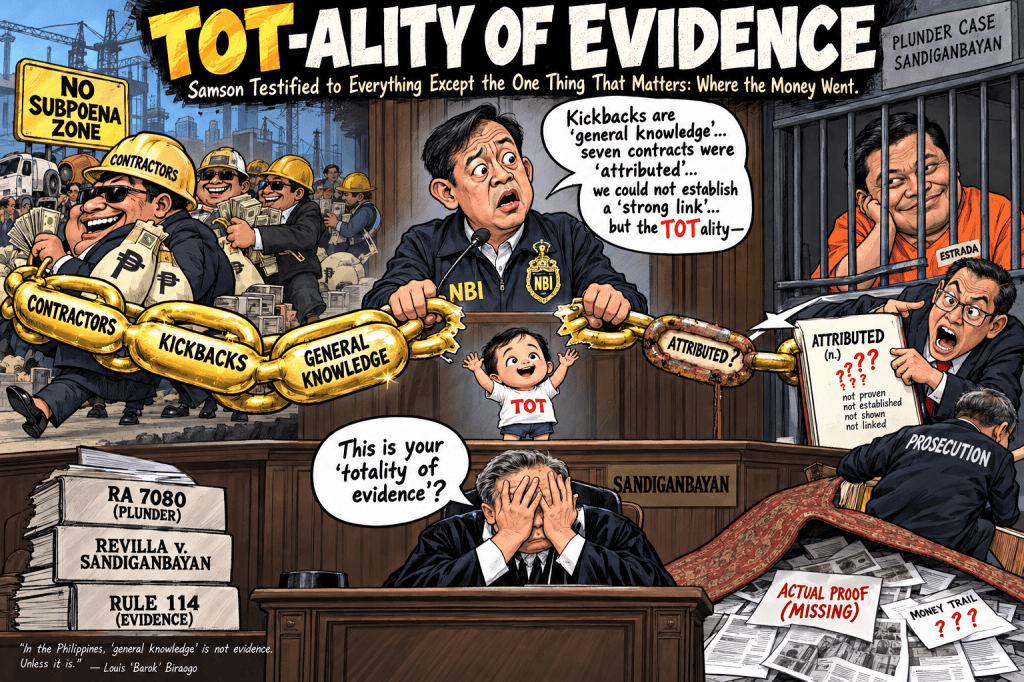
Samson Testified to Everything Except the One Thing That Matters: Where the Money Went
By Louis ‘Barok’ C Biraogo | October 21, 2026
THE Philippine anti-corruption establishment has a new legal theory, and it is breathtaking in its audacity. It goes something like this: Everyone knows kickbacks are standard. Therefore, a senator must have received them. Therefore, he should stay in jail.
This is not a parody. This is the actual state of the prosecution’s case against Senator Jinggoy Estrada, as revealed by the testimony of National Bureau of Investigation (NBI) Investigative Agent III Ivan Bernard Samson before the Sandiganbayan Fifth Division on October 20, 2026. Samson, the prosecution’s very first witness in a bail hearing that will determine whether Estrada remains detained at the New Quezon City Jail, delivered what can only be described as a masterclass in testifying to nothing while appearing to testify to everything.
What Samson Actually Said
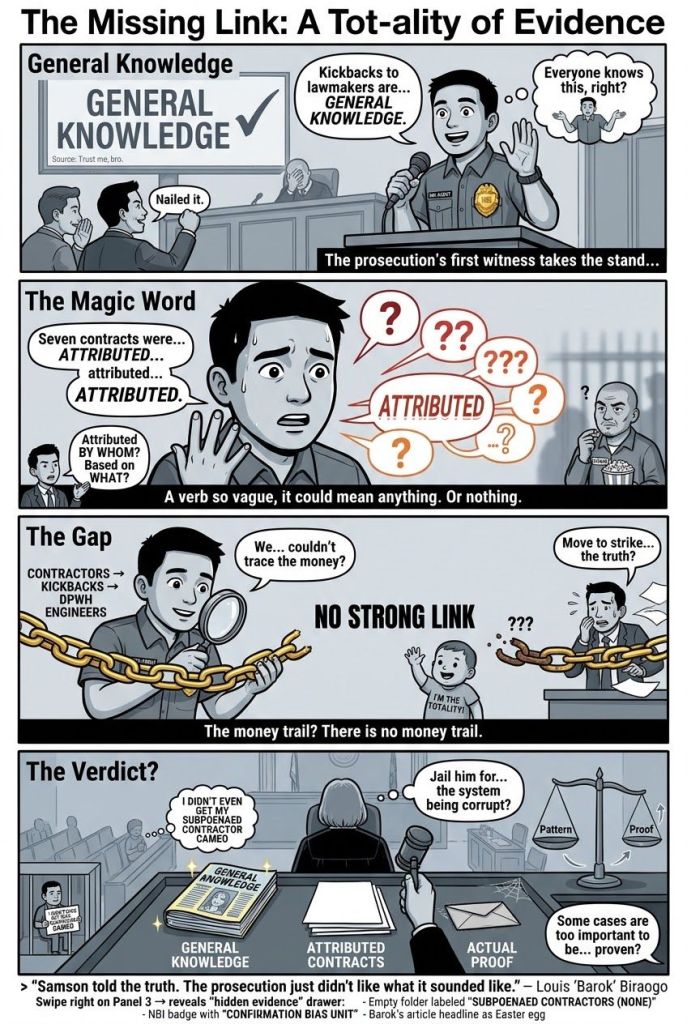
Let us review what Samson actually said. Kickbacks to lawmakers are “general knowledge” among flood control investigators. Seven contracts in Bulacan were “attributed” to Estrada. And—this is the part that should have the prosecutors reaching for something stronger than water—the NBI could not establish a “strong link” between the contractors and the district engineers, the “first layer” of the alleged corruption chain.
In other words: We know there was a system. We know contractors paid someone. We just cannot show that the money reached the man we are asking you to keep in jail.
And yet the NBI recommended charges anyway, because—wait for it—the “totality of evidence”. Totality of what, exactly? A general knowledge, seven attributed contracts, and an admitted gap in the middle of the money trail? That is not a totality. That is a hole with pretensions.
The Legal Architecture
Let us be clear about the legal architecture here. Plunder, under Republic Act No. 7080, is a non-bailable offense when the evidence of guilt is strong. The Rules of Court require the prosecution to demonstrate that strength. The Supreme Court, in cases like Revilla v. Sandiganbayan, has emphasized that the court must conduct a hearing, weigh the evidence, and exercise judicial discretion—not simply rubber-stamp an indictment. Samson’s testimony, offered by the prosecution itself, hands the defense a gift: the investigator admits the evidentiary chain is broken at its most critical link.
Now, I am told the Sandiganbayan allowed Samson to testify about the conduct of the investigation, not the truth of the underlying allegations. The defense objected on hearsay grounds. The court overruled, presumably because an investigator can describe what he did and found.
But here is the problem: what Samson found, by his own admission, is insufficient to establish the connection between the alleged bribe-givers and the alleged bribe-takers. The “general knowledge” that kickbacks exist is not evidence that Estrada received one. It is, at best, evidence that the NBI has a theory. Theories are not proof. They are not even prima facie proof.
A Verb and a Missing Money Trail
And what does “attributed” mean? Samson used the word seven times, and each time it became more mysterious. Attributed by whom? Based on what? A project being “attributed” to a senator could mean he advocated for it, endorsed its funding, requested it for his district, or simply represented the area where it was built. None of those things is a crime. The prosecution’s entire narrative rests on a verb so vague it could describe a newspaper headline.
Meanwhile, the actual evidence that might establish criminal participation—the contractors, the financial records, the intermediaries who allegedly moved the money—appears to be either unsubpoenaed or uncooperative. The defense reportedly challenged the NBI’s failure to subpoena the contractors themselves. If the contractors are the source of the alleged kickbacks, why are they not in the witness stand explaining how the scheme worked? Why is the prosecution’s first witness an investigator who admits he cannot trace the money?
The answer, I suspect, is uncomfortable for everyone involved. The NBI built a case from the top down: start with the politicians everyone suspects, work backward to find the evidence. That is not investigation. That is confirmation bias with a badge.
Let me be fair to Samson, who is the only person in this entire spectacle who appears to have told the truth. He did not claim to have witnessed a payoff. He did not pretend the money trail was complete. He said what he knew, acknowledged what he did not, and left the courtroom. In a hearing populated by prosecutors who seem to believe that repetition constitutes proof, Samson’s candor is almost admirable. He is the messenger, not the message.
The message, however, is damning. The prosecution’s case against Estrada, at least as presented in its opening salvo, is a structure built on three pillars: a generalization, a verb, and a gap. The generalization is that kickbacks are standard. The verb is “attributed.” The gap is the money trail that the NBI cannot find.
Compare this to the previous plunder case against Estrada, where the Sandiganbayan acquitted him of plunder but convicted him of bribery. That conviction rested on evidence of actual money changing hands—checks, intermediaries, specific transactions. The court found the plunder charge wanting because the evidence of criminal intent and personal enrichment was insufficient, but it found bribery because the prosecution could show actual payments. The current flood control case, if Samson’s testimony is any indication, has neither the ledgers nor the intermediaries nor the transactions. It has “general knowledge.”
The Sandiganbayan’s Choice
The bail hearing will continue. Other witnesses are scheduled: former Department of Public Works and Highways (DPWH) Secretary Manuel Bonoan, former Undersecretary Roberto Bernardo, and a cast of former officials and aides. Perhaps one of them will produce the missing link. Perhaps a contractor will testify that he personally delivered cash to Estrada’s office, and the NBI simply failed to mention it to Samson. Perhaps the “totality of evidence” is more total than it currently appears.
But the burden is on the prosecution, not on the public’s imagination. And the prosecution’s own witness has just told the court that the evidence of guilt is not strong. Not because the defense proved otherwise, but because the investigator admitted it.
The Sandiganbayan now faces a choice. It can accept the prosecution’s invitation to infer guilt from context—from the senator’s office, from the location of the projects, from the “general knowledge” that corruption exists. Or it can do what the rules require: examine whether the evidence actually presented establishes a strong presumption that Estrada personally received ill-gotten wealth.
If the court chooses the former, it will have set a precedent far more dangerous than any single acquittal. It will have said that in the Philippines, a public official can be jailed not because the evidence proves his guilt, but because the system he operates in is known to be corrupt. That is not justice. That is collective punishment dressed in judicial robes.
I have no particular affection for the Estrada family’s relationship with public funds. The father was convicted of plunder and pardoned. The son was convicted of bribery. The pattern is not reassuring. But the pattern is also not proof. And if we abandon the distinction between pattern and proof, we abandon the only thing that separates a court of law from a tribunal of public opinion.
Samson’s testimony is a warning. Not to Estrada, who will have his day in court regardless. To the rest of us, who are being asked to accept that “general knowledge” is a substitute for evidence. It is not. It never has been. And if the Sandiganbayan says otherwise, we will have learned something far more disturbing than the existence of kickbacks in flood control projects: we will have learned that the justice system has decided that some cases are too important to be proven.
Louis ‘Barok’ C Biraogo writes about law, politics, and the spaces between them. He is suspicious of everyone, including himself.
Key Citations
A. Legal & Official Sources
- Philippines. Republic Act No. 7080: An Act Defining and Penalizing the Crime of Plunder. 12 July 1991. Official Gazette, https://mirror.officialgazette.gov.ph/1991/07/12/republic-act-no-7080/.
- Revilla, Jr. v. Sandiganbayan (First Division). Supreme Court E-Library, Supreme Court of the Philippines, 2018, elibrary.judiciary.gov.ph/thebookshelf/showdocs/1/64378.
- Rules of Court, Rule 114 (Bail). Rules of Criminal Procedure. Lawphil, Arellano Law Foundation, lawphil.net/courts/rules/rc_110-127_crim.html.
- Rules of Court, Rules 128–134 (Evidence). Lawphil, Arellano Law Foundation, lawphil.net/courts/supreme/rc/rc_128-134_evidence.html.
- Enrile v. Sandiganbayan (Third Division). G.R. No. 213847, 18 Aug. 2015. Supreme Court of the Philippines, Lawphil, Arellano Law Foundation, lawphil.net/judjuris/juri2015/aug2015/gr_213847_2015.html.
- Estrada v. Sandiganbayan. G.R. No. 148560, 19 Nov. 2001. Supreme Court of the Philippines, Lawphil, Arellano Law Foundation, lawphil.net/judjuris/juri2001/nov2001/gr_148560_2001.html.
B. News Reports
- “Contractors Possible Kickback Source in Jinggoy Plunder Case but No Strong Link — Witness.” GMA News Online, GMA Network, 20 Oct. 2026, http://www.gmanetwork.com/news/topstories/nation/1006511/contractors-possible-kickback-source-in-jinggoy-plunder-case-but-no-strong-link-witness/story/.
- “NBI Witness: ‘Kickbacks’ to Lawmakers Standard in Gov’t Projects.” Philippine Daily Inquirer, Inquirer.net, 20 Oct. 2026, newsinfo.inquirer.net/2327292/nbi-witness-kickbacks-to-lawmakers-standard-in-govt-projects.
- “Ang Hirap Maging Mahirap”: The PAO Scandal That Proves Government Contempt Is Nothing New

- “Far-Off” My Axx: Malacañang’s Claire Castro Drowns in Her Own Legal Gaslighting
- “Forthwith” to Farce: How the Senate is Killing Impeachment—And Why Enrile’s Right (Even If You Can’t Trust Him)
- “HINDI AKO NAG-RESIGN!”

- “I Know Nothing”: Baste Duterte’s Amnesia Defense Meets ₱33M in GenCorp Contracts

- “I’m calling you from my new Globe SIM. Send load!”

- “Mahiya Naman Kayo!” Marcos’ Anti-Corruption Vow Faces a Flood of Doubt

- “Manageable” Debt, Unmanageable Lies: DBM’s ₱21 Trillion Fairy Tale
- “Meow, I’m calling you from my new Globe SIM!”

- “Natrabaho”: One Word, One Ombudsman, and a Judiciary on Trial
- “No Special Jail for Crooks!” Boying Remulla Slams VIP Perks for Flood Scammers

- “Philippine-Controlled” or Yankee Gas Station? The Davao Fuel Depot Farce Exposed




Leave a Reply