
223,214 Farmers, ₱61.99 Billion, and One Question Nobody in Malacañang Wants to Answer: Where Exactly Is the Money Going?
By Louis ‘Barok’ C Biraogo — October 21, 2026
The Art of the Fiscal Hallucination
Come closer, mga anak. This is the kind of story you hear at a wake—except the deceased is public accountability. It’s a story about how the Philippine government plans to spend Sixty-Two Billion Pesos to fight a weather phenomenon that has been occurring naturally since before the invention of agriculture, using methods that range from “scientifically dubious” to “outright magical thinking,” funded through mechanisms that would make the ghost of Ferdinand Marcos Sr. nod in grudging professional respect.
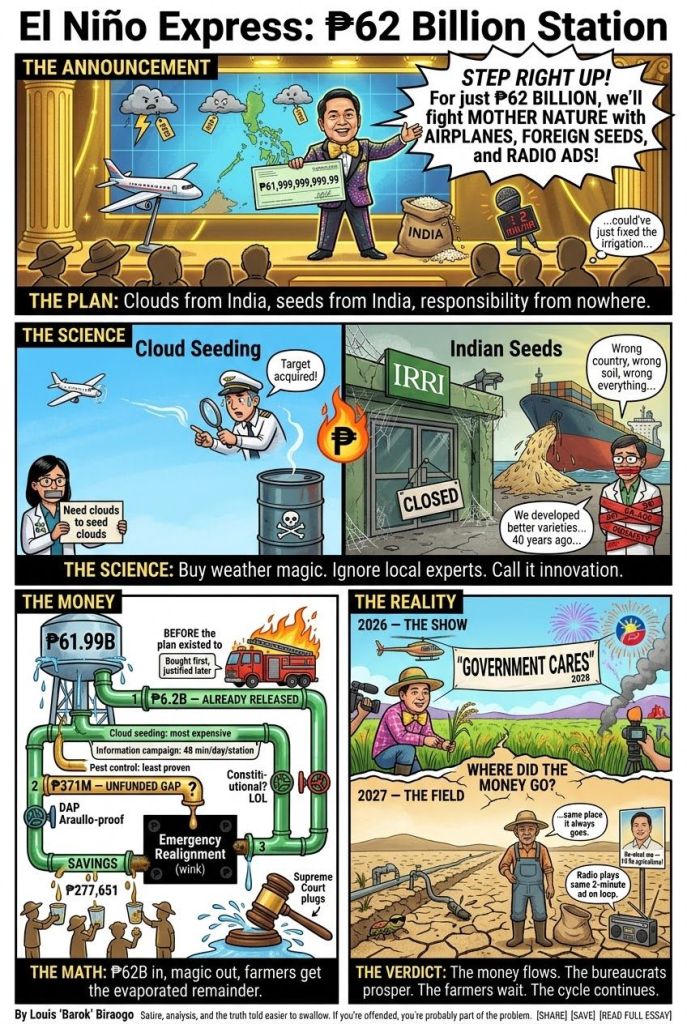
The Department of Agriculture, under former fishing magnate turned agriculture czar Francisco Tiu Laurel Jr., has unveiled a ₱61.99-billion “action plan” to combat El Niño. That’s roughly the cost of building 20,000 public school classrooms—or enough to give every one of the 223,214 affected farmers a check for ₱277,651 and a handwritten apology for decades of agricultural neglect.
Instead, we’re getting cloud seeding. And Indian rice seeds. And a two-minute-every-hour information campaign that sounds less like a public service announcement and more like a hostage situation for broadcast frequencies.
The Arithmetic That Doesn’t Add Up (Or Does It?)
The DA’s plan totals ₱61.99 billion. Already released? ₱6.2 billion. Unfunded gap? ₱371 million. Even I can see these figures are doing Olympic-level gymnastics.
Here’s what the government won’t tell you: ₱6.2 billion was released before the comprehensive plan was even presented. That’s not crisis response; that’s preemptive spending looking for a justification. It’s like buying a fire truck and then writing a plan that conveniently requires exactly one fire truck.
The ₱371 million “unfunded” gap is equally suspicious. Cloud seeding and pest control—the two most expensive, least proven interventions—are conveniently unfunded, suggesting they’re being held hostage for a supplementary budget fight resolved through the time-honored Philippine tradition of “budget realignment.”
Cloud Seeding: The Scientology of Agricultural Policy
Let me explain this the way I’d explain it to my lolo over tuba on a Sunday: Cloud seeding doesn’t work the way you think it works.
You pay for airplanes, pilots, chemicals, fuel, and the entire bureaucratic apparatus surrounding any government aviation operation. Then you fly into clouds that are already there—clouds that might have rained anyway—and spray stuff into them. If it rains, the government takes credit. If it doesn’t, conditions weren’t right.
It’s like wearing a lucky shirt to a job interview and claiming your success was due to the shirt.
The President has ordered a “comprehensive accounting” of cloud seeding operations. Translation: “Please explain why we’re spending money on expensive weather magic.” But here’s the thing about cloud seeding during strong El Niño: You need clouds to seed. During severe El Niño, the very atmospheric conditions that prevent rain also reduce cloud formation. You’re buying lottery tickets for a lottery that may not even be holding a draw.
The scientific consensus remains between “inconclusive” and “we’re not sure if this is science or performance art.” But cloud seeding is visible. It makes for good press releases and photo opportunities. You can’t cut a ribbon on “improved water management systems” but you can sure as hell file a flight plan and let the cameras roll.
Indian Rice Seeds: The IRRI Paradox
The President wants to import drought-resistant rice seeds from India—perhaps the most delightfully absurd element of this comedy.
The Philippines hosts the International Rice Research Institute (IRRI), the world’s premier rice research organization, which has spent decades developing climate-resilient varieties specifically adapted to Philippine conditions. We literally have the best rice research institution in the world in our backyard. It’s in Los Baños. You can visit it. They have a museum.
And yet, the President wants seeds from India, a country with fundamentally different soil, water patterns, temperature ranges, pest pressures, and farmer preferences. This is like importing snow to sell to Alaskans. We’re paying for something we already have, but worse.
Now, I’m not saying Indian varieties are bad. Some are excellent for Indian conditions. But there’s a reason we don’t grow basmati in Nueva Ecija and Indians don’t grow dinorado in Punjab. Agroecological adaptation isn’t optional; it’s fundamental.
The DA must navigate Republic Act No. 7308 (Seed Industry Development Act), Bureau of Plant Industry (BPI) certification, Philippine Rice Research Institute (PhilRice) evaluation, and possible biosafety reviews under DA Administrative Order No. 8. But all of this takes time—time a crisis doesn’t afford. So we’ll likely see “emergency” provisions invoked, “fast-tracked” approvals, and “streamlined” processes that always benefit the same connected suppliers while farmers become unwitting subjects of a national agricultural experiment.
The Red-Striped Soft Scale Insect: A Pest by Any Other Name
The Red-Striped Soft Scale Insect (RSSI) has infested 39,130 hectares—22.3% of national sugarcane area—with Negros Island bearing the brunt at 37,351 hectares. This is a genuine crisis for the sugar industry, which employs hundreds of thousands and contributes significantly to export earnings.
But RSSI isn’t new. It’s been monitored for years. The infestation didn’t appear overnight. And yet, it’s only now—during an El Niño crisis, when the government needs a distraction—that RSSI control becomes a priority requiring “unfunded” emergency spending.
This is the classic Philippine playbook: ignore a problem until it becomes a crisis, then declare an emergency and spend money without proper planning or accountability.
The Tiu Laurel Problem: When the Fox Regulates the Henhouse
We cannot discuss this plan without addressing Agriculture Secretary Francisco Tiu Laurel Jr.’s background as a fishing magnate (Frabelle Group) and his aggressive use of libel lawsuits against critics.
Since his September 2023 appointment with a mandate to “clean up” the DA, Tiu Laurel has filed cyberlibel cases against Zaldy Co, Levito Baligod, and 18 former Marines; been accused of agricultural smuggling involvement (which he denies as “fabricated lies”); and threatened libel action against Abante over the Vietnam rice scandal.
This is not the profile of a reformer. This is the profile of someone who uses legal threats to silence criticism while maintaining business interests that overlap uncomfortably with his regulatory responsibilities.
Republic Act No. 3019 (Anti-Graft and Corrupt Practices Act), Section 3(h), prohibits public officials from having direct or indirect financial interest in any transaction requiring government approval. Republic Act No. 6713 (Code of Conduct and Ethical Standards for Public Officials and Employees) requires officials to “avoid conflicts of interest.” When the Agriculture Secretary controls procurement for rice seeds, pest control chemicals, and equipment—and when his former industry stands to benefit indirectly—the public has a right to be skeptical.
The Constitutional Time Bomb: Araullo and Budget Realignment
President Marcos has authorized “budget realignment, subject to existing rules.” This sounds innocuous but runs directly into the constitutional wall erected by the Supreme Court’s 2014 decision in Araullo v. Aquino (G.R. No. 209287), which struck down the Disbursement Acceleration Program (DAP) as unconstitutional.
Araullo established that “savings” must be actual, not projected; cross-branch transfers are prohibited; augmentation cannot create new items; and presidential power over budget execution is limited.
Where will the ₱371 million gap come from? If from “savings” in other DA programs, the government must prove those are actual, realized savings. If from other agencies, that’s a cross-branch transfer requiring congressional approval. If it involves creating new budget items through augmentation, that’s explicitly unconstitutional.
Belgica v. Ochoa (G.R. No. 208566, 2013) further prohibits post-enactment realignment by individual legislators. The Court in Araullo explicitly rejected the argument that emergency conditions can override constitutional budget rules: “The power of the purse is vested in Congress, and the President’s power to augment cannot be used to usurp this legislative prerogative.”
This is not a technicality. This is the foundation of democratic accountability. If the President can realign billions without congressional approval, the entire budget process becomes theater.
The Information Campaign: Two Minutes Every Hour of What, Exactly?
Two minutes every hour is 48 minutes of airtime per day per station. Across multiple stations over multiple weeks, that’s thousands of hours of paid media. Who produces these programs? Who buys the airtime? At what cost? Through what procurement process?
RA 6713 requires public resources to be used “economically and efficiently.” An airtime blitz is neither if the content is poor and reach is unmeasured.
More importantly: What will farmers actually hear? Will they learn which specific seeds to plant in their circumstances? How to access aid without political intermediation? Or will they hear generic feel-good messaging about how the government “cares”?
The DA must measure not minutes of airtime but reach, comprehension, behavior change, and cost per successful outcome. Otherwise, this becomes a public relations campaign—potentially funded through government advertising budgets that have historically rewarded friendly media and punished critical ones.
The 2028 presidential elections are approaching. A government information campaign about agricultural programs, launched in late 2026—well before the official campaign period—but precisely when political positioning for 2028 begins… well, you do the math.”
The Beneficiary List: The Most Dangerous Document in the Philippines
In Philippine politics, the beneficiary list is where good intentions go to die.
Here’s how it works: Local officials identify potential beneficiaries. Lists are submitted to implementing agencies. The lists inevitably reflect political loyalties and strategic calculations. Opposition supporters are systematically excluded. The government denies manipulation. Independent verification is impossible because lists are confidential. Aid becomes a reward for political support rather than a response to genuine need.
The DA must establish transparent, verifiable eligibility criteria: climate exposure, production exposure, economic vulnerability, urgency. The selection process must be independently verifiable, with appeals processes and public reporting. RA 6713 requires “justness” and “political neutrality.” If beneficiaries are chosen based on political affiliation, the program is not just inequitable but potentially unlawful.
Emergency Procurement: The Fast Lane to Corruption
The President has authorized “fast-tracked procurement.” This is where the real money will disappear.
Republic Act No. 12009 (New Government Procurement Act) allows negotiated procurement in genuine emergencies, but only under specific conditions: imminent danger to life or property, goods urgently needed, ordinary procedures impractical, documentation of the emergency, and approval by appropriate authorities.
The DA will almost certainly invoke emergency provisions to bypass competitive bidding for cloud seeding contracts, Indian seed imports, pest control chemicals, and equipment. And once emergency provisions are invoked, the safeguards disappear. Contracts are awarded without competition. Prices are negotiated behind closed doors. Delivery is certified by the same officials who awarded the contracts.
The Supreme Court’s 2026 decision in Aseron v. Commission on Audit (COA) (G.R. No. 274126) upheld disallowances where procurement violations occurred, emphasizing that “good faith is not a universal cure for illegal expenditure.” The DA should document everything, publish contracts and delivery records, and verify actual delivery before payment.
But in the Philippines, “fast-track” usually means “skip the boring parts”—the parts where someone checks whether the price is fair, whether the supplier exists, whether goods were delivered, whether the project achieved its purpose.
The Interagency Coordination Theater
The plan involves DA, Department of Social Welfare and Development (DSWD), Department of Labor and Employment (DOLE), Philippine Atmospheric, Geophysical and Astronomical Services Administration (PAGASA), National Irrigation Administration (NIA), National Food Authority (NFA), and local government units (LGUs). This is either impressive whole-of-government coordination or a shell game where nobody is actually responsible for outcomes.
Each agency will report its own “successes,” claim credit for outcomes resulting from multiple interventions, blame other agencies for failures, and resist coordination that might reduce its budget share.
Under Republic Act No. 10121 (Philippine Disaster Risk Reduction and Management Act of 2010), LGUs are frontline implementers of disaster response. Yet the news report never mentions LGUs. Under Executive Order No. 53 (Reactivating Task Force El Niño), the Task Force El Niño is chaired by the Department of National Defense (DND), with the Department of Science and Technology (DOST) as co-chair. The DA is just a member—yet it’s proposing a ₱62-billion plan independently? Who coordinates? Who’s accountable when things fail?
The answer, based on decades of experience, is nobody.
The Political Economy of Crisis
Let’s be honest about what this plan really is.
It’s not primarily a response to agricultural vulnerability. That vulnerability is real, but it’s not new. Farmers have suffered from inadequate support, poor infrastructure, and climate shocks for decades. If the government genuinely cared, it would have invested in irrigation, extension services, and seed systems years ago.
This plan is a political instrument. Midterm elections in May 2027 will determine control of Congress for the remainder of Marcos’s term. The administration needs to demonstrate action, competence, and compassion. A ₱62-billion program hits all three notes.
But here’s the thing about political spending: it doesn’t have to work. It just has to be announced. The photo opportunities and press releases happen immediately. The actual outcomes won’t be known until much later, when attention has moved elsewhere. By then, the money will be spent, and any failures will be someone else’s problem.
What the Government Should Do (But Won’t)
If the government were serious—rather than just appearing serious—it would:
- Publish a line-by-line budget reconciliation showing how much is new money, existing appropriations, or contingent on future action.
- Subject cloud seeding to independent technical review before spending any money, including comparison with alternatives.
- Test Indian rice varieties in Philippine conditions before mass distribution, through PhilRice and IRRI.
- Establish transparent beneficiary selection criteria with independent verification and appeals.
- Use competitive bidding for all major contracts except genuine emergencies, with thorough documentation.
- Publish all contracts, supplier names, prices, and delivery records in real-time through the Philippine Government Electronic Procurement System (PhilGEPS).
- Coordinate with IRRI and PhilRice instead of importing seeds from halfway around the world.
- Fix the irrigation system before spending on cloud seeding, since irrigation provides predictable water while cloud seeding provides hope.
- Actually consult farmer organizations in planning, as required by Article XIII, Section 5 of the 1987 Constitution.
The DA won’t do most of these things, because they would reduce political benefits while increasing administrative burden. It’s much easier to announce a big number, hold a press conference, and move on.
The Verdict
The DA’s ₱61.99-billion El Niño plan is a masterpiece of Philippine governance theater: a huge headline number that may not actually exist, scientifically dubious interventions, import-dependent solutions that ignore local capacity, emergency procurement provisions that invite corruption, opaque beneficiary selection, interagency coordination that looks good on paper but won’t work in practice, and a political timeline that conveniently aligns with upcoming elections.
Should the government prepare for El Niño? Absolutely. PAGASA’s warnings are credible. Agricultural losses are real. Farmers and fisherfolk need support.
But this plan is not about preparing for El Niño. It’s about appearing to prepare while maximizing political benefits and minimizing accountability.
The Supreme Court has established that the President cannot realign appropriations without congressional approval (Araullo). The procurement law requires competition and transparency (RA 12009). The Constitution requires farmer participation in agricultural planning (Article XIII, Section 5). The ethical standards law requires officials to avoid conflicts of interest (RA 6713).
If the government violates these requirements while spending ₱62 billion on questionable interventions, the response should be a court challenge, a congressional investigation, an audit disallowance, and—if warranted—criminal prosecution.
But we all know that won’t happen. The money will be spent. The press releases will be issued. And when the next El Niño arrives, we’ll be told the previous spending was insufficient, that we need an even bigger emergency response.
The cycle continues. The money flows. The farmers wait. The bureaucrats prosper. And the Filipino taxpayers are left wondering where their money went and why nothing seems to change.
Epilogue: A Modest Proposal
If the government is determined to spend ₱62 billion, here’s a suggestion that would be more effective and less corrupt:
Give ₱50,000 to each of the 223,214 affected farmers—₱11.16 billion. Give ₱100,000 to each of the 39,130 sugarcane farmers affected by RSSI—₱3.91 billion. Use the remaining ₱46.93 billion to repair irrigation systems, build small farm reservoirs, and fund PhilRice/IRRI seed multiplication.
No cloud seeding. No Indian imports. No two-minute hourly broadcasts. No emergency procurement. No secret beneficiary lists.
Just money to the people who need it, infrastructure that lasts, and seeds adapted to local conditions.
Is this realistic? Of course not. It doesn’t generate photo opportunities. It doesn’t enrich connected suppliers. It doesn’t create opportunities for political patronage.
But it would actually work.
And that, more than anything else, is why it will never happen.
Louis ‘Barok’ C. Biraogo is a reformed true believer. He spent his youth thinking government could be a force for good, his thirties discovering it mostly isn’t, and his forties documenting the gap between the two. He writes from his kweba, surrounded by books he keeps meaning to read and news clippings he definitely should have recycled by now.
Disclaimer: This is satire, analysis, critique, and investigative journalism all rolled into one—the truth told in a way that makes it easier to swallow. If you are offended, you are probably part of the problem.
Key Citations
A. Legal & Official Sources
- The 1987 Constitution of the Republic of the Philippines. Lawphil Project, Arellano Law Foundation, 1987, http://www.lawphil.net/consti/cons1987.html.
- Republic Act No. 3019. Anti-Graft and Corrupt Practices Act. 1960, lawphil.net/statutes/repacts/ra1960/ra_3019_1960.html.
- Republic Act No. 6713. Code of Conduct and Ethical Standards for Public Officials and Employees. 1989, lawphil.net/statutes/repacts/ra1989/ra_6713_1989.html.
- Republic Act No. 7308. Seed Industry Development Act of 1992. 1992, lawphil.net/statutes/repacts/ra1992/ra_7308_1992.html.
- Republic Act No. 10121. Philippine Disaster Risk Reduction and Management Act of 2010. 2010, http://www.lawphil.net/statutes/repacts/ra2010/ra_10121_2010.html.
- Republic Act No. 12009. New Government Procurement Act. 2024, lawphil.net/statutes/repacts/ra2024/ra_12009_2024.html.
- Department of Agriculture. DA Administrative Order No. 8, S. 2002: Rules and Regulations for the Importation and Release into the Environment of Plants and Plant Products Derived from the Use of Modern Biotechnology. 3 Apr. 2002. Supreme Court E-Library, elibrary.judiciary.gov.ph/thebookshelf/showdocs/10/43382.
- Philippines. Office of the President. Executive Order No. 53, s. 2024: Reactivating and Reconstituting the Task Force El Niño, and for Other Purposes. 19 Jan. 2024. Official Gazette of the Republic of the Philippines, http://www.officialgazette.gov.ph/2024/01/19/executive-order-no-53-s-2024/.
- Araullo v. Aquino III. G.R. No. 209287, 1 July 2014. Supreme Court of the Philippines, lawphil.net/judjuris/juri2014/jul2014/gr_209287_2014.html.
- Belgica v. Ochoa. G.R. No. 208566, 19 Nov. 2013. Supreme Court of the Philippines, lawphil.net/judjuris/juri2013/nov2013/gr_208566_2013.html.
- Aseron v. Commission on Audit. G.R. No. 274126, 15 Apr. 2026. Supreme Court of the Philippines, elibrary.judiciary.gov.ph/thebookshelf/showdocs/18/70542.
- “El Niño/La Niña Advisories.” PAGASA, Philippine Atmospheric, Geophysical and Astronomical Services Administration, http://www.pagasa.dost.gov.ph/climate/el-nino-la-nina/advisories.
B. News Reports
- The Manila Times. Report on the Department of Agriculture’s ₱61.99-billion El Niño action plan. 20 Oct. 2026, https://www-manilatimes-net.cdn.ampproject.org/v/s/www.manilatimes.net/2026/10/20/business/top-business/da-presents-p62b-plan-to-combat-el-nio-effects/2449060/amp?amp_js_v=0.1&_gsa=1#webview=1.

- “Ang Hirap Maging Mahirap”: The PAO Scandal That Proves Government Contempt Is Nothing New

- “Far-Off” My Axx: Malacañang’s Claire Castro Drowns in Her Own Legal Gaslighting
- “Forthwith” to Farce: How the Senate is Killing Impeachment—And Why Enrile’s Right (Even If You Can’t Trust Him)
- “HINDI AKO NAG-RESIGN!”

- “I Know Nothing”: Baste Duterte’s Amnesia Defense Meets ₱33M in GenCorp Contracts
- “I’m calling you from my new Globe SIM. Send load!”

- “Mahiya Naman Kayo!” Marcos’ Anti-Corruption Vow Faces a Flood of Doubt

- “Manageable” Debt, Unmanageable Lies: DBM’s ₱21 Trillion Fairy Tale
- “Meow, I’m calling you from my new Globe SIM!”

- “Natrabaho”: One Word, One Ombudsman, and a Judiciary on Trial
- “No Special Jail for Crooks!” Boying Remulla Slams VIP Perks for Flood Scammers

- “Philippine-Controlled” or Yankee Gas Station? The Davao Fuel Depot Farce Exposed





Leave a Reply