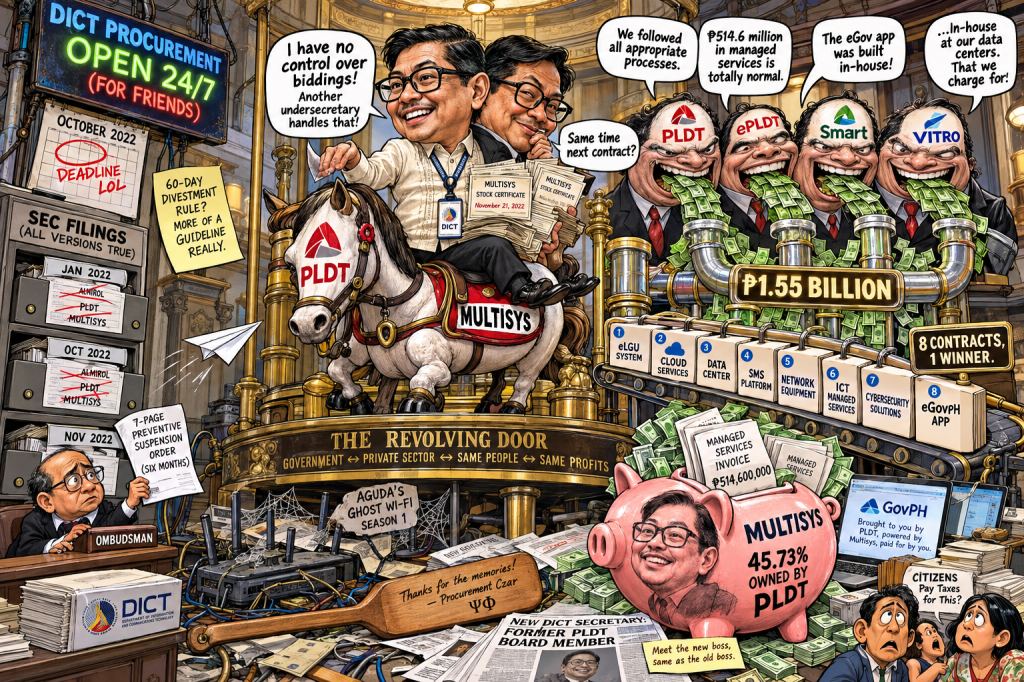
When your ex-company’s majority shareholder wins the contracts your office awards, that’s not a coincidence. That’s a business model.
By Louis ‘Barok‘ C. Biraogo — October 22, 2026
LET me get this absolutely, catastrophically straight, because the comedy here is too rich to ignore.
Two months ago, I told you about Henry Aguda’s Department of Information and Communications Technology (DICT) and its “ghost Wi-Fi”—routers installed, internet nowhere to be found, billions paid, and a procurement czar who just happened to be a fraternity brother under indictment. The department was a mess, Congress withheld its ₱19.49-billion budget, and the Ombudsman launched a fact-finding probe into what Assistant Ombudsman Mico Clavano called a scheme where contractors “install cheaper, outdated, or even fake software while still charging the government full price for the real thing”.
Cute story. But apparently, the DICT wasn’t content with just one flavor of procurement absurdity. While everyone was distracted by the phantom internet routers, another scandal was quietly marinating in the e-Government cluster, and it involves a ₱1.55-billion contract pile, a 49.21% shareholding that mysteriously lingered past its expiration date, and a tech founder who apparently believed the 60-day divestment rule was more of a suggestion than a statute.
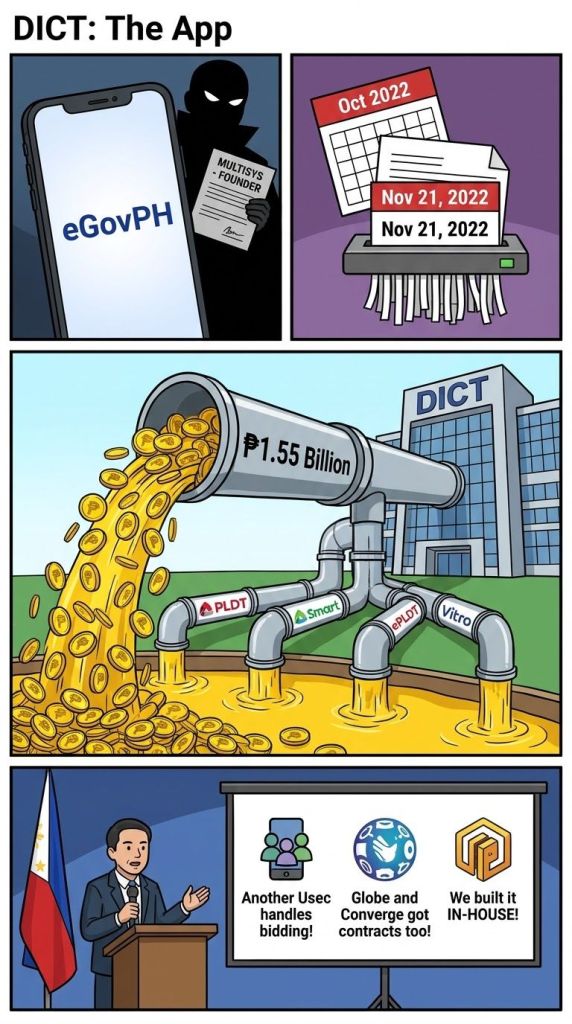
Enter David L. Almirol Jr., Undersecretary for E-Government, founder of Multisys Technologies Corporation, and—according to the Ombudsman’s seven-page suspension order—a man who somehow remained a substantial stockholder of his own company well after he was legally required to sever that financial umbilical cord.
The timeline, as reported, is not subtle. Almirol took his oath on August 4, 2022. Under Section 9 of Republic Act No. 6713 (Code of Conduct and Ethical Standards for Public Officials and Employees), he had sixty days to divest. That deadline would have landed somewhere around early October 2022. Yet a Multisys General Information Sheet (GIS) notarized on October 27, 2022, and received by the Securities and Exchange Commission (SEC) on November 2, still listed him as holding 49.21% of the company’s stocks. He only vanished from the stockholder list in a subsequent GIS notarized November 18 and received November 21.
Now, I’m just a blogger with a suspicious mind and a working knowledge of how deadlines function, but “November 21” is not “early October.” It’s not even close. It’s the difference between complying with the law and hoping nobody checks the SEC filings. Except somebody did check. The DICT Internal Audit Unit flagged the conflict in June 2025, and the Ombudsman apparently found the paper trail sufficiently damning to impose the maximum six-month preventive suspension without pay.
But here’s where the plot thickens into something resembling a telenovela written by someone who hates procurement law.
Between November 2023 and May 2025—after Almirol’s belated disappearance from the Multisys stock ledger—the DICT awarded eight e-government contracts worth approximately ₱1.55 billion to companies with financial relationships with Multisys. The recipients? Philippine Long Distance Telephone Company (PLDT), ePLDT, Smart, and Vitro—entities that, collectively, own 45.73% of Multisys, courtesy of a ₱2.15-billion investment back in 2018. Of that investment, roughly ₱500 million reportedly went directly to Multisys’ owners. Almirol included.
So let’s map this out with the clarity the Ombudsman’s order demands:
- Almirol founded Multisys.
- PLDT bought nearly half of Multisys.
- Almirol joined the DICT.
- Almirol’s divestment from Multisys was, at best, tardy.
- The DICT then awarded ₱1.55 billion in contracts to PLDT and its subsidiaries.
- Multisys, meanwhile, recorded ₱110.8 million in “managed services” revenue from related companies in 2023, and ₱514.6 million in 2024.
The Ombudsman’s order stops short of alleging that Almirol personally pocketed the ₱1.55 billion, because that would require evidence he actually did. What the order does establish—with the kind of documentary precision that makes defense lawyers reach for antacids—is that the statutory divestment requirement was blown, and that the financial ecosystem surrounding the man responsible for e-government procurement was, to put it gently, incestuous.
Almirol’s defense, as reported, is a masterpiece of misdirection. He claims procurement is “handled by another undersecretary”. He points out that the DICT also contracted Globe and Converge, so surely there’s no favoritism. He even suggested, at one point, that his team built the eGovPH app in-house, saving the government money.
I’m sorry—what?
If the app was built in-house, then what exactly was the ₱1.55 billion for? Cloud infrastructure? Data center colocation? Messaging services? Software subscriptions? Those are the categories listed in the Ombudsman’s order. Perhaps those are legitimate operational necessities. But if you’re the founder of a tech company that is 45.73% owned by PLDT, and PLDT’s subsidiaries are winning the DICT’s cloud and data center contracts while your former company is booking hundreds of millions in “managed services” revenue from those same related entities, the phrase “appearance of impropriety” doesn’t quite capture the aesthetic. This isn’t a conflict of interest. This is a conflict of interest wearing a tailored suit, holding a PowerPoint presentation, and explaining that everything is perfectly fine because the paperwork says so.
And speaking of paperwork—Rappler’s investigation into Multisys’ SEC filings found three GISs submitted in 2022 alone, with conflicting information about Almirol’s ownership status. The Ombudsman relied on the October/November filings to establish the divestment delay. Almirol could argue that the legal transfer occurred earlier and the GIS was merely a reporting lag. That’s a colorable defense, and the original stock transfer instruments would settle it. But here’s the problem: the burden of proving timely divestment falls on the public official who was legally obligated to divest. If the records are ambiguous, that ambiguity is not Almirol’s friend. It’s the prosecution’s exhibit.
The Ombudsman also flagged the hiring of former Multisys personnel at the DICT, which the internal audit report identified as a potential conflict channel. Almirol can argue that specialized tech talent is scarce and former employees are natural hires. Fine. But when you combine the personnel flows, the financial relationships, the tardy divestment, and the ₱1.55 billion in contracts flowing to your former company’s majority shareholder, you don’t get “ordinary professional mobility.” You get a pattern that a reasonable observer—the kind who doesn’t work at the DICT—might describe as a closed loop.
Now, let’s be fair, because even a sarcastic blogger must occasionally feign fairness. Preventive suspension is not a finding of guilt. The Ombudsman itself emphasized that it is a “precautionary measure intended to preserve the integrity of the proceedings.” Almirol has not been convicted of anything. He may have a perfectly innocent explanation for every document in that seven-page order. Perhaps the stock transfer was executed in September 2022, and the GIS filings were simply sloppy. Perhaps the PLDT contracts were competitively bid and represented the best value for government. Perhaps the former Multisys employees were hired strictly on merit. Perhaps the ₱625.4 million in managed services revenue had nothing to do with DICT contracts.
But here’s the thing about “perhaps”: it is not a legal defense. It is a hypothesis. And the Ombudsman, unlike the DICT’s internal audit unit, apparently found the evidence sufficient to act.
The broader institutional picture is even uglier. This is the second major procurement controversy to engulf the DICT in as many months. Aguda’s ghost Wi-Fi scandal featured routers without internet and a procurement appointee with frat-brother privileges. Almirol’s scandal features a delayed divestment and a ₱1.55-billion contract pipeline to a corporate ecosystem he helped build. At some point, the pattern stops looking like coincidence and starts looking like a department that treats procurement law as a series of optional guidelines.
And where is the Secretary in all this? Robert Joseph de Claro, appointed just eight days before the suspension order, has been directed to implement it. De Claro’s background reportedly includes a board position at PLDT—which, if true, adds yet another layer of corporate entanglement to a department that seems to collect them like trading cards. I await his proof of compliance with the kind of anticipation usually reserved for watching someone defuse a bomb while wearing oven mitts.
The Ombudsman, to its credit, appears to be doing its job. The suspension order is specific, documentary, and legally grounded. It cites RA 6713, identifies the divestment deadline, traces the SEC filings, and flags the control-of-documents rationale for preventive suspension—a standard ground under Republic Act No. 6770 (Ombudsman Act of 1989). If Almirol wants to challenge it, he’ll need more than a press release claiming the procurement was someone else’s job. He’ll need the actual stock transfer documents, dated before the deadline, with a paper trail that survives forensic scrutiny.
My suspicion—and it is a suspicion, not a finding—is that the defense will hinge on technicalities: the exact date of the legal transfer versus the GIS filing date, the distinction between direct and indirect financial interest, the argument that the PLDT contracts were awarded through regular processes. These are the kinds of arguments that can work in administrative proceedings, where the standard is substantial evidence rather than proof beyond reasonable doubt. But they are also the kinds of arguments that look less like innocence and more like a man who knows the rules were broken but hopes the penalty will be manageable.
The ₱1.55 billion figure is not, by itself, proof of corruption. The Ombudsman’s order does not allege that Almirol received a bribe. It does not allege that the contracts were overpriced. It does not allege that the government was defrauded. What it alleges—with documentary support—is that a public official with a substantial financial interest in a technology company failed to divest within the statutory period, and that the same official’s former company and its majority shareholder subsequently received a substantial volume of government contracts.
That is enough for preventive suspension. Whether it is enough for dismissal, criminal liability, or a full-blown Sandiganbayan prosecution is a question that will be answered by lawyers billing more hours than I care to imagine.
But here’s what I do know: the DICT has now produced two consecutive procurement scandals involving people who were supposed to be the adults in the room. Aguda’s frat-brother procurement czar. Almirol’s phantom divestment. The ghost routers. The ₱1.55-billion contract pipeline. The former Multisys employees. The SEC filings that don’t quite add up. The new Secretary with a PLDT board seat.
If this were a television drama, I’d say the writers were trying too hard. But this is the Philippine government, where the line between satire and procurement record is apparently thinner than a GIS filing deadline.
The Ombudsman has six months to conclude its administrative investigation. Almirol has six months to explain why his 49.21% stake in Multisys was still on the books when it shouldn’t have been. The DICT has six months to demonstrate that the ₱1.55 billion in contracts was awarded through processes that were actually competitive, actually transparent, and actually worth the money.
And the rest of us have six months to watch, take notes, and remember that the next time someone promises “digital transformation,” the first question should be: whose company is getting paid?
I’ll be here. Watching the SEC filings. Waiting for the stock transfer certificates. And wondering, idly, whether the DICT’s next procurement scandal will at least have the decency to involve a different fraternity.
Key Citations
A. Legal & Official Sources
- Republic Act No. 6713. An Act Establishing a Code of Conduct and Ethical Standards for Public Officials and Employees, to Uphold the Time-Honored Principle of Public Office Being a Public Trust, Granting Incentives and Rewards for Exemplary Service, Enumerating Prohibited Acts and Transactions and Providing Penalties for Violations Thereof and for Other Purposes. 1989, lawphil.net/statutes/repacts/ra1989/ra_6713_1989.html.
- Republic Act No. 6770. An Act Providing for the Functional and Structural Organization of the Office of the Ombudsman, and for Other Purposes (The Ombudsman Act of 1989). 1989, lawphil.net/statutes/repacts/ra1989/ra_6770_1989.html.
B. News Reports
- “DICT Exec Suspended over Alleged Conflict of Interest in ₱1.55B Contracts.” Manila Bulletin, 21 Oct. 2026, mb.com.ph/2026/10/21/dict-exec-suspended-over-alleged-conflict-of-interest-in-155b-contracts.
- Mendoza, John Eric “Ombudsman Suspends DICT Exec over Alleged Conflict in P1.5-B Deal.” Philippine Daily Inquirer, 21 October 2026, newsinfo.inquirer.net/2327873/ombudsman-suspends-dict-exec-over-alleged-conflict-in-p1-5-b-deal/amp.
- John Eric.Mendoza, “Ombudsman’s ‘Ghost Internet’ Probe Zeroes In on DICT.” Philippine Daily Inquirer, 22 September 2026, newsinfo.inquirer.net/2309778/ombudsmans-ghost-internet-probe-zeroes-in-on-dict.
- Gonzales, Gelo and Mendoza, Gemma. “Conflict of Interest? Audit Questions DICT Usec’s Ties to Former Company Multisys.” Rappler, 8 Dec. 2025, http://www.rappler.com/technology/egov-david-almirol-conflict-interest-multisys-dict-audit/.
- Barreiro, Victor Jr. “Ombudsman Suspends DICT Usec Almirol over Alleged eGov Conflicts of Interest.” Rappler, 21 Oct. 2026, http://www.rappler.com/philippines/ombudsman-suspends-dict-egov-david-almirol-multisys-conflicts-interest/.
- “SSS Chief Is New Interim DICT Secretary.” ABS-CBN News, 13 Oct. 2026, http://www.abs-cbn.com/news/technology/2026/10/13/sss-chief-is-new-dict-secretary-1446.
- “Ombudsman Slaps DICT Exec with Six-Month Suspension.” Daily Tribune, 21 Oct. 2026, tribune.net.ph/2026/10/21/ombudsman-slaps-dict-exec-with-six-month-suspension.
- “Ombudsman Suspends DICT Undersecretary.” The Manila Times, 21 Oct. 2026, http://www.manilatimes.net/2026/10/21/news/ombudsman-suspends-dict-undersecretary/2450560.
- “Ghost Wi-Fi, Real Billions: How Aguda’s DICT Turned ‘Free Internet’ into a Fraternity Slush Fund.” Kweba ni Barok, 30 Sept. 2026, kwebanibarok.com/2026/09/30/ghost-wi-fi-real-billions-how-agudas-dict-turned-free-internet-into-a-fraternity-slush-fund/.

- “Ang Hirap Maging Mahirap”: The PAO Scandal That Proves Government Contempt Is Nothing New
- “Far-Off” My Axx: Malacañang’s Claire Castro Drowns in Her Own Legal Gaslighting
- “Forthwith” to Farce: How the Senate is Killing Impeachment—And Why Enrile’s Right (Even If You Can’t Trust Him)
- “HINDI AKO NAG-RESIGN!”

- “I Know Nothing”: Baste Duterte’s Amnesia Defense Meets ₱33M in GenCorp Contracts

- “I’m calling you from my new Globe SIM. Send load!”

- “Mahiya Naman Kayo!” Marcos’ Anti-Corruption Vow Faces a Flood of Doubt

- “Manageable” Debt, Unmanageable Lies: DBM’s ₱21 Trillion Fairy Tale

- “Meow, I’m calling you from my new Globe SIM!”

- “Natrabaho”: One Word, One Ombudsman, and a Judiciary on Trial

- “No Special Jail for Crooks!” Boying Remulla Slams VIP Perks for Flood Scammers

- “Philippine-Controlled” or Yankee Gas Station? The Davao Fuel Depot Farce Exposed







Leave a Reply