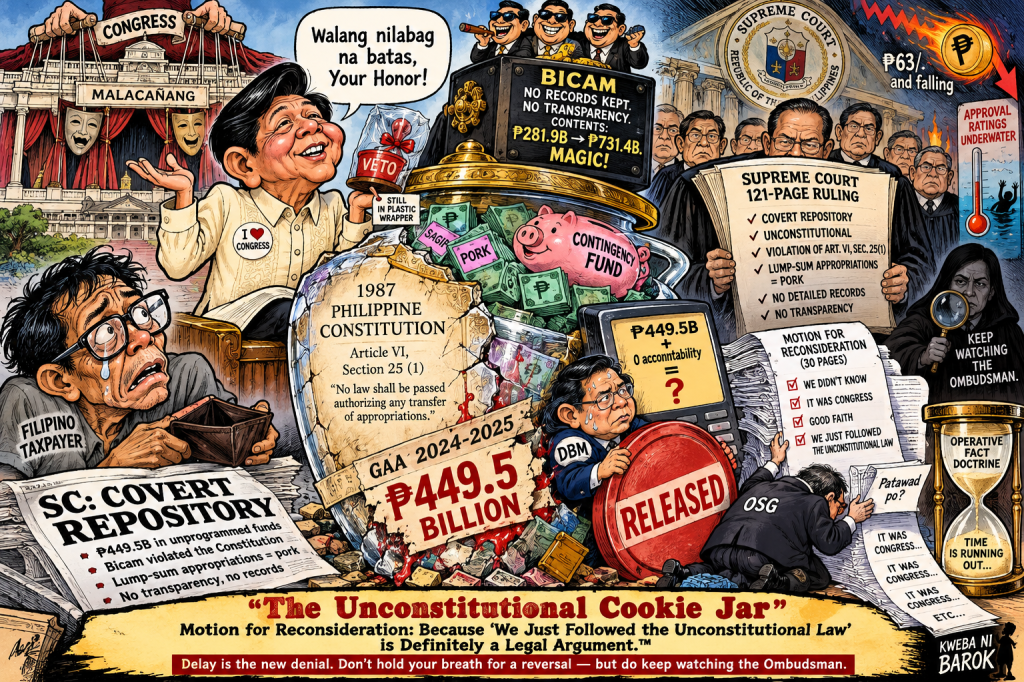
Inside the OSG’s Motion: 30 Pages of ‘We Didn’t Know,’ 5 Pages of ‘It Was Congress,’ and One Footnote Asking for Forgiveness
By Louis ‘Barok‘ C. Biraogo — October 22, 2026
MGA ka-kweba, sharpen your pencils and prepare your finest grains of salt. The Palace has finally responded to the Supreme Court’s 121-page budget bombshell, and the response is exactly what you’d expect from an administration that just got caught with its hand in the unprogrammed cookie jar: a motion for reconsideration and a press release insisting that “walang nilabag na batas.”
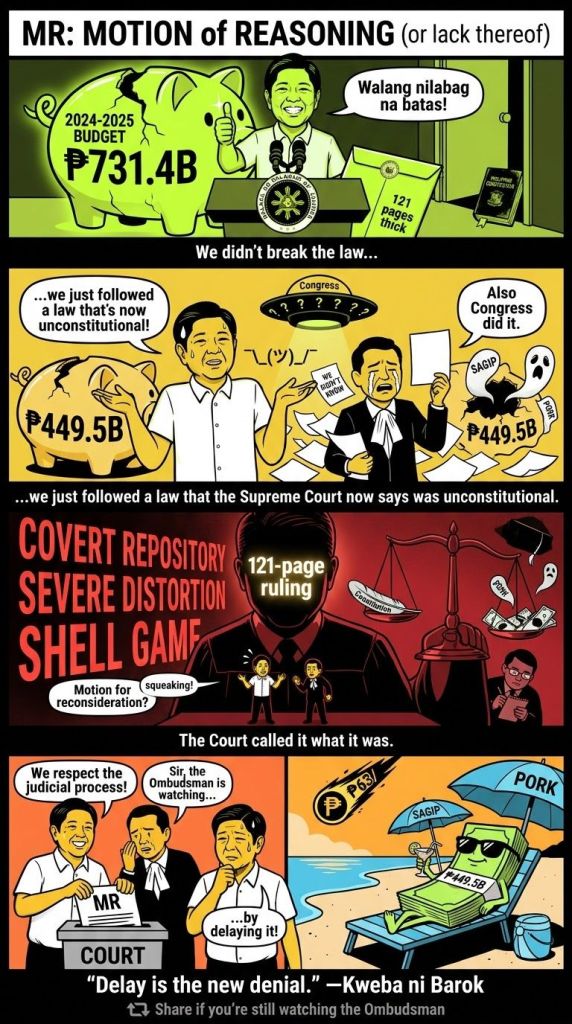
Let’s translate that from Malacañang-speak: “We didn’t break the law; we just followed a law that the Supreme Court now says was unconstitutional, which is technically a different thing, and also please stop asking about the ₱449.5 billion.”
President Marcos has directed the Office of the Solicitor General (OSG) to seek reconsideration of the October 20 ruling that voided the 2024 and 2025 budgets and gutted key provisions of the 2026 General Appropriations Act (GAA). The Palace’s legal theory, as far as anyone can tell from the public statements, appears to rest on three pillars:
- The Executive merely implemented duly enacted appropriations.
- The increases were Congress’s fault.
- Filing a motion is a lawful procedural step, so everyone should calm down.
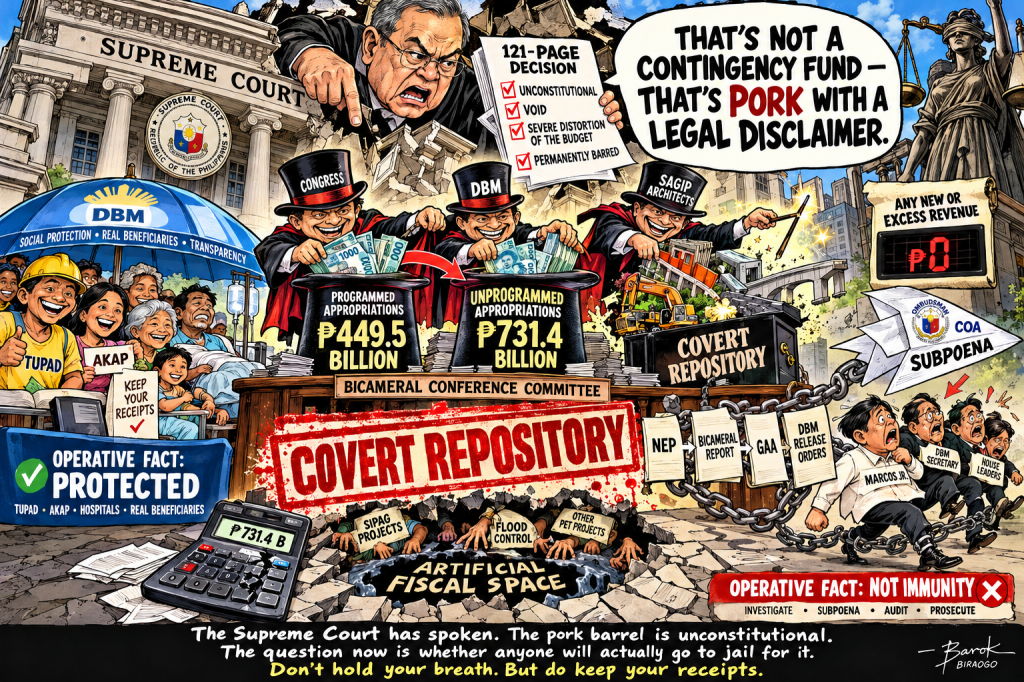
Here’s the problem, and it’s a big one: the Supreme Court didn’t just find a technical glitch. It found a “severe distortion” of the constitutional budget process, a “covert repository” for pork, and a bicameral conference committee that kept “no records” of how it turned ₱281.9 billion in proposed unprogrammed appropriations into ₱731.4 billion. The Court didn’t say “oops, minor accounting error.” It said the mechanism was designed to leave no fingerprints.
Now the OSG wants a do-over. Let’s examine the legal terrain with the skepticism it deserves.
The Procedural Shield: Filing Isn’t Winning
First, the obvious: yes, the government can file a motion for reconsideration. Rule 52 of the Rules of Court exists. Deadlines exist. The OSG is entitled to its day in court, or rather, its second day in the same court—but the Rules don’t care about your political inconvenience; they care about whether the motion was timely filed and whether it identifies an actual error.
Filing the motion doesn’t erase the ruling, doesn’t stay the constitutional findings automatically, and certainly doesn’t transform “covert repository” into “standard fiscal practice.”
But here’s where it gets interesting. A motion for reconsideration must identify specific errors in the Court’s reasoning or disposition. It cannot simply re-litigate the same arguments the Court already rejected across 121 pages and multiple separate opinions.
And the Court’s core findings were not marginal. The En Banc was not divided on the fundamental question of whether the ₱449.5 billion increase violated Article VI, Section 25(1) of the Constitution. It was divided on the scope of the ceiling, the application of the operative fact doctrine, and the remedies, but not on the existence of a constitutional problem.
The OSG’s strongest potential argument is interpretive: that Article VI, Section 25(1)’s prohibition on Congress increasing the President’s recommended appropriations applies only to programmed appropriations for “the operation of the Government,” and that unprogrammed appropriations, being contingent, fall outside the ceiling. This is essentially the position of Justices Zalameda and Lopez in their separate opinions. It is not frivolous. It is also a minority view that the majority explicitly considered and rejected.
The Court’s majority reasoning, as reported, is that allowing Congress to increase unprogrammed appropriations while keeping programmed appropriations at the proposed level would create an obvious loophole. Congress could simply transfer everything into the unprogrammed category and increase it at will, effectively nullifying the constitutional ceiling. The Court called this what it was: a shell game.
The “We Just Followed the Law” Defense: A Legal Non-Answer
The Palace’s public position, that the Executive implemented duly enacted appropriations in good faith, is not a legal argument. It is a liability defense masquerading as a constitutional argument.
There is a difference between asking “Was the appropriation constitutional?” and asking “Did the officials who implemented it commit a crime?” The Supreme Court’s ruling addresses the first question. The operative fact doctrine addresses the second, and the Court explicitly stated that the doctrine “does not automatically shield those who authored, proposed or implemented the invalid provisions” from criminal, civil, or administrative liability.
So when Malacañang says “walang nilabag na batas,” it is conflating two distinct inquiries. The Executive may have followed the administrative steps for releasing funds under a law that was formally enacted. But the Supreme Court has now determined that the law itself, or at least the relevant provisions, was constitutionally invalid.
Following an unconstitutional law is not the same as following the Constitution. The whole point of judicial review is that the Constitution trumps ordinary legislation.
If the OSG’s motion merely repeats “we followed the GAA” without engaging with the Court’s constitutional reasoning, it will be denied. The Court did not invalidate the budgets because the Department of Budget and Management (DBM) failed to fill out the right forms. It invalidated them because the mechanism itself violated the Constitution.
The Bicameral Black Box: Congress’s Problem Is Also the Executive’s Problem
The Palace’s fallback position appears to be: “Congress did it.” The ₱449.5 billion increase was inserted by the Bicameral Conference Committee, not the President. The President signed what Congress sent him. Blame the legislators.
This is politically convenient and legally incomplete. Yes, the bicameral committee is the immediate author of the increase. But the Executive is not a bystander in the budget process.
- The President submits the National Expenditure Program (NEP), which sets the constitutional baseline.
- The DBM implements the releases.
- The President signs the GAA into law.
If the enacted budget exceeds the constitutional ceiling set by the President’s own proposal, the Executive has a choice: sign it and implement it, or veto the unconstitutional provisions.
President Marcos chose to sign. He chose not to veto. His DBM then proceeded to release funds under the challenged provisions.
The Court’s ruling does not say the President personally drafted the bicameral report. It says the resulting budget was unconstitutional. The question of individual liability is separate, but the question of institutional responsibility is not.
And let’s not forget the timeline. The flood control scandal, the one involving alleged kickbacks, ghost projects, and the Speaker’s arrest, didn’t happen in a vacuum. The unprogrammed appropriations, particularly through SAGIP, became the “covert repository” for infrastructure funds that were then distributed without the usual congressional specificity.
The Court’s finding that SAGIP was a prohibited lump-sum appropriation is not an abstract constitutional principle. It is a direct application of Belgica v. Executive Secretary (G.R. No. 208566, November 19, 2013), which struck down the Priority Development Assistance Fund (PDAF) and held that even absent post-enactment legislative identification, a lump-sum appropriation remains constitutionally flawed because it leaves “the actual amounts and purposes of the appropriation for further determination”.
It is equally a replay of Araullo v. Aquino III (G.R. No. 209287, July 1, 2014), the Disbursement Acceleration Program (DAP) case, which held that “[s]avings cannot be used to fund programs and projects not appropriated for by Congress”.
SAGIP combined both defects, a lump-sum pool allocated by the Executive after enactment, the very discretionary spending these cases were supposed to have ended.
What the OSG Needs to Prove (and Probably Can’t)
If the motion for reconsideration is to have any chance, the OSG must demonstrate one of the following:
- The Court misread the factual record. Perhaps the bicameral committee did keep records, and the Court was mistaken. But the Court’s finding that there were “no records” and that the report “did not explain the increases and decreases” is a factual finding based on the documents submitted. Overturning it requires evidence, not assertions.
- The Court misapplied Article VI, Section 25(1). The OSG would need to persuade the Court that the constitutional ceiling does not apply to the combined total of programmed and unprogrammed appropriations. This is the strongest argument, but it requires convincing the majority to reverse its own interpretation of the Constitution’s text and purpose. The dissenters already made this argument, and the majority rejected it.
- The Court’s remedy was too broad. The OSG could argue that even if the increases were unconstitutional, the proper remedy is to sever only the offending provisions, not to void the entire budgets. But the Court already applied the operative fact doctrine to protect good-faith beneficiaries and irreversible programs. It did not void the entire budgets in a way that disrupts services. It voided the unconstitutional increases and left the rest standing.
- New evidence. The OSG could present evidence that the revenue certifications for unprogrammed fund releases were properly obtained and that the conditions were met. But this would only address the implementation of specific releases, not the constitutionality of the appropriation mechanism itself.
None of these arguments is a slam dunk. The first is factually unlikely. The second is a minority view. The third misunderstands the remedy. The fourth is irrelevant to the core holding.
The Political Theater: Why File at All?
If the legal case is weak, why bother? Because the motion is not really about winning. It’s about buying time and managing appearances.
Filing a motion for reconsideration allows the Palace to say: “We are exhausting all legal remedies. We respect the judicial process. We are not ignoring the Court.” It delays the moment when the administration must publicly accept the ruling and adjust its budget practices.
It gives the OSG a platform to argue, however weakly, that the Executive was not the villain. And it creates a window for negotiations, with Congress, with the Court, with the public, before the next budget cycle.
But here’s the risk. If the motion is seen as frivolous, if the OSG simply repeats the same arguments the Court already rejected, it will damage the administration’s credibility further. The Court’s ruling was emphatic. The separate opinions, even the dissents, acknowledged the constitutional problems with the mechanism. The motion must engage with the Court’s actual reasoning, not just assert that the Palace disagrees.
And the political context is brutal. The flood control scandal has already eroded public trust. The President’s approval ratings are underwater. The opposition is energized.
Every day the administration spends defending the indefensible budget mechanism is a day it is not spending on reforms that might restore confidence. The motion for reconsideration may be a legal necessity, but it is also a political liability.
What the Court Should Do (and Probably Will)
The Supreme Court should deny the motion. Not because the OSG doesn’t have the right to file it, but because the legal arguments, as publicly articulated so far, do not meet the standard for reconsideration. The Court’s ruling was thorough, considered multiple separate opinions, and addressed the key constitutional questions.
A motion that essentially asks the Court to change its mind without new evidence or a genuinely novel legal argument is not a basis for reversal.
But the Court may also use the motion as an opportunity to clarify its ruling. It could issue a resolution that reiterates the operative fact doctrine’s limits, provides guidance on how to handle ongoing programs, and clarifies the scope of the invalidity.
This would be a face-saving way for the Court to say “we heard you” without actually reversing the core holdings. The OSG could then claim a partial victory: “The Court clarified that good-faith implementors are protected.” The Palace could declare that it will comply with the clarified ruling. Everyone moves on.
Or the Court could simply deny the motion in a one-page resolution. That would be the judicial equivalent of a door slamming shut. Given the tone of the ruling, the “covert repository” language, the criticism of the bicameral committee’s lack of records, the Court does not appear to be in a mood for compromise.
The Bottom Line
The motion for reconsideration is a lawful procedural step. It is not, however, a legal silver bullet. The Supreme Court’s findings are detailed, grounded in precedent, and supported by multiple separate opinions that, while disagreeing on scope, largely accept the existence of constitutional violations.
The Palace’s “walang nilabag” narrative conflates executive implementation with constitutional validity and ignores the Court’s explicit reservation of liability for authors and implementors.
If the OSG files a focused, legally serious motion that challenges specific aspects of the Court’s reasoning, it deserves a fair hearing. If it files a political document that repeats the same arguments the Court already rejected, it deserves the denial it will likely receive.
Either way, the ₱449.5 billion question remains: who authorized it, who implemented it, who benefited from it, and who will be held accountable? The motion for reconsideration will not answer those questions. It will only delay them.
And delay, in this administration, has a way of looking a lot like denial.
Don’t hold your breath for a reversal. But do keep watching the Ombudsman.
Key Citations
A. Legal & Official Sources
- The 1987 Constitution of the Republic of the Philippines. The LAWPHiL Project, lawphil.net/consti/cons1987.html.
- “SC Holds Unprogrammed Appropriations Subject to Guidelines, Voids Congressional Increases in 2024 and 2025 Budgets.” Supreme Court of the Philippines, sc.judiciary.gov.ph/sc-holds-unprogrammed-appropriations-subject-to-guidelines-voids-congressional-increases-in-2024-and-2025-budgets.
- Philippines, Supreme Court. 1997 Rules of Civil Procedure. 1 July 1997. Lawphil, Arellano Law Foundation, https://lawphil.net/courts/rules/rc_1-71_civil.html.
- Araullo v. Aquino III. G.R. No. 209287, 1 July 2014, Supreme Court of the Philippines, The LAWPHiL Project, lawphil.net/judjuris/juri2014/jul2014/gr_209287_2014.html.
- Belgica v. Executive Secretary. G.R. No. 208566, 19 Nov. 2013, Supreme Court of the Philippines, The LAWPHiL Project, lawphil.net/judjuris/juri2013/nov2013/gr_208566_2013.html.
- “SC Sets Oral Arguments on Consolidated GAA Cases.” Supreme Court of the Philippines, sc.judiciary.gov.ph/sc-sets-oral-arguments-on-consolidated-gaa-cases.
B. News Articles and Analysis
- “Malacañang Asks SC to Revisit Ruling on 2024, 2025 National Budgets.” GMA News Online, gmanetwork.com/news/topstories/nation/1006646/malaca-ang-asks-sc-to-revisit-ruling-on-2024-2025-national-budgets/story.
- “SC: Congress Can’t Bloat President’s Budget.” Philippine Daily Inquirer, newsinfo.inquirer.net/2327363/sc-congress-cant-bloat-presidents-budget.
- “SolGen to Appeal SC Ruling That Declared 2024, 2025 Budgets Unconstitutional.” Philippine Daily Inquirer, newsinfo.inquirer.net/2327560/solgen-to-appeal-sc-ruling-that-declared-2024-2025-budgets-unconstitutional.
- “SC Declares 2024, 2025 Budgets, 2026 Special Provisions Unconstitutional.” ABS-CBN News, 20 Oct. 2026, abs-cbn.com/news/nation/2026/10/20/sc-declares-2024-2025-budgets-2026-special-provisions-unconstitutional-1913.
- “SC Declares Provisions of 2024, 2025, 2026 National Budgets Unconstitutional.” The Philippine Star, 21 Oct. 2026, philstar.com/headlines/2026/10/21/2564572/sc-declares-provisions-2024-2025-2026-national-budgets-unconstitutional.
- “SC Voids Budget Increases, Leaves Liability Questions Open.” Politiko, politiko.com.ph/sc-voids-budget-increases-leaves-liability-questions-open.
- “In This Economy: Marcos, Supreme Court, Unconstitutional Budgets 2024-2025: Who Will Answer?” Rappler, rappler.com/voices/thought-leaders/in-this-economy-marcos-supreme-court-unconstitutional-budgets-2024-2025-who-will-answer.
- “Supreme Court to Congress: That’s Not a Contingency Fund, That’s Pork.” Kweba ni Barok, 21 Oct. 2026, kwebanibarok.com/2026/10/21/supreme-court-to-congress-thats-not-a-contingency-fund-thats-pork.

- ₱9 Billion in ‘Savings’? DILG’s Fire Truck Deal Smells Like Smoke

- ₱8B BBM Pork: CCTV for Every Captain’s Kumpare?

- ₱8.9 Billion, 331 Ghost Police Stations: The TIKAS Scandal Explained

- ₱8.4 Billion, 42,000 Barangays, 1 Election: The “Bawat Barangay Makikinabang” Vote-Buying Masterclass

- ₱75 Million Heist: Cops Gone Full Bandit

- ₱63 to the Dollar: The Only Thing Falling Faster Than the Peso Is the Government’s Credibility

- ₱6.77B Ghost Haunts Duterte: RTC Dismisses Mans Carpio’s Desperate Plea

- ₱6.77 Billion and Zero Cash: The Sara Duterte SALN Math That Doesn’t Add Up

- ₱6.7-Trillion Temptation: The Great Pork Zombie Revival and the “Collegial” Vote-Buying Circus

- ₱58.53B, Zero Receipts: The LGSF Pork Barrel Nobody Wants to Name
- ₱53 Million Man Tells ₱695-a-Day Workers to Stop Being ‘Mayabang’: The Audacity of BSP’s Remolona

- ₱4.4 Billion and a Witness Who Can’t Explain It: The Duterte Impeachment’s Most Expensive Non-Answer





Leave a Reply