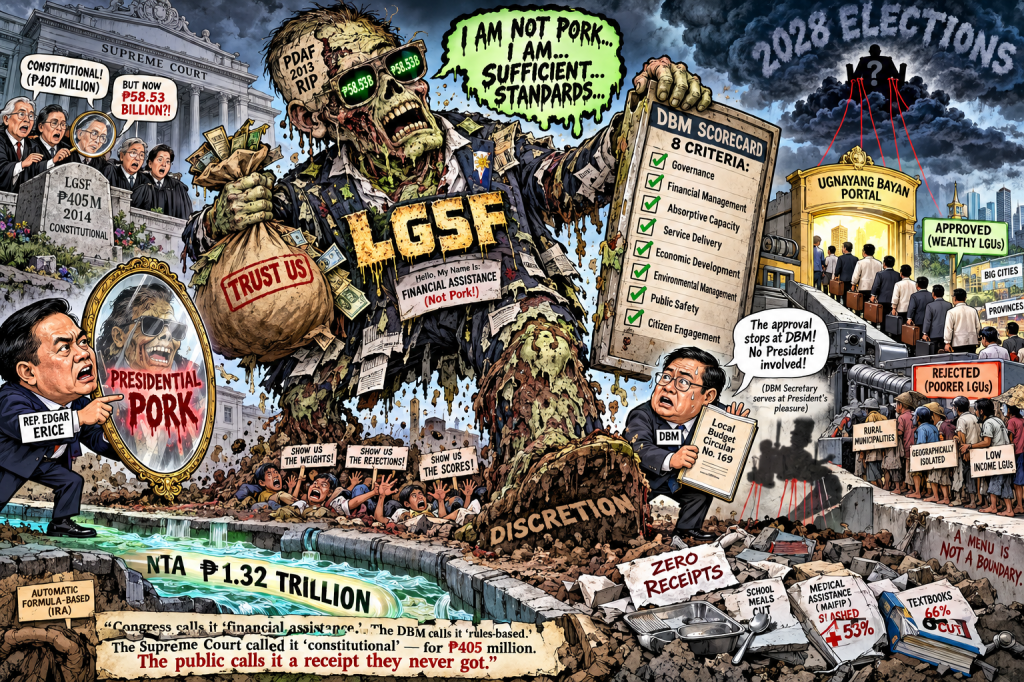
Congress calls it ‘financial assistance.’ Rep. Erice calls it ‘presidential pork.’ The public calls it a receipt they never got
By Louis ‘Barok‘ C. Biraogo — October 2, 2026
The Return of the Pork Barrel
Gather ’round, kweba-kids. Today’s bedtime story is about a fund that died long ago but refused to stay buried.
Back in 2013, the Supreme Court killed the Priority Development Assistance Fund (PDAF) in Belgica v. Ochoa. Pork barrel was unconstitutional. Post-enactment identification of projects by legislators violated separation of powers. The people celebrated. The crooks went underground.
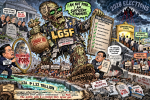
Fast forward to 2026. Congress is deliberating a ₱58.53 billion Local Government Support Fund (LGSF) for 2027. Caloocan Rep. Edgar Erice calls it “presidential pork barrel.” Malacañang says it’s not. The League of Municipalities of the Philippines (LMP) says it’s “equity.” The Department of Budget and Management (DBM) says it’s “rules-based.”
Everyone’s using the right words. That’s usually when you should start counting your silverware.
The Anatomy of a Zombie Fund
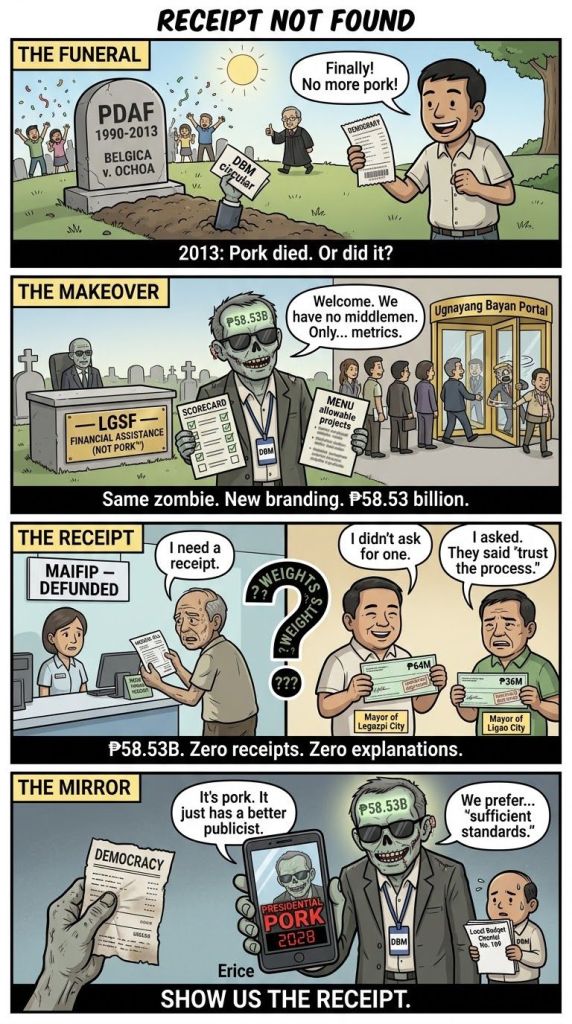
Here’s the thing about the LGSF that nobody wants to say out loud: it’s a zombie. It’s the PDAF that came back from the dead, put on a suit, got a DBM scorecard, and started calling itself “financial assistance to Local Government Units (LGUs).”
The government’s defense is elegant. The LGSF isn’t pork because it’s appropriated by Congress. It’s not pork because LGUs apply directly through the Ugnayang Bayan Portal. It’s not pork because the Supreme Court already upheld it in Belgica. It’s not pork because the DBM has a scorecard.
I want to believe. I really do.
But let me tell you what I see when I look at this fund.
Sufficient Standards or Trust Us?
I see ₱58.53 billion in lump-sum appropriations that are “not individually identified as line items” in the budget according to reporting by the BusinessMirror.
I see Rep. Erice asking the obvious question: “Who determines which LGUs receive assistance, how much they receive, and for what projects?” I see Committee on Appropriations Chair Suansing answering that the DBM “evaluates requests based on parameters and a menu approved by Congress.”
A menu. That’s the level of specificity we’re working with.
Congress says “here’s a pile of money and a menu of what you can spend it on” and calls that “sufficient standards.” The Supreme Court in the Belgica LGSF case agreed, holding that the 2014 General Appropriations Act (GAA) “provides adequate guidelines and limitations to map out the boundaries of the Executive’s authority.”
Boundaries. A menu. Scorecard criteria developed by the DBM “in coordination with relevant agencies.”
This is what constitutional lawyers call “the sufficient standard test.” This is what I call “trust us, we wrote it down somewhere.”
NTA vs. LGSF: Automatic Formula vs. Discretionary Generosity
Let me be clear about what the LGSF actually is, stripped of the press releases.
The National Tax Allotment (NTA)—₱1.32 trillion in the 2027 proposal—is the constitutionally guaranteed share of LGUs. It’s automatic. It’s formula-based. It’s released quarterly without holdbacks. It’s what the Supreme Court in Mandanas v. Ochoa said LGUs are entitled to. It’s the “just share” under Article X, Section 6 of the 1987 Constitution.
The LGSF is what you get when the NTA isn’t enough and the national government decides to be generous.
That’s not a legal distinction. That’s a political one. And political distinctions require political scrutiny.
Centralizing Executive Discretion
The DBM says requests are evaluated through the Ugnayang Bayan Portal without “middlemen.” Great. That’s a genuine improvement over the PDAF system, where legislators were the middlemen, and where the Supreme Court found that post-enactment legislative identification of projects violated the Constitution.
But here’s the problem: eliminating the legislative middleman doesn’t eliminate the executive discretion. It just centralizes it.
Erice asked the right question: “Why concentrate ₱58 billion in a fund that gives the Executive substantial discretion over which local governments will receive assistance, how much they will receive and when the money will be released?”
The DBM’s answer is that the scorecard prevents arbitrary discretion. The scorecard considers governance standards, financial management, absorptive capacity, service delivery, economic development, environmental management, public safety, and citizen engagement.
That’s eight criteria. Eight.
If you’ve ever tried to evaluate anything using eight criteria, you know what happens. You assign weights. You assign scores. And then you discover that the weights and scores are whatever the person doing the evaluation decides they are.
The DBM says it also considers “the necessity of the proposed assistance, just and equitable distribution, and availability of funds.”
Necessity. Equity. Availability. Those aren’t criteria. Those are adjectives.
The Mystery of Local Allocations
Let me show you what an actual allocation looks like:
- Albay Province (2026): Received ₱608 million overall.
- ₱274 million for the provincial government
- ₱10 million each for thirteen municipalities
- ₱30 million for Guinobatan
- ₱30 million for Jovellar
- ₱64 million for Legazpi City
- ₱36 million for Ligao City
- ₱44 million for Tabaco City
- Nueva Vizcaya (2026): Received nearly ₱370 million overall.
- ₱160 million for the provincial government
- ₱10 million each for twelve municipalities
- ₱49.5 million for Ambaguio
- ₱30 million for Villaverde
Why ₱64 million for Legazpi and ₱36 million for Ligao? Both are cities in Albay. Both presumably went through the same scorecard process. Why the difference?
The data doesn’t say. The data never says.
Transparency Gaps and Unchecked Power
The DBM’s defense is that the process is transparent because LGUs apply directly and the DBM evaluates the requests. But transparency isn’t just about who applies. It’s about why some applications succeed and others fail.
Show me the rejected applications. Show me the LGUs that applied for ₱500 million and got nothing. Show me the scores. Show me the weights. Show me the criteria actually applied, not the criteria described.
The BusinessMirror‘s own reporting notes that “some LGSF components are not individually identified as line items” in the budget. That means Congress appropriates the money but doesn’t specify who gets it. The Executive decides.
That’s exactly the structure that Belgica found unconstitutional for the PDAF. The Court said that “the power to appropriate includes the power to specify the project.” If Congress appropriates but the Executive specifies, where does the appropriation power live?
The Level Playing Field Fallacy
The government’s answer is that the LGSF is different because LGUs initiate the requests. It’s bottom-up, not top-down. The money flows to LGUs that ask for it.
But that assumes the playing field is level. It assumes every LGU has the same capacity to apply, the same knowledge of the process, the same ability to develop project proposals that meet the scorecard criteria.
It doesn’t.
The Growth Equity Fund (GEF) exists precisely because some LGUs are “poor, disadvantaged, lagging, and low-income.” Those are the LGUs least likely to have the administrative capacity to navigate a complex application process. Those are the LGUs most dependent on national government support. Those are the LGUs most vulnerable to political pressure.
The Coalition for Participatory Budgeting reportedly noted that the ₱1 billion Participatory Budgeting Support component requires projects to undergo “transparent and inclusive local processes” with Civil Society Organization (CSO) participation. That’s good. That’s genuinely good.
But the ₱37.49 billion Financial Assistance component? That’s not participatory. That’s DBM discretion with a scorecard.
Scaling Up: From ₱405 Million to ₱58.53 Billion
The LGSF’s defenders point to the Supreme Court’s decision in the Belgica case upholding the fund. But that decision was about the 2014 GAA, when the LGSF was ₱405 million. That’s less than 1% of the current proposal.
The Court in 2014 said the fund had “sufficient standards” because the GAA specified the amount and limited its use to “Maintenance and Other Operating Expenses.” The Court found that DBM guidelines “identify the programs and projects for which the LGSF may be expended.”
A ₱405 million fund with a narrow purpose is one thing. A ₱58.53 billion fund with broad purposes and eight scorecard criteria is another.
The Court’s reasoning in 2014 doesn’t necessarily apply to the 2027 proposal. The scale is different. The stakes are different. The political context is different.
The 2028 Election Shadow
And here’s what nobody in the government wants to talk about: the timing.
The 2027 LGSF proposal is ₱58.53 billion. That’s the budget year immediately preceding the 2028 national elections. The fund is described by Erice as a “war chest” for political consolidation. The Palace dismisses this as “negative thinking.”
But let’s be serious for a moment.
The DBM says the LGSF is not a “pork barrel” because it’s appropriated by Congress and implemented by the Executive through rules. But the same was true of the PDAF, which was also appropriated by Congress and implemented by agencies through rules. The problem wasn’t the formal structure. The problem was the informal practice: legislators identified projects, and the formal structure was a fig leaf.
The LGSF’s formal structure is better. No legislative identification. Direct LGU applications. A scorecard. These are improvements.
Informal Risks in the Executive Branch
But the informal risk remains. If the Executive wants to reward allies and punish opponents, it can do so through the scorecard. It can emphasize “governance standards” for some LGUs and “financial management” for others. It can find that an allied LGU’s application is “necessary” and an opponent’s is not.
The DBM says “submitting a request does not guarantee funding.” True. But it also doesn’t guarantee a fair evaluation. And without published criteria weights and published rejection reasons, we can’t tell the difference between a principled decision and a political one.
The government’s best defense is also its most revealing: “The approval, the evaluation, and the approval stops at the level of DBM. This does not need to be submitted to the Office of the President.”
That’s supposed to reassure us that the President isn’t personally deciding which LGUs get money. But the DBM is part of the Executive branch. The DBM Secretary serves at the President’s pleasure. The DBM’s scorecard is “developed by DBM in coordination with relevant agencies.” Those agencies are also part of the Executive.
The LGSF doesn’t need to go to the President’s office because the President’s office already controls the DBM. The distinction between “Executive discretion” and “Presidential discretion” is a distinction without a difference.
Mechanism vs. Purpose
I want to be fair. There’s a genuine case for the LGSF. The NTA formula doesn’t account for poverty incidence, revenue capacity, or cost of service delivery. Poor LGUs need more than their formula share. The Growth Equity Fund explicitly targets “poor, disadvantaged, lagging, and low-income LGUs.” That’s a legitimate equalization purpose.
The problem isn’t the purpose. The problem is the mechanism.
If the goal is equalization, why not make it formula-based? Why not use objective indicators—poverty incidence, local revenue effort, infrastructure deficit—to determine allocations automatically? Why create a discretionary fund with a scorecard that can be adjusted?
The answer, I suspect, is that discretionary funds serve purposes that formula-based funds cannot. They create gratitude. They create leverage. They create the possibility of political reward.
The LGSF’s defenders say the fund is transparent because the DBM publishes guidelines and the Supreme Court upheld it. But transparency isn’t a checklist. It’s a practice. And the practice of the LGSF is to publish just enough to satisfy the formal requirements while keeping the actual allocation decisions opaque.
Documented Failures: The Cebu City Audit
Show me the dashboard. Show me the applications. Show me the scores. Show me the rejections. Show me the contractors. Show me the outcomes.
The DBM says beneficiary LGUs are subject to “monitoring, evaluation, reporting, transparency, and public disclosure requirements.” But the Commission on Audit (COA) has already found that LGSF projects in Cebu City went unimplemented for years, with unexpended balances not reverted. The audit body found that the city failed to comply with disclosure requirements, with the focal person “unaware of the obligation to post the reports in three conspicuous places.”
That’s not a hypothetical risk. That’s a documented failure.
Conclusion: Demanding Proof Over Promises
The LGSF is not the PDAF. It’s better structured. It’s better documented. It’s better defended.
But it’s still a lump sum. It’s still discretionary. It’s still allocated through a process that the public cannot fully scrutinize.
And that’s the problem.
A fund that cannot be audited by the public is a fund that cannot be trusted. A process that cannot be tested is a process that cannot be defended. A ₱58.53 billion mystery is not an equalization instrument. It’s a political instrument with an equalization label.
The government says “trust us.” The data says “show us.”
Show us the criteria. Show us the weights. Show us the rejected applications. Show us the political-neutrality analysis. Show us that an opposition LGU with high poverty incidence and low revenue capacity receives the same treatment as an administration ally with the same indicators.
If you can’t show us that, then Erice is right. It’s pork. It just has a better publicist.
Key Citations
A. Legal Cases & Constitutional Provisions
- Supreme Court of the Philippines. Belgica v. Ochoa. G.R. No. 208566, 19 Nov. 2013, https://lawphil.net/judjuris/juri2013/nov2013/gr_208566_2013.html.
- Supreme Court of the Philippines. Mandanas v. Ochoa. G.R. No. 199802, 3 July 2018, https://lawphil.net/judjuris/juri2018/jul2018/gr_199802_2018.html.
- Constitutional Commission of 1986. The 1987 Constitution of the Republic of the Philippines, Article X, Section 6, Official Gazette, https://www.officialgazette.gov.ph/constitutions/1987-constitution/.
B. Official Government Reports & Portals
- Commission on Audit (COA). Annual Audit Reports on Local Government Units. Government of the Philippines, https://www.coa.gov.ph/.
- Department of Budget and Management (DBM). Local Government Support Fund (LGSF) Guidelines and Ugnayang Bayan Portal. Government of the Philippines, https://www.dbm.gov.ph/.
C. News & Media Coverage
- “Beyond the LGSF Controversy: Why Equalization Matters More than the Amount.” BusinessMirror, 28 Sept. 2026, https://businessmirror.com.ph/2026/09/28/beyond-the-lgsf-controversy-why-equalization-matters-more-than-the-amount/.
- “No Middleman: LGUs to Directly Seek P58.53-B Local Fund; Releases Transparent, Rules-Based — DBM.” Department of Budget and Management, Republic of the Philippines, 15 Sept. 2026, https://www.dbm.gov.ph/index.php/management-2/4233-no-middleman-lgus-to-directly-seek-p58-53-b-local-fund-releases-transparent-rules-based-dbm.
- “Solon Flags ₱58.53-B Local Government Support Fund as Possible Pork in 2027 Budget.” BusinessMirror, 15 Sept. 2026, https://businessmirror.com.ph/2026/09/15/solon-flags-%e2%82%b158-53-b-local-government-support-fund-as-possible-pork-in-2027-budget/#1.
- “Budgeting for 2028? Erice Slams P58-B LGSF ‘Pork’ Amid Deep Cuts to Medical Aid, School Meals.” Politiko, 8 Sept. 2026, https://politiko.com.ph/budgeting-for-2028-erice-slams-p58-b-lgsf-pork-amid-deep-cuts-to-medical-aid-school-meals/.
- Calipay, Connie. “Albay to Receive P608-M from PBBM’s Local Government Support Fund.” Philippine News Agency, 20 Feb. 2026, https://www.pna.gov.ph/articles/1269418.
- Magsumbol, Caecent No-ot. “City Eyes New Funds Amid COA Findings.” The Freeman, Philstar.com, 24 July 2026, https://www.philstar.com/the-freeman/cebu-news/2026/07/24/2544315/city-eyes-new-funds-amid-coa-findings.

- ₱9 Billion in ‘Savings’? DILG’s Fire Truck Deal Smells Like Smoke

- ₱8B BBM Pork: CCTV for Every Captain’s Kumpare?
- ₱8.9 Billion, 331 Ghost Police Stations: The TIKAS Scandal Explained

- ₱8.4 Billion, 42,000 Barangays, 1 Election: The “Bawat Barangay Makikinabang” Vote-Buying Masterclass

- ₱75 Million Heist: Cops Gone Full Bandit

- ₱63 to the Dollar: The Only Thing Falling Faster Than the Peso Is the Government’s Credibility

- ₱6.77B Ghost Haunts Duterte: RTC Dismisses Mans Carpio’s Desperate Plea
- ₱6.77 Billion and Zero Cash: The Sara Duterte SALN Math That Doesn’t Add Up

- ₱6.7-Trillion Temptation: The Great Pork Zombie Revival and the “Collegial” Vote-Buying Circus

- ₱58.53B, Zero Receipts: The LGSF Pork Barrel Nobody Wants to Name
- ₱53 Million Man Tells ₱695-a-Day Workers to Stop Being ‘Mayabang’: The Audacity of BSP’s Remolona
- ₱4.4 Billion and a Witness Who Can’t Explain It: The Duterte Impeachment’s Most Expensive Non-Answer





Leave a Reply