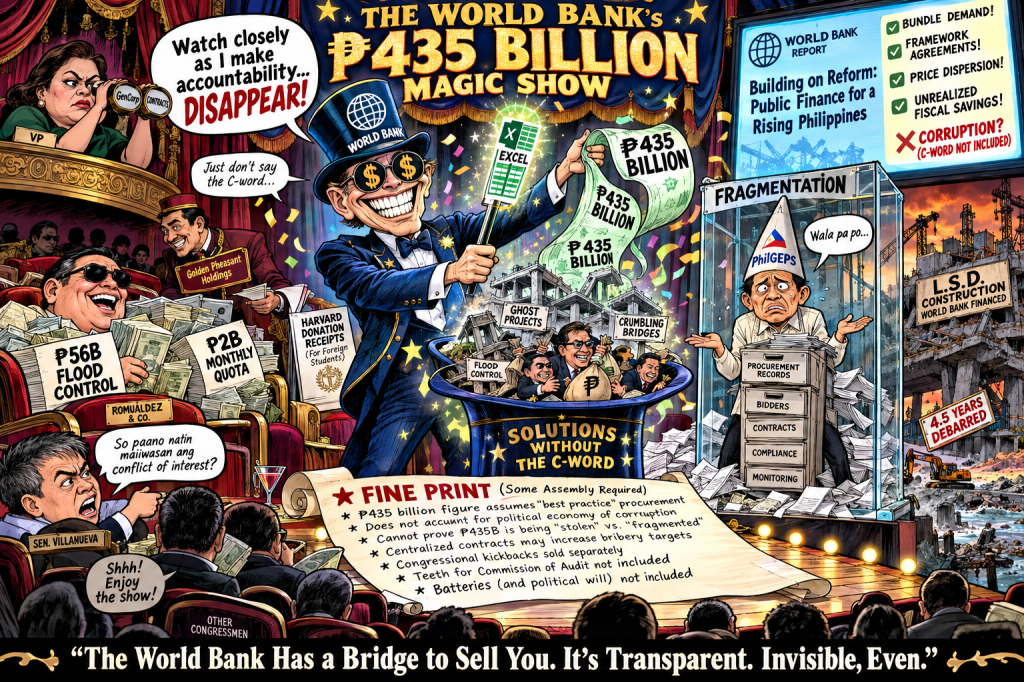
A Masterclass in Saying ‘Corruption’ Without Ever Saying ‘Corruption’—Featuring Special Guest, the ₱1 Trillion Flood Control Scandal
By Louis ‘Barok’ C. Biraogo — October 1, 2026
THE World Bank has done it again. In a feat of academic prestidigitation that would make a Las Vegas magician blush, the multilateral lender has conjured ₱435 billion from thin air—or rather, from the fertile imagination of spreadsheet economists who apparently believe that the Philippines’ procurement system is merely “fragmented” rather than fundamentally rotten to the core.
The report, released on September 28, 2026, is titled “Building on Reform: Public Finance for a Rising Philippines.” The subtitle should really be: “How to Sound Like You’re Solving Corruption Without Actually Saying the C-Word.”
Let’s unpack this masterpiece of diplomatic obfuscation.
The Magic Number
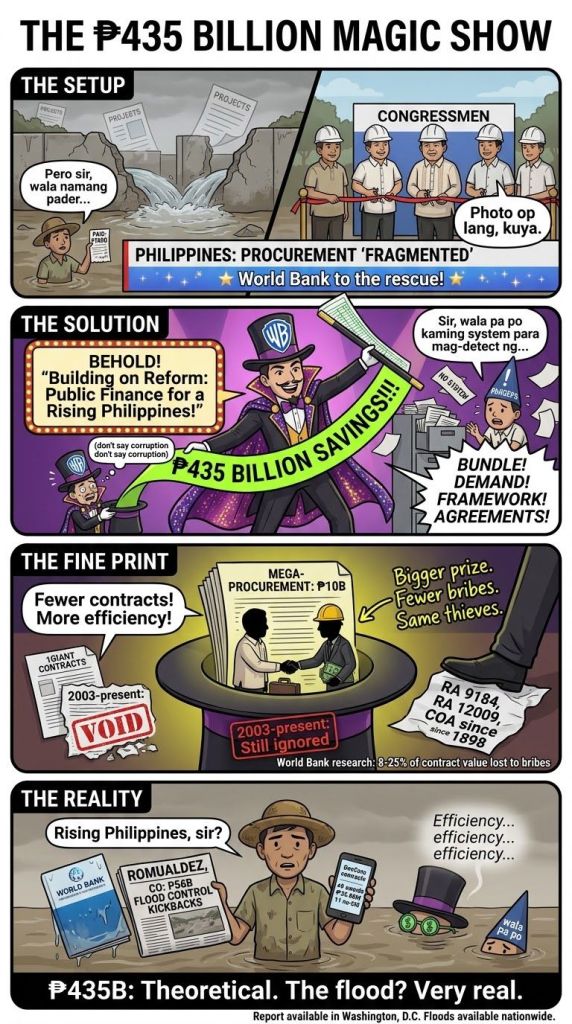
The World Bank’s central claim is that the Philippines could save up to ₱435 billion annually by “consolidating procurement” and negotiating “framework agreements” with suppliers. That’s 1.8 to 2.0 percentage points of Gross Domestic Product (GDP), they say.
How convenient.
You see, the World Bank has a problem. The Philippines is in the middle of what may be the largest corruption scandal in recent memory—a flood control fiasco involving ghost projects, congressional kickbacks, and estimates of losses ranging from ₱180 billion to ₱1 trillion.
The scandal has implicated everyone from Department of Public Works and Highways (DPWH) engineers to sitting congressmen. The public is furious. The President is scrambling. And the international community is watching.
So what does the World Bank do? It releases a report that conveniently reframes systemic corruption as a “procurement efficiency problem.”
It’s not theft, you see. It’s “fragmentation.” It’s not kickbacks. It’s “price dispersion.” It’s not ghost projects. It’s “unrealized fiscal savings.”
The linguistic gymnastics here are Olympic-level.
“Bundling Demand” and Other Euphemisms
Let me explain the World Bank’s grand solution, as articulated by Senior Economist Jaffar Al-Rikabi: the government should “bundle demand” and negotiate “framework agreements” with major suppliers. This, apparently, will magically save ₱435 billion.
Translation: The government should centralize procurement into fewer, larger contracts.
Do you know what else is a “larger contract”? A bigger target for corruption.
The World Bank’s own research acknowledges that procurement is among the most corruption-vulnerable government activities, with 8–25% of contract value lost to bribes. Yet their solution to this problem is to make contracts larger and fewer.
This is like responding to a wildfire by pouring gasoline on it and hoping the flames burn themselves out.
If ₱10 billion is split among 1,000 contracts, a corrupt network must manipulate many transactions. If ₱10 billion is consolidated into five contracts, the prize becomes enormous—and the number of people who need to be bribed shrinks dramatically.
The World Bank calls this “efficiency.” I call it creating a procurement oligopoly on both the buyer and seller sides.
The Great Data Illusion
Then there’s the Philippine Government Electronic Procurement System (PhilGEPS) angle.
During the Senate impeachment trial of Vice President Sara Duterte—yes, that’s the context in which procurement is being discussed—PhilGEPS Division Chief Rendell Sopeña testified that the current system cannot detect collusion, repetitive awards, or beneficial ownership overlaps.
“The current procuring system, wala pa po,” he said.
The system that manages ₱6–7 trillion in annual government procurement is essentially a glorified filing cabinet. It stores documents. It doesn’t analyze them. It doesn’t flag anomalies. It doesn’t connect dots.
Sopeña admitted that PhilGEPS is “heavily dependent” on what procuring entities enter into the system. If a local government unit (LGU) wants to award 11 contracts through “small-value procurement” to a company linked to the mayor’s sister, PhilGEPS will faithfully record it—and nothing more.
Senator Joel Villanueva put it bluntly: “So ang hirap po sabihin sa publiko na may maaasahan po kami na natukoy o maiwasan ‘yung anumang direct or indirect conflict of interest.”
Sopeña’s response: “With this case, I agree, Your Honor.”
Let that sink in.
The government’s own procurement system cannot detect conflicts of interest. And the World Bank thinks the solution is more centralization? Centralization into what? A system that doesn’t know what it’s storing?
The “No New Taxes” Sleight of Hand
The World Bank’s report is being sold as a way to generate fiscal space “without raising statutory tax rates.”
This is technically true but practically misleading.
Rationalizing Value-Added Tax (VAT) exemptions? That’s a tax increase on affected sectors. Streamlining corporate tax incentives? That’s a tax increase on businesses currently enjoying those incentives. Expanding e-invoicing and audits? That’s a compliance burden that functions as a de facto tax on informal businesses.
The World Bank knows this. They just prefer the softer language of “broadening the tax base.”
It’s the same trick they’ve been pulling for decades: reframe tax increases as “efficiency measures” and hope nobody notices.
The L.S.D. Precedent: The World Bank’s Own Track Record
Here’s the most delicious irony of all.
In May 2025, the World Bank debarred L.S.D. Construction & Supplies, a Philippine company, for 4.5 years over “collusive, fraudulent, and corrupt practices” in a World Bank-financed rural development project.
The company had:
- Entered undisclosed arrangements to use its credentials for bids
- Secretly subcontracted work to entities lacking qualifications
- Made improper payments to secure contracts and process invoices
This is a company operating inside a World Bank-financed project—with World Bank oversight, World Bank procurement rules, and World Bank monitoring.
And it still committed fraud.
If the World Bank cannot prevent corruption in its own projects, why should anyone believe that its recommendations will magically work for the entire Philippine government?
The GenCorp Distraction
Meanwhile, the actual procurement scandal unfolding in the Senate impeachment trial involves GenCorp Industries, a company linked to Vice President Sara Duterte. PhilGEPS records show 49 government contracts worth ₱35.88 million, including 15 from Davao City.
Of those 15 Davao City contracts, 11 did not undergo public bidding. They were awarded through “negotiated small-value procurement.”
The Vice President declared GenCorp as a business interest in her Statements of Assets, Liabilities and Net Worth (SALNs), though Securities and Exchange Commission (SEC) records don’t list her as an incorporator or director.
The prosecution calls this a “three-hit” violation: prohibition on owning a business, prohibition on operating a business, and conflict of interest.
This is exactly the kind of case that the World Bank’s procurement reforms are supposed to prevent. Yet the system that would need to detect this—PhilGEPS—cannot even flag it.
And the World Bank’s response? Consolidate procurement. Bundle demand. Negotiate framework agreements.
It’s like prescribing aspirin for a gunshot wound.
What the World Bank Won’t Say
Here’s what the World Bank’s report doesn’t say:
- It doesn’t say that ₱435 billion is being stolen. (Because they can’t prove it.)
- It doesn’t say that centralized procurement will reduce corruption. (Because it might increase it.)
- It doesn’t say that the Philippines lacks procurement laws. (It has Republic Act (RA) 9184, RA 12009, and a dozen others.)
- It doesn’t say that the problem is political will. (Because that would offend its hosts.)
What it does say is that the Philippines could save money through “efficiency measures.” Which is technically true and practically useless.
The Philippines has had procurement laws since 2003. It has had competitive bidding requirements for decades. It has had the Commission on Audit since 1898.
And yet here we are, in 2026, discussing a flood control scandal involving hundreds of billions of pesos in ghost projects.
The problem is not a lack of rules. The problem is that the people enforcing the rules are the same people benefiting from breaking them.
The Bottom Line
The World Bank’s ₱435 billion figure is not a discovery. It’s a hypothesis dressed up as a fact. It’s a modeling exercise that assumes the Philippines can achieve “best practice” procurement without addressing the political economy that makes corruption profitable.
Until congressional leaders face prosecution for the billions in alleged payoffs. Until sitting legislators are barred from holding government contracts. Until the Commission on Audit is given teeth. Until PhilGEPS can actually detect the fraud happening in its own database.
₱435 billion remains a theoretical number in a Washington report.
And the World Bank remains what it has always been: an institution that is very good at diagnosing problems and very bad at prescribing solutions that account for the messy reality of Philippine politics.
But hey, at least the report has a nice title. “Building on Reform: Public Finance for a Rising Philippines.”
Rising, indeed. Rising tide of unpunished corruption, more like it.
Louis ‘Barok’ C. Biraogo is the author of the Kweba ni Barok blog. He has been described as “the Philippines’ answer to a question nobody asked, except with more swearing and less prestige.”
Key Citations
A. Reports & Studies
- World Bank. Building on Reform: Public Finance for a Rising Philippines. World Bank Group, 28 Sept. 2026, https://www.worldbank.org/en/news/press-release/2026/09/28/philippines-could-unlock-up-to-7-1-percent-of-gdp-in-fiscal-gains.
- Bosio, Erica, et al. “Does Regulating Government Procurement Reduce Corruption?” Peterson Institute for International Economics, 10 Aug. 2020, https://www.piie.com/blogs/trade-and-investment-policy-watch/does-regulating-government-procurement-reduce-corruption.
- World Bank. “Data Analytics against Corruption: Advancing Accountability in Public Spending.” World Bank Blogs, 4 Dec. 2025, https://blogs.worldbank.org/en/governance/data-analytics-against-corruption–advancing-accountability-in-p.
B. News Articles
- Yu, Lance Spencer, and Marian Hukom. “Philippines Should Fix Tax Gaps and Procurement, Not Raise Tax Rates – WB.” Rappler, 28 Sept. 2026, https://www.rappler.com/business/tax-gap-procurement-world-bank-reforms-philippines/.
- Mangaluz, Jean. “P180 Billion Lost to Ghost Flood Control Projects since 2016 — Lacson.” Philstar.com, 3 Dec. 2025, https://www.philstar.com/headlines/2025/12/03/2491635/p180-billion-lost-ghost-flood-control-projects-2016-lacson.
- “The Massive, Layered Architecture of PH Infra Corruption.” Inquirer Opinion, 22 Oct. 2025, https://opinion.inquirer.net/186896/the-massive-layered-architecture-of-ph-infra-corruption.
- Associated Press. “Philippine Flood-Control Projects Made Substandard to Allow Huge Kickbacks, Senate Inquiry Told.” AP News, 23 Sept. 2025, https://apnews.com/article/philippines-flood-control-corruption-inquiry-6ec985cb21d1c14ba617a57b9f223974.
- Balagtas, Camille P. “PhilGEPS: GenCorp Got P35.88M in 49 Gov’t Contract Awards after Sara Became VP.” Journal News Online, 22 Sept. 2026, https://journalnews.com.ph/philgeps-gencorp-got-p35-88m-in-49-govt-contract-awards-after-sara-became-vp/.
- “Davao City, PhilGEPS Figures Differ on GenCorp Deals.” Philippine News Agency, 28 Sept. 2026, https://www.pna.gov.ph/articles/1284963.
- “Ombudsman: Romualdez, Co ‘Masterminds’ of P56-B Flood Control Kickbacks.” Bilyonaryo News Channel, 5 May 2026, https://bnc.bilyonaryo.com/ombudsman-romualdez-co-masterminds-of-p56-b-flood-control-kickbacks/news/.
- Mencias, Eileen. “No New Taxes Needed: PH Could Save P435B by Fixing Gov’t Procurement, World Bank Says.” Bilyonaryo Business, 28 Sept. 2026, https://bilyonaryo.com/no-new-taxes-needed-ph-could-save-p435b-by-fixing-govt-procurement-world-bank-says/.
C. Official Websites
- World Bank Group. “World Bank Group Debars L.S.D. Construction & Supplies.” World Bank, 28 May 2025, https://www.worldbank.org/en/news/press-release/2025/05/28/-world-bank-group-debars-l-s-d-construction-supplies.
- Republic of the Philippines. Republic Act No. 9184. Official Gazette, 10 Jan. 2003, https://www.officialgazette.gov.ph/2003/01/10/republic-act-no-9184/.
- Government Procurement Policy Board. “New Government Procurement Act or Republic Act No. 12009.” GPPB-TSO, 20 July 2024, https://www.gppb.gov.ph/new-government-procurement-act-or-republic-act-no-12009/.
- Philippine Government Electronic Procurement System. PhilGEPS, https://www.philgeps.gov.ph/.
- Commission on Audit. Commission on Audit, https://www.coa.gov.ph/.

- ₱9 Billion in ‘Savings’? DILG’s Fire Truck Deal Smells Like Smoke
- ₱8B BBM Pork: CCTV for Every Captain’s Kumpare?
- ₱8.9 Billion, 331 Ghost Police Stations: The TIKAS Scandal Explained

- ₱8.4 Billion, 42,000 Barangays, 1 Election: The “Bawat Barangay Makikinabang” Vote-Buying Masterclass
- ₱75 Million Heist: Cops Gone Full Bandit

- ₱63 to the Dollar: The Only Thing Falling Faster Than the Peso Is the Government’s Credibility
- ₱6.77B Ghost Haunts Duterte: RTC Dismisses Mans Carpio’s Desperate Plea
- ₱6.77 Billion and Zero Cash: The Sara Duterte SALN Math That Doesn’t Add Up

- ₱6.7-Trillion Temptation: The Great Pork Zombie Revival and the “Collegial” Vote-Buying Circus

- ₱58.53B, Zero Receipts: The LGSF Pork Barrel Nobody Wants to Name
- ₱53 Million Man Tells ₱695-a-Day Workers to Stop Being ‘Mayabang’: The Audacity of BSP’s Remolona
- ₱4.4 Billion and a Witness Who Can’t Explain It: The Duterte Impeachment’s Most Expensive Non-Answer



Leave a Reply