No Structure Found, Fully Paid: Inside the COA Report That Exposed ₱83 Million in Phantom Classrooms
By Louis ‘Barok’ C. Biraogo — September 30, 2026
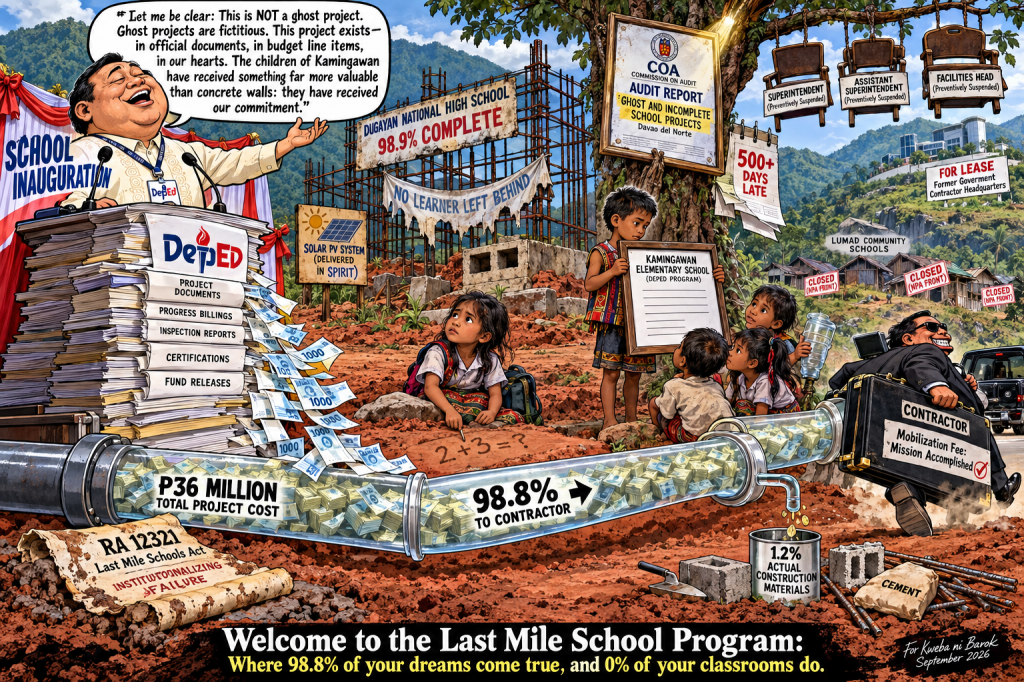
THE Commission on Audit (COA) has discovered that you can pay 98.8% of a ₱36-million school building contract and have absolutely nothing to show for it. Not a foundation. Not a wall. Not a single hollow block. Just the warm, fuzzy feeling of knowing that somewhere, a contractor is sleeping soundly on a bed made of your tax pesos.
This is the story of Davao del Norte’s Last Mile Schools Program (LMSP)—a heartwarming initiative designed to bring classrooms to the Lumad children of Talaingod. The noble goal: reach geographically isolated and disadvantaged areas that other government projects forgot. The reality: the government paid for schools that exist only in the fevered imaginations of procurement officials and the bank accounts of contractors.
Kamingawan Elementary School: A Masterclass in Spectral Construction
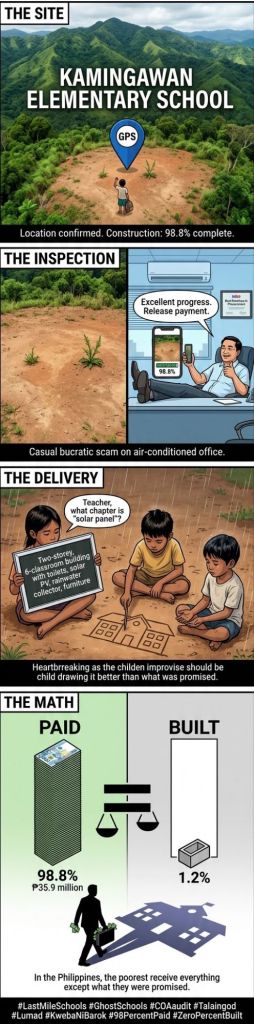
At Kamingawan Elementary School in Talaingod, COA found—and I quote, because you cannot make this up—”no structure found upon inspection but paid up to 98.8 percent.”
Let me translate. The government’s payment system looked at a patch of dirt and said, “Yes, this is 98.8% complete.” This is the accounting equivalent of paying for a steak dinner and receiving a photograph of a cow.
Department of Education (DepEd) Davao del Norte spokesperson Jenelito Atillo objected to the term “ghost project,” insisting the more accurate description was “not implemented” because the project existed in official program documents. Ah, yes. The project existed in documents. Documents are the only thing that did exist. The children of Kamingawan got documents. They can frame them and hang them where the classroom was supposed to be.
Atillo’s distinction is legally fascinating and morally bankrupt. A “ghost project,” he suggests, would be entirely fictitious. But this project was real in the sense that it appeared in the budget, was awarded to a contractor, and was paid for. It just didn’t exist physically. That’s not a ghost. That’s a zombie—a project that is legally alive but physically dead, stumbling through the procurement system consuming public funds.
The contractor received 98.8% of the contract amount—roughly ₱35.9 million for a school that doesn’t exist. At what point does someone look at a site with no building and say, “Excellent progress. Here’s your money”? Was there a progress billing for “existential contemplation of construction”? A certificate of completion for “vibes”?
Dugayan National High School: Where the Frame Is the Thing
At Dugayan National High School in Kapalong, COA found a ₱25.61-million project “largely incomplete and abandoned,” with “only the structural frame constructed.” Paid: 98.9%.
So the government paid nearly the full contract price for a building that consists of a frame. Just the skeleton. The construction equivalent of a stick figure. If you squint, it looks like a school. If you don’t squint, it looks like the contractor walked off the job after discovering that building things requires effort.
The project was supposed to include a two-storey, six-classroom building with toilets, rainwater collector, school furniture, solar PV system, and water system. What was actually delivered: the structural frame. That’s like ordering a seven-course meal and receiving a plate.
Where is the rest of it? Did the solar panels evaporate? Did the toilets ascend to a higher plane of existence? These are the questions the COA report does not answer, perhaps because the auditors were too stunned by the sheer audacity of the thing.
Dulyan Integrated School: The Solar Panels That Never Were
At Dulyan Integrated School, also in Talaingod, the school building and rainwater system were actually constructed. Progress! But the solar PV energy system and school furniture were not delivered. Paid: 98.8%.
So you have a building with no power and no desks. The children can attend class in a dark, empty room. That’s not a school; that’s a metaphor for the entire Philippine education system.
The contractor presumably submitted documentation claiming the solar panels and furniture had been delivered. Did anyone check? Or did the inspection consist of a phone call asking, “Everything good there?” and a contractor saying, “Absolutely, boss,” before hanging up and laughing all the way to the bank?
The Supporting Cast of Spectral Projects
The COA report also flagged a ₱10.42-million electrification project covering New Casay Integrated School and Carmen National High School, where distribution transformers and panel boards “remain uninstalled and undelivered.” At Carmen National High School, the transformers were, in COA’s immortal phrasing, “remain installed and undelivered”—a sentence so beautifully contradictory it deserves its own philosophical treatise.
Then there’s the ₱7.53-million repair project at Datu Balong National High School, where four classrooms were “unrepaired but claimed as implemented and paid up to 98.18 percent.” Unrepaired. Claimed as implemented. Paid. In what universe does “unrepaired” translate to “implemented”?
And finally, the ₱3.32-million health facility project at Gov. Dujali Elementary School, which COA described as “largely incomplete and abandoned.” The COA report helpfully notes this project “had no progress billing but had a mobilization cost.” Mobilization cost. The contractor mobilized. What did they mobilize? Their bank account? Their ability to disappear?
The Three Suspended Officials: Sacrificial Lambs or Architects of the Heist?
Three DepEd Davao del Norte officials—the schools division superintendent, assistant schools division superintendent, and schools facilities section head—were placed under 90-day preventive suspension. DepEd-11 spokesperson Atillo helpfully reminded the public that “preventive suspension does not necessarily mean the officials are guilty.”
No, of course not. Preventive suspension means only that the evidence is sufficiently troubling that the government would prefer these people not to have access to the office shredder while the investigation proceeds. It’s the bureaucratic equivalent of “you’re not fired, you’re just being asked to stay home while we figure out how many felonies you’ve committed.”
Governor Edwin Jubahib expressed dismay, saying the classrooms are important for the children and that the money should be returned and the schools built. This is a refreshingly straightforward position: the money was stolen, please give it back, and also, maybe build the schools. One wonders why this needed to be said aloud.
The Lumad Dimension: Ghost Schools for a Disappeared People
Here is where the story ceases to be merely a procurement scandal and becomes something darker.
The LMSP was launched in 2019, ostensibly to reach indigenous communities in geographically isolated and disadvantaged areas. In Talaingod, the beneficiaries are Lumad children—members of the Ata-Manobo tribe systematically marginalized by successive governments.
Between 2017 and 2020, over 200 Lumad schools across Mindanao were forcibly closed under the Duterte administration’s counterinsurgency campaign. These schools, including those run by the Salugpungan Ta’Tatanu Igkanugon Learning Center, were red-tagged as fronts for the New People’s Army (NPA). Volunteer teachers, including former lawmakers, were prosecuted and convicted for helping Lumad children.
The LMSP was supposed to be the government’s replacement—a state-sanctioned alternative to the community schools it had shut down. The message was clear: We will educate your children, not these communist-influenced outsiders.
And then the government didn’t build the schools.
Sabokahan, an indigenous women’s advocacy group, called the DepEd lapses “cruel.” SOS Network Mindanao noted that “in Talaingod, an unfinished classroom is not a minor bureaucratic lapse. It determines whether a child walks hours to school, studies in unsafe conditions, or stops attending altogether.”
Former Bayan Muna Representative Eufemia Cullamat, a Lumad leader, argued the probe should extend beyond DepEd to all government-funded projects in Talaingod, citing a 2024 COA report that flagged defects in the National Housing Authority’s (NHA) ₱20-million “Pabahay sa Lumad” housing projects.
“If the whole-of-government achieves peace and development, the whole-of-government should also be held accountable,” Cullamat said. “Credit cannot be collective, but responsibilities are only for a few if there is a serious problem.”
The math is brutal. The Lumad schools were closed. The replacement schools were paid for. The replacement schools don’t exist. The children have nothing.
Was this deliberate? The COA report does not allege intentional targeting of indigenous communities. But when you close community schools, promise state alternatives, and then deliver ghost projects to the same communities, the effect is indistinguishable from malice. Incompetence, when it falls disproportionately on the most vulnerable, becomes a policy.
The Broader LMSP Failure: A Pattern, Not an Anomaly
If Davao del Norte were an outlier, we could chalk this up to a particularly ambitious local racket. But the LMSP has been failing nationwide.
A 2024 COA report found that only 22 out of 98 LMSP projects centrally procured by DepEd were completed by 2023, despite ₱211.2 million in mobilization fees already paid. Three contractors handling four lots were over 500 days late. One contractor handling projects worth ₱327.8 million had become unreachable.
The COA report noted that DepEd’s “inaction in taking remedial measures in a timely manner” contributed to the delays, and that “the learners from far-flung communities were denied access to quality education and did not benefit from the project’s target that no learner is left behind.”
“No learner left behind.” It’s a beautiful slogan. It looks great on banners. It means nothing when the classrooms don’t exist.
The Mechanics of a Ghost Project: How Do You Pay for Nothing?
The COA report recommends termination of all contracts, blacklisting proceedings against contractors, fact-finding investigations to determine accountability, recovery of paid progress billings, and the filing of appropriate administrative, criminal, and civil charges.
But the fundamental question remains: How does this happen?
The payment chain involves multiple checkpoints. Someone must measure physical accomplishment. Someone must certify it. Someone must approve the progress billing. Someone must process the disbursement. Someone must record the asset.
For a ghost project to be paid 98.8%, one of two things must be true: either every single person in that chain was catastrophically negligent, or some of them were actively complicit.
The COA report recommends “a joint validation of completely delivered items by the Schools Facilities Division, Property/Supply Division and Accounting Division.” This recommendation would be laughable if it weren’t so damning: the COA is essentially saying the people who were supposed to validate deliveries never actually did so, and now someone else needs to do their job for them.
The Legal Reckoning: Estafa, Malversation, or Just Business as Usual?
Under Philippine law, the potential charges are serious. Estafa under Article 315 of Act No. 3815 (Revised Penal Code) covers fraud committed with false pretense—such as submitting progress billings for work that doesn’t exist. Malversation under Article 217 of the Revised Penal Code applies when public officers misappropriate funds or, through negligence, permit others to take them. Graft under Republic Act No. 3019 (Anti-Graft and Corrupt Practices Act), Section 3(e) penalizes causing undue injury to government through “manifest partiality, evident bad faith, or gross inexcusable negligence.”
The Supreme Court has been clear that these charges require proof of specific elements. In Rivera v. People, the Court stressed that an irregular procurement alone does not establish criminal liability without proof of the required mental state. The prosecution must show that officials knew the project was incomplete or should have known and acted with gross inexcusable negligence anyway.
The 98.8% payment rate for a non-existent school creates a powerful evidentiary foundation. It suggests either that the officials responsible for certifying accomplishment were utterly derelict in their duties or actively participating in fraud. The “good faith reliance” defense—claiming officials simply trusted the contractor’s documentation—becomes harder to sustain when the documentation describes a building that doesn’t exist.
The Ombudsman now faces a test of its own credibility. Will it pursue charges with the same vigor it applies to opposition politicians, or will Davao del Norte’s status as a political bellwether temper its enthusiasm?
The New Law: A Band-Aid on a Hemorrhage
In July 2026, President Marcos signed Republic Act No. 12321 (Last Mile and GIDA Schools Act), which institutionalizes support for schools in geographically isolated and disadvantaged areas. The law mandates a National Last Mile and GIDA Schools Map, accessibility standards ensuring schools within three kilometers of students’ homes, and a comprehensive support package for teachers.
It is a beautiful law. It has all the right provisions. It will do absolutely nothing to address the fundamental problem revealed by the Davao del Norte scandal: the government’s inability to verify that money spent actually produces physical results.
A law cannot build a school. A law cannot inspect a construction site. A law cannot look at a patch of dirt and say, “This is not a classroom.”
The Davao del Norte ghost projects occurred under the existing procurement framework. Adding another law to the pile does not fix the control failures that allowed 98.8% payment for a building that doesn’t exist. What is needed is not more legislation but basic competence: someone to visit the site, someone to measure the work, someone to refuse payment when the deliverable is imaginary.
The Question That Should Haunt Every Official in This Chain
Here is the question the COA report, for all its damning findings, does not fully answer: Who benefited?
The contractors received nearly full payment for work they didn’t perform. But contractors do not operate in a vacuum. They submit billings to government officials. Those officials certify accomplishment. Those certifications authorize payment. Someone, somewhere, signed documents stating that a school existed where none did.
The COA report’s recommendation for a “fact-finding investigation to determine the accountability of concerned officials” is bureaucratic language for “we know someone did something wrong, and we need to figure out who.”
The preventive suspension of three top DepEd Davao del Norte officials suggests COA and DepEd have identified suspects. But the question of motivation remains unaddressed. Was this simple negligence—officials overwhelmed by the challenges of monitoring remote construction and relying on fraudulent documentation? Or was it something more sinister—a deliberate scheme to extract public funds through ghost projects, with kickbacks flowing back to officials who certified the work?
The 98.8% payment rate is the smoking gun. No rational system of inspection and certification could produce that result for a non-existent building. Someone, somewhere, decided to pay for a school that didn’t exist. The investigation must determine whether that decision was made through incompetence, corruption, or—most likely—some combination of both.
The Lumad Children Who Will Never See Their Classroom
Let us end where the COA report begins: the children.
The children of Kamingawan, Dulyan, Dugayan, and the other communities affected by these ghost projects were promised classrooms. They were promised solar power and school furniture and rainwater collectors. They were promised an education.
What they received was a COA audit report and a 90-day suspension of officials who may or may not be held accountable. They received a new law that institutionalizes the program that failed them. They received, once again, the message that in the Philippines, the poorest and most marginalized are always the last to receive anything—except, of course, the bill.
The ₱83.26 million that was supposed to build their schools is somewhere. Some of it is in the contractors’ bank accounts. Some of it may have found its way into the pockets of officials who signed the certifications. None of it built a classroom.
The COA report recommends recovery of the funds. But you cannot recover what was never real. The Kamingawan Elementary School exists only in documents, in audit findings, in the hollow promises of a government that has forgotten what public service means.
And somewhere in Talaingod, a Lumad child is still waiting for a classroom that will never be built, paid for with money that will never be recovered, from a government that will never truly be held accountable.
Welcome to the Philippines. Where the ghosts of projects past haunt the living children of the present, and no one goes to jail.
Louis ‘Barok’ C. Biraogo is the author of the Kweba ni Barok blog and a recovering optimist about Philippine governance. He can be reached at the nearest COA audit site, preferably one that actually exists.
Key Citations
A. Legal & Official Sources
- Act No. 3815. An Act Revising the Penal Code and Other Penal Laws (Revised Penal Code). 1930, lawphil.net/statutes/acts/act_3815_1930.html.
- Republic Act No. 3019. Anti-Graft and Corrupt Practices Act. 1960, http://www.officialgazette.gov.ph/1960/08/17/republic-act-no-3019/.
- Republic Act No. 12321. An Act Institutionalizing Support for Public Basic Education Schools in Geographically Isolated and Disadvantaged Areas (GIDA) and Underserved Communities, and Appropriating Funds Therefor (Last Mile and GIDA Schools Act). 2026, http://www.officialgazette.gov.ph/2026/07/22/republic-act-no-12321/.
- Rivera v. People, G.R. No. 228154. Supreme Court of the Philippines, 16 Oct. 2019, lawphil.net/judjuris/juri2019/oct2019/gr_228154_2019.html.
- Commission on Audit. Annual Audit Reports. Commission on Audit, http://www.coa.gov.ph/reports/annual-audit-reports/.
B. News Reports
- Chi, Cristina. “DepEd’s Classroom Construction in Remote Areas Delayed by up to 555 Days — COA.” Philstar.com, 26 Dec. 2024, http://www.philstar.com/headlines/2024/12/26/2409936/depeds-classroom-construction-remote-areas-delayed-555-days-coa.
- “Dubious School Building Projects in Davao del Norte Hinterland Slammed.” Bulatlat, 24 Feb. 2026, http://www.bulatlat.com/2026/02/24/dubious-school-building-projects-in-davao-del-norte-hinterland-slammed/.
- Francas, Nova Mae. “DepEd Davao del Norte Officials Suspended Due to Unimplemented School Buildings.” Mindanao Times, 18 Feb. 2026, http://www.mindanaotimes.com.ph/deped-davao-del-norte-officials-suspended-due-to-unimplemented-school-buildings/.
- “Lumad Supporters Demand Probe on P36-M Unfinished Talaingod School Buildings.” Davao Today, 23 Feb. 2026, davaotoday.com/headline/lumad-supporters-demand-probe-on-p36-m-unfinished-talaingod-school-buildings/.
- Mantaring, Jelo Ritzhie. “COA Flags Ghost, Incomplete School Projects in Davao del Norte.” Rappler, 28 Sept. 2026, http://www.rappler.com/philippines/deped-school-projects-davao-del-norte-coa-audit-report-2025/.

- ₱8B BBM Pork: CCTV for Every Captain’s Kumpare?
- ₱8.9 Billion, 331 Ghost Police Stations: The TIKAS Scandal Explained

- ₱8.4 Billion, 42,000 Barangays, 1 Election: The “Bawat Barangay Makikinabang” Vote-Buying Masterclass

- ₱75 Million Heist: Cops Gone Full Bandit

- ₱6.77B Ghost Haunts Duterte: RTC Dismisses Mans Carpio’s Desperate Plea
- ₱6.7-Trillion Temptation: The Great Pork Zombie Revival and the “Collegial” Vote-Buying Circus

- ₱58.53B, Zero Receipts: The LGSF Pork Barrel Nobody Wants to Name
- ₱53 Million Man Tells ₱695-a-Day Workers to Stop Being ‘Mayabang’: The Audacity of BSP’s Remolona
- ₱3.06 Billion for Evacuation Centers—But Nobody Knows Where They’ll Stand (Or If They’ll Exist)
- ₱10B Ghost in New Clark City: Matibag’s Haunted Séance for Cayetano

- ₱1.9 Billion for 382 Units and a Rooftop Pool: Poverty Solved, Next Problem Please

- ₱1.35 Trillion for Education: Bigger Budget, Same Old Thieves’ Banquet









Leave a comment