
Inside the Prosecution’s Math Problem: Why a 45% Margin of Error Isn’t Evidence
By Louis ‘Barok’ C Biraogo — November 9, 2026
FULL disclosure before we proceed. I have spent the better part of this year chronicling the slow, agonizing death of the Sara Duterte impeachment trial as a coherent legal proceeding. I have watched the prosecution drop three of four articles with the grace of a drunk uncle at a wedding. I have watched the defense treat the Senate as an extension of a law school moot court. And I have watched the senator-judges—bless their constitutionally mandated hearts—discover that “two-thirds of all the Members” is apparently a number that fluctuates depending on who bothered to show up for work.
But this week, mga ka-kweba, we have been treated to something truly special: the moment the prosecution’s entire financial case revealed itself to be less a forensic accounting masterpiece and more a Price is Right episode where the contestant guessed “one billion pesos” and hoped for the best.
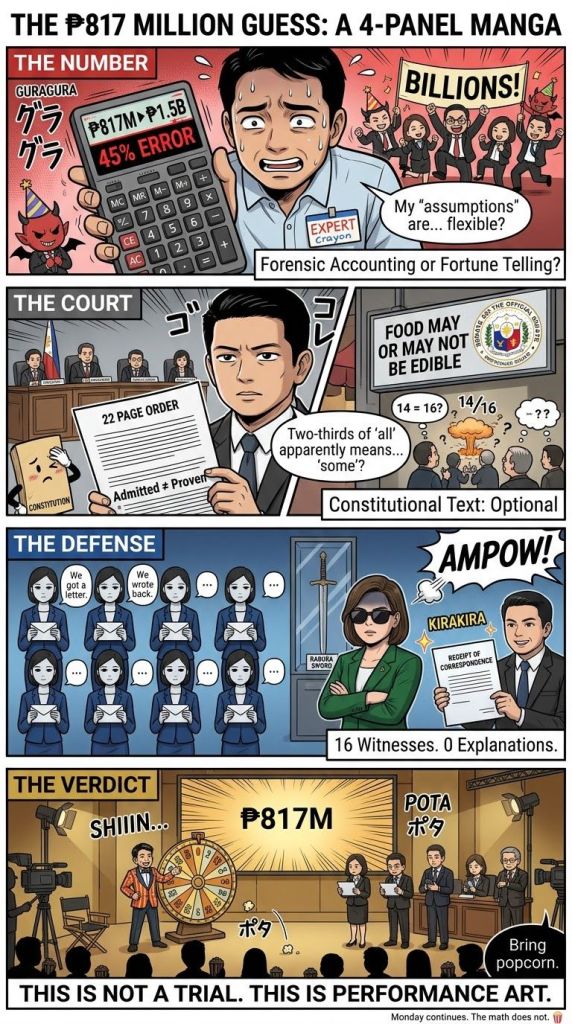
Sara Duterte’s impeachment in 4 panels. None of them flatter anyone.
#Duterte #ImpeachmentTrial #PoliticalManga
The Number That Launched a Thousand Objections
Let us start with the headline figure. Alexander Cabrera, the forensic analyst who apparently worked pro bono for the House prosecution—because nothing says “independent expertise” like unpaid labor for your political allies—estimated Sara Duterte’s unexplained wealth at somewhere between ₱817.87 million and ₱1.5 billion. The range, we are told, depends on “assumptions.” In forensic accounting, a 45% variance between your low and high estimates is not a range. It is an admission that you are not entirely sure what you are doing.
The prosecution’s theory, as I have previously noted in these pages, conflates bank deposits with income, corporate revenue with personal wealth, and—most audaciously—transaction volume with actual assets. The ₱4.4 billion figure that made headlines earlier this year? That was the total flow of money through accounts over nearly two decades. It is the financial equivalent of saying a man who drove a taxi for twenty years “earned” the entire fare box. The prosecution has since walked this back, but the damage to public discourse was already done. The headlines screamed “BILLIONS.” The nuance—that money moving between accounts is not the same as money kept—died quietly in a footnote.
The Senate’s November 5 Ruling: A Masterclass in Having It Both Ways
On November 5, the Senate impeachment court issued its 22-page order admitting the prosecution’s documentary evidence while simultaneously clarifying that admission does not mean the documents prove anything. This is, technically, correct. It is also the legal equivalent of a restaurant advertising “food may or may not be edible.” Presiding Officer Francis Escudero’s court admitted bank records, tax filings, Anti-Money Laundering Council (AMLC) reports, and Statements of Assets, Liabilities and Net Worth (SALNs) dating back to 2007—but with the caveat that pre-2022 records can only establish a “baseline” of Duterte’s financial position, not prove offenses committed before her vice presidency.
This is a sensible limitation. It is also a devastating one for the prosecution, which has spent months building a narrative that Duterte’s wealth is inherently suspicious without clearly distinguishing between what she owned before June 30, 2022 and what she allegedly acquired after. The ₱817.87 million figure, we are told, covers 2022-2025. But the methodology underpinning that figure relies on bank records dating back to 2007. If the baseline is wrong—if the prosecution misread a pre-existing asset as newly acquired, or double-counted a transfer that occurred years before Duterte became Vice President—the entire calculation collapses.
The Sixteen Bankers Who Knew Too Little
And now we arrive at the defense’s witness list, which House prosecutor Lorna Kapunan has already dismissed as “ampaw”—hollow, empty, devoid of substance. Kapunan’s critique is brutally specific: the sixteen bank officials the defense intends to call will testify only about whether Duterte’s lawyers sent them letters requesting documents, and whether the banks responded. That is it. Not what the documents mean. Not whether the prosecution’s interpretation is accurate. Just: “Did you receive our letter?” “Yes.” “Did you reply?” “Yes.”
If Kapunan is right—and her characterization is consistent with the defense’s own stated purposes for these witnesses—then the defense’s financial counteroffensive is not a counteroffensive at all. It is a procedural housekeeping exercise masquerading as evidentiary rebuttal. The Vice President’s lawyers are not planning to explain the money. They are planning to establish that they asked for the paperwork through proper channels. This is the litigation strategy of a client who has been advised to say nothing and hope the prosecution fumbles.
But here is the uncomfortable question I have been asking since October: What if the defense’s silence on the merits is not a legal strategy but a legal necessity? What if there is no clean explanation for the discrepancies the prosecution has identified, and the best available defense is to attack the methodology rather than confront the numbers? The defense’s decision to call corporate counsel for GenCorp and Metro City Chow—rather than, say, an independent forensic accountant of comparable expertise to Cabrera—suggests a team that knows it cannot win a battle of experts, according to The Manila Times. So it will fight a battle of technicalities instead.
The Rabusa Precedent: A Double-Edged Sword the Defense Hasn’t Sharpened
I have written before about Republic of the Philippines v. Lt. Col. George Abonito Rabusa, G.R. No. 208183 (Republic v. Rabusa), the 2022 Supreme Court decision that requires the State to prove how a public officer amassed allegedly ill-gotten wealth, not merely that the wealth exists. The defense has cited this case repeatedly. But here is what the defense has not done: it has not presented a Rabusa-style evidentiary reconstruction of Duterte’s legitimate financial history. In Rabusa, the respondent successfully argued that his spouse’s inheritance, his salary, and legitimate business income explained the assets in question. The Supreme Court ultimately dismissed the forfeiture petition for failure to meet the preponderance standard.
If Duterte’s defense team believes Rabusa supports their case, why have they not produced the equivalent evidentiary showing? Why have they not presented the inheritance documents, the business records, the loan agreements, the capital contributions—the paper trail that would demonstrate legitimate acquisition? Instead, they are calling assessors to testify about property valuations (which do not prove ownership) and barangay officials to testify about occupancy (which does not prove acquisition cost). The Rabusa defense was a documentary defense. The Duterte defense, at least in its opening act, is a character witness defense dressed up as financial rebuttal.
The Lowered Threshold: A Gift the Prosecution May Not Deserve
And let us not forget the September vote to lower the conviction threshold from sixteen to fourteen senators. The Senate reasoned that four members—Estrada, Marcoleta, dela Rosa, and Legarda—were “legally and factually incapable of participating,” and that the denominator should reflect only those capable of voting. Presiding Officer Escudero dissented, calling the new threshold a “moving target.” He was right.
The 1987 Constitution of the Republic of the Philippines (1987 Constitution) is unambiguous: conviction requires “the concurrence of two-thirds of all the Members of the Senate.” Not two-thirds of those present. Not two-thirds of those not detained. Not two-thirds of those who feel like showing up. The Framers chose “all” deliberately. The Senate’s interpretation is not a functional reading; it is a functional rewriting. And the timing—lowering the threshold before the defense presented its case—invites the obvious suspicion that the senator-judges anticipated needing fewer votes to convict.
But here is the irony: if the prosecution’s case is as strong as Cabrera’s ₱817 million figure suggests, why lower the bar? Why not let the case speak for itself and secure the full sixteen? The threshold change signals weakness, not strength. It tells the public that the prosecution’s evidence, however voluminous, may not be sufficient to persuade the supermajority the Constitution demands.
The Verdict I Would Render (If Anyone Asked)
I am not a senator-judge. I am a blogger who reads the actual orders, checks the actual math, and holds a grudge against intellectual dishonesty in all its forms. But if I were sitting in that chamber, here is what I would want before casting a vote:
- First, a transaction-by-transaction reconciliation of the ₱817.87 million. Not a summary. Not an estimate. A line-by-line accounting that identifies each disputed asset, its acquisition date, its funding source, and the specific evidence establishing that the funding was unlawful. The prosecution has not provided this. It has provided a number, and numbers are not evidence.
- Second, a defense explanation that goes beyond “we sent letters.” If Duterte’s lawyers believe the prosecution’s calculations are wrong, they should show where they are wrong, how they are wrong, and why the correct calculation matters. Calling sixteen bank tellers to confirm receipt of correspondence is not a defense. It is a delay tactic with a subpoena attached.
- Third, a Senate that respects the Constitution it swore to uphold. That means sixteen votes for conviction, not fourteen. It means admitting evidence without pretending admission equals proof. It means distinguishing between a political trial and a political outcome. The senator-judges are politicians by profession but judges by oath. The oath should win.
The Real Bottom Line
The prosecution’s case may ultimately succeed. The bank records are real. The SALN discrepancies, if accurately characterized, are real. The corporate interests, if proven, are constitutionally problematic, as a prosecutor explained to Manila Bulletin. But a case built on a fluctuating estimate, presented by an unpaid expert, admitted by a court that lowered the conviction threshold before hearing the defense, and rebutted by a defense team that seems more interested in procedural posturing than financial explanation—this is not accountability. This is performance art.
The Filipino people deserve better than a trial where the central question—did Sara Duterte acquire wealth she cannot lawfully explain?—is buried under a mountain of subpoenas, objections, and press releases. They deserve a prosecution that can defend its own math. They deserve a defense that can explain its client’s money. And they deserve a Senate that understands the difference between a conviction and a numbers game.
Until then, we are left with Cabrera’s ₱817 million question mark, a sixteen-witness defense that may prove nothing, and a fourteen-vote threshold that makes a mockery of the constitutional text. The trial continues Monday. Bring popcorn.
Key Citations
A. Legal & Official Sources
- The 1987 Constitution of the Republic of the Philippines. Official Gazette of the Republic of the Philippines, 1987, http://www.officialgazette.gov.ph/constitutions/the-1987-constitution-of-the-republic-of-the-philippines/the-1987-constitution-of-the-republic-of-the-philippines-article-xi/.
- Republic of the Philippines v. Lt. Col. George Abonito Rabusa, et al. G.R. No. 208183, 31 Aug. 2022. LawPhil Project, https://lawphil.net/judjuris/juri2022/aug2022/gr_208183_2022.html?hl=en-US.
B. News Reports
- Bacelonia, Wilnard. “Impeachment Court Admits VP Sara Financial Records, Restores Gag Rule.” Philippine News Agency, 6 Nov. 2026, http://www.pna.gov.ph/article/impeachment-court-admits-vp-sara-financial-records-restores-gag-rule.
- “Kapunan on Sara Duterte Camp’s Initial Witness List: ‘Ampaw!’” ABS-CBN News, 6 Nov. 2026, http://www.abs-cbn.com/news/nation/2026/11/6/kapunan-on-sara-duterte-camp-s-initial-witness-list-ampaw-1709.
- “VP’s Defense Team Tackles Wealth Raps.” The Manila Times, 9 Nov. 2026, beta.manilatimes.net/2026/11/09/podcasts/headlines-vps-defense-team-tackles-wealth-raps-november-9-2026/2464726.
- “VP Duterte’s Business Documents Could Get Her in Trouble for Perjury; Prosecutor Explains How.” Manila Bulletin, 6 Nov. 2026, mb.com.ph/2026/11/06/vp-dutertes-business-documents-could-get-her-in-trouble-for-perjury-prosecutor-explains-how.
- “Will Sara Duterte Take the Witness Stand? Lawyer Says It May Depend on 24 Defense Witnesses.” ABS-CBN News, 6 Nov. 2026, http://www.abs-cbn.com/news/nation/2026/11/6/will-sara-duterte-testify-lawyer-says-it-may-depend-on-24-defense-witnesses-1235.
- “Ang Hirap Maging Mahirap”: The PAO Scandal That Proves Government Contempt Is Nothing New

- “Far-Off” My Axx: Malacañang’s Claire Castro Drowns in Her Own Legal Gaslighting
- “Forthwith” to Farce: How the Senate is Killing Impeachment—And Why Enrile’s Right (Even If You Can’t Trust Him)

- “HINDI AKO NAG-RESIGN!”

- “I Know Nothing”: Baste Duterte’s Amnesia Defense Meets ₱33M in GenCorp Contracts

- “I’m calling you from my new Globe SIM. Send load!”

- “Mahiya Naman Kayo!” Marcos’ Anti-Corruption Vow Faces a Flood of Doubt

- “Manageable” Debt, Unmanageable Lies: DBM’s ₱21 Trillion Fairy Tale

- “Meow, I’m calling you from my new Globe SIM!”

- “Natrabaho”: One Word, One Ombudsman, and a Judiciary on Trial

- “No Special Jail for Crooks!” Boying Remulla Slams VIP Perks for Flood Scammers

- “Philippine-Controlled” or Yankee Gas Station? The Davao Fuel Depot Farce Exposed







Leave a Reply