FALGU, FMR, MAP: Three Acronyms, One Patronage Machine
By Louis “Barok” C. Biraogo — November 29, 2026
Once Upon a Peso
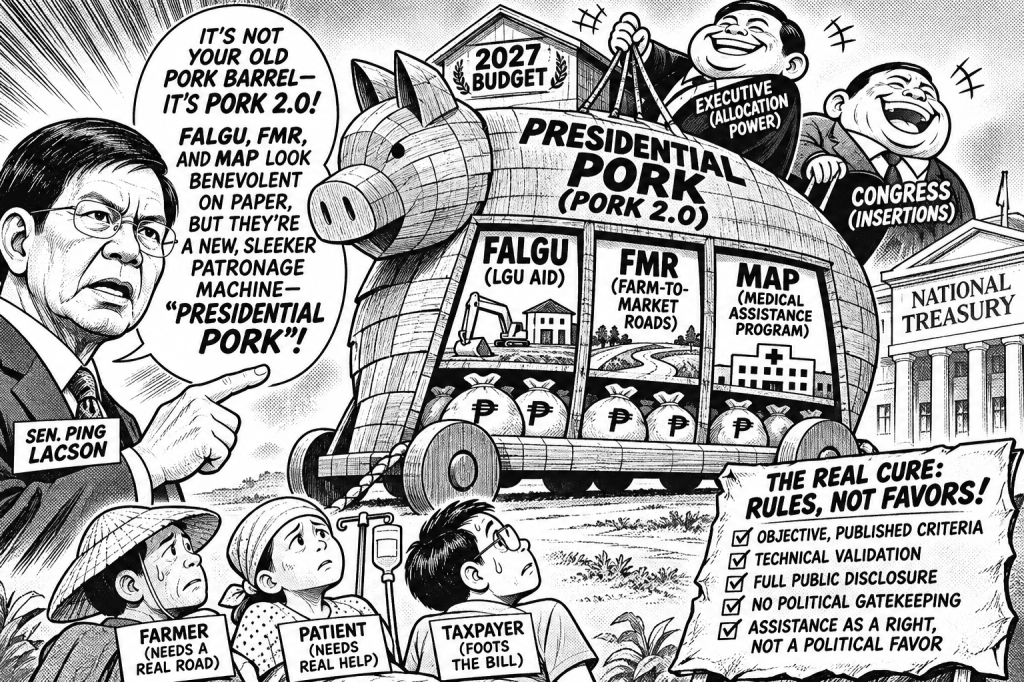
In the grand theater of Philippine public finance, where the plot is as predictable as a telenovela and the denouement always involves a mysterious disappearance of public funds, a new act has begun. The protagonist this time is Senator Panfilo “Ping” Lacson, a man who has built a career on the quixotic quest to slay the many-headed hydra of pork barrel. His current crusade targets the 2027 budget, not for the usual suspects—the notorious “congressional insertions”—but for something far more insidious, a sleeper cell of patronage cleverly disguised as “presidential pork.”
At the heart of this latest fiscal thriller are three programs with names so anodyne they could lull a taxpayer to sleep: the Financial Assistance to Local Government Units (FALGU), Farm-to-Market Roads (FMRs), and the Medical Assistance Program (MAP). On paper, these are the very picture of a benevolent state: helping cash-strapped Local Government Units (LGUs), building roads for our beleaguered farmers, and ensuring no Filipino dies because they can’t afford a hospital bill. Who could possibly object?
Pork 2.0: Now With Better PR
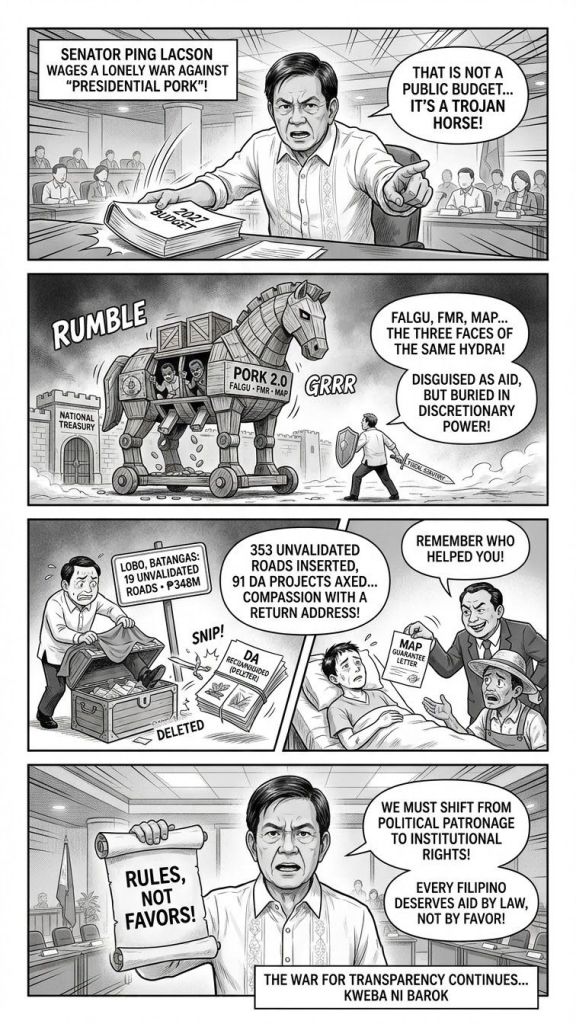
Enter Lacson, the fiscal Cassandra of the Senate, warning that the Trojan Horse is not just at the gates, but already inside the city’s treasury. His argument, as reported by the Philippine Star and ABS-CBN News, is not that these programs are inherently evil, but that their architecture is a blueprint for a new, more sophisticated form of the political disease we thought we had cured. This is not your father’s pork barrel; it’s Pork 2.0—sleeker, stealthier, and with better PR.
FALGU: The Rules-Based Fairy Tale
Let’s start with FALGU. The Department of Budget and Management (DBM) has issued a shiny new circular, Local Budget Circular No. 169, promising a process where LGUs “directly seek” funds and releases are “transparent, rules-based.” On paper, it’s a technocrat’s dream. But as any student of Philippine politics knows, the gap between “rules-based” on paper and “patronage-based” in practice is a chasm wide enough to swallow the entire national budget.
Lacson’s label of “presidential pork” is an astute one. He is arguing that a system with broad categories of projects but insufficient project-level earmarking hands the Executive branch a tremendous amount of discretionary power. Instead of a legislator earmarking a specific amount for a specific project in their district, the Executive can now decide, post-enactment, which LGU gets the road, the water system, or the evacuation center. The power to allocate is the power to reward. The politician who secures the project—be it a local mayor or a generous president—becomes the benevolent patron, while the State’s role as a neutral provider is erased. The public then sees assistance not as an entitlement, but as a favor.
DBM’s defense is that LGUs submit requests directly, subject to criteria and evaluation. This is the “we follow the rules” defense. But the crucial question is not whether rules exist, but who writes them, who evaluates the proposals, and who has the final say. In a system where the Executive controls the purse strings, the potential for political alignment to become the unwritten criterion is not a bug; it is the system’s most intoxicating feature.
The Belgica Elephant
This brings us to the legal elephant in the room: the Belgica decisions (Belgica v. Ochoa, G.R. Nos. 208566, 208493, and 209251, and Belgica v. Executive Secretary, G.R. No. 210503). In 2013, the Supreme Court declared the old Congressional Pork Barrel, the Priority Development Assistance Fund (PDAF), unconstitutional, and in 2019, it upheld the Local Government Support Fund (LGSF)—the progenitor of FALGU—as constitutional. The Court’s reasoning in the 2019 ruling is a subtle but critical one: a lump-sum appropriation is not inherently illegal. The constitutional violation arises when the implementation, not the appropriation itself, allows for unlawful interference or arbitrary discretion. Lacson’s accusation is not a legal verdict; it is a political critique of a system that, while seemingly compliant with the Belgica 2019 ruling, remains perilously vulnerable to the same political vices. The question has simply shifted from “is this illegal?” to “can this be abused?” The answer, in the Philippines, is always a resounding yes.
Farm-to-Market Roads: Highway Robbery, Literally
Then we come to the Farm-to-Market Roads, the most concrete and damning part of the story. Here, the numbers paint a picture more damning than any political speech. The House of Representatives allegedly inserted 353 roads worth ₱5.92 billion that were not validated by the Department of Agriculture (DA). At the same time, it deleted 91 DA-recommended roads worth ₱2.23 billion. The Senate, in a fit of fiscal sanity, retained only 10 of the House insertions. This is not a debate about project prioritization; it is a heist in broad daylight.
The concentration of these insertions is equally breathtaking. That one town—Lobo, Batangas—was allocated 19 roads worth ₱348 million is not a testament to its agricultural prowess but a blazing red flag of political favoritism. The defense that these projects are technically valid because they serve livestock and coconut production is the kind of hollow reasoning that would make a mockery of any real planning process. A road that is “unvalidated” is not necessarily corrupt, but when it is inserted in place of a technically-vetted project, it ceases to be a neutral proposal and becomes a monument to political muscle.
This is the classic pork barrel modus operandi, just wearing a new hat. The argument that congressmen are constitutionally empowered to propose amendments is a constitutional fig leaf for a system that has been weaponized for patronage. The Supreme Court did not prohibit the power of the purse; it prohibited its exercise in a post-enactment, project-specific, legislator-controlled manner. The new FMR insertions are a workaround, a way to reintroduce legislative discretion while maintaining a veneer of constitutional propriety.
MAP: Compassion With a Return Address
Finally, we have the Medical Assistance Program, the most emotionally compelling and politically sensitive piece of the puzzle. Here, we see the politics of compassion in its most naked form. The need is real. Patients facing catastrophic illnesses cannot wait for the slow, grinding gears of Universal Health Care (UHC) reform. A guarantee letter from a politician can literally be the difference between life and death. This is the program’s unassailable moral high ground.
But this is precisely why it is so easily exploited. The guarantee letter is a ticket to political indebtedness. The politician who signs it is not just a benefactor; they are a savior. The system creates a dependency on political intermediaries rather than institutional entitlements. Lacson’s allegation that the MAP system may be inflating medical costs is a serious one that requires evidence, but the economic logic of a third-party payer system makes it a plausible hypothesis. When the government is paying, hospitals have less incentive to be price-sensitive.
His proposed solution—to consolidate MAP funds into public assistance centers (PACs) controlled by the Senate and House but vetted by the Department of Health (DOH)—is a step in the right direction, but it’s a half-measure. The decisive question remains: who ultimately controls eligibility? If political endorsement remains a requirement, then the patronage structure has simply been transferred from a senator’s office to a politically supervised center. It is Pork 2.0, now with a DOH logo.
Same Hydra, New Heads
The ultimate scam, the grandest illusion of all, is that the abolition of the PDAF solved the problem. It did not. It merely decentralized the patronage, forcing it to find new, more resilient hosts. The FALGU, the FMR insertions, and the MAP are the mutant progeny of the old system. They are the three faces of a single, enduring reality: in the Philippines, the power to allocate public money is the power to buy political loyalty.
Senator Lacson’s crusade is necessary, but it is not a cure. It is a diagnostic. He has identified the symptoms, but the disease is systemic. The real solution is not just to reform one program or defund another. It is to fundamentally change the culture of public finance. It requires a radical shift from a system of political patronage, where assistance is a favor granted by the powerful, to one of institutional entitlement, where it is a right guaranteed by law and delivered through an impartial, transparent, and rules-based bureaucracy.
Rules, Not Favors
- It means objective, published criteria for every single project and beneficiary.
- It means technical validation by competent agencies, not political sponsors.
- It means full public disclosure of every contract, every release, and every beneficiary.
- It means absolutely no political gatekeeping in the approval or release of funds.
- It means that a Filipino farmer gets a road because it is in the DA’s plan, not because a congressman wanted to reward his district.
- It means a sick patient gets help because they are eligible under the law, not because a senator’s office issued a letter.
Curtain Call, Same Script
Until that day comes, we will continue to be treated to this tragicomedy year after year, watching our elected officials fight over the spoils of a system that is rotten at its core. We will hear the usual pledges of transparency and reform, the usual denials of wrongdoing, and the usual accusations of “presidential pork” or “congressional pork.” And the ordinary Filipino, the farmer, the patient, the taxpayer, will remain what they have always been in this drama: a mere prop, useful for taking credit, but powerless to change the script.
The more things change, the more they stay the same. The names change, the acronyms change, but the game remains the same. It’s just pork barrel in a new suit.
Key Citations
A. Legal & Official Sources
- The 1987 Constitution of the Republic of the Philippines. Official Gazette of the Republic of the Philippines, 1987, http://www.officialgazette.gov.ph/constitutions/1987-constitution/.
- Belgica, Greco Antonious Beda B., et al. v. Ochoa, Jr., et al. G.R. Nos. 208566, 208493, and 209251, Supreme Court of the Philippines, 19 Nov. 2013. LawPhil, lawphil.net/judjuris/juri2013/nov2013/gr_208566_2013.html.
- Belgica, Greco Antonious Beda B. v. The Honorable Executive Secretary, et al. G.R. No. 210503, Supreme Court of the Philippines, 8 Oct. 2019. Supreme Court E-Library, elibrary.judiciary.gov.ph/thebookshelf/showdocs/1/66038.
- Department of Budget and Management. Guidelines on the Release and Utilization of the Local Government Support Fund–Financial Assistance to Local Government Units under the FY 2026 General Appropriations Act, Republic Act No. 12314. Local Budget Circular No. 169, 16 Feb. 2026, http://www.dbm.gov.ph/wp-content/uploads/Issuances/2026/Local-Budget-Circular/LOCAL-BUDGET-CIRCULAR-NO-169.pdf.
- Department of Budget and Management. “No Middleman: LGUs to Directly Seek P58.53-B Local Fund; Releases Transparent, Rules-Based — DBM.” Department of Budget and Management, 15 Sept. 2026, http://www.dbm.gov.ph/index.php/management-2/4233-no-middleman-lgus-to-directly-seek-p58-53-b-local-fund-releases-transparent-rules-based-dbm.
- Republic Act No. 11223. An Act Instituting Universal Health Care for All Filipinos, Prescribing Reforms in the Health Care System, and Appropriating Funds Therefor. 20 Feb. 2019, http://www.officialgazette.gov.ph/2019/02/20/republic-act-no-11223/.
B. News Reports
- Cruz, RG. “Lacson Flags ‘Presidential Pork’ in 2027 Budget.” ABS-CBN News, ABS-CBN Corporation, 26 Nov. 2026, http://www.abs-cbn.com/news/nation/2026/11/26/lacson-flags-presidential-pork-in-2027-budget-1705.
- Servallos, Neil Jayson. “LGU Aid in 2027 Budget ‘Presidential Pork’ – Ping.” The Philippine Star, 28 Nov. 2026, http://www.philstar.com/headlines/2026/11/28/2573125/lgu-aid-2027-budget-presidential-pork-ping.



Leave a Reply