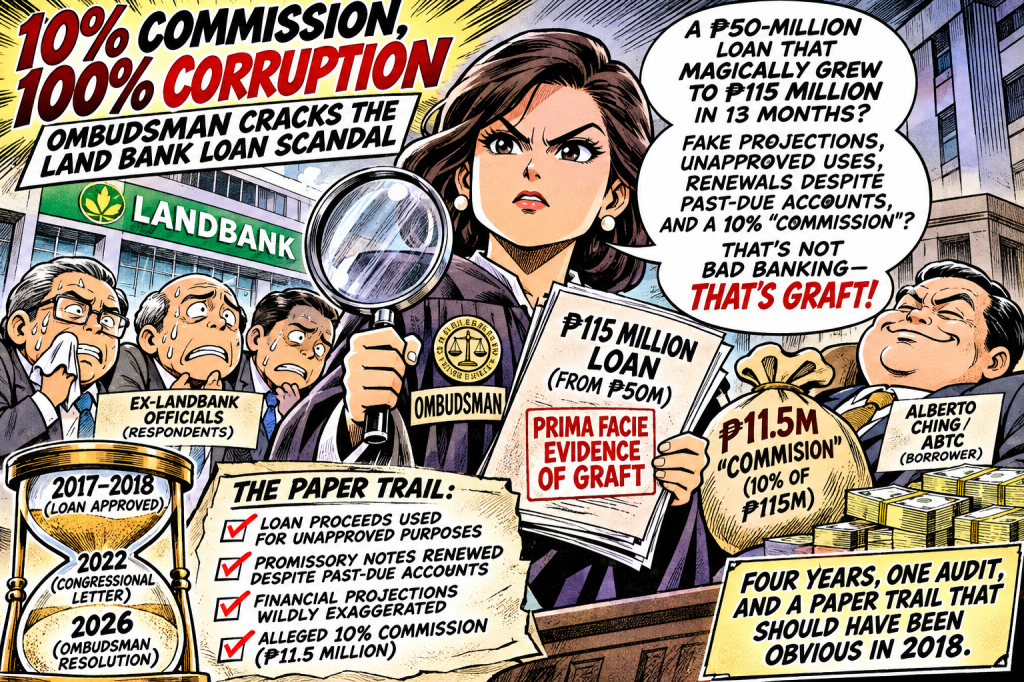
Four Years, One Audit, and a Paper Trail That Should Have Been Obvious in 2018
By Louis ‘Barok’ C Biraogo — November 27, 2026
LET’S pause for a moment of genuine, jaw-dropping appreciation. While the rest of the Philippine financial regulatory apparatus was busy polishing letterheads and drafting memoranda no one reads, the Office of the Ombudsman did the actual work. It looked at a ₱115-million loan that magically grew from ₱50 million in thirteen months, noticed the borrower’s financial projections resembled speculative fiction, and concluded something smelled worse than a Pasig canal at low tide.
The Ombudsman’s resolution finding prima facie evidence against three former Land Bank of the Philippines (Land Bank) officials and one fortunate borrower is a quiet, devastating indictment of institutional somnolence. That it took a congressional letter from a House Assistant Majority Floor Leader—and the borrower’s own alleged loose lips about a ten-percent commission—to trigger this investigation tells you everything about how government banks “police” themselves. They don’t. They wait to be embarrassed into it.
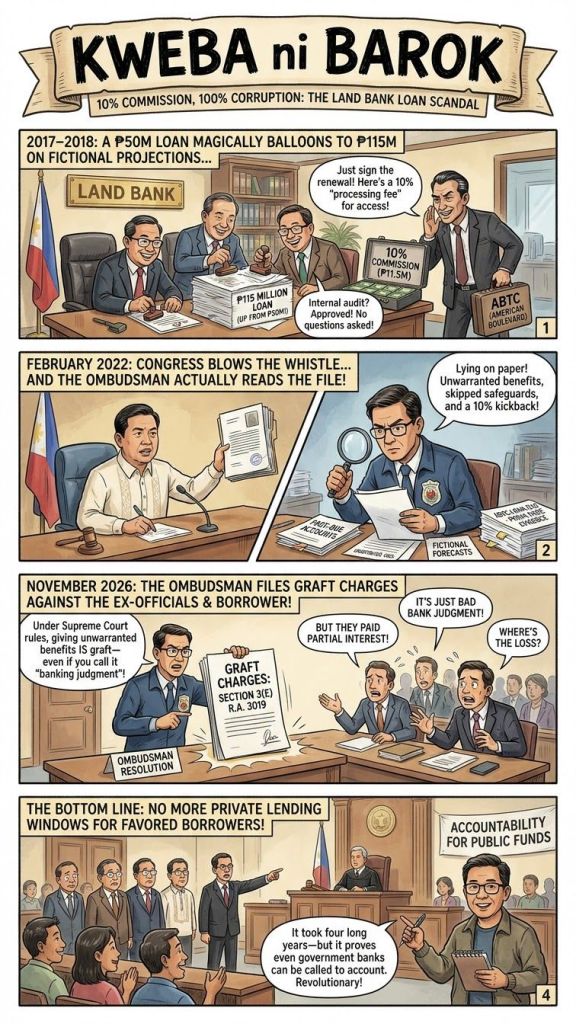
The Ombudsman’s Finest Moment: Actually Reading the Loan Documents
The Ombudsman read the file. Loan proceeds used for unapproved purposes. Promissory notes renewed despite past-due accounts. Financial projections that “substantially exceeded historical figures.” In lending, we call this “lying on paper.” The Ombudsman recognized that when a borrower’s projected future is wildly disconnected from their actual past, the appropriate response is not to nod approvingly and stamp the renewal.
Its finding that the respondents gave American Boulevard Trading Corp. (ABTC) “unwarranted benefits, advantage, or preference” is precisely the correct legal lens. This is not a loan gone bad because the economy sneezed. This is a loan allegedly structured, renewed, and expanded in ways that bypassed the very safeguards designed to prevent this outcome. The Ombudsman understood the assignment. Why the bank’s internal audit and credit committees did not is the real question.
The 10-Percent Commission: The Ombudsman Followed the Smell
Ten percent of ₱115 million is ₱11.5 million. That is not a “processing fee.” That is a down payment on a Bonifacio Global City (BGC) condominium. The allegation reportedly came from borrower Alberto Ching himself—adding delicious complexity the Ombudsman did not ignore. A cynic might say Ching’s disclosure paints him as victim rather than co-conspirator. Legitimate defense theory. But the Ombudsman’s job at this stage is not to resolve every factual dispute—it is to determine whether evidence warrants prosecution. When a borrower says he was asked to pay for access to public credit, and loan documents show access was granted despite glaring deficiencies, the Ombudsman has every obligation to take that seriously. It did. Good.
The Supreme Court Already Told Everyone How This Works
The legal architecture is not novel, creative, or aggressive. It is firmly grounded in existing jurisprudence. In the Development Bank of the Philippines (DBP) behest-loan litigation, the Supreme Court made clear that Section 3(e) of Republic Act No. 3019 (Anti-Graft and Corrupt Practices Act) can be violated two ways: causing undue injury or giving unwarranted benefits. The defense’s inevitable argument—partial payment, interest earned, no proven loss—is legally irrelevant under the “unwarranted benefit” mode. The Ombudsman understands this distinction. That is not clever lawyering. That is basic competence. That it feels remarkable says more about the baseline than about the Ombudsman.
A Preemptive Note to the Defense Bar
Yes, a loan is not a gift. Yes, Land Bank takes risks. Yes, 2017 decisions should be judged by 2017 information, not a 2026 audit. Legitimate arguments, all. The Ombudsman’s probable-cause finding does not relieve the prosecution of proving guilt beyond reasonable doubt.
But the defense cannot pretend the Ombudsman acted improperly by noticing a ₱50-million facility became ₱115 million while financial disclosures remained creatively incomplete. It cannot claim overreach in investigating an alleged demanded commission. And it certainly cannot argue deference to Land Bank’s internal processes—because those processes are precisely what failed.
The Real Scandal Is That This Took So Long
Loans approved 2017–2018. Congressional letter February 2022. Ombudsman resolution November 2026. Four years to investigate a single borrower’s loan file. Four years during which the officials involved presumably went about their lives, reputations intact, pensions accruing. Four years during which the Ombudsman was doing work that the bank’s audit department, the Bangko Sentral ng Pilipinas, and every other oversight body should have done with more urgency.
This is not criticism of the Ombudsman. It is acknowledgment of reality. The Ombudsman is under-resourced, over-politicized, perpetually one scandal from defunding by the very people it investigates. Producing a coherent, legally defensible resolution at all is a minor miracle of institutional persistence. Doing so in a case involving a government bank, a well-connected borrower, and cash-for-approval allegations is not just a miracle. It is a warning.
The Bottom Line
The Ombudsman did its job. Read the documents. Identified irregularities. Applied the correct legal standard. Named names. Did not flinch—despite what must have been considerable pressure to let the matter quietly expire, to chalk it up to “bad banking judgment,” to let the responsible parties retire in peace and the borrower restructure without the inconvenience of a criminal information.
That it proceeded anyway is the entire point of having an Ombudsman. The office exists precisely for moments when the institutions supposed to catch the problem cannot or will not. Land Bank’s internal controls failed. Its credit review failed. Supervisory oversight failed. The Ombudsman, against all odds and considerable institutional inertia, did not.
The prosecution will be messy. The defense will be vigorous. The outcome is uncertain. But the Ombudsman has already accomplished something significant: it established, on the record, that a government bank cannot be operated as a private lending window for favored borrowers, and that officials who facilitate such arrangements will be called to account.
That is not a small thing. In this country, it is practically revolutionary.
Key Citations
A. Legal & Official Sources
- Republic Act No. 3019. Anti-Graft and Corrupt Practices Act. 1960, http://www.officialgazette.gov.ph/1960/08/17/republic-act-no-3019/.
- “G.R. Nos. 217417 & 217914.” Supreme Court of the Philippines, 7 Aug. 2023, lawphil.net/judjuris/juri2023/aug2023/gr_217417_2023.html.
B. News Reports
- “Ombudsman Orders Graft Raps vs ex-LandBank Execs, Businessman over Loans.” GMA News Online, GMA Network, 26 Nov. 2026, http://www.gmanetwork.com/news/money/companies/1010887/ombudsman-orders-graft-raps-vs-ex-landbank-execs-businessman-over-loans/story/.
- “Ombudsman Orders Graft Raps vs 3 Ex-Landbank Execs, Bizman.” Philippine News Agency, 26 Nov. 2026, http://www.pna.gov.ph/article/ombudsman-orders-graft-raps-vs-3-ex-landbank-execs-bizman.

- “Ang Hirap Maging Mahirap”: The PAO Scandal That Proves Government Contempt Is Nothing New
- “Far-Off” My Axx: Malacañang’s Claire Castro Drowns in Her Own Legal Gaslighting

- “Forthwith” to Farce: How the Senate is Killing Impeachment—And Why Enrile’s Right (Even If You Can’t Trust Him)
- “HINDI AKO NAG-RESIGN!”

- “I Have No Reason to Doubt”: Teodoro’s MDT Fairy Tale
- “I Know Nothing”: Baste Duterte’s Amnesia Defense Meets ₱33M in GenCorp Contracts

- “I’m calling you from my new Globe SIM. Send load!”

- “Mahiya Naman Kayo!” Marcos’ Anti-Corruption Vow Faces a Flood of Doubt

- “Manageable” Debt, Unmanageable Corruption: The ₱19.66-Trillion Lie
- “Manageable” Debt, Unmanageable Lies: DBM’s ₱21 Trillion Fairy Tale
- “Meow, I’m calling you from my new Globe SIM!”

- “Natrabaho”: One Word, One Ombudsman, and a Judiciary on Trial



Leave a Reply