Inside the Legal Maneuver That Wants You to Believe Bato’s Freedom Is a Bill of Rights Issue
By Louis ‘Barok‘ C. Biraogo — November 25, 2026
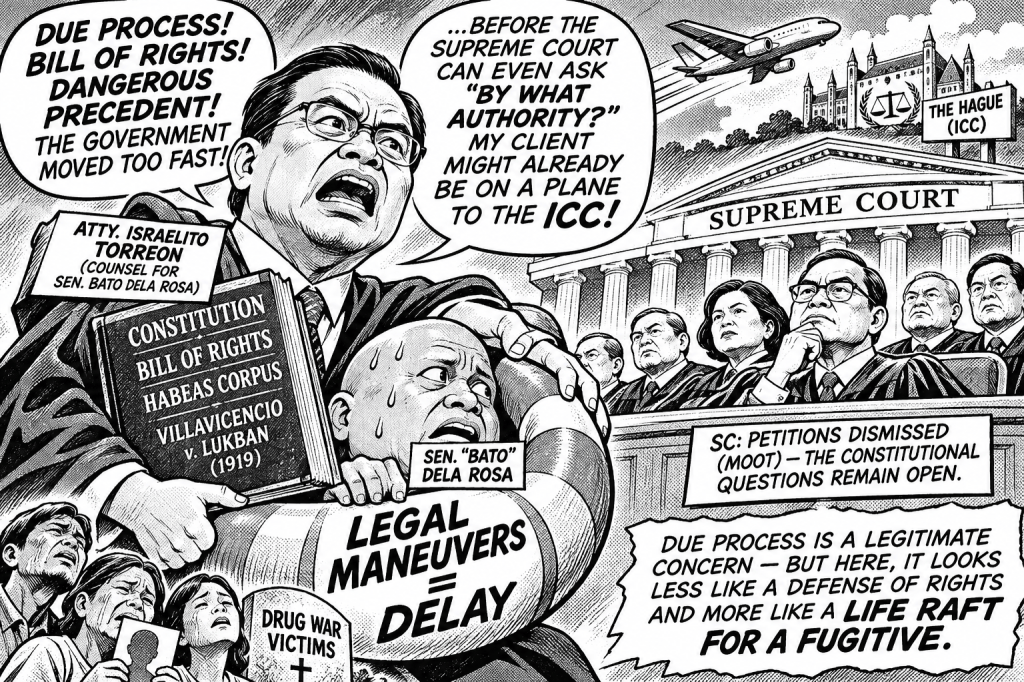
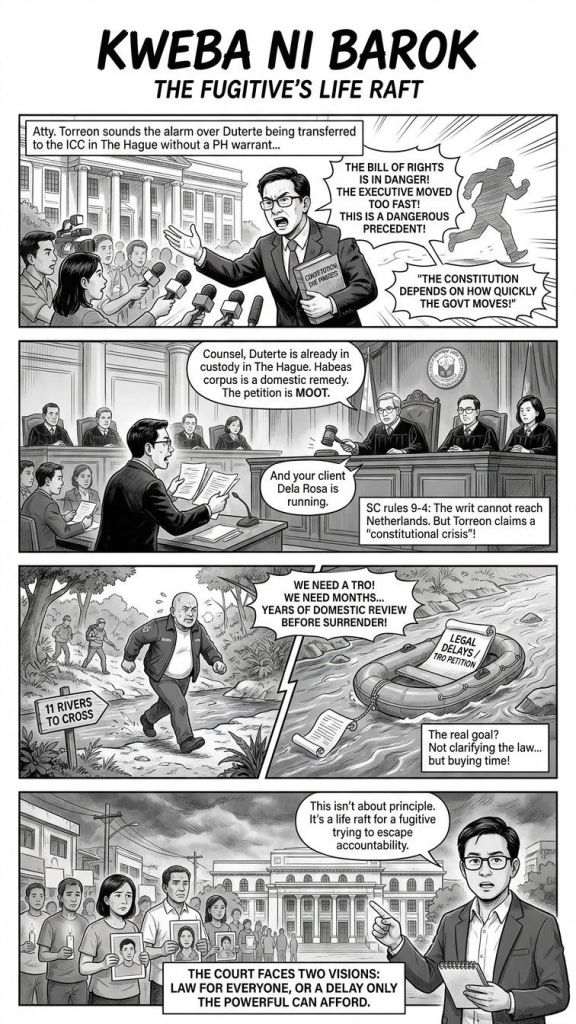
NOTHING sharpens a lawyer’s love of due process quite like a client with a head start on the warrant. It is a beautiful thing to watch. Almost cinematic. Atty. Israelito Torreon, counsel for Senator Ronald “Bato” Dela Rosa—the man who once promised to throw drug suspects into Manila Bay and is now apparently hiding in places where you have to “cross 11 rivers” to reach—has suddenly become the Philippines’ most passionate defender of constitutional due process. The timing is not suspicious at all. Not even a little.
The Court Said Moot. Torreon Said Dangerous.
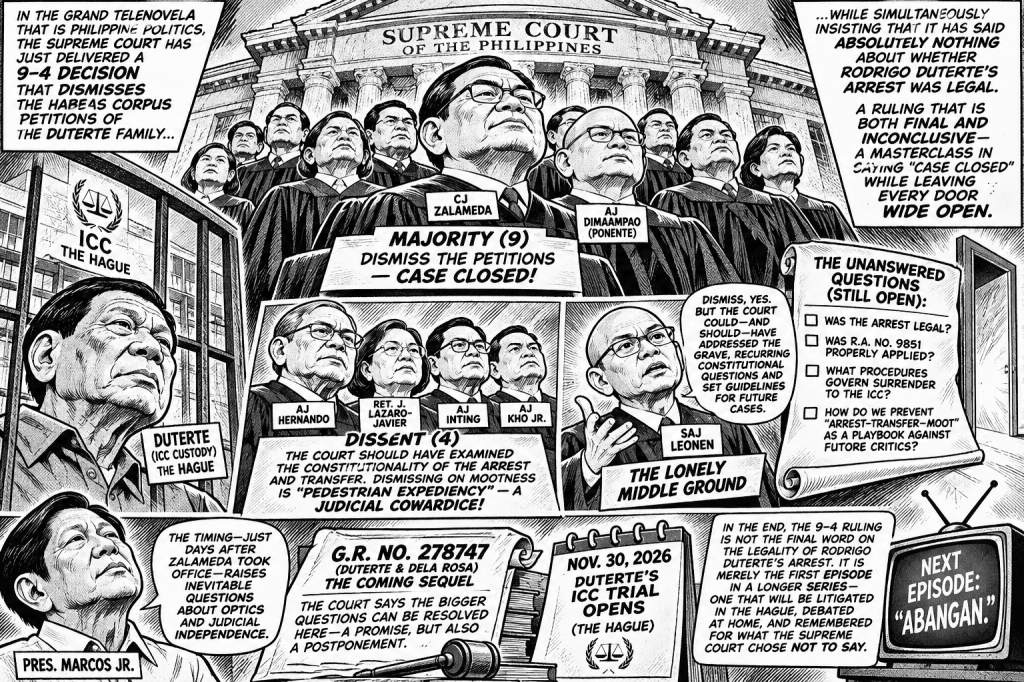
The Supreme Court, by a 9–4 vote, dismissed the consolidated habeas corpus petitions filed by Duterte’s children because the former president is now in International Criminal Court (ICC) custody in The Hague, beyond the reach of Philippine courts. The Court was careful—almost painfully careful—to say that this dismissal did not mean the arrest and transfer were lawful, only that the writ could no longer accomplish anything practical. Torreon, apparently reading from a different script, declared himself “concerned” that this ruling might become a “guide for the future.”
A guide. For the future. Let that sink in.
Outrunning the Judiciary
Torreon’s argument, stripped of its constitutional drapery, is this: the government moved too fast. Duterte was arrested on Philippine soil, held at Villamor Air Base, and flown to The Hague within hours—all without a Philippine warrant. If the Court lets that stand as a template, the Executive can defeat judicial review by simply outrunning the judiciary. The Bill of Rights, Torreon warns, becomes “a promise that depends on how quickly the government moves.”
It is, I concede, a genuinely troubling hypothetical. The image of a Philippine president—or anyone else—being whisked out of the country before a single judge can ask “by what authority?” is the stuff of authoritarian nightmares. Torreon even invokes Villavicencio v. Lukban (G.R. No. L-14639), the 1919 case where the Supreme Court held that officials cannot evade judicial scrutiny by moving a detainee beyond the court’s reach. The rhetorical move is elegant. The historical parallel is dramatic. The problem is that Villavicencio involved women who were moved from Manila to Davao—still within the Philippines, still within the coercive power of Philippine courts. Duterte is in the Netherlands. The ICC is not a Philippine municipality. The writ of habeas corpus, as the Supreme Court patiently explained, is a domestic remedy.
The Real Scandal Nobody Wants to Name
But here is what Torreon is not saying, and what the Marcos administration’s critics on the left are also not saying: the speed of Duterte’s transfer is not the constitutional scandal. The scandal is that the Philippines has spent years pretending it could have it both ways—withdrawing from the Rome Statute of the International Criminal Court (Rome Statute) while insisting that the ICC has no jurisdiction, then acting surprised when the international legal machinery it once invited into its own backyard came knocking with warrants. The Supreme Court itself ruled in 2021 that withdrawal did not extinguish ICC jurisdiction over crimes committed before March 17, 2019. That was not a secret. That was not hidden. That was the law.
The Fugitive in the Footnotes
Torreon knows this. Or he should. His client, after all, is not some random bystander to the drug war. Dela Rosa was the Philippine National Police (PNP) chief who operationalized the killings. The ICC warrant against him is not a clerical error. It is the consequence of a policy he proudly owned. And now his lawyer wants the Supreme Court to intervene before the government can arrest him, arguing that the absence of a Philippine warrant renders the entire ICC process constitutionally suspect.
Let us be precise about what Torreon is actually asking for. He is not asking for a trial. He is not asking for evidence to be tested. He is asking the Supreme Court to rule that the Philippine government cannot surrender a Filipino citizen to an international tribunal without a prior domestic judicial process—a process that, conveniently, would take months or years to complete, during which his client could remain free, or at least free enough to negotiate, to maneuver, to do whatever fugitives do when the law is closing in. Interior Secretary Jonvic Remulla has already warned that arresting Dela Rosa could lead to “10,000 deaths.” That is not a legal argument. That is a threat dressed in a press release.
The TRO That Wasn’t
The Supreme Court, to its credit, has not entirely taken the bait. It denied Dela Rosa’s request for a temporary restraining order, noting that his claimed right to be protected was “contingent” on the resolution of the very constitutional questions his lawyer now wants answered immediately. The Court effectively told him: you cannot demand emergency relief based on a right that has not yet been established. This is basic. This is law school. And yet Torreon’s public statements suggest that the denial of a TRO is itself evidence of judicial abdication.
What Torreon is doing—and doing well, I might add—is conflating two distinct questions. Question one: can the Philippine government lawfully arrest and surrender a person to the ICC without a Philippine warrant? That is a serious question. It deserves an answer. Question two: should the Supreme Court grant emergency relief to a fugitive senator who has already demonstrated, according to a Supreme Court justice, a “stark” capacity to escape accountability while under the Senate’s “protective custody”? That is not a serious question. The answer is no.
A Real Gap, the Wrong Messenger
The irony is that Torreon’s constitutional argument might actually have merit if it were being made by someone with clean hands. The absence of a detailed statutory framework for ICC surrender is a real gap in Philippine law. Section 17 of Republic Act No. 9851 (Philippine Act on Crimes Against International Humanitarian Law, Genocide, and Other Crimes Against Humanity) authorizes surrender to an international tribunal, but it does not specify the procedure. A person facing an ICC warrant could reasonably ask: who decides? Under what standards? With what judicial oversight? These are legitimate rule-of-law concerns. But they are being raised, in this instance, by the lawyer of a man who is not seeking clarity for the sake of the republic. He is seeking delay for the sake of his client.
Delay Is the Whole Point
And the delay matters. Every month Dela Rosa remains free is a month the victims of the drug war are told, again, that accountability is optional for the powerful. Every legal maneuver is a reminder that the same system that moved with breathtaking speed to put Duterte on a plane has spent years allowing his police chief to roam the country, to run for the Senate, to make jokes about the killings, to threaten that his arrest would cause mass death. The Supreme Court may eventually rule on the constitutional questions Torreon raises. It may even rule in his favor, requiring a Philippine judicial process before any future ICC surrender. That would be a legitimate development in Philippine constitutional law.
But let us not pretend that this is about principle. Torreon’s “dangerous precedent” is not the precedent of a government moving too fast. It is the precedent of a government finally moving at all. And for a man who has spent years treating the law as something that applies to other people, that must be terrifying.
Leonen Has a Point
The Court’s decision left the constitutional question open. Leonen, in his separate opinion, criticized the majority for failing to provide guidance on issues that “can recur yet may evade judicial review.” He is right. The Court should answer those questions. But it should answer them in a case where the petitioner is not a fugitive, where the urgency is not manufactured, and where the constitutional argument is not a life raft for a man who has done everything in his power to avoid the consequences of his own actions.
Until then, Torreon can keep writing statements about Villavicencio and the Bill of Rights and the speed of government. He can keep warning that liberty is being taken beyond our borders. He can keep asking the Supreme Court to save his client from the ICC. But every Filipino who remembers the drug war—the bodies in the streets, the families who waited for justice, the police who killed with impunity—knows what this is really about. It is not about precedent. It is not about due process. It is about a man who ran, and a lawyer who is trying to make running look like a constitutional principle.
Two Visions, One Choice
The Supreme Court has not yet decided Dela Rosa’s case. It may decide it soon. And when it does, it will have to choose between two visions of the Philippines: one where the law applies to everyone, even senators who once commanded the police, or one where the law is only as fast as the government wants it to be, and only as slow as the powerful can afford.
Torreon has made his choice. The Court will have to make its own.
Key Citations
A. Legal & Official Sources
- The 1987 Constitution of the Republic of the Philippines. Official Gazette of the Republic of the Philippines, 1987, http://www.officialgazette.gov.ph/constitutions/1987-constitution/.
- Zacarias Villavicencio et al. v. Justo Lukban et al. G.R. No. L-14639, Supreme Court of the Philippines, 25 Mar. 1919. The LawPhil Project, lawphil.net/judjuris/juri1919/mar1919/gr_l-14639_1919.html.
- Pangilinan v. Cayetano. G.R. Nos. 238875, 239483, and 240954, Supreme Court of the Philippines, 16 Mar. 2021, lawphil.net/judjuris/juri2021/mar2021/gr_238875_2021.html.
- Republic Act No. 9851. Philippine Act on Crimes Against International Humanitarian Law, Genocide, and Other Crimes Against Humanity. 2009, lawphil.net/statutes/repacts/ra2009/ra_9851_2009.html.
- Rome Statute of the International Criminal Court. 1998. International Criminal Court, http://www.icc-cpi.int/sites/default/files/RS-Eng.pdf.
- Villavicencio v. Lukban. G.R. No. L-14639, Supreme Court of the Philippines, 25 Mar. 1919. University of Minnesota Human Rights Library, humanrts.umn.edu/research/Philippines/Villavicencio%20v%20Lukban,%20GR%20No.%20L-14639,%20March%2029,%201919%20-%20on%20the%20right%20not%20to%20be%20forced%20to%20change%20residence.pdf.
B. News Reports
- “4 SC Justices Challenge Dismissal of Duterte Habeas Corpus Petitions.” Daily Tribune, 24 Nov. 2026, tribune.net.ph/2026/11/24/4-sc-justices-challenge-dismissal-of-duterte-habeas-corpus-petitions.
- Mendoza, John Eric. “Dela Rosa’s Counsel ‘Concerned’ about SC’s Duterte Writ Ruling.” INQUIRER.net, 25 Nov. 2026, newsinfo.inquirer.net/2346600/dela-rosas-counsel-concerned-about-scs-duterte-writ-ruling/.
- “Sen. Bato Should Be Arrested or Should Surrender before He Could Challenge Validity of His Arrest, Detention—SC Justice Leonen.” Manila Bulletin, 26 May 2026, mb.com.ph/2026/05/26/sen-bato-should-be-arrested-or-should-surrender-before-he-could-challenge-validity-of-his-arrest-detention-sc-justice-leonen.
- “SC Junks Duterte Habeas Corpus Petitions.” Daily Tribune, 24 Nov. 2026, tribune.net.ph/2026/11/24/sc-junks-duterte-habeas-corpus-petitions.
- “SC Urged: Break ICC Impasse: Tribunal Sat on Petitions for 600 Days.” Daily Tribune, 31 Oct. 2026, tribune.net.ph/2026/10/31/sc-urged-break-icc-impasse-tribunal-sat-on-petitions-for-600-days.
- “Supreme Court Junks Bid to Question Duterte’s Arrest, ICC Transfer.” The Philippine Star, 24 Nov. 2026, https://www.philstar.com/headlines/2026/11/24/2572311/supreme-court-junks-bid-question-dutertes-arrest-icc-transfer/amp/.
Unmatched (deleted from Key Citations):
- ICC, “ICC Appeals Chamber Confirms Jurisdiction in Duterte Case” (the body never mentions the Appeals Chamber)
- PNA, “Palace: Marcos Admin Did Not Abuse Power in Duterte’s Arrest” (the body has no Palace claim)
Replaced or dropped because I couldn’t confirm the links:
- The ABS-CBN, both PNA, SC e-library (G.R. No. 278747) and SC press-release entries are swapped for live Tribune, Philstar and Manila Bulletin pieces.
- The Instagram entry (Torreon’s statement) is dropped. Its URL looked malformed and I found no live copy.
Not verified: I couldn’t confirm the Inquirer (Mendoza) link, or the lawphil links for RA 9851 and Pangilinan v. Cayetano. The Rome Statute PDF and Constitution page are the standard URLs, but I didn’t load them. Please tap-test those five before publishing.



Leave a Reply