A 9-4 ruling that is both final and inconclusive, and conspicuously leaves every door open
By Louis ‘Barok‘ C. Biraogo — November 25, 2026
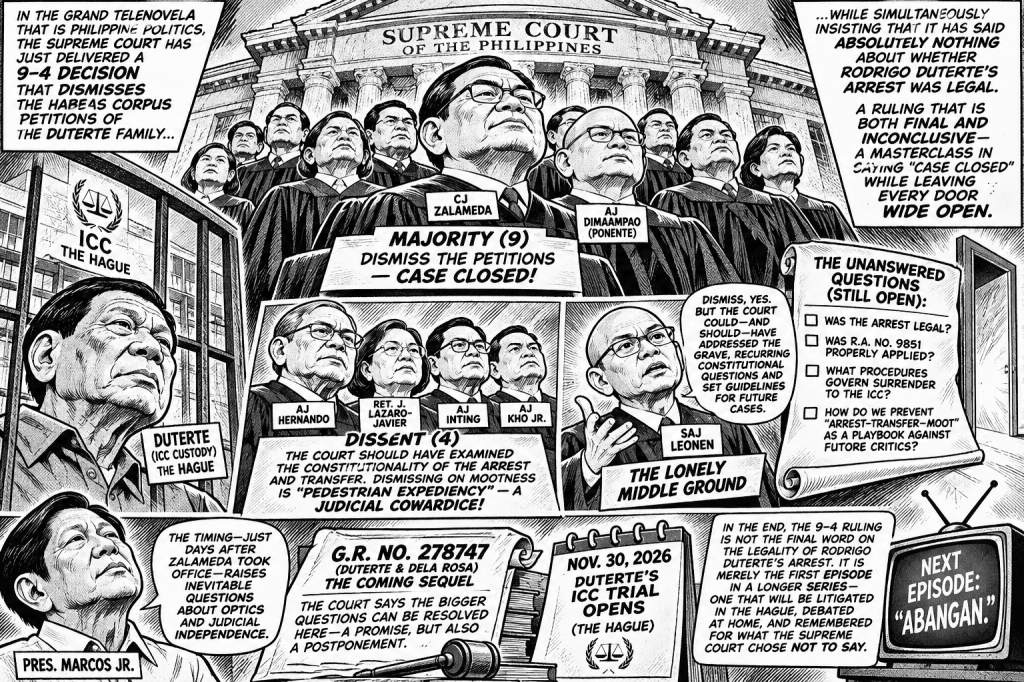
IN THE grand telenovela that is Philippine politics, the Supreme Court has just delivered what can only be described as the judicial equivalent of a cliffhanger episode: a 9-4 decision that dismisses the habeas corpus petitions of the Duterte family while simultaneously insisting it has said absolutely nothing about whether Rodrigo Duterte’s arrest was legal. It is a ruling that manages to be both final and inconclusive, both dispositive and evasive—a masterclass in saying “case closed” while conspicuously leaving every door wide open.
Forgive the skepticism, but when the High Court takes pains to clarify that dismissing a case “does not validate the legality of the arrest or transfer,” one cannot help but wonder: what exactly did the nine justices think they were deciding?
The Territoriality Two-Step
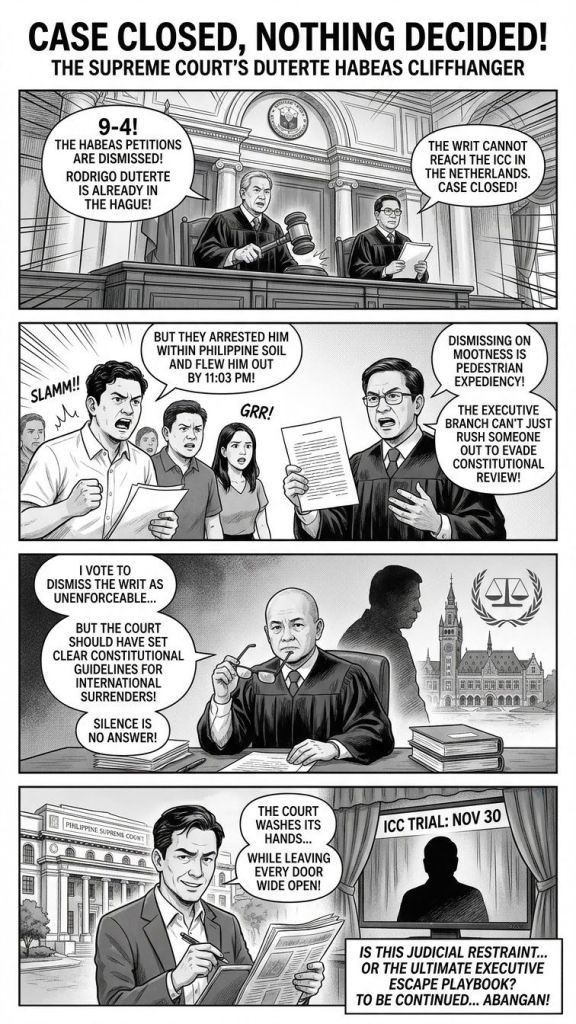
The majority’s core reasoning, penned by Associate Justice Japar Dimaampao under the freshly minted Chief Justice Rodil Zalameda, rests on a deceptively simple proposition: habeas corpus is a domestic writ, enforceable only within Philippine territory, and Rodrigo Duterte is currently in The Hague, beyond the coercive reach of Philippine courts. The Philippine respondents—those named in the petitions—no longer hold custody. Case closed. Move along. Nothing to see here.
It is, on its face, a legally defensible position. One cannot compel an international tribunal in the Netherlands to produce a body via a writ that derives its authority from Philippine sovereignty. The Supreme Court is not, after all, an international police force.
But here is where the analytical gears begin to grind. The petitions filed by Sebastian, Veronica, and Paolo Duterte did not merely challenge the International Criminal Court’s (ICC) present custody. They challenged the conduct of Philippine officials who arrested their father on March 11, 2025, held him in Philippine custody, and facilitated his transfer to The Hague by 11:03 p.m. that same evening—all within Philippine territory, all within the reach of Philippine constitutional guarantees.
The dissenters, led by Associate Justice Ramon Paul Hernando and joined by retired Justice Amy Lazaro-Javier, Associate Justice Henri Jean Paul Inting, and Associate Justice Antonio Kho Jr., saw this distinction clearly. Dismissing on mootness, Hernando wrote, was “pedestrian expediency”—a phrase that deserves to enter the legal lexicon alongside “judicial cowardice” and “abdication of duty.” The dissenters argued that the Court’s refusal to examine the constitutionality of the arrest, the warrantless seizure, the custodial rights violations, and the restrictions on liberty of travel amounted to allowing the executive branch to manufacture mootness through the sheer speed of its actions.
And here we arrive at what may be the most troubling implication of the majority’s reasoning: if the government can arrest a citizen, transfer that citizen abroad before the courts can act, and then argue that judicial review is impossible because the citizen is no longer in Philippine custody, what exactly prevents future administrations from using this playbook against political opponents, activists, or anyone else deemed inconvenient?
The majority would presumably respond that such concerns are speculative and that the legality of the arrest can still be challenged in other proceedings. But this is precisely the point. The Court had before it a concrete case involving a former president, alleged constitutional violations, and a transfer that occurred with breathtaking speed. If this is not the proper case to establish standards for international surrender, what is?
Leonen’s Lonely Middle Ground
Senior Associate Justice Marvic Leonen’s separate opinion deserves particular attention, not because it offers a satisfying resolution, but because it highlights the institutional stakes more clearly than either the majority or the Hernando dissent.
Leonen voted to dismiss the habeas petitions, accepting that the writ could no longer provide effective relief. But he dissented from the majority’s refusal to address the “grave, recurring constitutional questions capable of repetition yet evading review.” In other words, Leonen agreed that the Court could not order the ICC to release Duterte, but he believed the Court could—and should—have used the opportunity to establish guidelines for future cases involving international warrants, surrender requests, and the extraterritorial reach of Philippine constitutional protections.
His position is institutionally coherent but politically awkward. It neither satisfies those who believe Duterte’s arrest was a lawful exercise of international cooperation nor those who believe the Supreme Court should have ordered his return. Instead, it occupies the uncomfortable middle ground of acknowledging the limits of judicial power while insisting that those limits do not require judicial silence.
The majority, of course, chose silence. The question is whether that silence is wise or merely convenient.
The Zalameda Transition and the Optics of Judicial Independence
The timing of the decision has not escaped scrutiny. The ruling was promulgated on November 11, 2026, just days after Rodil Zalameda was appointed Chief Justice by President Ferdinand Marcos Jr., effective November 5, 2026. Both Zalameda and ponente Dimaampao were originally appointed to the High Court by former President Rodrigo Duterte—a fact that has fueled speculation about institutional loyalty, factional dynamics within the Court, and the new Chief Justice’s public declaration of a “No Zalameda Court.”
The phrase “No Zalameda Court” is meant to signal that the Court answers to the Constitution and the people, not to any individual or faction. But actions speak louder than press releases. A Court that dismisses a case of extraordinary constitutional significance on procedural grounds, just days after a new Chief Justice takes office, and just days before the ICC trial opens in The Hague, cannot be surprised when observers connect the dots—even if the dots form a picture the justices would reject.
This is not to allege improper influence. It is merely to note that the appearance of independence matters as much as independence itself, and that the 2025 Code of Judicial Conduct and Accountability (A.M. No. 25-04-04-SC) explicitly requires judges to avoid both actual bias and the appearance of impropriety. Whether the majority’s decision creates such an appearance is a question the justices might have asked themselves before ruling.
G.R. No. 278747: The Coming Sequel
The majority’s repeated invocation of G.R. No. 278747—the pending case filed by Duterte and Senator Ronald “Bato” dela Rosa against Executive Secretary Lucas Bersamin and other officials—as the proper forum for resolving jurisdictional and procedural questions is both a promise and a postponement. It suggests that the Court will eventually address the substantive issues raised by the arrests and potential surrenders of Filipino citizens to international tribunals. But it also functions as a convenient mechanism for avoiding those issues now, when the political stakes are highest and the public scrutiny most intense.
G.R. No. 278747 is itself a legal entanglement of extraordinary complexity. The ICC issued an arrest warrant against dela Rosa in November 2025. Executive enforcement moves followed in May 2026, along with controversies over Senate protective custody and reported bounties. The case has produced multiple concurring opinions, including those of Associate Justices Maria Filomena Singh and Alfredo Benjamin Caguioa, which delve into the constitutionality of arrest and surrender procedures. If the Court intends to resolve these questions there, it has left itself a daunting task—and the public a frustrating wait.
In the meantime, Duterte’s ICC trial on three counts of crimes against humanity opens before Trial Chamber III on November 30, 2026. The former president has waived physical attendance. The prosecution will proceed. And the Philippine Supreme Court, the institution most directly charged with protecting the constitutional rights of Filipino citizens, will have already washed its hands of the matter.
The Statutory Fault Line: R.A. No. 9851
The dissenters’ concerns about Republic Act No. 9851 (Philippine Act on Crimes Against International Humanitarian Law, Genocide and Other Crimes Against Humanity) deserve serious attention, even if the majority chose to defer them. Section 17 of the statute authorizes Philippine authorities to “surrender or extradite suspected or accused persons in the Philippines to the appropriate international court, if any.” But who are the “relevant Philippine authorities”? What procedures must they follow? Is a domestic judicial warrant required? Must the accused be given notice and an opportunity to challenge the surrender?
These are not academic questions. They are the difference between a lawful transfer conducted under constitutional safeguards and a rendition executed on the fly, with the executive branch improvising its way through international cooperation while the judiciary looks the other way.
The government’s strongest defense is that R.A. No. 9851 expressly contemplates surrender to an international court and that the executive acted within its statutory authority. The dissenters’ strongest counterargument is that statutory authority does not answer constitutional questions, and that a law that allows “relevant authorities” to surrender citizens without specifying who they are, what process they must follow, and what judicial oversight applies is, at minimum, dangerously vague.
The Court’s refusal to address these questions leaves a constitutional vacuum that future governments may exploit. It also leaves law enforcement officers, prosecutors, and executive officials without clear guidance on how to handle future international warrants—a recipe for improvisation in matters involving human liberty.
The Fait Accompli Problem
Perhaps the most troubling aspect of the majority’s reasoning is its implicit acceptance of what the dissenters describe as “fait accompli” constitutionalism: the idea that if the government acts fast enough, completes the controversial act before judicial review can occur, and then points to the completion as evidence of mootness, the courts have no choice but to stand aside.
If this principle is accepted without qualification, it creates a perverse incentive structure. Governments that wish to avoid constitutional scrutiny need only act quickly, transfer the affected person beyond the reach of domestic courts, and invoke mootness when the inevitable petitions arrive. The speed of the transfer becomes a shield against accountability. The completion of the act becomes the justification for judicial abdication.
This is not a hypothetical concern. The March 11, 2025 arrest and transfer of Rodrigo Duterte occurred within hours. He arrived from Hong Kong, was taken into custody, and was on a plane to The Hague by 11:03 p.m. The habeas petitions followed, but by then it was too late—at least according to the majority.
The dissenters understood that if the Court accepts this state of affairs, it has effectively written a manual for executive evasion: act first, litigate later, and make sure the person is in The Hague before the Supreme Court can act.
The Rule of Law and the Rule of Optics
In the end, the Duterte habeas dismissal is a ruling that will be praised by supporters of the ICC prosecution as a pragmatic exercise of judicial restraint and condemned by Duterte loyalists as a failure to protect a former president from foreign prosecution. Both sides will claim victory. Both sides will be partially right.
The majority’s decision is legally defensible. Habeas corpus is a domestic writ. The ICC is not a Philippine agency. The Court cannot compel a foreign tribunal to produce a body. These are facts, not opinions.
But the majority’s refusal to resolve the constitutional questions raised by the arrest and transfer—or even to establish guidelines for future cases—is not required by the limits of habeas corpus. It is a choice. And it is a choice that leaves important constitutional questions unanswered, the executive branch without clear legal guidance, and the public with the impression that the Supreme Court, when confronted with a politically explosive case involving a former president, chose procedural convenience over constitutional accountability.
Associate Justice Leonen’s separate opinion offers a more institutionally responsible path: dismiss the petitions if the remedy is unavailable, but use the opportunity to clarify the constitutional standards governing international surrender. The majority did not take that path. Instead, it chose to say nothing while insisting it had said nothing about the merits—a position that may satisfy the technical requirements of justiciability but fails to satisfy the broader demands of judicial responsibility.
The Duterte case will now proceed in The Hague. The victims of the drug war will have their day in court. The former president will defend himself before international judges. And the Philippine Supreme Court will have already moved on to other matters—including, presumably, G.R. No. 278747, where it may or may not eventually address the questions it deferred on November 11, 2026.
Whether that deferral was prudent restraint or unfortunate avoidance depends on one’s view of the Court’s role in a constitutional democracy. But one thing is certain: the 9-4 decision is not the final word on the legality of Rodrigo Duterte’s arrest. It is merely the first episode in a longer series—one that will be litigated in international courtrooms, debated in domestic political arenas, and remembered for what the Supreme Court chose not to say.
And in the grand tradition of Philippine telenovelas, the title of the next episode remains: “Abangan.”
Key Citations
A. Legal & Official Sources
- Duterte, Veronica A. Memorandum of Petitioner Veronica A. Duterte, G.R. No. 278768. Supreme Court of the Philippines, 5 Jan. 2026, sc.judiciary.gov.ph/wp-content/uploads/2026/01/278768-Memorandum-of-Petitioner-Veronica-A.-Duterte.pdf.
- Institute of International Legal Studies. Frequently Asked Questions on the Arrest, Surrender and Proceedings Involving Former President Duterte at the International Criminal Court. University of the Philippines Law Center, 29 Apr. 2025, law.upd.edu.ph/wp-content/uploads/2025/04/FREQUENTLY-ASKED-QUESTIONS-ON-THE-ARREST-SURRENDER-AND-PROCEEDINGS-INVOLVING-FORMER-PRESIDENT-DUTERTE-AT-THE-INTERNATIONAL-CRIMINAL-COURT.pdf.
- Philippines. Congress. Republic Act No. 9851: An Act Defining and Penalizing Crimes Against International Humanitarian Law, Genocide and Other Crimes Against Humanity, Organizing Jurisdiction, Designating Special Courts, and for Related Purposes. The Lawphil Project, 11 Dec. 2009, lawphil.net/statutes/repacts/ra2009/ra_9851_2009.html.
- Supreme Court of the Philippines. A.M. No. 25-04-04-SC: The 2025 Code of Judicial Conduct and Accountability. 11 Nov. 2025, sc.judiciary.gov.ph/wp-content/uploads/2025/12/A.M.-NO.-25-04-04-SC.pdf.
- Supreme Court of the Philippines. G.R. No. 278747: Rodrigo Roa Duterte and Senator Ronald “Bato” M. Dela Rosa v. Hon. Lucas Bersamin et al.—Concurring Opinion of Associate Justice Alfredo Benjamin S. Caguioa. 20 May 2026, sc.judiciary.gov.ph/wp-content/uploads/2026/05/278747-CAGUIOA.pdf.
- Supreme Court of the Philippines. G.R. No. 278747: Rodrigo Roa Duterte and Senator Ronald Dela Rosa v. Hon. Lucas Bersamin et al.—Concurring Opinion of Associate Justice Maria Filomena D. Singh. 20 May 2026, sc.judiciary.gov.ph/wp-content/uploads/2026/05/278747-SINGH.pdf.
- Supreme Court of the Philippines. Rodrigo Roa Duterte and Senator Ronald Dela Rosa v. Hon. Lucas Bersamin et al., G.R. No. 278747, Resolution. 20 May 2026, batasnatin.com/laws/9efb40e5-83a5-4e57-8ec1-490e45951a1f.
B. News Reports
- Ayalin, Adrian. “Supreme Court Dismisses Habeas Corpus Petitions vs Duterte’s Arrest.” ABS-CBN News, 24 Nov. 2026, http://www.abs-cbn.com/news/nation/2026/11/24/supreme-court-junks-petitions-vs-duterte-s-icc-arrest-1517.
- Belara, Barr. “SC Dismisses Habeas Corpus Petitions Over Former President Duterte’s Arrest.” The Chronicle, 24 Nov. 2026, thechronicle.com.ph/sc-dismisses-habeas-corpus-petitions-over-former-president-dutertes-arrest/.
- Bonzo, Lyjah Tiffany. “SC Junks Petitions Challenging Ex-President Duterte’s Arrest.” GMA News Online, GMA Network, 24 Nov. 2026, http://www.gmanetwork.com/news/topstories/nation/1010604/sc-junks-petitions-challenging-ex-president-duterte-s-arrest/story/.
- Filipino Times. “Supreme Court Dismisses Petitions Seeking Duterte’s Release Before ICC Trial.” The Filipino Times, 24 Nov. 2026, filipinotimes.net/latest-news/2026/11/24/supreme-court-dismisses-petitions-seeking-dutertes-release-before-icc-trial/.
- Murcia, Alvin. “Petitions Beset New CJ Zalameda.” Daily Tribune, 7 Nov. 2026, tribune.net.ph/2026/11/06/petitions-beset-new-cj-zalameda.
- Pulta, Benjamin. “Behind the Robes: Getting to Know the Chief Justice Contenders.” Philippine News Agency, 3 Nov. 2026, http://www.pna.gov.ph/article/behind-the-robes-getting-to-know-the-chief-justice-contenders.
- Torres-Tupas, Tetch. “Duterte Siblings to SC: Legality of Father’s Arrest Far from Being Moot.” Inquirer.net, 6 Jan. 2026, globalnation.inquirer.net/304604/duterte-siblings-legality-of-fathers-arrest-far-from-being-moot.
- “Ang Hirap Maging Mahirap”: The PAO Scandal That Proves Government Contempt Is Nothing New

- “Far-Off” My Axx: Malacañang’s Claire Castro Drowns in Her Own Legal Gaslighting
- “Forthwith” to Farce: How the Senate is Killing Impeachment—And Why Enrile’s Right (Even If You Can’t Trust Him)

- “HINDI AKO NAG-RESIGN!”

- “I Have No Reason to Doubt”: Teodoro’s MDT Fairy Tale

- “I Know Nothing”: Baste Duterte’s Amnesia Defense Meets ₱33M in GenCorp Contracts

- “I’m calling you from my new Globe SIM. Send load!”

- “Mahiya Naman Kayo!” Marcos’ Anti-Corruption Vow Faces a Flood of Doubt

- “Manageable” Debt, Unmanageable Corruption: The ₱19.66-Trillion Lie

- “Manageable” Debt, Unmanageable Lies: DBM’s ₱21 Trillion Fairy Tale

- “Meow, I’m calling you from my new Globe SIM!”

- “Natrabaho”: One Word, One Ombudsman, and a Judiciary on Trial








Leave a Reply