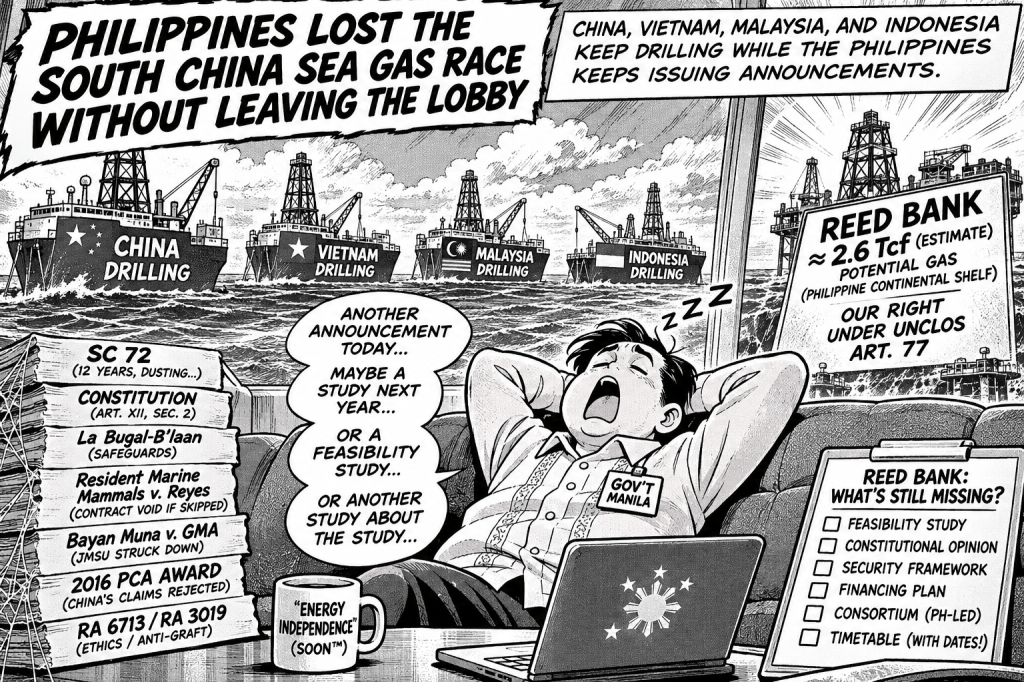
China, Vietnam, Malaysia, and Indonesia keep drilling while the Philippines keeps issuing announcements.
By Louis ‘Barok‘ C. Biraogo — November 25, 2026
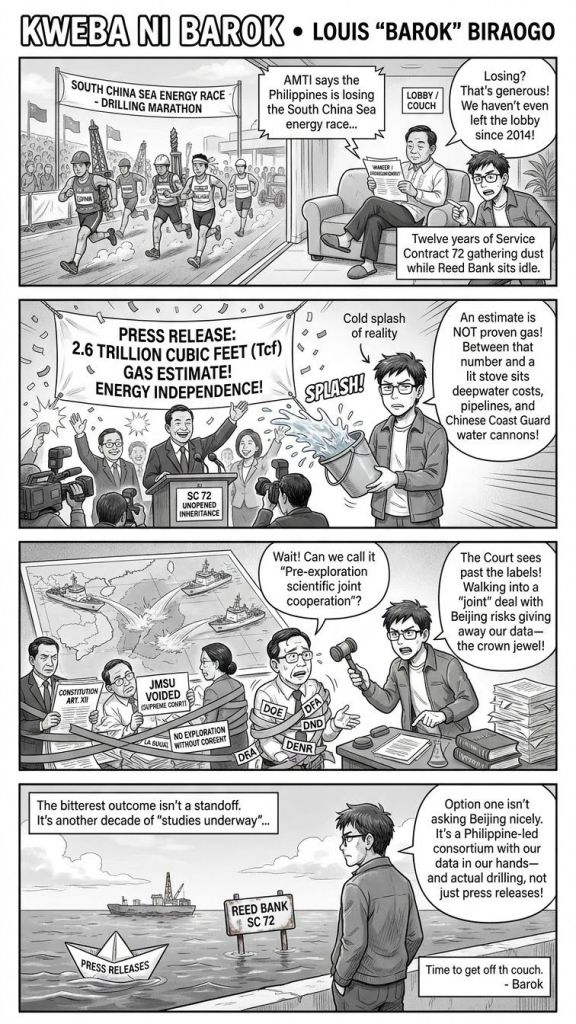
THE Asia Maritime Transparency Initiative (AMTI) has told us that the Philippines is losing the South China Sea energy race. Fine. But that’s like telling a man who hasn’t left his couch since 2014 that he’s lost the marathon. We were never at the starting line. We were in the lobby, reviewing the waiver.
According to AMTI’s November 16, 2026 study, “Tapping Out or Tapping In?”, China, Vietnam, Malaysia, and Indonesia keep drilling while Manila “remains comparatively restrained.” The Manila Times ran the headline on November 19: the Philippines “falls behind.” Restrained is a lovely word. It sounds like discipline. It is actually twelve years of Service Contract 72 (SC 72) gathering dust while Reed Bank, estimated at roughly 2.6 trillion cubic feet (Tcf) of gas, sits there like an unopened inheritance.
The Estimate Is Not the Gas
Before anyone in the Palace starts printing “Energy Independence” tote bags, a cold splash of reality. A 2.6-Tcf figure is a geological estimate, not proven, recoverable, bankable reserves. Between the estimate and a lit stove sit reservoir quality, drilling costs, pipelines or floating liquefied natural gas (LNG), financing, insurance, and a Chinese Coast Guard with a hobby of ruining other people’s logistics. AMTI sounds the alarm, but it doesn’t prove that every delay was cowardice, corruption, or incompetence. It proves we’re slow. The why is the part nobody has bothered to document.
Which is rich, because the government has had twelve years to write that document. Instead we got announcements.
The Law Is Not the Excuse (But It Is a Landmine)
Here is where the self-congratulation about our “strong legal position” runs into the Constitution. Article XII, Section 2 of the 1987 Constitution keeps petroleum under the State’s “full control and supervision,” and permits foreign involvement only through limited agreements involving technical or financial assistance. La Bugal-B’laan spelled out the safeguards: a governing general law, presidential involvement, reporting to Congress within thirty days, and real State control. Resident Marine Mammals v. Reyes then voided the Tañon Strait service contract when those safeguards were skipped, including the President’s personal role.
And then there is the ghost that haunts every “joint exploration” press conference: the Joint Marine Seismic Undertaking (JMSU). In Bayan Muna v. Macapagal-Arroyo, G.R. No. 182734, the Supreme Court struck down the Joint Marine Seismic Undertaking among Philippine, Chinese, and Vietnamese state-linked firms, because gathering data on petroleum potential is exploration no matter what you call it. “Pre-exploration,” “scientific cooperation,” “diplomatic framework”: the Court looked past the labels. Any official who dusts off the word “joint” without first reading that decision is volunteering for a petition under Rule 65.
The Seduction of “Joint Development”
Let’s be fair to the pragmatists, since someone should be. Joint development promises capital, equipment, risk-sharing, and maybe a calmer sea. Gas is gas, and Luzon’s lights don’t care about ideology. The Malampaya Phase 4 news is welcome too. It reportedly extends Service Contract 38 through 2032 for a field supplying about 20 percent of Luzon’s electricity. But Malampaya is a bridge, and we keep celebrating the bridge as if it were the destination.
Now the unflattering part. Reed Bank is a submerged feature on the Philippine continental shelf, and United Nations Convention on the Law of the Sea (UNCLOS) Article 77 gives the coastal state exclusive sovereign rights over its resources. If we don’t explore, nobody else may without our consent. That is the strongest card we hold. Walking into a “joint” arrangement with China, the very country the 2016 Award rejected, risks handing Beijing a political argument it could never win in court: that the area is a negotiated common pot and Manila needed permission. A “without prejudice to sovereignty” clause is decorative if the data, the operations, and the decisions drift elsewhere. And the data is the crown jewel. Seismic information tells you where the gas is, how much, and who should drill. Give that away and you’ve gifted the treasure map and kept the shovel.
Competing Explanations, All Equally Embarrassing
Why the twelve-year freeze? My findings offer hypotheses, not proof, and I’ll label them as such:
Fear. Chinese water cannons make insurers sweat, and the quiet veto is “nobody will underwrite this.” The counterargument writes itself: if threats alone can freeze our rights, they were never rights, just decorations on a map.
Diplomacy. The administration may be preserving channels. Possible, and it would be more convincing if anyone had published the plan.
Plain inertia. Department of Energy (DOE), Department of Foreign Affairs (DFA), Department of National Defense (DND), Department of Environment and Natural Resources (DENR), and Philippine National Oil Company (PNOC) all hold a piece, and nobody owns the outcome. A country can sabotage itself without foreign help. We’ve done it before, with a straight face.
Bad economics. Deepwater is brutal, and investors can compare Reed Bank with a dozen friendlier basins.
There are also the whispers: backdoor chats between private consortiums and Chinese state firms, officials quietly auditioning a joint venture. I will say this plainly. Nothing in my materials documents any of it. It is rumor, and rumors get resolved by paper: DOE records, SC 72 suspension and force majeure notices, cabinet decisions, correspondence, procurement files. If those documents exist, let’s see them. If officials hold undisclosed interests, Republic Act (RA) No. 6713 (Code of Conduct and Ethical Standards for Public Officials and Employees) and RA No. 3019 (Anti-Graft and Corrupt Practices Act) are waiting. But “the policy failed” and “someone got paid” are different allegations, and only one requires an indictment.
The Verdict
The most defensible path, based on my analysis, is boring and therefore politically unlikely: a Philippine-led, constitutionally compliant consortium of qualified international operators, financed diversely, with our geological data locked in Philippine hands and every contract published. Option one is not “ask Beijing nicely.” Option one is to test whether Reed Bank can be developed without making China the indispensable partner.
AMTI is right about the gap and a little too tidy about the causes. Our constraints are real, which is why the response cannot be to bulldoze them. But constraints are not a strategy. After twelve years, the government owes the public a status report on SC 72, an independent constitutional opinion, a feasibility study, a security framework, and a timetable with dates attached.
The bitterest outcome isn’t a standoff with China or a doomed joint venture. It’s another decade of “studies underway,” where the only thing extracted from Reed Bank is press releases.
Key Citations
A. Legal & Official Sources
- Bayan Muna Party-List Representatives Satur C. Ocampo and Teodoro A. Casiño, et al. v. President Gloria Macapagal-Arroyo, et al. G.R. No. 182734, 10 Jan. 2023. Supreme Court E-Library, Supreme Court of the Philippines, https://elibrary.judiciary.gov.ph/thebookshelf/showdocs/1/68723.
- La Bugal-B’laan Tribal Association, Inc. v. Ramos. G.R. No. 127882, Resolution, 1 Dec. 2004. The Lawphil Project, Arellano Law Foundation, https://lawphil.net/judjuris/juri2004/dec2004/gr_127882_2004.html.
- Permanent Court of Arbitration. The South China Sea Arbitration (The Republic of the Philippines v. The People’s Republic of China). PCA Case No. 2013-19, Award, 12 July 2016, https://pca-cpa.org/en/cases/7/.
- Philippines. The 1987 Constitution of the Republic of the Philippines. Official Gazette of the Republic of the Philippines, 1987, https://www.officialgazette.gov.ph/constitutions/1987-constitution/.
- Philippines. Republic Act No. 3019. Anti-Graft and Corrupt Practices Act. 17 Aug. 1960. Senate of the Philippines Legislative Issuances Library, https://issuances-library.senate.gov.ph/legislative%2Bissuances/Republic%20Act%20No.%203019.
- Philippines. Republic Act No. 6713. Code of Conduct and Ethical Standards for Public Officials and Employees. 20 Feb. 1989. The Lawphil Project, Arellano Law Foundation, https://www.lawphil.net/statutes/repacts/ra1989/ra_6713_1989.html.
- Resident Marine Mammals of the Protected Seascape Tañon Strait v. Reyes. G.R. Nos. 180771 and 181527, 21 Apr. 2015. Supreme Court E-Library, Supreme Court of the Philippines, https://elibrary.judiciary.gov.ph/thebookshelf/showdocs/1/60478.
- United Nations. United Nations Convention on the Law of the Sea. 10 Dec. 1982, https://www.un.org/depts/los/convention_agreements/texts/unclos/unclos_e.pdf.
- Division for Ocean Affairs and the Law of the Sea. “United Nations Convention on the Law of the Sea of 10 December 1982: Overview and Full Text.” Oceans and Law of the Sea, United Nations, 24 Apr. 2026, http://www.un.org/depts/los/convention_agreements/convention_overview_convention.htm.
B. News Reports
- Asia Maritime Transparency Initiative. “Tapping Out or Tapping In? South China Sea Oil and Gas in 2026.” Center for Strategic and International Studies, 16 Nov. 2026, https://amti.csis.org/tapping-out-or-tapping-in-south-china-sea-oil-and-gas-in-2026/.
- Baroña, Franco Jose C. “Philippines Falls Behind as South China Sea Rivals Ramp Up Oil, Gas Exploration—Study.” The Manila Times, 19 Nov. 2026, https://www.manilatimes.net/2026/11/19/news/philippines-falls-behind-as-south-china-sea-rivals-ramp-up-oil-gas-exploration-study/2473715.

- ₱9 Billion in ‘Savings’? DILG’s Fire Truck Deal Smells Like Smoke

- ₱8B BBM Pork: CCTV for Every Captain’s Kumpare?
- ₱8.9 Billion, 331 Ghost Police Stations: The TIKAS Scandal Explained

- ₱8.4 Billion, 42,000 Barangays, 1 Election: The “Bawat Barangay Makikinabang” Vote-Buying Masterclass

- ₱75 Million Heist: Cops Gone Full Bandit

- ₱63 to the Dollar: The Only Thing Falling Faster Than the Peso Is the Government’s Credibility

- ₱6.77B Ghost Haunts Duterte: RTC Dismisses Mans Carpio’s Desperate Plea
- ₱6.77 Billion and Zero Cash: The Sara Duterte SALN Math That Doesn’t Add Up

- ₱6.7-Trillion Temptation: The Great Pork Zombie Revival and the “Collegial” Vote-Buying Circus

- ₱58.53B, Zero Receipts: The LGSF Pork Barrel Nobody Wants to Name
- ₱53 Million Man Tells ₱695-a-Day Workers to Stop Being ‘Mayabang’: The Audacity of BSP’s Remolona

- ₱491-M Right-of-Way Scam: DPWH Paid for Ghost Land, Ombudsman Finally Notices




Leave a Reply