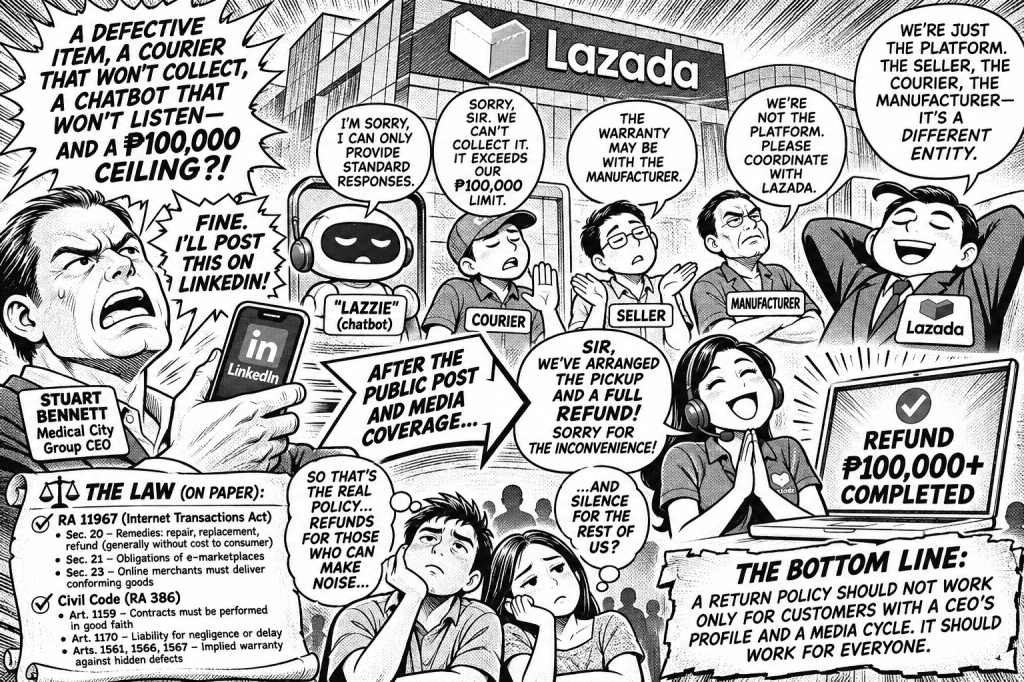
Inside the defective-product return that took a hospital CEO, a media cycle, and one very persistent LinkedIn post to fix.
By Louis “Barok” C. Biraogo | November 28, 2026
Let me tell you a story about a ₱100,000 ceiling—not the kind that keeps the rain off your head, but the kind that keeps a refund from reaching your wallet. It is a story about a courier who would not collect, a chatbot that would not listen, and a marketplace that discovered, with breathtaking speed, the lost art of customer service the moment a hospital Chief Executive Officer (CEO) pressed “post.”
Stuart Bennett, the Medical City Group’s chief executive, bought something defective through LazMall. It cost more than ₱100,000. The courier allegedly refused to collect it because it exceeded an internal collection limit. The 60-day return window ticked toward November 27 like a bomb in a movie. Follow-ups went nowhere. Then Bennett did what any executive with a LinkedIn account and a grievance does: he made noise. The next day—the next day—Lazada called, arranged the return, and issued a full refund.
Now, I am not here to bury Bennett. I am here to ask why the rest of us are still waiting on hold.
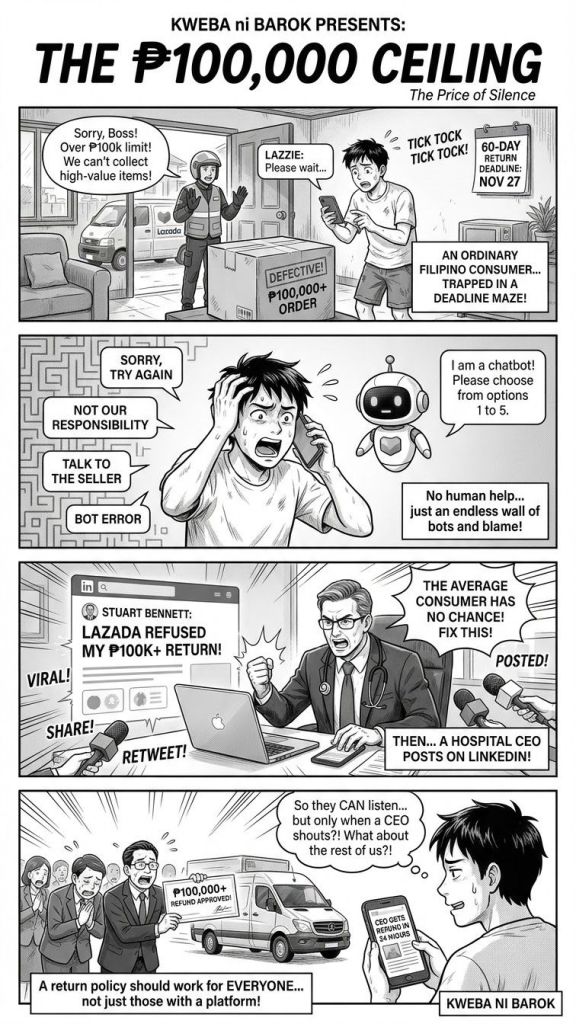
The Architecture of Accountability-Free Retail
Here is the trick, and it is a beautiful trick if you can get away with it. The modern e-marketplace has perfected the fragmentation of blame. Lazada is not the seller. The seller is not the manufacturer. The manufacturer is not the courier. The courier is not the warranty provider. And the chatbot, bless its silicon heart, is not a person at all—which is precisely the point.
When the courier refused to collect a high-value item, whose problem was that? The platform’s, one would think, since the platform advertised the 60-day return. But the platform can point to the courier. The courier can point to its insurance limits. The seller can point to the warranty. And the consumer is left standing in the middle of this corporate ring-around-the-rosy, holding a defective product and a deadline.
Republic Act No. 11967 (Internet Transactions Act of 2023) was supposed to fix this. Section 20 gives online consumers remedies—repair, replacement, refund—for defective goods, generally without cost to the consumer. Section 21 imposes obligations on e-marketplaces. Section 23 obliges online merchants to deliver goods that conform to their descriptions. On paper, this is a consumer-protection cathedral. In practice, it is a cathedral with a ₱100,000 ceiling and a courier who will not climb the stairs.
The Deadline That Wasn’t
Here is the legal sleight of hand that should make every Filipino consumer’s blood run cold. If a consumer timely initiates a return and the platform’s own courier refuses collection, does the consumer lose the remedy because the deadline passes? The company, after all, created the logistical arrangement that prevented compliance.
This is the fairness principle that separates a functioning legal system from a bureaucratic maze: a party should not benefit from the failure of its own infrastructure. Article 1159 of Republic Act No. 386 (Civil Code of the Philippines) tells us contracts have the force of law between parties and must be performed in good faith. Article 1170 makes parties liable for negligence or delay in the performance of obligations. If Lazada’s return process could not accommodate a high-value item, that is Lazada’s operational problem—not the consumer’s penalty to absorb.
The refund arrived before the deadline. Bully for Bennett. But the deadline should never have been in play. The fact that it was—that a consumer’s remedy hung on whether a courier would deign to collect—tells you everything about how the system is designed. It is designed to work for predictable transactions and to fail, quietly and expensively, for everyone else.
The Public Relations Paradox
The sequence of events is devastating precisely because it is so legible:
- routine channels allegedly failed
- public criticism followed
- senior-level intervention occurred
- refund completed
Lazada’s defenders will say the company responded promptly once the issue reached the right people. Perhaps. But the right people, apparently, were reachable only through LinkedIn and media coverage. The ordinary consumer does not have a LinkedIn following. The ordinary consumer has a chatbot named something like “Lazzie” and a ticket number that goes to die in a database.
Bennett himself reportedly said “the average consumer has no chance.” This is rhetorically extravagant, but it is not wrong. It is the plain description of a two-tier consumer system: those with visibility get refunds; those without get silence. The company can recover a dissatisfied customer. It cannot so easily recover the perception that publicity—not policy—is the effective remedy.
The Legal Illusion
Let us be fair to Lazada, which is not a phrase I enjoy writing. The company is not necessarily the manufacturer. If an independent merchant sold the defective product through LazMall, the warranty obligation may lie elsewhere. The courier’s ₱100,000 limit may reflect legitimate insurance, liability, or fraud-prevention concerns. And a poorly handled return is not automatically an actionable abuse of rights under Articles 19, 20, and 21 of the Civil Code. Solidbank Corporation v. Mindanao Ferroalloy Corporation and CJH Development Corporation v. Aniceto both remind us that bad faith must be established and is not synonymous with bad judgment or simple negligence.
But here is the legal detail that Lazada’s lawyers would rather you overlook: the implied warranty against hidden defects in the Civil Code—Articles 1561, 1566, and 1567—does not require the vendor to have known about the defect. RCBC Savings Bank v. Odrada is instructive on this point. The vendor may be liable for qualifying hidden defects even when unaware of them. So the question is not simply whether Lazada “meant well.” The question is whether the goods conformed to what was promised, and whether the remedy promised was operationally accessible.
An advertised remedy that cannot be exercised is not a remedy. It is a marketing slogan.
The Ethical Core
Strip away the statutes and the case law and you find a simple management principle that Lazada apparently discovered on November 26: the customer is not supposed to be the company’s systems integrator. A consumer should not have to coordinate the marketplace, the seller, the courier, the warranty provider, and the chatbot merely to return an eligible defective item.
Bennett’s call for trained human escalation is sound—not because Artificial Intelligence (AI) is evil, but because AI is excellent at routine and catastrophic at exception. A product above a courier’s collection limit is precisely the exception that should trigger a human being. Instead, it triggered a wall. That wall came down only when someone with a public platform leaned on it.
What Lazada Should Do
Lazada can still convert this embarrassment into competence. Create a dedicated high-value returns channel. Automatically suspend return deadlines when collection is blocked by a platform-arranged logistics limitation. Assign a human case owner after repeated failed escalations. Publish courier restrictions before purchase, not after the defect appears. And stop making customers explain the same problem to a different chatbot every week.
If the company does these things, the ₱100,000 ceiling becomes a footnote. If it does not, the ceiling becomes the metaphor: a company that can reach you the moment you shout, but never the moment you whisper.
The Bottom Line
Bennett won his individual dispute. The bigger question is whether the rest of us will ever get the same courtesy without a CEO’s profile and a media cycle. A return policy should not work only for customers who can make noise. It should work for everyone. Until it does, every Filipino consumer should save their screenshots, log their ticket numbers, and remember the lesson of November 25: in the Philippines, the squeaky wheel does not just get the grease—it gets the refund.
Key Citations
A. Legal & Official Sources
- CJH Development Corporation v. Aniceto. G.R. No. 224006, 6 July 2020. Supreme Court E-Library, elibrary.judiciary.gov.ph/thebookshelf/showdocs/1/66462.
- Civil Code of the Philippines. Republic Act No. 386, 18 June 1949. Lawphil, lawphil.net/statutes/repacts/ra1949/ra_386_1949.html.
- Internet Transactions Act of 2023. Republic Act No. 11967, 5 Dec. 2023. Lawphil, lawphil.net/statutes/repacts/ra2023/ra_11967_2023.html.
- RCBC Savings Bank v. Odrada. G.R. No. 219037, 19 Oct. 2016. Lawphil, lawphil.net/judjuris/juri2016/oct2016/gr_219037_2016.html.
- Solidbank Corporation v. Mindanao Ferroalloy Corporation. G.R. No. 153535, 28 July 2005. Supreme Court E-Library, elibrary.judiciary.gov.ph/thebookshelf/showdocs/1/48727.
B. News Reports
- Abante. “Higit P100K Item Sablay: Medical City CEO Imbiyerna sa Lazada.” Abante, 25 Nov. 2026, http://www.abante.com.ph/2026/11/25/higit-p100k-item-sablay-medical-city-ceo-imbiyerna-sa-lazada/.
- Abante. “Lazada Ni-Refund Higit P100K ng The Medical City President-Group CEO.” Tonite, Abante, 26 Nov. 2026, tonite.abante.com.ph/lazada-ni-refund-higit-p100k-ng-the-medical-city-president-group-ceo/news/.
- Bilyonaryo. “Medical City CEO Hits Lazada over Unresolved Return of Defective Purchase.” Bilyonaryo, 25 Nov. 2026, bilyonaryo.com/medical-city-ceo-hits-lazada-over-unresolved-return-of-defective-purchase/.

- ₱9 Billion in ‘Savings’? DILG’s Fire Truck Deal Smells Like Smoke

- ₱8B BBM Pork: CCTV for Every Captain’s Kumpare?
- ₱8.9 Billion, 331 Ghost Police Stations: The TIKAS Scandal Explained

- ₱8.4 Billion, 42,000 Barangays, 1 Election: The “Bawat Barangay Makikinabang” Vote-Buying Masterclass

- ₱75 Million Heist: Cops Gone Full Bandit

- ₱63 to the Dollar: The Only Thing Falling Faster Than the Peso Is the Government’s Credibility

- ₱6.77B Ghost Haunts Duterte: RTC Dismisses Mans Carpio’s Desperate Plea

- ₱6.77 Billion and Zero Cash: The Sara Duterte SALN Math That Doesn’t Add Up

- ₱6.7-Trillion Temptation: The Great Pork Zombie Revival and the “Collegial” Vote-Buying Circus

- ₱58.53B, Zero Receipts: The LGSF Pork Barrel Nobody Wants to Name

- ₱53 Million Man Tells ₱695-a-Day Workers to Stop Being ‘Mayabang’: The Audacity of BSP’s Remolona

- ₱491-M Right-of-Way Scam: DPWH Paid for Ghost Land, Ombudsman Finally Notices




Leave a Reply