From Honoraria to RATA to Unobligated Capital Outlay: COA Audits UP’s Creative Interpretation of ‘Use It or Lose It’
By Louis “Barok” C. Biraogo | November 29, 2026
THE University of the Philippines (UP) has produced presidents, chief justices, senators, and the scholars who wrote the very rules governing public funds. What it has apparently never produced, according to the Commission on Audit (COA), is a procurement office capable of spending ₱3.3 billion before the fiscal year ends.
COA has just released its 2025 findings on the University of the Philippines (UP) System, and the numbers are the kind that make you want to sit down, pour yourself a glass of something strong, and reconsider every assumption you’ve ever held about the relationship between intelligence and administrative competence.
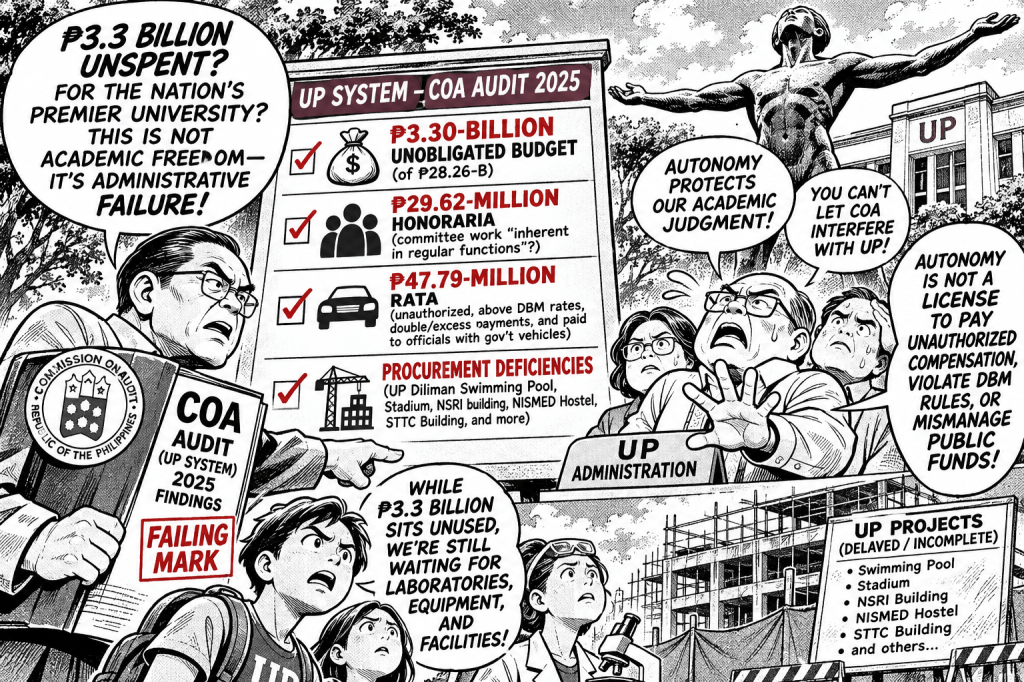
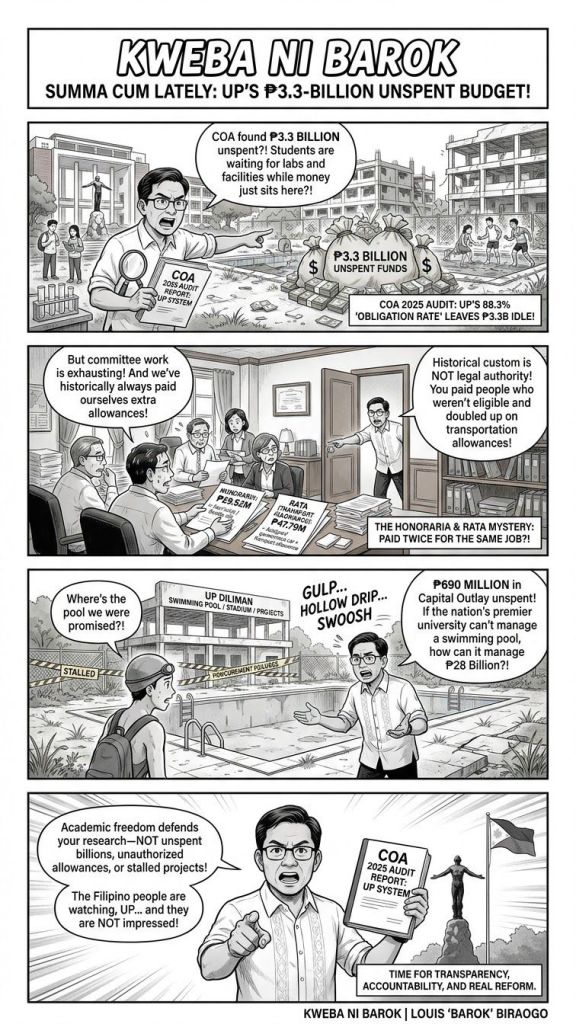
Of the ₱28.26 billion in adjusted allotments handed to UP, the university managed to obligate only ₱24.95 billion. That leaves ₱3.30 billion—billion, with a “b”—sitting around like an uninvited guest at a party, doing absolutely nothing, while students wait for laboratories, researchers wait for equipment, and Filipino taxpayers wonder whether their money is being held hostage by a procurement system that moves at the speed of a Senate hearing on constitutional amendments.
Now, before the UP faithful start drafting their angry Facebook posts and before the COA critics begin polishing their “institutional autonomy” arguments, let me be clear about something: I am not here to declare anyone guilty of anything. I am here to ask questions. Lots of them. The kind that make public officials uncomfortable. The kind that people with something to hide hope nobody asks.
The Obligation Rate That Wasn’t
An 88.30% obligation rate. On its face, that sounds almost respectable—like a student who got a B+ and wants you to know it’s technically above average. But this isn’t a classroom. This is public money.
And the ₱3.3 billion that remained unobligated isn’t a rounding error; it’s roughly the entire annual budget of a mid-sized state university or the cost of several hundred kilometers of farm-to-market roads.
COA, in its characteristic understated way, concluded that the unobligated balances “affected the timely implementation of projects and delivery of services.” That’s audit-speak for “the money was there, the needs were there, and somehow the two never met.”
The breakdown is particularly illuminating. Of the ₱3.3 billion, ₱2.61 billion was Maintenance and Other Operating Expenses—the kind of funding that covers research, laboratory supplies, student services, facilities maintenance, and healthcare. Another ₱690.38 million was Capital Outlay, which is supposed to build things. Buildings. Facilities. Infrastructure that students can actually use.
One might reasonably ask: Did UP’s planning process consist of a group prayer and a hope that procurement would sort itself out? Or did someone simply forget to file the paperwork?
The university’s defenders will argue—and they have already begun to argue—that unobligated balances do not necessarily mean waste. They point out that procurement failures, bidder shortages, project redesigns, delayed permits, contractor failures, and circumstances beyond institutional control can all leave funds unspent. This is true. It is also irrelevant to the central question, which is whether those circumstances were documented, whether they were foreseeable, and whether the university took reasonable steps to address them.
Because here’s the thing about administrative competence: it is not measured by how well you explain failures after the fact. It is measured by whether you anticipated obstacles and planned around them.
The Honoraria Question: Or, How to Pay Yourself Twice for the Same Job
Let us now turn to the ₱29.62 million in honoraria payments that COA flagged. The figures are instructive: ₱3.35 million in 2024 and ₱26.27 million in 2025—a nearly eightfold increase in a single year.
The audit found that these payments were made to university and hospital personnel for committee work that COA considered “inherent in their regular functions.” In plain English: people were being paid extra for doing the jobs they were already being paid to do.
Now, I understand that committee work can be burdensome. I understand that serving on a procurement committee, an academic review panel, or a hospital administrative body involves time and effort that may exceed ordinary duties. But here is a legal principle that seems to have escaped some UP administrators: public compensation must have a legal basis. It cannot be conjured into existence because the work is important, because the committee is prestigious, or because the institution has “historically done it this way.”
The Supreme Court’s decision in Nayong Pilipino Foundation, Inc. v. COA—which I’m increasingly convinced should be required reading for every government financial officer—established a clear principle: honoraria must have legal authority and must satisfy the governing conditions. Institutional custom is not legal authority. Committee importance is not legal authority. The perceived value of someone’s contribution is not legal authority.
The pattern COA identified—a committee is formed, employees are assigned, additional compensation is paid, the practice continues over several years—is the kind of thing that happens when institutions confuse precedent with permission. Just because you’ve done something before doesn’t mean you’re allowed to keep doing it.
RATA: The ₱47.79-Million Transportation Allowance Mystery
The audit also questioned ₱47.79 million in Representation and Transportation Allowance (RATA) payments. The breakdown reads like a how-not-to manual for government compensation:
- ₱13.27 million paid to unauthorized personnel
- ₱33.74 million in payments exceeding Department of Budget and Management (DBM)-prescribed rates
- ₱124,500 in double or excess payments
- ₱585,000 paid to officials who were already assigned government vehicles
Let me translate this into plain language: the university appears to have paid people who weren’t eligible, paid them more than they were supposed to receive, paid them twice in some cases, and paid some of them for transportation even though the government was already providing transportation.
This is not fiscal mismanagement. This is fiscal interpretive dance—an elaborate, creative, and legally questionable attempt to redefine what constitutes “allowance” and who is entitled to receive it.
The Department of Budget and Management’s National Budget Circular No. 593, issued in May 2024, updated the rules governing RATA. The circular establishes clear eligibility requirements, rate ceilings, and restrictions—including the prohibition on paying transportation allowances to officials who have been assigned government vehicles. These rules are not optional. They are not suggestions. They are mandatory conditions for the lawful expenditure of public funds.
If UP violated them, the question is not whether the university “meant well” or whether the officials involved “worked hard.” The question is whether public money was spent without legal authority. And if it was, the consequences must follow.
Procurement: Where Infrastructure Projects Go to Die
The audit also identified procurement and project implementation deficiencies involving seven constituent or operating units, including projects like the UP Diliman Swimming Pool, the UP Diliman Stadium, the National Science Research Institute building, waterproofing works at the Institute of Mathematics Annex, the National Institute for Science and Mathematics Education Development (NISMED) Hostel, and the STTC Building.
These are not abstract accounting entries. These are facilities that were supposed to serve students, faculty, researchers, and the public. The fact that multiple projects across different units encountered similar problems suggests something more troubling than isolated administrative failures. It suggests systemic weaknesses in project planning, procurement execution, contract supervision, and accountability.
One might reasonably ask: If UP cannot manage the construction of a swimming pool, how can it be trusted to manage a ₱28-billion budget? If it cannot ensure that building projects are completed on schedule, why should anyone believe its promises about delivering world-class education and research?
Now, I want to be fair. The university’s defenders will argue—correctly—that procurement in the Philippines is a labyrinthine nightmare of regulations, documentary requirements, and bureaucratic bottlenecks. Republic Act (RA) 12009, the New Government Procurement Act, only became effective in February 2025, and the transitional provisions create additional complexity. Projects initiated under RA 9184 may have been subject to different rules than those begun under the new framework.
But here’s the thing: competence in procurement is not optional. It is not a nice-to-have. It is a fundamental requirement of public administration. If UP lacks the capacity to navigate procurement rules, it has a responsibility to build that capacity. If its procurement officers are overwhelmed, it has a responsibility to hire more. If its processes are inefficient, it has a responsibility to reform them.
The alternative—allowing projects to languish while funds remain unobligated and needs go unmet—is not acceptable. Not for the premier state university. Not for any public institution. Not for the Filipino people who pay for it.
The Autonomy Defense: A Shield or a Blanket Excuse?
I anticipate that some of UP’s defenders will invoke institutional autonomy, citing Article XIV of the Constitution and the university’s tradition of academic freedom. They will argue that COA does not understand the complexities of university operations, that the audit intrudes upon academic decision-making, and that the findings represent an attack on the institution’s independence.
To these defenders, I say: read the Constitution carefully.
Academic freedom protects the university’s right to determine who teaches, what is taught, how research is conducted, and how academic programs are designed. It does not protect the right to pay unauthorized compensation, violate procurement laws, ignore DBM circulars, or mismanage public funds.
The Supreme Court has been clear on this point. Government institutions—including state universities—are subject to audit. Their autonomy does not exempt them from fiscal accountability. The Constitution’s grant of academic freedom is not a license to spend public money however the institution pleases.
The strongest autonomy argument is not that COA should not audit UP. It is that COA should audit UP in a manner that respects academic decision-making and distinguishes between legitimate institutional judgment and administrative failure. That is a reasonable position. It is also not the position that some UP defenders are taking, which seems to be that any criticism of the university is an attack on academic freedom itself.
This is nonsense. Accountability and autonomy are not opposites. They are complementary principles that, when properly applied, strengthen both public institutions and democratic governance.
The Unmodified Opinion: A Red Herring or a Defense?
I expect that some will point to COA’s unmodified opinion on UP’s financial statements as evidence that the university did nothing wrong. This is a misunderstanding of what an unmodified opinion means.
An unmodified opinion indicates that the financial statements are fairly presented, in all material respects, under the applicable financial reporting framework. It does not mean that every expenditure was lawful, every procurement was compliant, or every payment was authorized.
The financial statement opinion and the audit findings address different questions. The opinion answers: “Are the numbers accurate?” The findings answer: “Were individual transactions compliant with the law?”
UP can have accurate financial statements and still have paid unauthorized honoraria. It can have accurate financial statements and still have violated procurement rules. It can have accurate financial statements and still have left ₱3.3 billion unspent.
The unmodified opinion is neither a vindication nor a condemnation. It is simply a statement about the reliability of the financial reporting. The audit findings are where the real story lies.
What Should Happen Next
If I were advising UP’s Board of Regents—and let me be clear, no one is asking me—I would recommend the following:
- First, publish a comprehensive response to each audit finding, with supporting documentation. If the unobligated balances were justified, show the evidence. If the honoraria were legally authorized, produce the legal basis. If the RATA payments were proper, demonstrate the eligibility of each recipient.
- Second, establish a system-wide accountability mechanism that assigns responsibility for each finding to specific officials. Not vague “management” responsibility, but individual accountability. Who approved the payments? Who certified the transactions? Who supervised the projects?
- Third, implement corrective measures immediately. Stop payments that lack legal basis. Reform procurement processes. Strengthen internal controls. Improve planning and project readiness.
- Fourth, disclose the results publicly. Not in a defensive press release, but in a comprehensive report that acknowledges shortcomings and demonstrates a commitment to reform.
The university’s reputation is not served by denial, minimization, or political deflection. It is served by transparency, accountability, and a genuine commitment to good governance.
The Real Scandal
The real scandal here is not that UP left ₱3.3 billion unspent. It is that public money, public authority, and public trust may have failed to produce the public benefit for which they were entrusted.
Students who waited for facilities. Researchers who waited for equipment. Patients who depended on hospital services. Taxpayers who funded projects that were never completed. These are the people who bear the cost of administrative failure.
The university’s response will determine whether this controversy strengthens or weakens its credibility. A university that openly investigates, corrects, and discloses its shortcomings can emerge with greater moral authority than one that denies, minimizes, or politically reframes its own administrative problems.
COA has done its job. It has identified problems, demanded explanations, and recommended corrective action. Now it is UP’s turn.
The nation’s premier university has an opportunity to demonstrate that academic excellence and administrative competence are not mutually exclusive. It has an opportunity to show that institutional autonomy and public accountability can coexist. It has an opportunity to prove that it takes its responsibilities as a steward of public funds as seriously as it takes its reputation as a center of learning.
Whether it will seize that opportunity remains to be seen.
But one thing is certain: the Filipino people are watching. And they are not impressed.
Key Citations
A. Reports & Official Documents
- Commission on Audit. “Constitutional Mandate.” Commission on Audit, Republic of the Philippines, www.coa.gov.ph/about-us/constitutional-mandate/.
- Commission on Audit. “University of the Philippines System Annual Audit Report 2025.” Commission on Audit, 23 Sept. 2026, www.coa.gov.ph/wpfd_file/university-of-the-philippines-system-annual-audit-report-2025/.
- Commission on Audit. “University of the Philippines System Executive Summary 2025.” Commission on Audit, 23 Sept. 2026, www.coa.gov.ph/wpfd_file/university-of-the-philippines-system-executive-summary-2025/.
- Department of Budget and Management. “IRR of New Gov’t Procurement Act Now Published.” Department of Budget and Management, 11 Feb. 2025, www.dbm.gov.ph/index.php/management-2/3212-irr-of-new-govt-procurement-act-now-published.
- Department of Budget and Management. National Budget Circular No. 593: Updated Rules and Regulations on the Grant of Representation and Transportation Allowances (RATA) for FY 2024 and Years Thereafter. 3 May 2024, www.dbm.gov.ph/wp-content/uploads/Issuances/2024/National-Budget-Circular/NATIONAL-BUDGET-CIRCULAR-NO-593-DATED-MAY-03-2024.pdf.
- Government Procurement Policy Board–Technical Support Office. “Important Update: Effectivity and Transitory Periods under RA 12009.” GPPB-TSO, 30 July 2024, www.gppb.gov.ph/important-update-effectivity-and-transitory-periods-under-ra-12009/.
B. News Articles
- BusinessWorld. “UP System Flagged over Unused P3B.” BusinessWorld, 26 Nov. 2026, bworldonline.com/the-nation/2026/11/26/797163/up-system-flagged-over-unused-p3b/.
C. Laws & Court Decisions
- Nayong Pilipino Foundation, Inc. v. Commission on Audit. G.R. No. 213200. Supreme Court of the Philippines, 2017. Supreme Court E-Library, elibrary.judiciary.gov.ph/thebookshelf/showdocs/1/63446.
- Philippines. 1987 Constitution of the Republic of the Philippines. Official Gazette of the Republic of the Philippines, www.officialgazette.gov.ph/constitutions/the-1987-constitution-of-the-republic-of-the-philippines/.
- Philippines. New Government Procurement Act. Republic Act No. 12009, 20 July 2024. Supreme Court E-Library, elibrary.judiciary.gov.ph/thebookshelf/showdocs/2/97750.

- “Ang Hirap Maging Mahirap”: The PAO Scandal That Proves Government Contempt Is Nothing New

- “Far-Off” My Axx: Malacañang’s Claire Castro Drowns in Her Own Legal Gaslighting
- “Forthwith” to Farce: How the Senate is Killing Impeachment—And Why Enrile’s Right (Even If You Can’t Trust Him)

- “HINDI AKO NAG-RESIGN!”

- “I Have No Reason to Doubt”: Teodoro’s MDT Fairy Tale

- “I Know Nothing”: Baste Duterte’s Amnesia Defense Meets ₱33M in GenCorp Contracts

- “I’m calling you from my new Globe SIM. Send load!”

- “Mahiya Naman Kayo!” Marcos’ Anti-Corruption Vow Faces a Flood of Doubt

- “Manageable” Debt, Unmanageable Corruption: The ₱19.66-Trillion Lie
- “Manageable” Debt, Unmanageable Lies: DBM’s ₱21 Trillion Fairy Tale
- “Meow, I’m calling you from my new Globe SIM!”

- “Natrabaho”: One Word, One Ombudsman, and a Judiciary on Trial




Leave a Reply