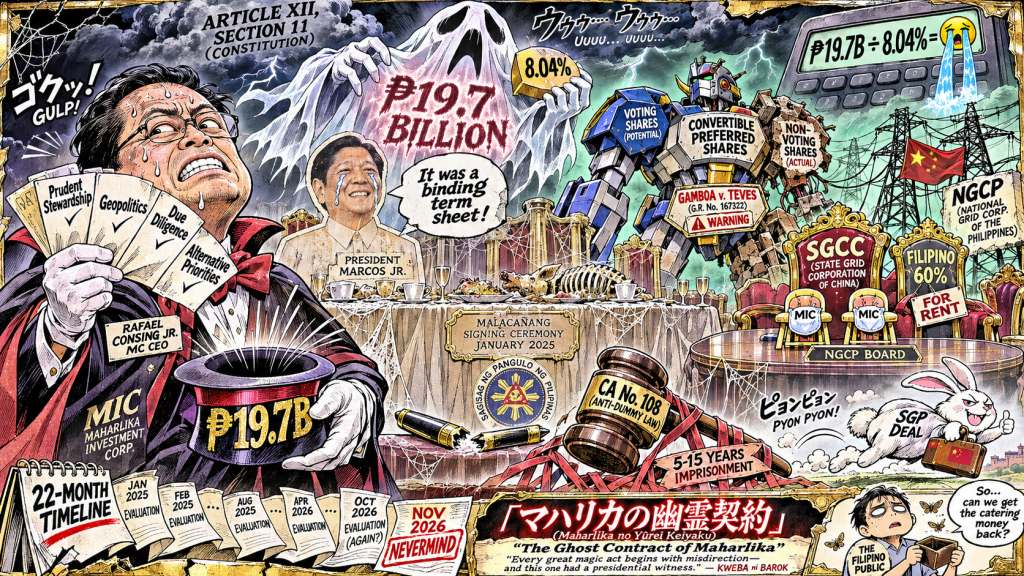
A signing ceremony at Malacañang, twenty-two months of silence, and a quiet walk-away—inside the sovereign fund’s first big test of whether it can actually invest, or only announce.
By Louis ‘Barok‘ C. Biraogo — November 10, 2026
EVERY great magic act begins with misdirection—and this one had a presidential witness. In January 2025, the Maharlika Investment Corporation (MIC) staged a signing ceremony at Malacañang—presidential witness, presumably adequate catering—to announce a ₱19.7-billion investment in Synergy Grid & Development Philippines, Inc. (SGP), the holding company with an indirect controlling interest in the National Grid Corporation of the Philippines (NGCP). Nearly two years later, MIC quietly announced it was walking away. No ceremony. No catering. No presidential witness.
MIC CEO Rafael Consing Jr. explained the decision followed “continuing evaluation of the proposed transaction as its terms developed during detailed negotiations, taking into account its investment mandate, current priorities, and responsibility to exercise prudent stewardship of public funds” (Cabuenas). Translation: after twenty-two months of due diligence and PowerPoint presentations, the fund discovered that maybe—just maybe—paying ₱19.7 billion for approximately 8.04% indirect economic exposure to a Chinese-partnered transmission monopoly wasn’t the brilliant idea everyone at the signing ceremony thought it was.
What changed between the triumphant January 2025 announcement and the November 2026 retreat? Did the geopolitical environment suddenly become more geopolitical? Or did someone finally perform the arithmetic that ₱19.7 billion divided by 8.04% effective exposure equals a valuation that would make a Norwegian oil fund manager weep into his fjord?

The Constitutional Minefield Nobody Bothered to Map
Here the story graduates from “corporate misadventure” to “constitutional theater of the absurd.” NGCP’s ownership structure—40% held by State Grid Corporation of China (SGCC), a Chinese state-owned enterprise, with 60% ostensibly Filipino—has been legally contested for years. Under Article XII, Section 11 of the 1987 Constitution, public utilities must be at least 60% Filipino-owned. Gamboa v. Teves (2011) established that “capital” means voting shares; the 2012 resolution clarified that both controlling interest and beneficial ownership must rest with Filipinos.
Enter MIC, proposing to acquire 20% of SGP through convertible preferred shares. Under Gamboa, non-voting preferred shares don’t count toward the “capital” requirement—a nuance someone at MIC’s legal department presumably noticed eventually. But convertible preferred shares can convert into common voting shares. The structure gave MIC two board seats on an expanded nine-member board—approximately 22.2%—at SGP and potentially at NGCP. This is the kind of architecture that makes constitutional scholars reach for calculators and national security hawks for smelling salts.
The Commonwealth Act No. 108 (Anti-Dummy Law), as amended, criminalizes evading nationality requirements, with penalties of five to fifteen years imprisonment. MIC’s proposed investment would have put the government in the position of buying into an entity whose ownership structure might itself be constitutionally suspect.
One imagines the internal deliberations: “Let’s invest public funds in a company that might be violating the Anti-Dummy Law, creating a national security vulnerability with a foreign state-owned enterprise during geopolitical tension—but we’ll get two board seats!” The business case practically writes itself, provided the author has a strong stomach for irony.
The Arithmetic That Dares Not Speak Its Name
MIC proposed ₱19.7 billion for approximately 20% of SGP. SGP has a 40.2% effective ownership interest in NGCP. On a simplified look-through basis, MIC’s indirect economic exposure would have been approximately 8.04%.
Let me repeat: ₱19.7 billion for 8.04% indirect exposure.
That valuation implies a total SGP equity value that would make the Philippine Stock Exchange’s price discovery mechanism blush. The convertible preferred structure—with dividend preferences, redemption rights, conversion ratios, liquidation preferences—could conceivably justify a premium. But the public has never seen those terms. MIC has not disclosed the valuation methodology, conversion price, dividend rate, redemption schedule, or anti-dilution protections. What we know is that MIC committed nearly ₱20 billion in public capital and walked away without explaining what made the price unacceptable.
Perhaps the terms were unfavorable. Perhaps due diligence uncovered material risks. We don’t know. What we do know: MIC’s existing 0.96% stake in SGP—50.7 million common shares acquired before the larger proposed investment—remains on the books, its fate undisclosed. Strategic position? Failed investment? Orphaned asset? Inquiring taxpayers would like to know.
Governance: A Masterclass in Process Theater
The January 2025 announcement was staged at Malacañang with President Marcos Jr. personally witnessing the signing of a binding term sheet (Presidential Communications Office). This was not merely a corporate transaction; it was a political event. The President’s presence signaled executive endorsement, if not direction.
Here we must distinguish legitimate executive support from improper political influence. The President has constitutional responsibility for national development. It is entirely proper for the executive to support strategic investments. But the decision to deploy ₱19.7 billion in public funds must rest on independent financial assessment, statutory compliance, and fiduciary duty—not political convenience.
Did the board exercise independent judgment? Did it commission an independent valuation? Did it receive a geopolitical risk assessment considering the SGCC dimension? Did it document the reasons for abandonment? These are not accusations. They are basic governance questions that any fund claiming to follow the Generally Accepted Principles and Practices (Santiago Principles)—which emphasize independent management, risk management systems, and transparent reporting—should answer.
A fund that publicly announces a ₱19.7-billion investment, maintains it for nearly two years, and abandons it without disclosing reasons, costs, or lessons learned is not following the Santiago Principles. It is following the “announce, delay, retract, and hope nobody asks too many questions” principles.
The Regulatory Conflict That Everyone Saw Coming
If the government owns shares in a regulated utility, what happens when the regulator must choose between protecting consumers through lower transmission charges and protecting the value of MIC’s investment? Or between requiring capital expenditure and preserving investment returns? Or between imposing penalties for noncompliance and not devaluing the government’s own stake?
The Energy Regulatory Commission (ERC) has already demonstrated willingness to scrutinize NGCP. In July 2023, the ERC required NGCP to explain delays involving 37 projects, with average delays of 820 days (Energy Regulatory Commission). In August 2026, NGCP obtained additional time for certain projects citing right-of-way problems. These are precisely the regulatory actions that could affect MIC’s investment value.
Would ERC regulators feel subtle pressure to go easy on NGCP because the government now owns a stake? Would MIC officials privately lobby for favorable regulatory treatment? Would Department of Energy (DOE) transmission planning become influenced by MIC’s portfolio considerations rather than pure public interest? These are not hypothetical concerns. They are predictable conflicts that should have been addressed in the investment design—and perhaps were, but we don’t know because the terms have not been disclosed. MIC abandoned the deal, which conveniently resolves the conflict by eliminating the investment. Whether this represents prudent governance or belated recognition of an unworkable structure remains unclear.
The Political Subtext That Dares Not Speak Its Name
The Maharlika Fund was created through legislation that drew constitutional challenges from opposition legislators, including Bayan Muna chair Neri Colmenares and Senate Minority Leader Aquilino “Koko” Pimentel III (Colmenares et al.). The fund’s passage involved last-minute amendments communicated through messaging apps and a presidential certification of urgency that critics argued violated constitutional requirements (Bayan Muna et al.). The bill was initially proposed by seven House members including Sandro Marcos (the President’s son) and Speaker Martin Romualdez (the President’s cousin).
Now the fund’s first major announced investment—a strategically sensitive transmission deal involving a Chinese state-owned enterprise—has collapsed after nearly two years. This is a fund critics have compared to Malaysia’s 1Malaysia Development Berhad (1MDB) scandal, where approximately US$4.5 billion was misappropriated. This is a fund opposition Senator Risa Hontiveros characterized as a “liability fund” that would “doom Filipinos to more foreign debt” (South China Morning Post).
Do I have evidence that improper political influence affected the NGCP transaction? No. Do I have evidence that the collapse reflects institutional weakness rather than prudent commercial judgment? Not definitively. But the pattern deserves scrutiny: a politically celebrated announcement, a prolonged negotiation with no public updates, an abrupt cancellation with minimal explanation, and a pivot to “alternative priorities” including a strategic petroleum reserve and port investments.
MIC’s pivot—ports, petroleum reserves, Mindoro power infrastructure—may represent genuine portfolio diversification or a strategy of avoiding the NGCP controversy entirely. The petroleum reserve project with the Philippine National Oil Company (PNOC), announced July 2026, and the Mindoro power partnership, strengthened May 2026, are less politically sensitive than buying into a Chinese-linked transmission monopoly. Whether these alternatives offer superior risk-adjusted returns, or merely superior political optics, is a question MIC has not answered.
The Congressional Oversight That Might Actually Matter
Congress has a constitutional role in oversight under Article VI, Section 21. The Senate and House could examine whether the SGP transaction was properly evaluated, whether public funds were spent on advisers and due diligence, and whether lessons are being incorporated into future procedures.
Will they? The House is controlled by administration allies. The Senate has a mix of administration supporters and opposition figures. Hearings into the NGCP deal could illuminate the collapse—or devolve into political theater designed to embarrass or defend the administration, depending on who holds the gavel.
The Commission on Audit (COA) has constitutional authority under Article IX-D, Section 2 to examine government expenditures, including Government-Owned and Controlled Corporations (GOCCs). A special audit of MIC’s transaction-related expenses—advisory fees, legal retainers, valuation services, travel—would be appropriate. But a failed transaction does not automatically make every expense irregular. Professional services may be properly incurred even when an investment is abandoned. The question is whether the services were necessary, authorized, reasonably priced, properly procured, and supported by deliverables.
Here’s the inconvenient truth: a poorly executed investment strategy is not necessarily illegal. A publicly announced deal that fails is not automatically evidence of corruption. A sovereign wealth fund that walks away because terms became unfavorable is not necessarily guilty of mismanagement—it may be exercising exactly the commercial discipline its critics accuse it of lacking.
Section 3(e) of Republic Act No. 3019 (Anti-Graft and Corrupt Practices Act) requires “manifest partiality, evident bad faith, or gross inexcusable negligence” causing “undue injury” or giving “unwarranted benefits.” A failed investment, standing alone, does not satisfy these elements. Section 3(g) concerns contracts “manifestly and grossly disadvantageous to the government”—but the SGP transaction was never completed, so any prosecution would have to establish the legally relevant act rather than treating an abandoned proposal as a consummated disadvantageous transaction.
This is not to say accountability is unnecessary. It is to say the framework must distinguish commercial judgment from criminal conduct. MIC’s decision may have been correct, incorrect, or merely convenient. But without disclosure of the valuation analysis, risk assessment, board deliberations, and total costs, the public cannot evaluate whether the decision was prudent or merely politically expedient.
The Comparative Perspective That Should Humble Us
Successful sovereign wealth funds—Norway’s Government Pension Fund Global, Singapore’s Temasek, Abu Dhabi Investment Authority (ADIA)—share characteristics: surplus revenues, clear investment mandates, independent governance insulated from political interference, rigorous transparency. The Philippines has none of these in abundance. The country runs fiscal deficits. The fund draws from Land Bank, the Development Bank of the Philippines (DBP), and the Bangko Sentral ng Pilipinas (BSP)—potentially undermining their mandates. Political influence is pervasive. Transparency rankings are middling at best.
The Maharlika Investment Fund (MIF) is not Norway’s oil fund. It is a fund created through politically expedited processes, funded through questionable sources, now seeking to make commercially and politically neutral decisions in a highly politicized environment. Its first major announced investment has collapsed after nearly two years. Its credibility is uncertain. Its institutional capacity is unproven. Its commitment to transparency is questionable.
This does not mean the fund is doomed. It means the fund has not yet demonstrated it can operate as a genuine sovereign wealth fund rather than a political investment vehicle. The SGP collapse is an opportunity for MIC to prove it can make independent commercial judgments, learn from failures, and operate transparently. Whether it will seize this opportunity remains to be seen.
The Unanswered Questions That Demand Answers
The public deserves to know:
- What was the independent valuation of SGP and the proposed convertible preferred shares? Who conducted it? What were the key assumptions?
- What specific risks were identified during due diligence? Which were material to abandonment?
- What geopolitical factors were considered? Did any foreign government or intelligence assessment influence the decision?
- Were there disagreements between MIC’s management, board, and the executive branch? If so, what were they?
- How much was spent on advisers, legal fees, valuation services, and other transaction costs? Were these properly procured and documented?
- What is the status of MIC’s existing 0.96% SGP shareholding? Retained, sold, or held pending review?
- What lessons has MIC incorporated into future investment procedures?
- Did the MIC board formally approve the final proposed terms before abandonment? If not, why not?
These are not “gotcha” questions. They are basic governance questions any sovereign wealth fund claiming to follow international best practices should answer. That MIC has not answered them—and may not—is itself a governance failure.
The Verdict: Prudent Retreat or Institutional Failure?
MIC’s decision to abandon the SGP transaction may have been commercially prudent. A sovereign wealth fund must be willing to walk away from investments that fail to satisfy return and risk requirements. Committing ₱19.7 billion merely to preserve the appearance of policy consistency would have been irresponsible. The convertible preferred structure, the indirect exposure to NGCP, the geopolitical complications of the SGCC partnership, and the regulatory conflicts of interest all provided legitimate reasons for caution.
But the process by which the transaction was pursued and abandoned suggests institutional weaknesses deserving scrutiny. The January 2025 announcement created expectations of a strategic government presence in NGCP. Twenty-two months of negotiations produced no public updates. The November 2026 cancellation was explained in vague terms. The lessons learned—if any—have not been disclosed.
A sovereign wealth fund should not merely announce ambitious investments. It must demonstrate it can identify commercially sound opportunities, negotiate favorable terms, manage risks, protect public funds, and deliver measurable economic benefits. On the evidence available, MIC has demonstrated it can announce investments. It has not yet demonstrated it can execute them, manage them, or learn from them.
The SGP collapse is not necessarily a failure. It may be a responsible exercise of fiduciary judgment. But the circumstances—prolonged negotiations, vague explanations, absence of disclosure—suggest MIC’s institutional development remains incomplete. The fund that was supposed to transform public wealth into national prosperity has instead demonstrated it can walk away from a deal. Whether it can walk toward a better one remains the central question.
The Final Irony
Maharlika was created to mobilize public wealth for long-term economic development. Its proposed investment in the company behind the national transmission operator was consistent with a legitimate national objective: strengthening energy security, improving infrastructure, asserting Filipino oversight over critical infrastructure.
But the fact that an investment serves a national objective does not mean it is automatically a good investment. The government must demonstrate that the price is fair, the risks acceptable, the governance arrangements adequate, and the public benefits justify the expenditure. On these criteria, the SGP transaction raised more questions than it answered.
The cancellation may ultimately be a victory for financial discipline. Alternatively, it may reveal a failure of investment planning and execution. The distinction will depend on what the government is willing to disclose. And on that front, the early indications are not encouraging.
A sovereign wealth fund cannot operate on political announcements, strategic slogans, and promises of future prosperity. It must operate on evidence, financial discipline, transparency, and accountability. The real test of Maharlika is not whether it can buy a piece of the national grid. It is whether it can turn public wealth into measurable national prosperity without turning public money into another instrument of political influence.
On that test, the jury remains out—and the jury is the Filipino public, which deserves better than a signing ceremony and a silent retreat.
Key Citations
A. Legal & Official Sources
- Commonwealth Act No. 108. Anti-Dummy Law, as Amended. 1936. Asian Development Bank Law and Policy Reform, https://lpr.adb.org/resource/anti-dummy-law-commonwealth-act-no-108-amended-philippines.
- Gamboa v. Teves. G.R. No. 176579, 28 June 2011. Supreme Court of the Philippines. Supreme Court E-Library, https://elibrary.judiciary.gov.ph/thebookshelf/showdocs/4/37041.
- Heirs of Gamboa v. Teves. G.R. No. 176579, Supreme Court of the Philippines, 9 Oct. 2012. Supreme Court E-Library, elibrary.judiciary.gov.ph/assets/pdf/philrep/2012/G.R.%20No.%20176579.pdf.
- Presidential Communications Office. “SGP Accepts MIC’s Binding Offer for Acquisition of Shares.” Presidential Communications Office, 27 Jan. 2025, https://mirror.pco.gov.ph/?p=202705.
- Republic Act No. 3019: Anti-Graft and Corrupt Practices Act. Official Gazette, 17 Aug. 1960, http://www.officialgazette.gov.ph/1960/08/17/republic-act-no-3019/.
- Republic Act No. 11954. Maharlika Investment Fund Act of 2023. 18 July 2023. LawPhil Project, https://lawphil.net/statutes/repacts/ra2023/ra_11954_2023.html.
- The 1987 Constitution of the Republic of the Philippines. Official Gazette of the Republic of the Philippines, 1987, https://www.officialgazette.gov.ph/constitutions/1987-constitution/.
B. News Reports
- Cabuenas, Jon Viktor D. “Maharlika Defers Investment in Synergy Grid.” GMA News Online, GMA Network, 5 Nov. 2026, https://www.gmanetwork.com/news/money/companies/1008413/maharlika-defers-investment-in-synergy-grid/story/.
- Colmenares, Neri, et al. “Supreme Court Asked to Declare ‘Dangerous’ Maharlika Fund Unconstitutional.” Philstar.com, 18 Sept. 2023, https://philstar.com/headlines/2023/09/18/2297198/supreme-court-asked-declare-dangerous-maharlika-fund-unconstitutional.
- Presidential Communications Office. “SGP Accepts MIC’s Binding Offer for Acquisition of Shares.” Philippine Information Agency, 26 Jan. 2025, pia.gov.ph/gallery/sgp-accepts-mics-binding-offer-for-acquisition-of-shares/.
- “NGCP to Face Penalties on Project Delays.” Manila Bulletin, 6 July 2023, https://mb.com.ph/2023/7/6/ngcp-to-face-penalties-on-project-delays.
- “Supreme Court Asked to Declare Maharlika Fund Unconstitutional.” Inquirer.net, 18 Sept. 2023, https://newsinfo.inquirer.net/1833052/supreme-court-asked-to-declare-maharlika-fund-unconstitutional.
- “Philippines’ First Sovereign Fund Slammed by Critics: ‘Our Children Will Be Buried in Debt’.” South China Morning Post, June 2023, https://www.scmp.com/week-asia/politics/article/3223100/philippines-first-sovereign-fund-slammed-critics-our-children-will-be-buried-debt.

- “Ang Hirap Maging Mahirap”: The PAO Scandal That Proves Government Contempt Is Nothing New

- “Far-Off” My Axx: Malacañang’s Claire Castro Drowns in Her Own Legal Gaslighting
- “Forthwith” to Farce: How the Senate is Killing Impeachment—And Why Enrile’s Right (Even If You Can’t Trust Him)

- “HINDI AKO NAG-RESIGN!”

- “I Know Nothing”: Baste Duterte’s Amnesia Defense Meets ₱33M in GenCorp Contracts

- “I’m calling you from my new Globe SIM. Send load!”

- “Mahiya Naman Kayo!” Marcos’ Anti-Corruption Vow Faces a Flood of Doubt

- “Manageable” Debt, Unmanageable Lies: DBM’s ₱21 Trillion Fairy Tale
- “Meow, I’m calling you from my new Globe SIM!”

- “Natrabaho”: One Word, One Ombudsman, and a Judiciary on Trial

- “No Special Jail for Crooks!” Boying Remulla Slams VIP Perks for Flood Scammers

- “Philippine-Controlled” or Yankee Gas Station? The Davao Fuel Depot Farce Exposed







Leave a Reply