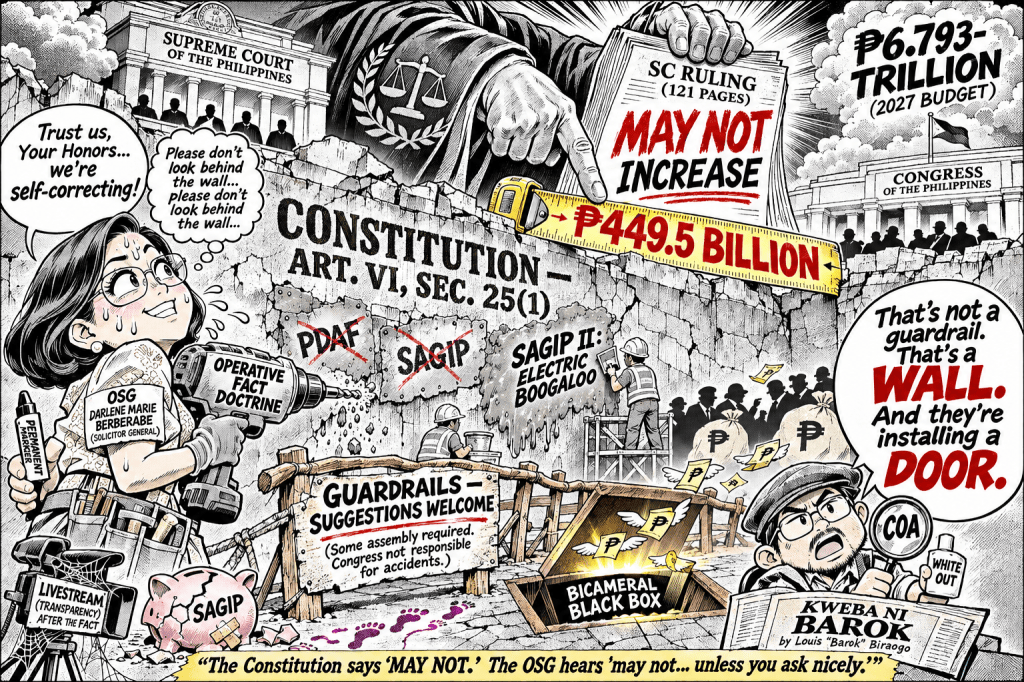
The Solicitor General Wants the Court to Trust Congress. The Same Congress That Gave Us SAGIP, the ₱449.5-Billion Increase, and the Bicameral Black Box.
By Louis ‘Barok‘ C. Biraogo — November 9, 2026
MGA ka-kweba, gather ’round the constitutional campfire, because the Office of the Solicitor General (OSG) has done it again. On November 9, 2026, Solicitor General Darlene Marie Berberabe filed a motion for clarification and partial reconsideration that is less a legal pleading and more a masterpiece of institutional ventriloquism. The OSG wants the Supreme Court to clarify that its budget “guardrails” may “inform” the political branches, but that “the choice of safeguards within those bounds and the responsibility to the people for the choices made must remain with the branches to which the Constitution entrusted them.”
Translation: Your Honors, you were right that we violated the Constitution. But please let us decide how to stop violating it.
This is the legal equivalent of a toddler caught drawing on the wall with permanent marker, promising to clean it up himself—while hiding the marker behind his back. The Supreme Court spent 121 pages explaining exactly why Congress and the Executive cannot be trusted to self-regulate unprogrammed appropriations. The OSG’s response is to ask the Court to trust them anyway.
Let us dissect this with the precision of a Commission on Audit (COA) auditor who has just found a ₱449.5-billion discrepancy and a bottle of White Out.
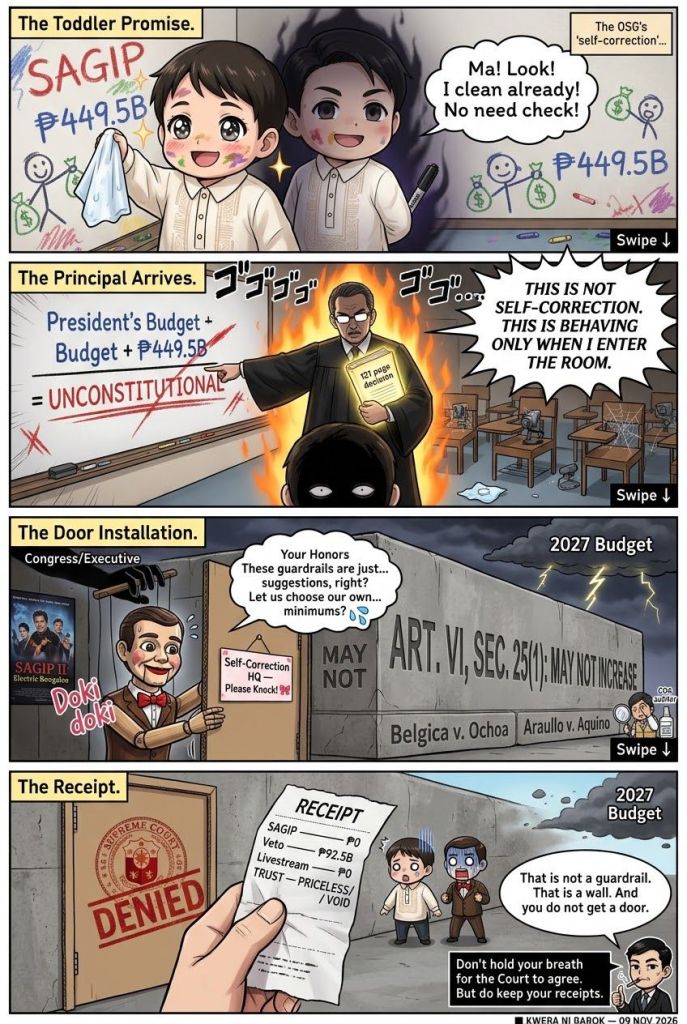
Same black box. Same acronyms. Same “trust us.” Four panels on why the Supreme Court should say “may not” — and mean it.
The “Self-Correction” Fiction
Berberabe’s core argument, repeated at a Palace briefing in October, is that the political branches have already demonstrated “self-correction”. Congress removed SAGIP—the Strengthening Assistance for Government Infrastructure and Social Programs—from the 2026 budget. The President vetoed ₱92.5 billion in unprogrammed funds. The bicameral meetings were livestreamed. Look, Ma, no judicial supervision needed!
Except.
SAGIP was removed after the Supreme Court’s decision was already looming. The veto came after public outrage over the flood control scandal. The livestreaming started after the Court noted that the Bicameral Conference Committee kept “no records” of its discussions and “did not explain the increases and decreases in budget items.” This is not self-correction. This is a student who starts behaving the moment the principal walks into the classroom and then claims he was always well-behaved.
The OSG’s “self-correction” argument is constitutionally circular. It says: We can fix this without you because we have already started fixing it in response to you. The logical conclusion is that the Court should have done nothing in the first place, and Congress would have magically reformed itself out of the goodness of its collective heart. The same heart that created the “covert repository” known as SAGIP.
The “Guardrails Are Judicial Overreach” Canard
The OSG’s motion argues that the Court “should not extend to prescribing what Congress must include in future General Appropriation Bills or imposing additional conditions for the release of funds.” The Solicitor General frames this as a separation-of-powers issue: the Court is dictating policy, not interpreting the Constitution.
But here is what the OSG conveniently omits from its motion: the Court did not invent these guardrails in a fit of judicial creativity. It derived them from Article VI, Section 25(1) of the 1987 Constitution, which states in plain English that “the Congress may not increase the appropriations recommended by the President.” The Court’s conditions—no lump sums, clear differentiation between programmed and unprogrammed, sufficient prioritization standards, consistency with the national fiscal program—are not policy preferences. They are the minimum conditions necessary to prevent Congress from doing exactly what it did: transferring ₱449.5 billion from programmed to unprogrammed appropriations, creating “artificial fiscal space,” and then funneling that space into the pet projects of the Bicameral Conference Committee.
The OSG calls this “judicial overreach.” I call it arithmetic. The Court added up the numbers, subtracted the President’s proposal from the final General Appropriations Act (GAA), and got a number that should not exist under the Constitution. The OSG’s response is to argue that the Court should have simply noted the discrepancy and asked Congress to please not do it again.
This is the legal theory of a child who believes “I’m sorry” is a get-out-of-jail-free card.
The 2027 Budget: The Tell
Here is where the OSG’s motion becomes not just legally weak but politically revealing. The 2027 budget is already being deliberated. The proposed ₱6.793-trillion budget contains provisions that, according to budget watchdogs, resemble the very mechanisms the Court struck down. The People’s Budget Coalition has raised concerns about project documentation, technical descriptions, and amendments. Speaker Faustino Dy III has promised transparency. The OSG is simultaneously arguing for more discretion for the political branches.
Do you see the contradiction, mga ka-kweba?
The House is promising to be transparent. The OSG is arguing that the Court should not require transparency. The Court has said: Here are the constitutional minimums. The OSG says: Let us choose our own minimums. And the 2027 budget is being written right now, with the same institutional incentives that produced SAGIP, the ₱449.5-billion increase, and the bicameral black box.
If the Court grants the OSG’s motion in any meaningful form, it will have handed Congress and the Executive a permission slip to revert to form the moment public attention shifts. The “guardrails” will become suggestions. The “constitutional requirements” will become “best practices.” And the 2027 budget will contain a new acronym—perhaps SAGIP II: Electric Boogaloo—that functions exactly like the old one but with better paperwork.
The “Operative Fact” Dodge
The OSG has also invoked the operative fact doctrine to argue that projects already underway should continue and that funds already released need not be returned. The Court was explicit: the doctrine covers only irreversible programs whose beneficiaries acted in good faith. It does not automatically shield the authors, proponents, or implementors from criminal, civil, or administrative liability.
The OSG’s motion does not challenge this directly—it would be too brazen. But the practical effect of its requested clarification would be to muddy the waters enough that the Ombudsman and COA can plausibly claim uncertainty about who, exactly, is liable for what. The Court said: Good faith must be determined by the proper tribunals. The OSG says: Let us determine what the proper tribunals should look at.
This is not clarification. This is an attempt to write the terms of reference for the investigation that the Court has already authorized.
What the Court Should Do
The Court has several options. It could deny the motion outright, which would be satisfying but perhaps unnecessarily rigid. It could grant clarification while denying reconsideration—the “constitutional minimums” approach that I suggested in my earlier analysis. It could distinguish between the 2026 implementation (where the operative fact doctrine applies to past transactions) and future budgets (where the guardrails are binding).
But here is what the Court should not do: it should not accept the OSG’s framing that there is a meaningful distinction between “safeguards the Constitution requires” and “safeguards that are policy choices.” This distinction sounds elegant in a law school seminar. In the real world of Philippine budget politics, it is a loophole generator.
Every safeguard the Court identified is traceable to a specific constitutional provision or a specific precedent:
- The ban on lump sums? Belgica v. Ochoa (G.R. Nos. 208566, 208493, and 209251).
- The requirement of sufficient standards? The non-delegation doctrine.
- The prohibition on increasing the President’s recommendations? Article VI, Section 25(1).
- The requirement that unprogrammed funds remain within the fiscal program? Araullo v. Aquino III (G.R. No. 209287), which held that savings cannot be declared into existence through executive discretion.
The OSG wants the Court to say: These are all very good ideas, but Congress and the President should decide which ones to adopt. That is not clarification. That is an invitation to nullification by inaction.
The Bottom Line
The Solicitor General is not asking the Court to clarify its ruling. She is asking the Court to soften it—to convert binding constitutional requirements into advisory guidelines, to replace judicial enforcement with political promises, and to trust the same institutions that spent years perfecting the art of turning unprogrammed appropriations into a slush fund with a legal disclaimer.
The Court has already seen this movie. It was called Belgica v. Ochoa. The Court struck down PDAF. Congress replaced it with SAGIP. The Court struck down SAGIP. Congress is already working on the sequel in the 2027 budget.
The OSG’s motion is not a request for clarity. It is a request for permission. Permission to keep the corpse of pork barrel on life support while the 2027 budget is written. Permission to let the political branches “self-correct” at their own pace, on their own terms, with their own definitions of what counts as a correction.
The Court should say no.
Not because it wants to micromanage the budget. Not because it wants to dictate fiscal policy. But because the Constitution does not say “Congress may not increase the appropriations recommended by the President, except when it really wants to and promises to be careful next time.”
It says: May not.
That is not a guardrail. That is a wall. And the OSG is asking the Court to install a door.
Don’t hold your breath for the Court to agree. But do keep your receipts.
Key Citations
A. Legal & Official Sources
- Araullo v. Aquino III. G.R. No. 209287, 1 July 2014. Lawphil Project, lawphil.net/judjuris/juri2014/jul2014/gr_209287_2014.html.
- Belgica v. Ochoa, Jr. G.R. Nos. 208566, 208493, and 209251, 19 Nov. 2013. Lawphil Project, lawphil.net/judjuris/juri2013/nov2013/gr_208566_2013.html.
- The 1987 Constitution of the Republic of the Philippines. Official Gazette of the Republic of the Philippines, http://www.officialgazette.gov.ph/constitutions/1987-constitution/.
- Supreme Court of the Philippines. “SC Holds Unprogrammed Appropriations Subject to Guidelines, Voids Congressional Increases in 2024 and 2025 Budgets.” Supreme Court of the Philippines, 20 Oct. 2026, sc.judiciary.gov.ph/sc-holds-unprogrammed-appropriations-subject-to-guidelines-voids-congressional-increases-in-2024-and-2025-budgets/.
B. News Reports
- Biraogo, Louis ‘Barok’ C. “The OSG’s ‘Guardrails’ Gambit: A Motion for Reconsideration or a License to Ignore the Court?” Kweba ni Barok, 23 Oct. 2026, kwebanibarok.com/2026/10/23/the-osgs-guardrails-gambit-a-motion-for-reconsideration-or-a-license-to-ignore-the-court/.
- Ong, Ghio. “SolGen Tells SC: Budgeting under Executive, Congress.” The Philippine Star, 9 Nov. 2026, http://www.philstar.com/headlines/2026/11/09/2568874/solgen-tells-sc-budgeting-under-executive-congress/.
- Philippine News Agency. “OSG to Ask SC to Let Congress, Executive ‘Self-Correct’ Budget Issues.” Philippine News Agency, 22 Oct. 2026, http://www.pna.gov.ph/article/osg-to-ask-sc-to-let-congress-executive-self-correct-budget-issues.
- “Ang Hirap Maging Mahirap”: The PAO Scandal That Proves Government Contempt Is Nothing New
- “Far-Off” My Axx: Malacañang’s Claire Castro Drowns in Her Own Legal Gaslighting
- “Forthwith” to Farce: How the Senate is Killing Impeachment—And Why Enrile’s Right (Even If You Can’t Trust Him)
- “HINDI AKO NAG-RESIGN!”

- “I Know Nothing”: Baste Duterte’s Amnesia Defense Meets ₱33M in GenCorp Contracts
- “I’m calling you from my new Globe SIM. Send load!”

- “Mahiya Naman Kayo!” Marcos’ Anti-Corruption Vow Faces a Flood of Doubt

- “Manageable” Debt, Unmanageable Lies: DBM’s ₱21 Trillion Fairy Tale
- “Meow, I’m calling you from my new Globe SIM!”

- “Natrabaho”: One Word, One Ombudsman, and a Judiciary on Trial
- “No Special Jail for Crooks!” Boying Remulla Slams VIP Perks for Flood Scammers

- “Philippine-Controlled” or Yankee Gas Station? The Davao Fuel Depot Farce Exposed




Leave a Reply