Inside the Revenue Split That Senate Hearings, PCCI Testimony, and a Suspended Audit System All Point To
By Louis ‘Barok‘ C. Biraogo | November 9, 2026
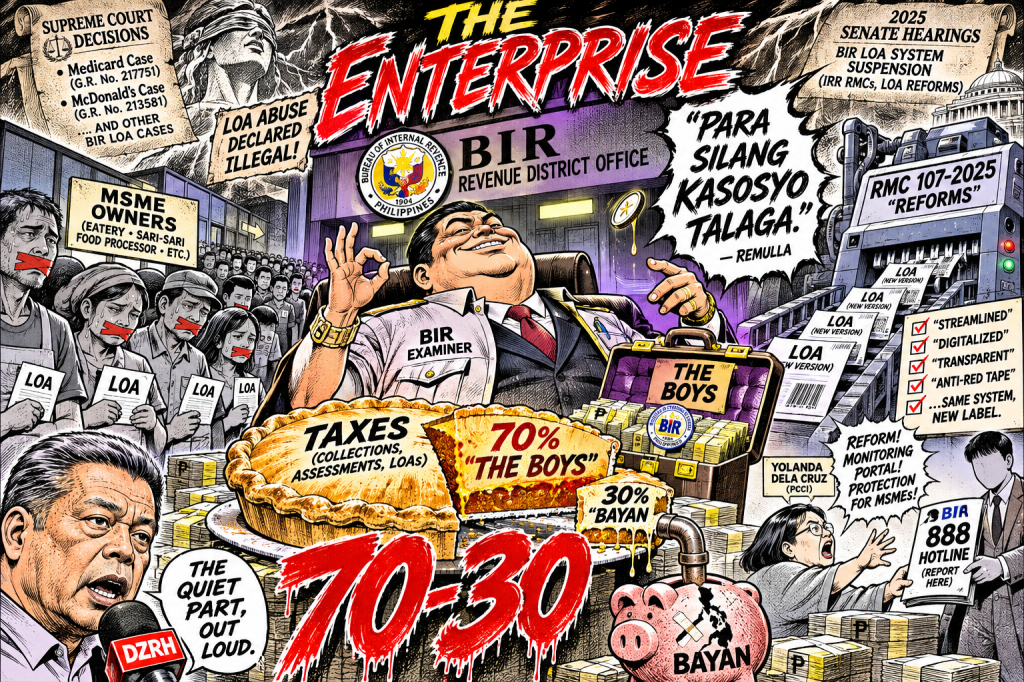
THE Bureau of Internal Revenue (BIR) does not have a corruption problem. It has a business model. And Ombudsman Jesus Crispin Remulla just walked onto the radio and described the revenue split in terms any Filipino entrepreneur who has opened a Letter of Authority (LOA) would recognize with a bitter laugh.
“70 sa BIR, 30 sa bayan.” Seventy for the Bureau. Thirty for the Republic.
The headlines screamed vagueness. The commentariat clutched its pearls about “lack of specificity.” Somewhere in a revenue district office, an examiner choked on his coffee and started deleting spreadsheets.
Here is what the skeptics miss: Remulla did not invent the 70-30 figure. The number has floated in Senate hearing rooms since November 2025, when Senator JV Ejercito told the Blue Ribbon Committee that of the billions supposedly collected through LOA-driven assessments, roughly seventy percent allegedly went into pockets while thirty percent trickled into the Treasury. Senator Erwin Tulfo had his own version: a 75-25 split, even worse arithmetic for the government. The Ombudsman did not break new ground. He said the quiet part into a live microphone.
That is precisely why the BIR is panicking.
The Paper Trail Nobody Wants to Follow
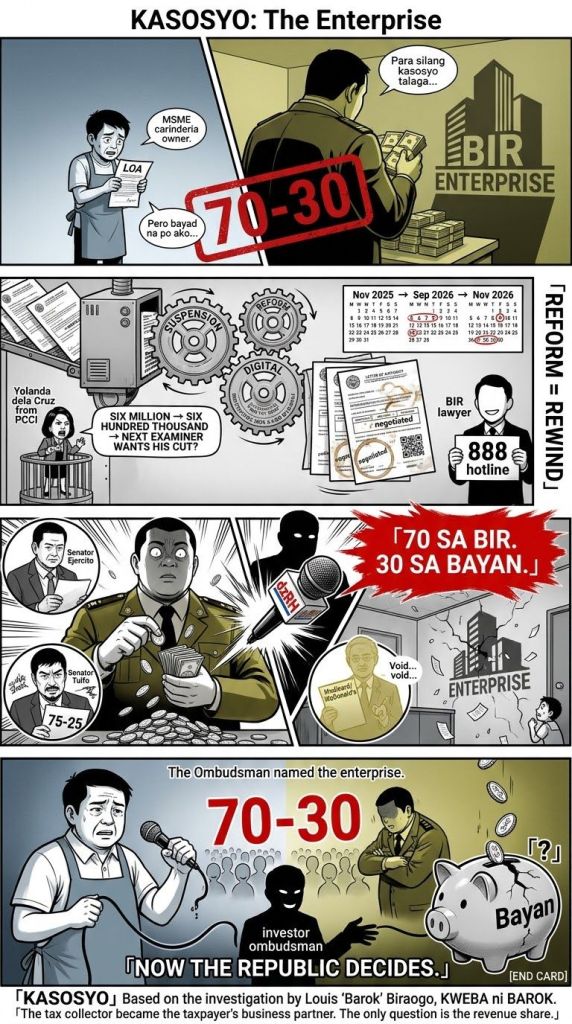
The BIR’s own institutional history tells the story Remulla is narrating. In November 2025, the Bureau suspended all field audits and LOA issuance nationwide through Revenue Memorandum Circular No. 107-2025. An agency whose enforcement apparatus depends on audit authority voluntarily shut that apparatus down. Why? Because the Finance Secretary—not the Ombudsman, not a senator—acknowledged “long-standing concerns of our taxpayers regarding red tape, audits and alleged weaponization of letters of authority.”
The Department of Finance (DOF)’s December 11, 2025 release admitted the BIR was pursuing a digital audit-selection system precisely because “minimizing discretion in the selection process” had become an institutional necessity. It promised a portal to monitor pending LOAs and mandated that only the Commissioner or Deputy Commissioner could approve them. These are not the reforms of an agency with a few bad apples. These are the reforms of an agency that knows its orchard is rotten.
Then came September 2026. Yolanda dela Cruz, Philippine Chamber of Commerce and Industry (PCCI) vice president for Metro Manila, testified that corruption had continued despite the suspension. Her story was specific: a demand for six million pesos, a negotiated reduction to six hundred thousand, and then—the part that should make every taxpayer’s blood run cold—succeeding examiners demanding their own separate cuts. Her 2022 LOA remained “unsettled” years later, documents bouncing between offices, payments demanded at every turn.
The BIR’s response? A lawyer named James Ellis Lagasca reminded everyone there is an 888 hotline and an email address. That is the bureaucratic equivalent of telling a mugging victim to fill out a customer satisfaction survey.
Why Remulla’s “Vagueness” Is Actually Strategic
The chattering classes complain that Remulla did not elaborate. They want names. They want documents. They want a PowerPoint with footnotes.
They misunderstand the Ombudsman’s function at this stage. Remulla is not a prosecutor filing an information before the Sandiganbayan. He is the constitutional officer tasked under Republic Act No. 6770 (The Ombudsman Act of 1989) with investigating “illegal, unjust, improper, or inefficient” acts of public officials. The power to publicize matters under investigation—Section 15(6), if anyone bothers to read the statute—exists precisely to encourage witnesses and victims to come forward. And who would come forward if the Ombudsman waited until he had an airtight case? The business leaders who allegedly told Remulla about the 70-30 scheme are not going to file sworn complaints unless they believe the political wind has shifted.
Remulla’s radio program was the political wind.
Consider the alternative: that the Ombudsman should have stayed silent, built a case in secret, then announced a fait accompli. That works in jurisdictions where the bureaucracy is cooperative and the press is patient. In the Philippines, it works approximately never. The BIR has had a full year since the LOA suspension to demonstrate the rot was being excised. Dela Cruz’s September 2026 testimony suggests the excision was cosmetic at best. At worst, it was a temporary pause while everyone figured out how to monetize the new digital system.
The Supreme Court Already Told Us the LOAs Were Broken
The detail the BIR’s defenders conveniently ignore: the Supreme Court has spent a decade building a jurisprudence of LOA abuse that reads like a prosecution brief.
In Medicard Philippines v. Commissioner of Internal Revenue (2017), the Court held that an assessment issued without a valid LOA is void—not voidable, void. In Commissioner of Internal Revenue v. McDonald’s Philippines Realty Corp. (2021), the Court went further: substituting a revenue officer without an amended or new LOA violates taxpayer due process. The Court described a “disturbing trend” of audits conducted by officers who were not specifically named or authorized.
That was five years ago. The problem the Court identified in 2021 is the problem Remulla described in 2026. The difference is that the Court could only invalidate individual assessments. The Ombudsman can investigate the system that produced them.
And what a system it is. The BIR issued over 62,000 LOAs in 2022, 75,000 in 2023, and 82,000 in 2024. Even if the vast majority were legitimate, the sheer volume creates an environment where the cost of challenging a questionable assessment—in legal fees, accounting time, and operational disruption—almost always exceeds the cost of settling. That is not a bug. It is the feature corrupt examiners exploit. Make the official process expensive enough, and the unofficial process becomes the rational choice.
The Enterprise Metaphor Is Not Hyperbole
Remulla called the BIR an “enterprise” where “the republic always owes them something.” Critics dismissed this as colorful language. It is actually the most precise description of the problem I have read from any government official.
An enterprise exists to generate revenue. It measures success by the bottom line. It rewards employees who bring in business. And when employees discover they can generate more revenue for themselves by threatening taxpayers with inflated assessments and then offering to make the problem disappear, the enterprise’s official mission—collecting lawful taxes—becomes a loss leader for the real business.
The 70-30 split, if it exists in the form Remulla suggests, is simply the enterprise’s profit-sharing arrangement. Seventy percent to the people who do the work. Thirty percent to the government as a franchise fee.
Is this speculation? Yes. But it is speculation grounded in a PCCI vice president telling senators that examiners demanded payments larger than what appeared on official receipts. It is grounded in Senator Ejercito’s documented case of a thirty-million-peso assessment reduced to 1.2 million, with eight hundred thousand allegedly “for the boys” and only four hundred thousand receipted. It is grounded in the Finance Department’s own admission that the LOA system had been “weaponized.”
When the government’s own reform agenda reads like a confession, the Ombudsman does not need a smoking gun to ask who is holding the matches.
What Remulla Got Right That Everyone Else Got Wrong
The commentariat’s obsession with the 70-30 figure misses the forest for the accounting. Remulla’s real point is structural, not numerical. He is saying the BIR’s enforcement machinery has become a rent-extraction apparatus, and the people who suffer most are not the giant corporations with tax departments and retained counsel. They are the Micro, Small, and Medium Enterprises (MSMEs)—the food processing companies, the mini-groceries, the eateries—that Dela Cruz described being hit with four LOAs in six months. These are the businesses that cannot afford to litigate a void assessment for five years while the BIR’s legal office bounces their documents back and forth. These are the taxpayers who pay the unofficial price because the official process is designed to exhaust them.
The Ombudsman’s intervention, whatever its evidentiary gaps, has forced a conversation the BIR has spent a year trying to manage through press releases. The Bureau announced reforms in January 2026: electronic LOAs, risk-based selection, centralized approval, a monitoring portal. By September 2026, the PCCI was telling the Senate that nothing had changed. By November 2026, the Ombudsman was on the radio saying the quiet part out loud.
The sequence matters. The reform announcements did not stop the alleged abuses. The Ombudsman’s public accusation might.
The Burden Remulla Now Carries
Let me be clear about something that will annoy both the Ombudsman’s fans and his detractors: Remulla now has an obligation to convert the 70-30 claim into evidence. The power to publicize is not a license for permanent vagueness. If he has complainants, they need to be interviewed under oath. If he has documents, they need to be authenticated. If the 70-30 figure came from a single business leader over merienda, he needs to say so and adjust expectations.
But the standard for investigating is not the standard for convicting. The BIR’s own history—the suspension, the Senate resolution, the DOF’s reform agenda, the PCCI’s continued complaints—provides more than enough probable cause to justify a comprehensive Ombudsman inquiry into the LOA system. The question is not whether the 70-30 split is precisely accurate. The question is whether the enforcement machinery creates systematic opportunities for private enrichment at the expense of the Treasury. Every piece of publicly available evidence suggests it does.
The BIR’s defenders will say Remulla is prejudging the Bureau. But the Bureau has been judging itself for a year, and the verdict from the business community is not flattering. The Ombudsman’s intervention is not a rush to judgment. It is the first external audit the BIR’s audit system has ever received.
And if the 70-30 figure turns out imprecise—if the real split is 65-35, or 80-20, or varies by region and the negotiating skills of the taxpayer—the underlying allegation remains intact. The tax collector has become the taxpayer’s business partner. The only question is the revenue share.
Remulla, for all the criticism he is about to endure, has done what no BIR Commissioner has been willing to do: he has named the enterprise. Now the Republic needs to decide whether it wants to be a minority shareholder in its own tax system.
Key Citations
A. Legal & Official Sources
- Bureau of Internal Revenue. BIR 2024 Annual Report. Bureau of Internal Revenue, 2025, https://web-services.bir.gov.ph/annual_reports/annual_report_2024/BIR%20AR%202024.html?hl=en-US.
- Commissioner of Internal Revenue v. McDonald’s Philippines Realty Corp. G.R. No. 242670, Supreme Court of the Philippines, 10 May 2021. Supreme Court E-Library, elibrary.judiciary.gov.ph/thebookshelf/showdocs/31/67422.
- Department of Finance. “DOF Vows Full Cooperation in LOA Probe and Reform to Protect Taxpayer Rights.” Department of Finance, 11 Dec. 2025, http://www.dof.gov.ph/dof-vows-full-cooperation-in-loa-probe-and-reform-to-protect-taxpayer-rights/.
- Medicard Philippines, Inc. v. Commissioner of Internal Revenue. G.R. No. 222743, Supreme Court of the Philippines, 5 Apr. 2017. LawPhil, lawphil.net/judjuris/juri2017/apr2017/gr_222743_2017.html.
- Republic Act No. 6770. An Act Providing for the Functional and Structural Organization of the Office of the Ombudsman, and for Other Purposes (The Ombudsman Act of 1989). 1989, lawphil.net/statutes/repacts/ra1989/ra_6770_1989.html.
- Senate of the Philippines. “Senate Resolution No. 180: Alleged Misuse and Weaponization of LOA by Personnel of BIR.” 20th Congress, 24 Nov. 2025, legacy.senate.gov.ph/lis/bill_res.aspx?congress=20&q=SRN-180.
B. News Reports
- Abarca, Charie. “JV Ejercito: 70% of LOA Collections Pocketed by Some BIR Officials.” INQUIRER.net, 25 Nov. 2025, newsinfo.inquirer.net/2146000/fwd-bir-corruption-explained-70-of-loa-collections-pocketed-only-30-remitted-to-govt-says-ejercito/amp.
- Locus, Sundy. “Senate Opens Probe on Alleged ‘Weaponization’ of Letters of Authority.” GMA News Online, 11 Dec. 2025, www.gmanetwork.com/news/topstories/nation/969196/senate-opens-probe-on-alleged-weaponization-of-letters-of-authority/story/.
- Mangaluz, Jean. “Ombudsman Remulla Flags BIR over Taxation, Abuse Concerns.” GMA News Online, GMA Network, 7 Nov. 2026, http://www.gmanetwork.com/news/topstories/nation/1008653/ombudsman-remulla-flags-bir-over-taxation-abuse-concerns/story/.
- “PCCI Exec: BIR Corruption Stays; Examiners’ Kickbacks Bigger.” Philippine Daily Inquirer, 11 Sept. 2026, plus.inquirer.net/news/bir-examiners-still-into-extortion-senate-told/.
- Tan-Torres, Joel L. “A Culture under Scrutiny: Inside the BIR’s First Blue Ribbon Test.” BusinessMirror, 15 Dec. 2025, businessmirror.com.ph/2025/12/15/a-culture-under-scrutiny-inside-the-birs-first-blue-ribbon-test/.

- ₱9 Billion in ‘Savings’? DILG’s Fire Truck Deal Smells Like Smoke

- ₱8B BBM Pork: CCTV for Every Captain’s Kumpare?
- ₱8.9 Billion, 331 Ghost Police Stations: The TIKAS Scandal Explained

- ₱8.4 Billion, 42,000 Barangays, 1 Election: The “Bawat Barangay Makikinabang” Vote-Buying Masterclass

- ₱75 Million Heist: Cops Gone Full Bandit

- ₱63 to the Dollar: The Only Thing Falling Faster Than the Peso Is the Government’s Credibility

- ₱6.77B Ghost Haunts Duterte: RTC Dismisses Mans Carpio’s Desperate Plea
- ₱6.77 Billion and Zero Cash: The Sara Duterte SALN Math That Doesn’t Add Up

- ₱6.7-Trillion Temptation: The Great Pork Zombie Revival and the “Collegial” Vote-Buying Circus

- ₱58.53B, Zero Receipts: The LGSF Pork Barrel Nobody Wants to Name
- ₱53 Million Man Tells ₱695-a-Day Workers to Stop Being ‘Mayabang’: The Audacity of BSP’s Remolona
- ₱491-M Right-of-Way Scam: DPWH Paid for Ghost Land, Ombudsman Finally Notices



Leave a Reply