
The Warden, the Aide, and the Medical Note That Never Was
By Louis ‘Barok‘ C. Biraogo — November 8, 2026
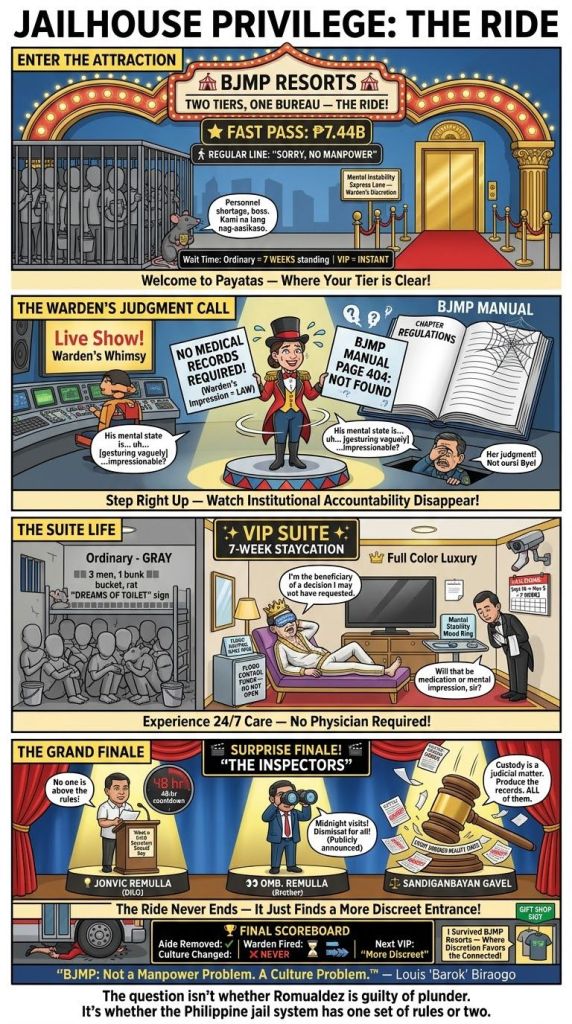
A moment of silence, please, for the Philippine criminal justice system, which apparently suffered a brief, catastrophic bout of amnesia sometime between September 14 and November 5. For seven weeks, a former House Speaker and current plunder defendant was allegedly enjoying the company of a personal aide inside his detention cell at the New Quezon City Jail.
That is a privilege that, according to the Bureau of Jail Management and Penology’s (BJMP) own manual, does not exist for the ordinary tao who can barely afford a decent lawyer, let alone a live-in servant.
The Warden’s Reasoning
The warden, Supt. Maria Lourdes Pacion, testified under oath that she allowed this arrangement because Romualdez’s “mental state is not yet that stable” and because the jail simply couldn’t spare personnel to attend to his personal needs. This is a remarkable piece of administrative reasoning.
The BJMP, an agency tasked with the custody and safekeeping of persons deprived of liberty (PDLs), apparently lacks the manpower to ensure that a detainee receives his medications or eats his meals. Yet it possesses the institutional flexibility to house a private citizen inside a government cell for nearly two months. One wonders if this same “personnel shortage” defense applies to the thousands of other PDLs who share cells with rats and dream of a working toilet.
The Timeline
The timeline is instructive. Romualdez was committed to the Payatas facility on September 14. The aide’s presence was not revealed to the Sandiganbayan, not disclosed in any public BJMP report, and not flagged to the Department of the Interior and Local Government (DILG) until Pacion casually mentioned it while testifying about an entirely different allegation. That allegation was that Romualdez was sneaking out of jail in an ambulance during brownouts.
The ambulance story turned out to be fiction, retracted by broadcaster Ramon Tulfo with the kind of theatrical self-flagellation that only Philippine media can produce. But the aide story was not fiction.
It was an administrative fact that had been sitting in a cell for seven weeks, undocumented, unapproved by higher-ups, and apparently unremarkable to everyone involved until a journalist’s wild guess forced the warden to volunteer the truth.
Fairness to Romualdez, and Why It Is Not Enough
Now, let us be fair to Romualdez. The man is facing a ₱7.44-billion plunder case. He has diabetes, hypertension, and hypothyroidism. He lost a hundred pounds. He is, by all accounts, not a well man.
The Constitution presumes him innocent. The State has an obligation to provide humane treatment. If a physician, a real one, with a license and a stethoscope, determined that he required continuous assistance, then an accommodation might be legally defensible.
But here is the problem: the warden is not a physician. She is a jail administrator. Her assessment that his “mental state is not yet that stable” is not a medical diagnosis. It is an impression.
And a jail warden’s impression, however well-intentioned, is not the legal basis for creating a two-tier custodial system in which one detainee gets a personal attendant and everyone else gets a bunk and a bucket.
What the BJMP Manual Actually Says
The BJMP’s own Comprehensive Operations Manual, which I have read with the grim fascination of a man watching a train wreck in slow motion, permits visitation under strict supervision. It allows jail aides, meaning inmates assigned cleaning duties, to assist personnel. It does not contain a provision authorizing an outside private employee to reside inside a detainee’s cell on a 24/7 basis.
If such a provision exists, the BJMP has had ample opportunity to produce it. Instead, its spokesperson, Supt. Jayrex Bustinera, threw the warden under the proverbial bus, stating that the arrangement was “her judgment, not the chief BJMP or the BJMP’s position.”
This is institutional accountability in the Philippines: the moment a controversy becomes inconvenient, the decision becomes the sole invention of a mid-level official who will now be left to twist in the wind.
The Two Remullas
Secretary Jonvic Remulla, to his credit, has responded with the correct noises. He gave the BJMP 48 hours to explain the legal basis for the arrangement, warned of administrative and criminal proceedings, and declared that “no position, political influence, or personal connection exempts anyone from compliance with established rules.”
This is precisely what a DILG Secretary should say. It is also precisely what a DILG Secretary says when he wants to be seen saying it.
The real test is whether the investigation stops at Pacion or climbs the chain of command. Did the BJMP Regional Director know? Did the national headquarters know? Did anyone in the DILG know? If the answer is no to all of the above, then the Bureau has a supervision problem so profound that the warden’s cell-block favoritism is the least of its worries.
Ombudsman Jesus Crispin Remulla, brother of the DILG Secretary, because of course he is, has promised surprise inspections and dismissal for violators. This is a welcome escalation, but it raises its own uncomfortable questions.
The Ombudsman’s office is not a jail inspection agency. Its involvement signals that the government recognizes this is not merely an administrative irregularity but a potential corruption issue.
Yet the Ombudsman also announced his intentions publicly, which somewhat defeats the purpose of a “surprise” inspection. If the goal is to catch jail officials in the act of providing special treatment, announcing your midnight visits in advance is an odd strategy. One suspects the inspections are less about catching wrongdoing and more about performing vigilance.
The Optics for Romualdez
And what of Romualdez himself? He has not been accused of bribing anyone. He has not been accused of threatening the warden. He is, as his lawyers correctly point out, the beneficiary of a decision he may not have requested.
But the optics are catastrophic. A former Speaker, cousin to the President, facing plunder charges for allegedly looting flood control funds, is discovered to have had a personal servant in his cell for seven weeks while the warden cites “mental instability” as the justification.
If the Romualdez camp has medical records establishing that a psychiatric or medical professional recommended continuous caregiving, now would be the time to produce them. If they do not, then the warden’s “assessment” is the entire evidentiary basis for the arrangement, and that is not a legal foundation. It is a hunch.
The Deeper Scandal: A Regulatory Void
The deeper scandal here is not that Romualdez had an aide. It is that the BJMP apparently has no standardized protocol for handling high-profile detainees with medical needs.
- It has no written procedure for authorizing outside caregivers.
- It has no requirement that a physician, rather than a warden, certify the necessity.
- It has no mechanism for reviewing such arrangements, documenting them, or reporting them to the court.
The result is a system in which discretion fills the vacuum left by regulation, and discretion in the Philippines has a well-documented tendency to favor the wealthy, the connected, and the famous.
The Sandiganbayan as the Only Real Check
The Sandiganbayan, which has ordered the BJMP to produce CCTV footage, logs, medical records, and the identities of everyone authorized to assist Romualdez, is now the only institution in this saga that is behaving like an actual check on arbitrary power.
The court understands something the executive branch seems determined to forget: custody is a judicial matter. If the conditions of detention deviate from what the court ordered, the court has the right, and the duty, to know why.
The Question That Must Be Answered
So here is the question that Secretary Remulla, Ombudsman Remulla, and BJMP Chief Nemeno must answer: If a former Speaker with a plunder case can have a private aide in his cell because a warden thought he seemed unstable, what is to stop every wealthy detainee from claiming the same?
And if the answer is “medical necessity,” then where are the medical records, who signed them, and why were they not presented to the court before a journalist’s retraction accidentally exposed the arrangement?
The Romualdez aide controversy is not about whether Martin Romualdez is guilty of plunder. That is for the Sandiganbayan to decide. It is about whether the Philippine jail system has one set of rules or two.
The warden’s testimony suggests the answer is two. The DILG’s investigation will determine whether that answer is allowed to stand. The Ombudsman’s surprise inspections will determine whether anyone is held accountable. And the Sandiganbayan’s inquiry will determine whether the court’s custody means anything at all.
A Culture Problem, Not a Manpower Problem
In the meantime, the rest of the PDLs in Payatas can take comfort in knowing that the BJMP’s personnel shortage is so severe that it cannot attend to a single congressman’s personal needs, but apparently sufficient to house, feed, and supervise a private citizen living inside a cell for seven weeks without anyone noticing.
That is not a manpower problem. That is a culture problem.
And until someone at the top of the BJMP chain of command is made to explain why the warden’s “judgment” was allowed to operate in a regulatory void, the culture will not change. The aide will be removed, the warden will be sanctioned, and the next high-profile detainee will simply find a more discreet way to bring his household staff along for the ride.
Key Citations
A. Official Websites and Documents
- Bureau of Jail Management and Penology. BJMP Comprehensive Operations Manual 2015 Edition. BJMP, 2015, car.bjmp.gov.ph/wp-content/uploads/2024/11/BJMP-Comprehensive-Operations-Manual-2015-Edition.pdf.
- Bureau of Jail Management and Penology. BJMP Official Website. Bureau of Jail Management and Penology, bjmp.gov.ph.
- Sandiganbayan. Sandiganbayan Official Website. Republic of the Philippines, sb.judiciary.gov.ph.
B. News Articles
- “BJMP: Warden Solely Decided Romualdez Aide’s Stay at QC Jail.” Manila Bulletin, 7 Nov. 2026, mb.com.ph/2026/11/07/bjmp-warden-solely-decided-romualdezs-aides-stay-at-qc-jail.
- “Court Orders Jail Authorities to Submit Detailed Report on Romualdez’s Whereabouts.” GMA News Online, 6 Nov. 2026, www.gmanetwork.com/news/topstories/nation/1008509/court-orders-jail-authorities-to-submit-detailed-report-on-romualdez-s-whereabouts/story/.
- Flores, Helen. “Palace Wants Deeper Probe on Romualdez’s Jail ‘Assistant.’” Philstar.com, 7 Nov. 2026, qa.philstar.com/headlines/2026/11/07/2568413/palace-wants-deeper-probe-romualdezs-jail-assistant.
- Galvez, Daphne. “Romualdez Has Personal Staff in Jail – Warden.” Philstar.com, 6 Nov. 2026, www.philstar.com/headlines/2026/11/06/2568196/romualdez-has-personal-staff-jail-warden/amp.
- Mangaluz, Jean. “Ombudsman Calls Out BJMP for Allowing Romualdez Aid While in Detention.” GMA News Online, 7 Nov. 2026, www.gmanetwork.com/news/topstories/nation/1008625/ombudsman-calls-out-bjmp-for-allowing-romualdez-aid-while-in-detention/story/.
- “Ombudsman to Conduct Surprise Inspections at Quezon City Jail.” ABS-CBN News, 6 Nov. 2026, www.abs-cbn.com/news/nation/2026/11/6/ombudsman-to-conduct-surprise-inspections-at-quezon-city-jail-2142.
- “QC Jail Personnel Could Face Dismissal over Romualdez Aide’s Stay—Ombudsman.” Manila Bulletin, 7 Nov. 2026, mb.com.ph/2026/11/07/qc-jail-personnel-could-face-dismissal-over-romualdez-aides-stayombudsman.
- “Remulla to BJMP: Explain Legality of Romualdez’s Aide Presence at QC Jail.” Manila Bulletin, 7 Nov. 2026, mb.com.ph/2026/11/07/remulla-to-bjmp-explain-legality-of-romualdezs-aide-presence-at-qc-jail.
- “Remulla to Conduct ‘Personal, Surprise Visits’ to QC Jail.” Daily Tribune, 6 Nov. 2026, tribune.net.ph/2026/11/06/remulla-to-conduct-personal-surprise-visits-to-qc-jail.
- Tupas, Emmanuel. “Jonvic Wants BJMP Explanation on Romualdez Aide.” Philstar.com, 8 Nov. 2026, www.philstar.com/headlines/2026/11/08/2568678/jonvic-wants-bjmp-explanation-romualdez-aide.
- “Tulfo Admits He Goofed; Romualdez Tale Untrue.” The Manila Times, 6 Nov. 2026, www.manilatimes.net/2026/11/06/news/national/tulfo-admits-he-goofed-romualdez-tale-untrue/2463194.
- “‘Humiliating’: Mon Tulfo Retracts Romualdez Claim.” Daily Tribune, 5 Nov. 2026, tribune.net.ph/2026/11/05/humiliating-mon-tulfo-retracts-romualdez-claim.
- “Warden Says Romualdez Has Personal Staff for 24/7 Monitoring.” News5, 5 Nov. 2026, news.tv5.com.ph/articles/breaking/read/warden-says-romualdez-has-personal-staff-for-24-7-monitoring.

- ₱9 Billion in ‘Savings’? DILG’s Fire Truck Deal Smells Like Smoke

- ₱8B BBM Pork: CCTV for Every Captain’s Kumpare?

- ₱8.9 Billion, 331 Ghost Police Stations: The TIKAS Scandal Explained

- ₱8.4 Billion, 42,000 Barangays, 1 Election: The “Bawat Barangay Makikinabang” Vote-Buying Masterclass

- ₱75 Million Heist: Cops Gone Full Bandit

- ₱63 to the Dollar: The Only Thing Falling Faster Than the Peso Is the Government’s Credibility

- ₱6.77B Ghost Haunts Duterte: RTC Dismisses Mans Carpio’s Desperate Plea

- ₱6.77 Billion and Zero Cash: The Sara Duterte SALN Math That Doesn’t Add Up

- ₱6.7-Trillion Temptation: The Great Pork Zombie Revival and the “Collegial” Vote-Buying Circus

- ₱58.53B, Zero Receipts: The LGSF Pork Barrel Nobody Wants to Name
- ₱53 Million Man Tells ₱695-a-Day Workers to Stop Being ‘Mayabang’: The Audacity of BSP’s Remolona

- ₱491-M Right-of-Way Scam: DPWH Paid for Ghost Land, Ombudsman Finally Notices







Leave a Reply