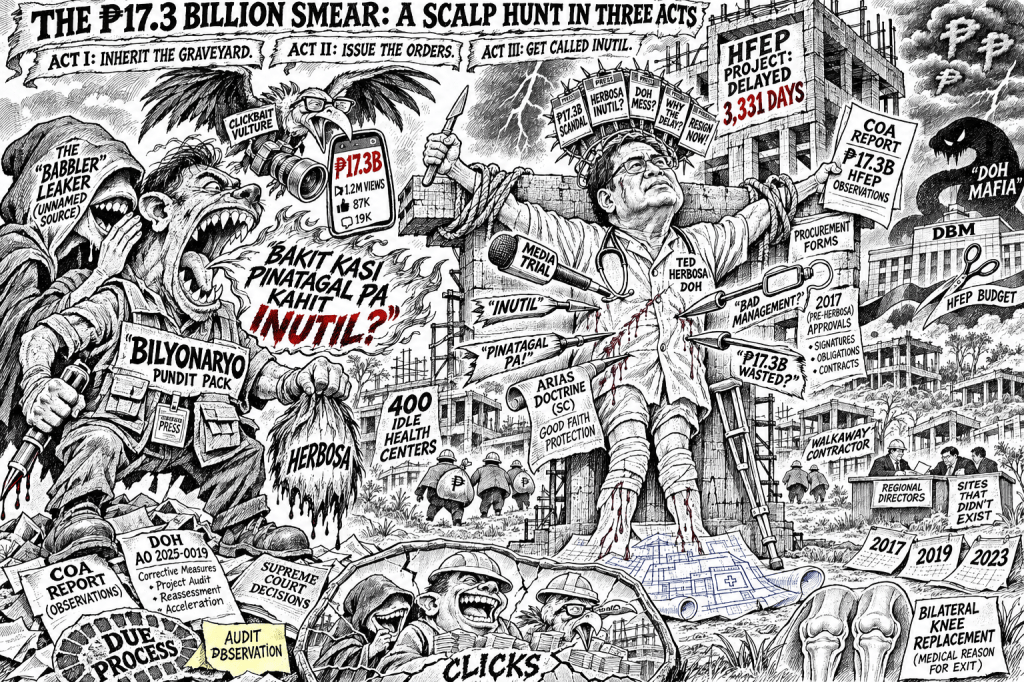
He Inherited the Graveyard, Issued the Orders, Terminated the Contractors—and Still Got Called Inutil
By Louis ‘Barok‘ C. Biraogo — November 8, 2026
The Scalp Hunt
There is a particular species of Manila pundit that can smell a scalp from three time zones away and has never once let a fact-check ruin a good pile-on. They want scalps. And when they can’t find a real scandal, they’ll manufacture one out of audit language, a provocative headline, and the kind of breathless innuendo that would make a tabloid editor blush.
The target du jour? Former Health Secretary Ted Herbosa. The weapon? A ₱17.27 billion figure that Bilyonaryo flung across its homepage like a molotov cocktail, complete with the subtle-as-a-sledgehammer headline: “Bakit kasi pinatagal pa kahit inutil?”
Translation: “Why prolong it when he’s useless?”
Charming. Truly the apex of Philippine journalism.
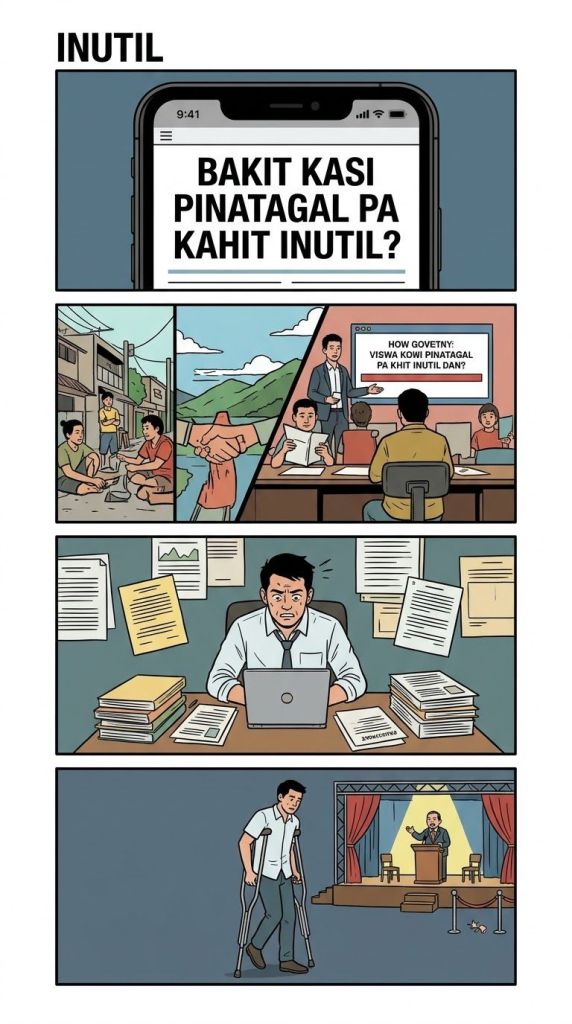
What the Headline Leaves Out
But here’s what the headline doesn’t tell you—and what the Bilyonaryo stenographers conveniently omitted while they were busy polishing their knives. That ₱17.27 billion is not money stolen. It is not money lost. It is not even money missing. It is the value of project entries flagged for various deficiencies, a distinction the article itself admits in a single buried sentence before sprinting back to the pitchforks.
The Commission on Audit (COA) did not declare a single peso missing. No Ombudsman finding of plunder. No Sandiganbayan conviction. Just audit observations—the bureaucratic equivalent of a yellow sticky note—transformed into a criminal indictment by headline writers who couldn’t spell “due process” if you spotted them the first four letters.
The Man They’re Crucifying
And who is the man they’re crucifying? A physician. A former University of the Philippines-Philippine General Hospital (UP-PGH) professor. A public health expert who stepped into the Department of Health (DOH) in June 2023 and inherited a bureaucracy so sclerotic, so captured by internal fiefdoms, so thoroughly poisoned by what he himself called the “DOH mafia,” that even COA had been flagging the same damn problems since 2017.
The Nine-Year Delay Myth
Let’s talk about those nine-year delays, shall we? Bilyonaryo breathlessly reports that 14 Central Office projects worth ₱8.45 billion were delayed between 203 and 3,331 days. Nine years! they shriek. What was Herbosa doing?
He was in medical school, you absolute muppets. Or running a hospital. Or serving as Undersecretary under a different administration. The longest-delayed project predates his tenure by nearly a decade.
The 2023 audit findings—₱2.83 billion—landed on his desk the same year he took office. The man inherited a graveyard of half-built hospitals and abandoned health centers, and the best the Bilyonaryo brain trust could come up with is “why didn’t he fix it in eighteen months while also running a department of 53,000 employees during a period of unprecedented health system stress?”
This is not accountability journalism. This is a hit job with a byline.
What Herbosa Actually Did
Now, let’s be clear about something the critics never are: Herbosa did act. The DOH issued two administrative orders in 2025—including AO 2025-0019—establishing stricter guidelines for Health Facilities Enhancement Program (HFEP) procurement, implementation, and monitoring. He terminated agreements with “walkaway” contractors and reassigned projects.
He went before Congress and disclosed that 400 of 600 health centers were idle because contractors had simply abandoned them. That is a systemic procurement failure that predated his watch and implicates the entire government procurement apparatus, not one Cabinet secretary.
What COA Itself Said
And what did COA itself say about the broader context? In its own report, the Commission acknowledged that the DOH operates within a “complex, decentralized landscape” and that the “observed delays do not signify a failure of intent, but rather reflect external systemic dependencies,” including multiagency regulatory approvals and local infrastructure readiness, as reported by the Inquirer.
The auditors—the actual auditors, not the Bilyonaryo comment section—explicitly declined to pin the failures on DOH leadership alone.
But that nuance doesn’t sell clicks, does it?
The “Babbler” Problem
Let’s talk about the company Herbosa kept—or rather, the company that kept him. Bilyonaryo ran a February 2026 piece claiming Herbosa survived in his post thanks to a “Romualdez lifeline,” first from then-Speaker Martin, later from Ambassador Babes. The sourcing? A “Babbler.” An unnamed insider. The kind of journalistic rigor that would get you laughed out of a freshman newswriting class.
And yet this is the narrative they’ve constructed: Herbosa as political parasite, clinging to power through fraternity ties and backroom deals. Never mind that President Marcos himself rejected Herbosa’s resignation in June 2025 during the “bold reset” reshuffle—a decision that, if Herbosa were truly the incompetent crony they describe, would reflect poorly on the President’s judgment.
Never mind that when Herbosa finally did step down in July 2026, it was for bilateral knee replacement surgery—a medical procedure so unambiguous that even the Palace confirmed it.
The man literally had both knees replaced. And the conspiracy theorists at Bilyonaryo framed it as a convenient exit.
The Systemic Rot Nobody Mentions
Here’s the part that really gets me. The same people screaming about ₱17.27 billion in “troubled” projects are utterly silent on the systemic rot that created the problem in the first place. The HFEP budget was slashed from ₱30 billion to ₱50 million in 2019 by the Department of Budget and Management (DBM), citing “dismal spending performance”—which is bureaucratic speak for “we’re punishing you for being bad at spending, so here’s less money to spend.”
The program then spent years in a death spiral: underfunded, under-monitored, and staffed by regional offices that lacked the engineering and project management capacity to execute what remained.
Herbosa walked into that. And instead of getting credit for the administrative orders, the contractor terminations, the transparency before Congress, he got a headline calling him inutil.
The Convenient Timing
Let’s also address the convenient timing. Bilyonaryo’s big exposé dropped on November 6, 2026. Herbosa resigned in July. Pujalte came and went by August, replaced by Edwin Mercado. The article is a post-mortem on a Secretary who had already left office—a fact the piece mentions only in passing, if at all, because acknowledging that Herbosa is gone would undercut the breathless urgency of the gotcha.
Why publish now? Perhaps because the current Secretary, Mercado, has inherited the same problems and the same structural constraints, and the Bilyonaryo crowd needs a villain whose name they’ve already primed the public to hate. Or perhaps because certain political factions never forgave Herbosa for the “DOH mafia” comment—for naming the internal resistance to reform and making enemies of the very people who now leak to friendly reporters.
Either way, the result is the same: a good man’s reputation sacrificed at the altar of clickbait, while the real culprits—the contractors who walked away with mobilization funds, the regional directors who signed off on unstarted projects, the procurement officials who approved contracts for sites that didn’t exist—continue their merry way, unnamed and unbothered.
The Standard of Accountability
I am not saying Herbosa was perfect. No Cabinet secretary is. The DOH’s infrastructure program is a disaster, and it has been for years. But the standard for accountability cannot be “the Secretary must personally inspect 488 project sites across an archipelago of 7,000 islands while simultaneously running a department that manages hospitals, disease surveillance, health financing, and a post-pandemic recovery.”
The Arias doctrine—which the Supreme Court has repeatedly affirmed—holds that heads of offices may rely on their subordinates in good faith unless circumstances should have alerted them to exercise greater diligence. Herbosa received COA warnings. He responded with administrative orders. He terminated contractors. He disclosed the scale of the problem to Congress.
That is not inutil. That is a man fighting a bureaucracy that was fighting back.
The Real Scandal
The real scandal here is not that Ted Herbosa left the DOH with ₱17.27 billion in flagged projects. The real scandal is that the Philippine government has spent a decade building health facilities that cannot function, and the only thing anyone wants to talk about is the guy who happened to be holding the bag when the music stopped.
And the real tragedy is that the Bilyonaryo crowd—and the political operators feeding them—have made it impossible for anyone with actual expertise to want the job. Why would a competent physician-administrator accept a Cabinet post knowing that every inherited problem will be pinned on them, every audit observation will become a headline, and every unnamed “Babbler” with an axe to grind will get the last word?
Herbosa is gone. His knees are healing. The hospitals are still half-built. And the people who actually broke the system are still writing the headlines.
Key Citations
A. News Articles
- Bilyonaryo Staff. “Bakit Kasi Pinatagal Pa Kahit Inutil? COA Warned, Herbosa Promised to Fix It, Yet ₱17.3B in DOH Projects Remained Troubled After 3 Years.” Bilyonaryo Business News, 6 Nov. 2026. Accessed 8 Nov. 2026.
- Bilyonaryo Staff. “From Martin to Babes: Ted Herbosa Finds a New Romualdez Lifeline as Corruption Scandal and Infighting Rock DOH.” Bilyonaryo Business News, 20 Feb. 2026. Accessed 8 Nov. 2026.
- Esguerra, Darryl John. “New DOH Chief Named as Herbosa Resigns Due to Health Concern.” Philippine News Agency, 13 July 2026. Accessed 8 Nov. 2026.
- Inquirer Plus. “COA Notes P242-M Idled Equipment for Still-Unfinished Gov’t Hospitals.” Inquirer.net, 20 Oct. 2026. Accessed 8 Nov. 2026.
B. Official Websites and Legal Sources
- Presidential Communications Office. “President Marcos Swears in New DOH Secretary, PhilHealth Head.” PCO.gov.ph, 10 Aug. 2026. Accessed 8 Nov. 2026.
- Supreme Court E-Library. “Arias v. Sandiganbayan Doctrine and Exceptions.” Supreme Court E-Library. Accessed 8 Nov. 2026.
- Republic of the Philippines. “Republic Act No. 9184 (Government Procurement Reform Act).” Lawphil. Accessed 8 Nov. 2026.
- Republic of the Philippines. “Republic Act No. 7080 (An Act Defining and Penalizing the Crime of Plunder).” Lawphil. Accessed 8 Nov. 2026.
- Department of Health. “Administrative Order No. 2025-0019: Guidelines on the Implementation of Projects Funded Under the Health Facilities Enhancement Program (HFEP).” Health Facility Development Bureau (HFDB-DOH), 16 Sept. 2025, sites.google.com/view/doh-hfdb/2025-q4-updates/ao-2025-0019. Accessed 8 Nov. 2026.
- Department of Health. “Administrative Order No. 2025-0018: Omnibus Guidelines on the Preparation of HFEP Proposals.” Health Facility Development Bureau (HFDB-DOH), 8 Sept. 2025, sites.google.com/view/doh-hfdb/2025-q3-updates/ao-2025-0018. Accessed 8 Nov. 2026.
- “Due Process.” Encyclopaedia Britannica. Accessed 8 Nov. 2026.
- ₱9 Billion in ‘Savings’? DILG’s Fire Truck Deal Smells Like Smoke

- ₱8B BBM Pork: CCTV for Every Captain’s Kumpare?
- ₱8.9 Billion, 331 Ghost Police Stations: The TIKAS Scandal Explained

- ₱8.4 Billion, 42,000 Barangays, 1 Election: The “Bawat Barangay Makikinabang” Vote-Buying Masterclass

- ₱75 Million Heist: Cops Gone Full Bandit

- ₱63 to the Dollar: The Only Thing Falling Faster Than the Peso Is the Government’s Credibility
- ₱6.77B Ghost Haunts Duterte: RTC Dismisses Mans Carpio’s Desperate Plea
- ₱6.77 Billion and Zero Cash: The Sara Duterte SALN Math That Doesn’t Add Up

- ₱6.7-Trillion Temptation: The Great Pork Zombie Revival and the “Collegial” Vote-Buying Circus

- ₱58.53B, Zero Receipts: The LGSF Pork Barrel Nobody Wants to Name
- ₱53 Million Man Tells ₱695-a-Day Workers to Stop Being ‘Mayabang’: The Audacity of BSP’s Remolona
- ₱491-M Right-of-Way Scam: DPWH Paid for Ghost Land, Ombudsman Finally Notices




Leave a Reply