Why a Housing Fair Is Neither Housing Nor Fair—But It Sure Is a Great Photo Op
By Louis “Barok” C. Biraogo | November 8, 2026
LET me begin with a confession: I love a good housing fair. The free tote bags, the scale models of “affordable communities” that look like they were designed by someone who has never taken public transportation, the aspirational PowerPoints about “inclusive growth.” It’s theater, and I say that as someone who appreciates theater.
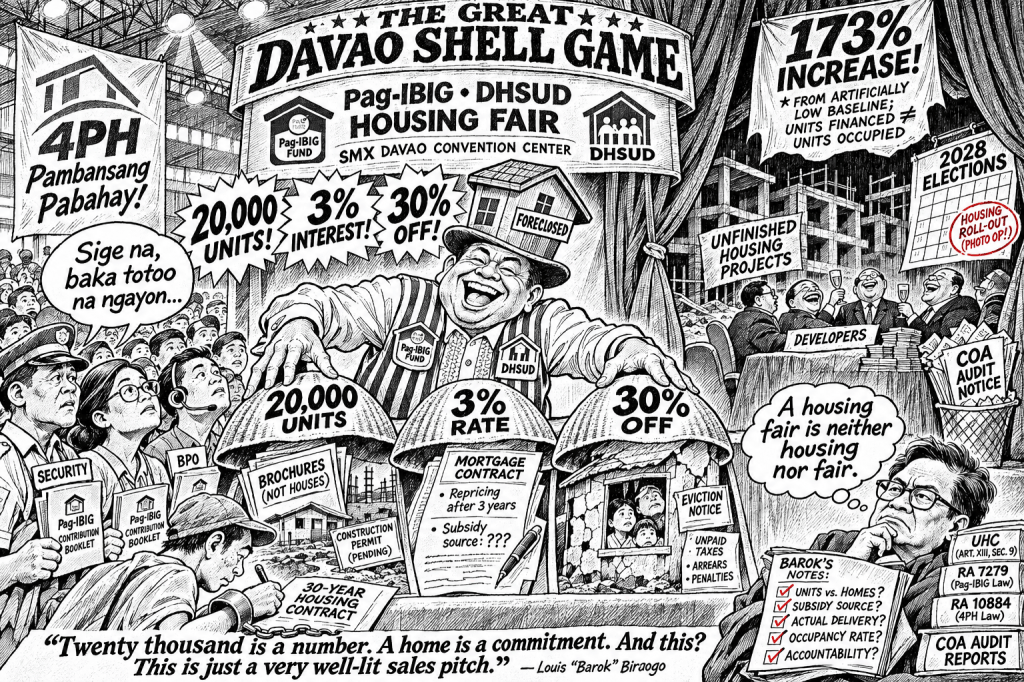
But when Pag-IBIG Fund and the Department of Human Settlements and Urban Development (DHSUD) announce that 40+ developers will trot out “over 20,000 housing units” at the SMX Convention Center in Davao on November 12-13—the third stop of the second National Housing Expo Series, because apparently we’re numbering housing expos now like they’re Marvel sequels—I don’t reach for my checkbook. I reach for my spreadsheet, my statute book, and my skepticism.
Here’s the headline the government wants: 20,000 homes, 3% interest, up to 30% off foreclosed properties. Here’s the headline no one is writing: We don’t know if these units exist, if anyone can afford them, or who is actually paying for the subsidy.
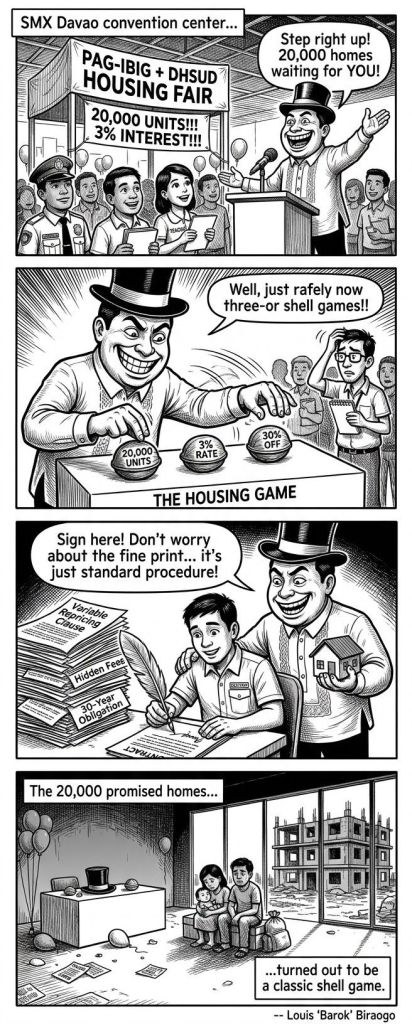
Welcome to the Philippines’ most expensive shell game.
The 20,000-Unit Mirage
Let’s start with the number. Twenty thousand housing units. It’s a lovely, round, politically convenient number. It’s also a number that, upon any serious examination, means absolutely nothing.
Are these units completed? Under construction? Approved? Merely proposed? The SunStar Davao report breathlessly announcing the fair doesn’t say. And here’s the thing: a housing fair, by design, is a marketing event. It addresses inventory and financing—the first and third stages of the housing delivery pipeline. It says nothing about project readiness, physical delivery, or sustainable occupancy.
The government has mastered the art of conflating these stages. A unit can be “available” on a marketing brochure, “approved” for a loan, and still be a muddy lot in Pantukan with a prayer and a promise. Until Pag-IBIG and DHSUD publish a line-by-line classification of every one of those 20,000 units—completed, under construction, permit-pending, purely fictional—the figure is not a housing statistic. It’s a press release.
This is not an abstract concern. The 2025 assessment by the UP Center for Integrative and Development Studies (UP CIDS)—titled, with devastating academic understatement, More Modalities, Still Limited Reach for the Poorest?—found that the Expanded Pambansang Pabahay para sa Pilipino (4PH) program’s expanded modalities had not resolved the “fundamental accessibility and affordability problems” facing the poorest households. High amortization costs, rising price ceilings, rigid eligibility criteria, weak land governance. These are not bugs. They are features.
The 3% Rate: A Subsidy Without a Source
Now, the 3% socialized housing rate. Genuinely attractive, I’ll grant you. On a ₱1 million loan over 30 years, you’re paying roughly ₱4,216 a month versus ₱5,841 at 5.75%. That’s ₱1,625 a month—real money for a minimum-wage earner.
But here’s the question the government hopes you won’t ask: Who pays the difference?
A subsidized rate doesn’t materialize from the ether. If the borrower pays 3% and the underlying financing cost is higher, some funding mechanism absorbs the gap. Is it a General Appropriations Act line item? A Pag-IBIG internal subsidy? A government guarantee? The announcement is conspicuously silent.
Under Article VI, Section 29(1) of the Constitution, no public money leaves the Treasury without a lawful appropriation. If public funds are backstopping this rate, the appropriation and its implementing rules must be identifiable. If Pag-IBIG is absorbing the cost, then the Fund’s members—the security guards, teachers, and call center agents whose contributions built the Fund—are subsidizing the program. Either way, the public deserves to know.
And here’s the deeper problem: a low interest rate on an overpriced house is still an overpriced house. Developers can simply raise selling prices while government makes financing cheaper. The subsidy gets captured by the seller, not the buyer. Without independent comparative valuations and enforced price ceilings, the 3% rate is not affordability policy. It’s demand-side stimulus for developers.
Then there’s the three-year repricing cliff. The 4.5% and 5.75% promotional rates are fixed only for the first three years. A household that can afford the opening act may be financially devastated by the second. The fair should publish repricing scenarios and total loan costs. Instead, it publishes discounts. This is consumer protection as afterthought.
Pag-IBIG’s Fiduciary Bind
Here is where the story gets institutionally interesting—and by “interesting,” I mean legally fraught.
Pag-IBIG is not a spending agency. Under Republic Act No. 9679, the Home Development Mutual Fund Law of 2009, the Fund is “private in character, owned wholly by its members, administered in trust, and applied exclusively for their benefit.” Section 11 directs the Board to consider a member’s “ability to pay” and to institute policies ensuring lower-income members obtain housing loans. Section 18 requires investments to be made with “due and prudent regard for safety, growth, and liquidity.”
Read those provisions together and you find the fault line. Pag-IBIG must promote housing access and protect member resources. These imperatives can coexist—until a presidential flagship program needs loan-release numbers, and political pressure meets fiduciary duty.
The Supreme Court has already flagged this. In Menzon v. Commission on Audit (G.R. No. 241394), the Court upheld Commission on Audit (COA) disallowances of Pag-IBIG housing loans with irregular documentation, emphasizing that officials cannot be “mere rubber stamps” and that disbursements of government funds “shall invariably bear their imprimatur.” The lesson: Pag-IBIG officials bear personal liability for irregular lending. If the housing fair becomes a volume game—approve first, assess later—someone will eventually be signing a notice of disallowance.
And what about the government’s victory lap over a “173% increase” in socialized housing financing—10,904 units in 2026 versus 3,987 in 2025? Impressive, until you realize the percentage is calculated against a tiny baseline, and that units financed is not units occupied. A loan release is not a home. Until Pag-IBIG publishes completed units, turnover figures, occupancy rates, beneficiary income distribution, and delinquency rates, the 173% figure is a financial statistic masquerading as a social outcome.
The Acquired Assets Fire Sale
Now for the Super Sale: up to 30% off Pag-IBIG’s acquired assets. Fewer than 1,000 remain in the Davao Region, per an official who admitted the number wasn’t exact. Comforting.
Here’s what the brochure won’t tell you: an acquired asset is a foreclosed property. It may be occupied by the former borrower. It may have unpaid real-property taxes, association dues, and utility bills. It may have structural defects from prolonged vacancy. Its title may take years to consolidate.
And the Maceda Law—Republic Act No. 6552 (Realty Installment Buyer Protection Act), the installment buyer’s shield—does not protect Pag-IBIG mortgage borrowers the way it protects buyers from developers. The discount isn’t a bargain; it’s a risk premium you’re being paid to accept, and the government is betting you won’t price it correctly.
A 30% discount off an inflated or outdated valuation is not a discount. It’s an accounting exercise. Pag-IBIG should publish a standardized disclosure sheet for every acquired asset: title status, occupancy, encumbrances, inspection findings, outstanding obligations, and the party responsible for settling them. Until then, the Super Sale is less a consumer opportunity than a liability transfer.
DHSUD: Promoter and Regulator, Comfortably Conflicted
The most structurally uncomfortable fact about this entire exercise is that DHSUD is simultaneously the fair’s promotional partner and the country’s principal housing regulator.
Under Presidential Decree No. 957, the Subdivision and Condominium Buyers’ Protective Decree, developers must register projects and secure licenses to sell. Under Republic Act No. 11201 (Department of Human Settlements and Urban Development Act), DHSUD has authority over the “planning, production, marketing, and management of housing projects”—and may take over abandoned or incomplete licensed projects.
The Supreme Court has repeatedly emphasized PD 957’s public-interest character, from Osea v. Ambrosio (G.R. No. 162774, 2006) to the 2021 ruling in G.R. No. 200991, which protected bona fide buyers in possession against the mechanical issuance of writs of possession.
So here’s my question: before endorsing 40+ developers in a government-sponsored fair, has DHSUD verified every participating project’s license to sell, registration, and 4PH eligibility? Has it checked for pending regulatory violations? Has it disclosed the criteria for developer selection and whether any official has a disqualifying interest under Republic Act No. 6713 (Code of Conduct and Ethical Standards for Public Officials and Employees) or Republic Act No. 3019 (Anti-Graft and Corrupt Practices Act)?
Because if the answer is “we’ll get to that,” then DHSUD is not regulating a marketplace. It is curating one. That’s not a housing fair. That’s a trade show with a government seal.
The Political Economy of 20,000 Homes
Let’s be adults about the timing. The fair runs November 12-13, 2026—midway through the Marcos administration, with the 2028 elections on the horizon. The promotional rates expire December 31, 2026.
The administration’s flagship 4PH program has already seen its targets revised downward, from six million units to a range of 1.2 to 3.2 million, with President Marcos himself citing slow private financing. Former DHSUD Secretary Jerry Acuzar was reportedly removed over “underdelivery.” His successor, Jose Ramon Aliling, now chairs the Pag-IBIG Board and preaches “zero tolerance” for corruption—rhetoric that is either reassuring or a tell, depending on your disposition.
None of this proves corruption at the Davao fair. I want to be scrupulously fair: there is no verified evidence in the public record establishing a corrupt arrangement between Pag-IBIG, DHSUD, and any participating developer. What the record does establish is a pattern worth watching: a flagship program under delivery pressure, a financing institution with fiduciary obligations, a regulator acting as promoter, and a political calendar that rewards visible announcements over verifiable outcomes.
The strongest documented criticism remains the policy critique: the Expanded 4PH program, as assessed by UP CIDS, may increase financing transactions without proportionately increasing access for the poorest. The families with the greatest housing need are often those least able to qualify for a mortgage—informal workers with irregular income, no payslips, no credit history.
A program that relies primarily on conventional mortgage eligibility selects for creditworthiness, not deprivation. That is not a failure of Pag-IBIG’s credit assessment. It is a failure of program design, and no interest-rate subsidy fixes it.
What Would Actual Accountability Look Like?
I’m not asking for the fair to be canceled. I’m asking for it to be honest. Specifically:
- First, publish a complete inventory audit before the doors open—every project, every unit, classified by actual construction status, license status, and 4PH eligibility.
- Second, disclose the full financial structure of the 3% subsidy: source, appropriation, per-beneficiary cost, duration, and contingent liability.
- Third, adopt a genuine affordability test that includes utilities, transport, association dues, maintenance, and taxes—not just amortization.
- Fourth, expand rental housing, rent-to-own, and community mortgage modalities for households that cannot sustainably service a mortgage.
- Fifth, require a standardized disclosure sheet for every acquired asset.
- Sixth, publish a quarterly housing-delivery dashboard: loans approved, released, units completed, turned over, occupied, beneficiary income distribution, and delinquency rates.
None of this is radical. It is the minimum disclosure a government should provide before asking a minimum-wage earner to sign a 30-year contract.
The Verdict
I support the objectives of the Pag-IBIG–DHSUD Mindanao Housing Fair. Lower borrowing costs, expanded socialized housing financing, and discounted acquired assets are potentially meaningful interventions. The Constitution commands the State to make decent housing available at affordable cost—Article XIII, Section 9 is not a suggestion—and Republic Act No. 7279 (Urban Development and Housing Act of 1992) operationalizes that mandate. Government has every right, and indeed a duty, to intervene in a housing market that has failed millions.
But there is a difference between a government that helps developers sell houses and a government that houses its people. The first requires exhibitions, financing gimmicks, and promotional campaigns. The second requires land-use planning, enforceable price controls, responsible lending, independent regulation, infrastructure, livelihood access, and sustained public accountability.
The ultimate test of the Expanded 4PH Program is not how many units the government can advertise at a convention center in Davao. It is how many families it can permanently lift out of inadequate housing without pushing them into unsustainable debt—and whether it can prove it with data that survives scrutiny.
Twenty thousand is a number. A home is a commitment. Until Pag-IBIG and DHSUD can tell the difference in public, with receipts, the Davao fair is not a housing solution. It is a very well-lit sales pitch.
And I, for one, will be watching what happens after the tote bags run out.
Key Citations
A. Legal & Official Sources
- The 1987 Constitution of the Republic of the Philippines. Official Gazette of the Republic of the Philippines, 1987, http://www.officialgazette.gov.ph/constitutions/1987-constitution/.
- Congress of the Philippines. Republic Act No. 3019: Anti-Graft and Corrupt Practices Act. 17 Aug. 1960, lawphil.net/statutes/repacts/ra1960/ra_3019_1960.html.
- —. Republic Act No. 6552: Realty Installment Buyer Protection Act. 26 Aug. 1972, lawphil.net/statutes/repacts/ra1972/ra_6552_1972.html.
- —. Republic Act No. 6713: Code of Conduct and Ethical Standards for Public Officials and Employees. 20 Feb. 1989, lawphil.net/statutes/repacts/ra1989/ra_6713_1989.html.
- —. Republic Act No. 7279: Urban Development and Housing Act of 1992. 24 Mar. 1992, lawphil.net/statutes/repacts/ra1992/ra_7279_1992.html.
- —. Republic Act No. 9679: Home Development Mutual Fund Law of 2009. 21 July 2009, lawphil.net/statutes/repacts/ra2009/ra_9679_2009.html.
- —. Republic Act No. 11201: Department of Human Settlements and Urban Development Act. 14 Feb. 2019, lawphil.net/statutes/repacts/ra2019/ra_11201_2019.html.
- Dimalanta, Rafael Vicente V., et al. More Modalities, Still Limited Reach for the Poorest?: A Preliminary Assessment of the Expanded 4PH Social Housing Program. University of the Philippines Center for Integrative and Development Studies, 2025, cids.up.edu.ph/discussion_paper/more-modalities-still-limited-reach-poorest-preliminary-assessment-expanded-4ph-social-housing-program/.
- Menzon v. Commission on Audit. G.R. No. 241394, Supreme Court of the Philippines, Supreme Court E-Library, elibrary.judiciary.gov.ph/thebookshelf/showdocs/1/126164.
- Osea v. Ambrosio. G.R. No. 162774, Supreme Court of the Philippines, 7 Apr. 2006, lawphil.net/judjuris/juri2006/apr2006/gr_162774_2006.html.
- Presidential Decree No. 957: Subdivision and Condominium Buyers’ Protective Decree. 1976, lawphil.net/statutes/presdecs/pd1976/pd_957_1976.html.
- Rosario v. Government Service Insurance System. G.R. No. 200991, Supreme Court of the Philippines, 18 Mar. 2021, lawphil.net/judjuris/juri2021/mar2021/gr_200991_2021.html.
B. News Reports
- “Expanded 4PH Boosts Socialized Housing Financing by 173%.” Philippine News Agency, 3 Nov. 2026, http://www.pna.gov.ph/article/expanded-4ph-boosts-socialized-housing-financing-by-173.
- “Pag-IBIG Brings 20K Housing Units to Davao Fair.” SunStar Davao, 5 Nov. 2026, http://www.sunstar.com.ph/davao/pag-ibig-brings-20k-housing-units-to-davao-fair.
- “Ang Hirap Maging Mahirap”: The PAO Scandal That Proves Government Contempt Is Nothing New
- “Far-Off” My Axx: Malacañang’s Claire Castro Drowns in Her Own Legal Gaslighting
- “Forthwith” to Farce: How the Senate is Killing Impeachment—And Why Enrile’s Right (Even If You Can’t Trust Him)
- “HINDI AKO NAG-RESIGN!”

- “I Know Nothing”: Baste Duterte’s Amnesia Defense Meets ₱33M in GenCorp Contracts
- “I’m calling you from my new Globe SIM. Send load!”

- “Mahiya Naman Kayo!” Marcos’ Anti-Corruption Vow Faces a Flood of Doubt

- “Manageable” Debt, Unmanageable Lies: DBM’s ₱21 Trillion Fairy Tale
- “Meow, I’m calling you from my new Globe SIM!”

- “Natrabaho”: One Word, One Ombudsman, and a Judiciary on Trial
- “No Special Jail for Crooks!” Boying Remulla Slams VIP Perks for Flood Scammers

- “Philippine-Controlled” or Yankee Gas Station? The Davao Fuel Depot Farce Exposed




Leave a Reply