
A ₱10-Billion Purchase, a ₱1.4-Billion Claim, and Zero Published Arithmetic
By Louis ‘Barok’ C Biraogo — November 7, 2026
LET me begin with a confession. I love the phrase “open competitive bidding.” It announces virtue so loudly that you are supposed to stop asking questions. And the Department of Education (DepEd) has just announced that open competitive bidding saved the government at least ₱1.4 billion on more than 231,000 laptops for public school teachers.
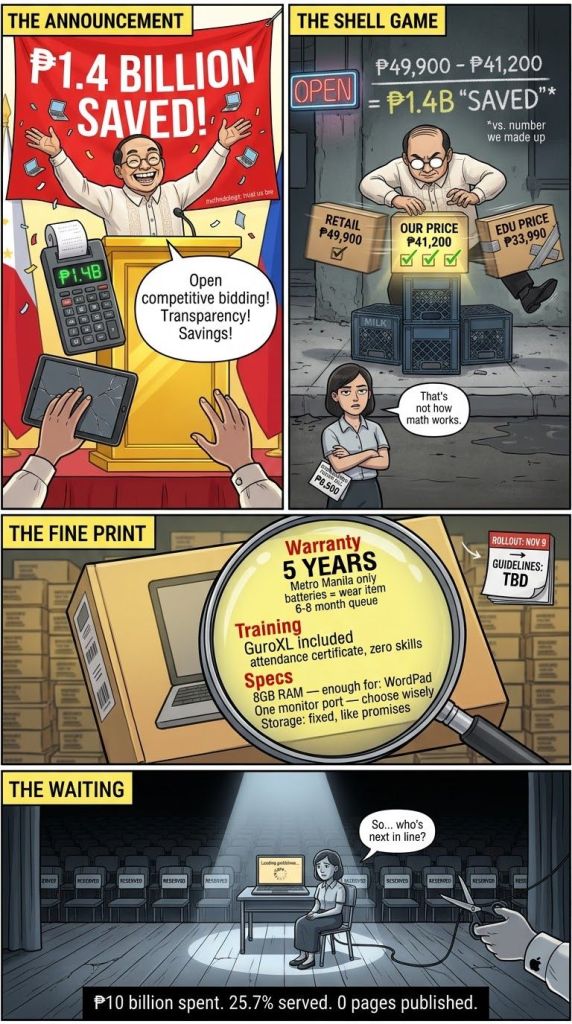
The Ceiling Is Not a Savings
The timing is impeccable. The 2021 laptop scandal—39,583 laptops at ₱58,300 each against a ₱35,000 budget—resulted in graft charges against former Secretary Leonor Briones and thirteen others in July 2025. Now Sonny Angara’s DepEd wants applause because the new unit prices of ₱41,200 to ₱42,700 are lower than the maximum allowable ceiling of ₱42,718.
That is like bragging that your hospital bill came in under the maximum possible charge for a broken arm. The ceiling is not the national debt. It is the amount the government was willing to spend.
And here is where the magic happens. DepEd’s “savings” are computed against a MacBook Neo retail price of around ₱49,900. A ₱6,900 discount multiplied by 172,654 units yields approximately ₱1.19 billion. Add some Windows discounting and you might squint your way to ₱1.4 billion—if you have a very forgiving optometrist.
But the savings methodology has been withheld with the tightness of state secrets. DepEd saved ₱1.4 billion the way a man saves money by buying a yacht on sale; the achievement is real, but only if you ignore what he spent.
The Benchmark Problem
Now, the benchmark, because this is where the sausage-making gets unsavory. Apple’s own education pricing for the MacBook Neo starts at ₱33,990. Retail is ₱39,990. DepEd’s price is ₱41,200 to ₱42,700.
So the department did not beat Apple’s education price—it paid ₱7,000 to ₱8,700 more per unit, bundled with a five-year warranty, software, delivery, and “training” of unspecified content and unknown value. At Apple’s education price, the MacBooks alone might have cost ₱5.9 billion instead of ₱7.1 billion, and the ₱1.4 billion “savings” would have evaporated like a puddle in April.
Perhaps the “commercial value of more than ₱70,000” claim is real. Perhaps my hair is naturally this black. But a public procurement should not require taxpayers to take an advertised value on faith—especially when no line-item breakdown has been published.
Warranty, Licenses, and Training
Consider the warranty. Five years is genuinely better than the one-year standard, and I grant DepEd credit. But it is not a gift; it is a contract term with exclusions and small print where “full coverage” means “we will repair the laptop in Metro Manila whenever we feel like it.”
Does it cover battery deterioration? Accidental damage? Replacement units during repairs? DepEd has not said. Are the software licenses perpetual or will they expire quietly, like political promises? Is “GuroXL training” a day of ribbon-cutting or a program with measurable outcomes? These are the questions any auditor would ask, and if DepEd cannot answer them, its savings figure is a marketing brochure masquerading as a financial statement.
The MacBook Question
Then there is the MacBook question. A department serving roughly 900,000 teachers has chosen 172,654 units of one Apple model—a model with 8GB of unified memory that cannot be upgraded, a single external display limit, and fixed storage. Fine for word processing. Questionable for the teacher who edits video lessons or runs a dozen browser tabs. Worse if DepEd’s enrollment, grading, and reporting systems are Windows-based—and they generally are.
No compatibility study has been published. No explanation for why 73 percent went to one brand. No explanation for the 3,646 MacBooks allocated to administrative officers when the procurement was sold as laptops for teachers. No explanation for why specifications attracted 23 bidders while contracts landed so lopsidedly. The scale of the Apple education deal only sharpens these questions.
Procedure Is the Skeleton, Not the Flesh
To be fair, open competitive bidding is not nothing. In 2021, procurement was routed through the Procurement Service–Department of Budget and Management (PS-DBM) with specifications that appear, per the Ombudsman, to have been massaged to ₱58,300 per unit. This time DepEd ran its own bidding, divided it into regional lots (58 per YugaTech, though DepEd reports 78 contracts—a discrepancy it should explain), and attracted multiple suppliers. That is procedural improvement.
But procedure is the skeleton, not the flesh. A procurement can comply fully with Republic Act No. 12009 (New Government Procurement Act) and still be economically unwise, technologically mismatched, or distributed unfairly. The law’s central principle is “value for money,” not “value for paperwork.”
Three Out of Four Teachers Left Out
Speaking of value, the coverage arithmetic is brutal: 231,725 teacher units against roughly 900,000 teachers is 25.7 percent. Three out of four teachers will still use personal devices and personal money for government work. The Alliance of Concerned Teachers (ACT) has made precisely this point, and it is not radical—it is arithmetic.
DepEd’s response is “guidelines to be issued” before distribution begins. Guidelines. To be issued. After ₱10 billion in contracts. That is like announcing a lottery winner and then deciding who gets the tickets. If distribution is opaque, the laptops become political patronage in a box, and the teachers who most need them will be last in line.
The Legal Landmine
And then the legal landmine. Section 3(e) of Republic Act No. 3019 (Anti-Graft and Corrupt Practices Act) punishes giving unwarranted benefits through manifest partiality, evident bad faith, or gross inexcusable negligence. Section 3(g) punishes contracts grossly and manifestly disadvantageous to the government. The Ombudsman used these against the Briones-era officials; Tio, Jaspe, and Villanueva establish that collusion may be inferred from collective acts and that multiple entities simulating competition defeat the purpose of bidding.
If specifications were crafted to favor one brand, or prices structured to look like savings, the same machinery that caught the last scandal can catch this one. Angara’s team surely knows this. The question is whether transparency is a defense because they have nothing to hide, or because it is a better defense than silence when the Ombudsman is watching.
What Is the ₱1.4 Billion Measured Against?
What exactly is the ₱1.4 billion measured against? The ceiling? Retail? Apple’s education pricing? The 2021 debacle? These baselines are not interchangeable, and the choice determines the headline.
Against retail, DepEd compares a bulk purchase to a mall shelf price—like comparing a wedding banquet to a single restaurant meal. Against the ceiling, the savings are budget discipline, which is mandatory, not miraculous. Against the 2021 scandal, congratulations on clearing a bar so low most of us clear it every morning.
DepEd should publish its computation. If it cannot, the ₱1.4 billion is not a fact. It is a claim. And claims require verification, not applause.
78 Contracts, Six Suppliers
There is also the matter of 78 contracts to six suppliers. Not inherently wrong—regional lots can broaden participation—but fragmented contracting is a classic technique for avoiding thresholds, dispersing responsibility, and muddying the paper trail. The public needs the complete award matrix: approved budget per lot, winning bidder, bid amount, number of bidders, disqualifications and reasons, technical evaluation, post-qualification results.
Without it, “competition” is a press release with a PDF. And under RA 12009, every bidder must disclose ultimate beneficial ownership. If two of the six winners share an owner, a director, an address, or a photocopier, the public should know. Political connections are not evidence of corruption. But the absence of disclosure is evidence of something—carelessness or calculation.
Political Motives
On political motives, I will be careful, because the line between analysis and accusation is the line between journalism and slander. Angara took over a department with a crater in its reputation; a clean procurement is his best answer to the Briones scandal. The President’s education agenda needs a visible deliverable. Apple gets its largest Philippine education deal. Six suppliers get ₱10 billion. Teachers get laptops.
Everyone is happy—which is precisely when the public should read the fine print. The devices are entry-level, the coverage is a quarter of the workforce, the savings methodology is unpublished, the distribution rules are unwritten, and the warranty’s reach is unknown.
What DepEd Should Do
I am not saying the procurement is corrupt. I am saying DepEd has built a narrative in which every doubt is answered by the word “competitive,” and competition is a means, not an end. The end is whether a teacher in a far-flung school can prepare lessons, record grades, and teach digitally without buying a laptop with her own salary. The end is whether the government got the best equipment at the best price with the best support. The end is whether the remaining three-quarters of teachers get anything at all. On those questions, the press release is silent, and silence is the oldest form of spin.
My advice is simple and cheap:
- Publish the savings computation.
- Publish all 78 contracts and the full award matrix.
- Publish the technical specification and market-scoping report.
- Publish the warranty terms, software licenses, and training syllabus.
- Publish the distribution criteria before the distribution, not after.
- Commission an independent technical and financial review and invite the Commission on Audit (COA) and the Ombudsman to watch.
If the procurement is as clean as the department says, transparency costs nothing. If it is not, then ₱1.4 billion is not a savings. It is a promissory note written against the public’s trust.
Because here is the thing about a ₱10-billion laptop deal: the money is already real. The savings are still hypothetical. And the teachers—the actual beneficiaries, invoked in every press release—are still waiting for guidelines. If the department can spend ₱10 billion but cannot publish a single page of its arithmetic, it has not learned the lesson of 2021. It has learned the vocabulary.
That is not a savings. That is a scandal in its larval stage, and the public should demand the paperwork before the ribbon-cutting.
Key Citations
A. Legal & Official Sources
- Jaspe v. Public Assistance and Corruption Prevention Office. G.R. No. 251940, Supreme Court of the Philippines, 12 July 2021, elibrary.judiciary.gov.ph/thebookshelf/showdocs/1/67455.
- Philippines. Republic Act No. 3019: Anti-Graft and Corrupt Practices Act. 17 Aug. 1960, elibrary.judiciary.gov.ph/thebookshelf/showdocs/2/22050.
- Philippines. Republic Act No. 12009: New Government Procurement Act. 20 July 2024, lawphil.net/statutes/repacts/ra2024/ra_12009_2024.html.
- Tio v. People. G.R. Nos. 230132 and 230252, Supreme Court of the Philippines, 19 Jan. 2021, lawphil.net/judjuris/juri2021/jan2021/gr_230132_2021.html.
- Villanueva v. People. G.R. No. 218652, Supreme Court of the Philippines, 23 Feb. 2022, elibrary.judiciary.gov.ph/thebookshelf/showdocs/14/68291.
B. News Reports
- “Apple’s Latest Giant Education Deal: 170,000 MacBook Neo to Philippines.” AppleInsider, 2 Nov. 2026, appleinsider.com/articles/26/11/02/apples-latest-giant-education-deal-170000-macbook-neo-to-philippines.
- “Apple Macbook Neo Price in the Philippines Starts at PHP 39,990 – Officially Announced.” TechPinas, Mar. 2026, http://www.techpinas.com/2026/03/Apple-Macbook-Neo-Philippines.html.
- Cariaso, Bella. “‘DepEd Saved P1.4 Billion in Laptop Procurement for Teachers.’” The Philippine Star, 7 Nov. 2026, http://www.philstar.com/headlines/2026/11/07/2568427/deped-saved-p14-billion-laptop-procurement-teachers.
- Cariaso, Bella, and Elizabeth Marcelo. “Ex-DepEd Chief Briones Faces Graft, Falsification Raps over Laptops.” The Philippine Star, 12 July 2025, http://www.philstar.com/headlines/2025/07/12/2457434/ex-deped-chief-briones-faces-graft-falsification-raps-over-laptops.
- Chi, Cristina. “DepEd Procures 172,654 MacBooks for Teachers.” The Philippine Star, 4 Nov. 2026, http://www.philstar.com/headlines/2026/11/04/2567740/deped-procures-172654-macbooks-teachers.
- “DepEd Says Laptop Bidding Saved P1.4B; Rollout Starts Nov. 9.” Newsbytes.PH, 6 Nov. 2026, newsbytes.ph/2026/11/06/deped-says-laptop-bidding-saved-p1-4b-rollout-starts-nov-9/.
- “Former DepEd Execs Face Graft Charges over Laptop Deals.” Daily Tribune, 11 July 2025, tribune.net.ph/2025/07/11/former-deped-execs-face-graft-charges-over-laptop-deals.
- “172K Laptops Not Enough, Teachers’ Groups Tell DepEd.” Daily Tribune, 4 Nov. 2026, tribune.net.ph/2026/11/04/172k-laptops-not-enough-teachers-groups-tell-deped.
- “Over 172,000 MacBook Neo Laptops Set for DepEd Rollout.” Daily Tribune, 3 Nov. 2026, tribune.net.ph/2026/11/03/over-172000-macbook-neo-laptops-set-for-deped-rollout.

- “Ang Hirap Maging Mahirap”: The PAO Scandal That Proves Government Contempt Is Nothing New
- “Far-Off” My Axx: Malacañang’s Claire Castro Drowns in Her Own Legal Gaslighting
- “Forthwith” to Farce: How the Senate is Killing Impeachment—And Why Enrile’s Right (Even If You Can’t Trust Him)
- “HINDI AKO NAG-RESIGN!”

- “I Know Nothing”: Baste Duterte’s Amnesia Defense Meets ₱33M in GenCorp Contracts

- “I’m calling you from my new Globe SIM. Send load!”

- “Mahiya Naman Kayo!” Marcos’ Anti-Corruption Vow Faces a Flood of Doubt

- “Manageable” Debt, Unmanageable Lies: DBM’s ₱21 Trillion Fairy Tale
- “Meow, I’m calling you from my new Globe SIM!”

- “Natrabaho”: One Word, One Ombudsman, and a Judiciary on Trial
- “No Special Jail for Crooks!” Boying Remulla Slams VIP Perks for Flood Scammers

- “Philippine-Controlled” or Yankee Gas Station? The Davao Fuel Depot Farce Exposed






Leave a Reply