No Consignee, No Arrests, No Answers: The Anatomy of a Seizure That Solved Nothing
By Louis ‘Barok’ C Biraogo — November 6, 2026
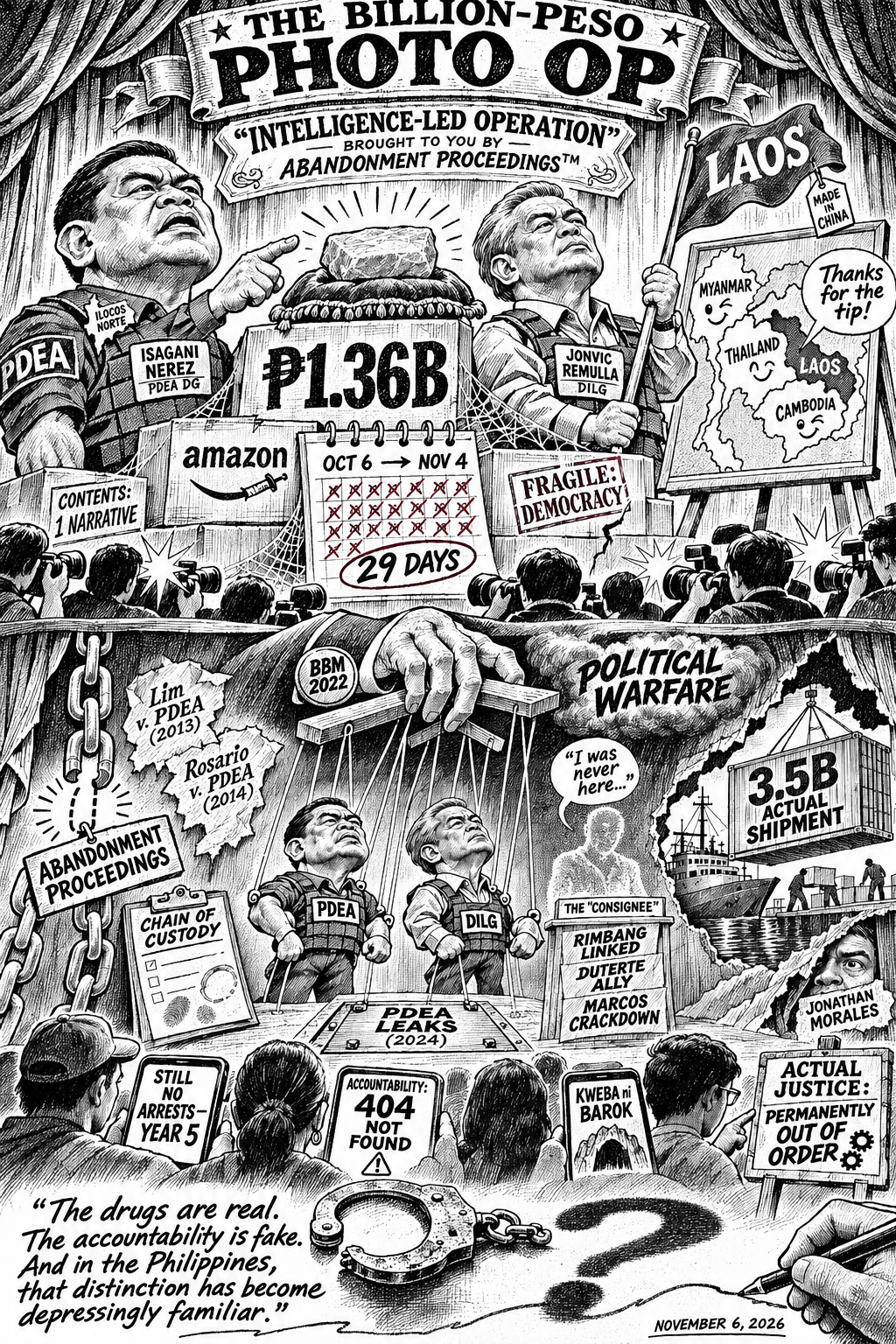
ONCE again we are invited to marvel at a press conference featuring cardboard boxes, vacuum-sealed plastic bags, and officials wearing expressions of grim determination. On November 4, 2026, the Philippine Drug Enforcement Agency (PDEA) announced the seizure of approximately 200 kilograms of shabu valued at ₱1.36 billion from an unclaimed shipment originating in Laos. The drugs allegedly traveled through Vietnam and Hong Kong before arriving at Manila’s North Harbor on October 6, where they sat unclaimed like an abandoned Amazon package—if Amazon packages contained enough methamphetamine to supply a small nation’s worth of questionable life choices.
The headline writes itself: “Intelligence-Led Operation Nets Billion-Peso Drug Haul.” Cue the congratulatory statements and the inevitable photographs of officials pointing at plastic-wrapped bricks as if they were exhibits at a particularly depressing art gallery.
But let us apply the scrutiny Philippine authorities seem to reserve exclusively for opposition politicians and inconvenient journalists.
The Curious Case of the 29-Day Gap
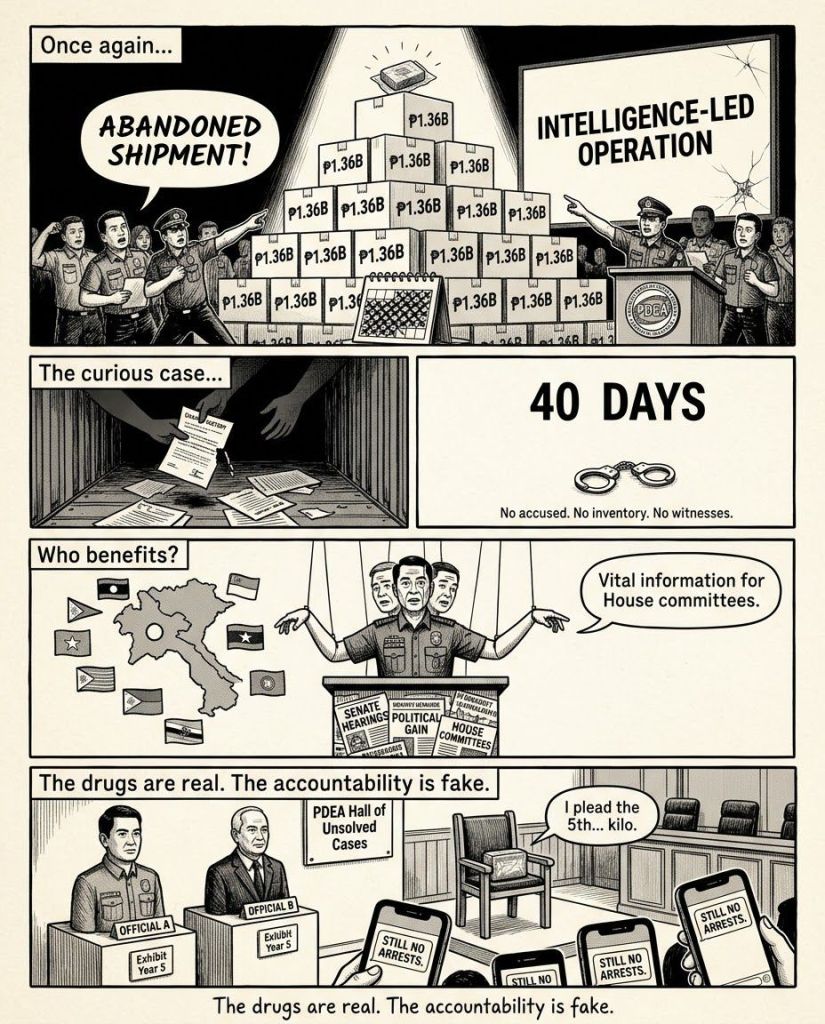
Intelligence from Vietnam’s Anti-Narcotics Police Department arrives September 25. The container reaches Manila October 6. Testing occurs October 14. The public announcement comes November 4—29 days after arrival, 40 days after the tip.
The official explanation involves “abandonment proceedings” under the Customs Modernization and Tariff Act, allowing authorities to open cargo left unclaimed after a prescribed period. The implication: the syndicate simply forgot about its ₱1.36-billion investment.
This strains credulity to breaking point. Drug syndicates do not “abandon” billion-peso shipments. They retrieve them, destroy them, or—if they suspect surveillance—redirect them. The notion that a sophisticated transnational operation shrugged and walked away from 200 kilograms of high-grade methamphetamine suggests one of several possibilities, none reflecting well on the official narrative.
Possibility One: The syndicate was tipped off. Someone with knowledge of the operation—within the Bureau of Customs, PDEA, or another agency—warned the recipients. The abandonment was a defensive response to a leak.
Possibility Two: The shipment was a decoy. While authorities congratulated themselves over 200 kilograms, a larger shipment passed through a different route.
Possibility Three: The consignee was never real. The documents may have been designed to create an ownerless shipment—a legal orphan seized to generate headlines while leaving organizers anonymous.
Each possibility points to the same conclusion: the seizure, however impressive in street value, may tell us almost nothing about the network behind it.
The Chain of Custody: A Link Missing in Action
Republic Act No. 9165 imposes strict chain-of-custody requirements under Section 21. Upon seizure, authorities must immediately conduct a physical inventory and photograph the items in the presence of the accused (or representative), an elected public official, and a media or Department of Justice (DOJ) representative. These are not technicalities; the Supreme Court has repeatedly held that non-compliance can render evidence inadmissible.
In People v. Lim (G.R. No. 231989, 2018), the Court underscored that the prosecution bears the positive duty to demonstrate observance of these procedures, and any justifiable deviation must be alleged and proven. People v. Rosario (G.R. No. 235658, 2020) stressed establishing the drug’s identity with moral certainty.
Now consider an “unclaimed” shipment. There is no accused present at inventory—because there is no accused. The “abandonment proceedings” serve as a legal fiction to justify opening the container, but they do not satisfy the constitutional and statutory requirements designed to protect the accused and preserve evidentiary integrity.
Who witnessed the opening? Who conducted the inventory? Were required officials present? Was the chain documented from October 6 onward? The public has been told none of this.
The extended timeline compounds the problem. Between October 6 and the eventual opening, the container sat in a customs facility. Who had access? Were seals intact? Were there opportunities for tampering or substitution? In a country where the Department of the Interior and Local Government (DILG) Secretary himself acknowledged that police have historically recycled drugs—reporting one kilo while pocketing four—these are not hypothetical concerns.
The Ghost of PDEA Leaks Past
Any assessment of PDEA’s credibility must grapple with its recent history.
In 2024, the Senate investigated the “Philippine Drug Enforcement Agency (PDEA) leaks,” involving former PDEA agent Jonathan Morales’s claim that leaked 2012 documents implicated then-Senator (later President) Ferdinand Marcos Jr. and actress Maricel Soriano in illegal drug use. Morales was subsequently widely discredited: former PDEA officials revealed he had admitted to planting evidence, the Senate President stated his accusations lacked corroborating evidence, and he was later convicted of perjury. The incident did raise questions about PDEA’s document management and the credibility of its personnel, but the hearings themselves became mired in disputes over Morales’s credibility rather than producing substantive evidence regarding Marcos.
More troubling is the agency’s history with its informant reward system. Former PDEA Director General Lazo once admitted that informants sometimes received drugs as part of their compensation—a revelation that prompted House hearings. If informants are paid in product, what prevents the product from being diluted, substituted, or fabricated?
The current seizure is led by Director General Isagani Nerez, appointed February 2025 by President Marcos—a former Philippine National Police (PNP) general with Ilocos Norte ties. His appointment came amid the administration’s aggressive posture toward Duterte-era figures, and PDEA has since provided “vital information” to House committees investigating allies of the former president.
This does not prove the current seizure is politically motivated. But any high-profile PDEA announcement—especially one involving a former Bangsamoro legislator with ties to the Duterte political machine—will be viewed through the lens of political alignment. The agency cannot credibly demand trust while every enforcement action appears calibrated to the sitting administration’s interests.
The Laos Connection: A Regional Puzzle with Missing Pieces
The seizure follows an October 1, 2026 operation in Laos that netted 521 kilograms of shabu and implicated several Filipino nationals, including former Bangsamoro Transition Authority parliament member Edrieza Rimbang, whom PDEA has identified as an alleged financier. Rimbang denies the claim, attributing it to political persecution.
The parallels are striking: both involve suspected shabu originating in Laos and destined for the Philippines; both involve high-value shipments; both are entangled in the Marcos-Duterte rivalry. The obvious question is whether they share a common network.
The government has not established such a connection—nor convincingly investigated the possibility. The two cases are handled by different workstreams, with no documented evidence linking them beyond geography and drug type. “Common country of origin” is a risk indicator, not a conspiracy proof.
But the failure to systematically cross-reference raises its own questions. If investigators are serious about dismantling a network, they would compare not just routes but people: Who financed each shipment? Who arranged logistics? Who were the intended recipients? A single shared telephone number, bank account, or broker would be more probative than a hundred press releases.
It may be that no connections exist—that two separate enterprises happened to use the same origin country at the same time. Or it may be that the connections are too politically sensitive to acknowledge, implicating networks reaching into the highest levels of Philippine politics.
The Great Laos Flagging Initiative: Policy by Panic
On November 5, DILG Secretary Jonvic Remulla announced the Philippines would flag all shipments originating from Laos following the seizure. This sounds tough until one considers its implications.
Laos is a sovereign nation with legitimate trade relationships, exporting agricultural products, textiles, and other goods. Flagging every shipment would mean increased scrutiny for legitimate businesses, delays for consumers, and diplomatic friction with a neighbor that has done nothing to warrant blanket suspicion.
The proposal also assumes drug syndicates are too stupid to adapt. If Laos shipments are flagged, they will route through Cambodia, Thailand, or Myanmar. If commercial shipping is scrutinized, they will use fishing vessels, private aircraft, or air cargo. The drug trade is nothing if not adaptable; every enforcement measure creates an incentive for innovation.
A smarter approach would be intelligence-based scrutiny—targeting shipments matching specific risk profiles based on evidence rather than geography. But that requires actual investigative work, not press conferences announcing “initiatives” that generate headlines without generating arrests.
The Fundamental Question: Who Is Actually Benefiting?
What is the actual purpose of this seizure announcement?
If the goal is to dismantle a trafficking network, the seizure is at best a partial success. No arrests have been made. No financiers identified. No distribution network rolled up. The drugs are in custody; the people who organized their journey are not.
If the goal is to deter future shipments, the deterrent effect is questionable. Syndicates that can afford to lose ₱1.36 billion in product will not be deterred by a press conference.
If the goal is to demonstrate the Marcos administration’s commitment to anti-drug enforcement—that is a legitimate political objective, but it should not be confused with actual law enforcement. The government may highlight its successes, but it does not have the right to claim victory when the evidence suggests otherwise.
And if the goal is to send a message to political opponents—particularly those associated with the Duterte camp—then the seizure becomes something else entirely: a tool of political warfare dressed up as crime-fighting. This possibility is strengthened by timing: the seizure was announced just weeks after PDEA publicly identified Rimbang, a Duterte ally, as an alleged drug financier in the separate Laos case. The juxtaposition creates a narrative of the Marcos administration cracking down on Duterte-linked criminality, even though no evidence connects the two shipments.
None of this suggests the drugs are fake or the seizure staged. The shipment almost certainly contained actual shabu. The question is not whether the drugs are real, but whether the government is using them to construct a narrative serving political purposes beyond public safety.
What Would Accountability Actually Look Like?
If PDEA and its partners were serious about dismantling the network, they would do several things differently.
First, release a detailed operational chronology. When exactly did each inspection occur? What were the results? Who was present? What was the chain of custody at each stage? These are not state secrets; they are basic components of a prosecutable case.
Second, identify the consignee—even if only to say the name was fictitious and the documents fabricated. The public has a right to know whether the shipment was registered to a legitimate business, a shell company, or a nonexistent entity.
Third, explain why the shipment was abandoned. Was the recipient tipped off? Did the syndicate detect surveillance? Was the container always intended as a sacrifice?
Fourth, pursue financial investigations aggressively. Drug trafficking is a business, and businesses leave financial trails. Who paid for the freight? Who insured the cargo? Who guaranteed the letters of credit? These transactions leave records, and those records can identify the people behind the drugs.
Finally, acknowledge the limits of what has been accomplished. Seizing drugs is not the same as dismantling a network. Arresting couriers is not the same as convicting masterminds.
The Verdict of History
The ₱1.36-billion Laos shipment will be remembered in one of two ways. If investigators eventually identify, arrest, and convict the people who financed and organized the operation, it will be remembered as the beginning of a serious effort to dismantle a major trafficking network.
If, as seems more likely, the investigation fizzles into unanswered questions and unfulfilled promises, it will be remembered as another example of what Filipinos have come to expect from their institutions: a spectacular announcement, a flurry of press coverage, and ultimately nothing.
The drugs themselves—200 kilograms of methamphetamine—are a tangible public safety success. They will not reach the streets. That matters.
But public safety requires more than drug seizures. It requires functioning institutions, trustworthy evidence, and a genuine commitment to the rule of law. On those measures, this case remains an open question—one the government has been conspicuously reluctant to answer.
Until the day when officials stand beside cardboard boxes and actually identify the people responsible for filling them, the public should remain skeptical. Not because the drugs are fake, but because the accountability is. And in the Philippines, that distinction has become depressingly familiar.
Key Citations
A. Laws & Court Decisions
- Congress of the Philippines. “Republic Act No. 9165: Comprehensive Dangerous Drugs Act of 2002.” Lawphil, 7 June 2002, lawphil.net.
- Congress of the Philippines. “Republic Act No. 10863: Customs Modernization and Tariff Act.” Lawphil, 30 May 2016, lawphil.net.
- Congress of the Philippines. “The 1987 Constitution of the Republic of the Philippines.” Lawphil, 2 Feb. 1987, lawphil.net.
- Peralta, Diosdado M., J. People of the Philippines v. Romy Lim y Miranda. G.R. No. 231989, 4 Sept. 2018, Supreme Court of the Philippines, Lawyerly, lawyerly.ph.
- Alburo Law Offices. “Summary of People of the Philippines v. Rosario, G.R. No. 235658, 22 June 2020.” Alburo Law Offices, alburolaw.com.
B. News Articles
- Cariaso, Bella. “P1.36 Billion Shabu from Vietnam Seized.” The Philippine Star, 5 Nov. 2026, philstar.com.
- Chi, Cristina. “Ex-Bangsamoro Solon Rimbang Denies Bankrolling P3.5-Billion Laos Shabu Shipment.” The Philippine Star, 23 Oct. 2026, philstar.com.
- Daily Tribune. “PNP Probes Possible Links between P1.36-B Manila Drug Haul, Laos Seizure.” Daily Tribune, 5 Nov. 2026, tribune.net.ph.
- Villamente, Jing. “PDEA Probes Davao Drug Ring Link to Laos Shabu Bust.” Daily Tribune, 12 Oct. 2026, tribune.net.ph.
- GMA News. “PDEA: 2 Filipinos under Investigation over PH-Bound Shabu Seized in Laos.” GMA News Online, Oct. 2026, gmanetwork.com.
- Rita, Joviland. “PH to Flag All Shipments from Laos after P1.36-B Shabu Seizure — DILG.” GMA News Online, 5 Nov. 2026, gmanetwork.com.
- Rita, Joviland. “Shabu Worth P1.36B from Laos Seized at Manila Port — PDEA.” GMA News Online, 4 Nov. 2026, gmanetwork.com.
- Inquirer.net. “Illegal Drugs Paid as Reward to PDEA Informants? House Panel Wants Urgent Probe.” Inquirer.net, 21 Feb. 2023, newsinfo.inquirer.net.
- Inquirer.net. “Morales’ Credibility Questioned in Senate Probe on PDEA ‘Leak’.” Inquirer.net, 7 May 2024, newsinfo.inquirer.net.
- Inquirer.net. “Senators Cite Ex-PDEA Agent Morales for Contempt, Order His Detention.” Inquirer.net, 20 May 2024, newsinfo.inquirer.net.
- Philippine News Agency. “PNP, PDEA Probe Possible PH Links to P3.54-B Shabu Haul in Laos.” PNA, 12 Oct. 2026, pna.gov.ph.
- The Philippine Star. “Ex-Solons Dismiss ‘PDEA Leaks’.” The Philippine Star, 14 May 2024, philstar.com.
- Philstar.com. “11 Persons of Interest Identified in Laos Drug Haul.” Philstar.com, 17 Oct. 2026, philstar.com.
Not individually opened: the lawphil RA 10863 and Constitution pages, Lawyerly (Lim), Alburo (Rosario), and the Philstar Oct. 17 and Tribune Nov. 5 pages (found through search results or sidebar links). Your text says Lazo “admitted” informants received drugs, but the Inquirer report says he said informants asked for a 30% cut and he rejected it, so check that wording. “PDEA has identified Rimbang” also reads as Remulla’s (DILG) naming, per Philstar.


Leave a Reply