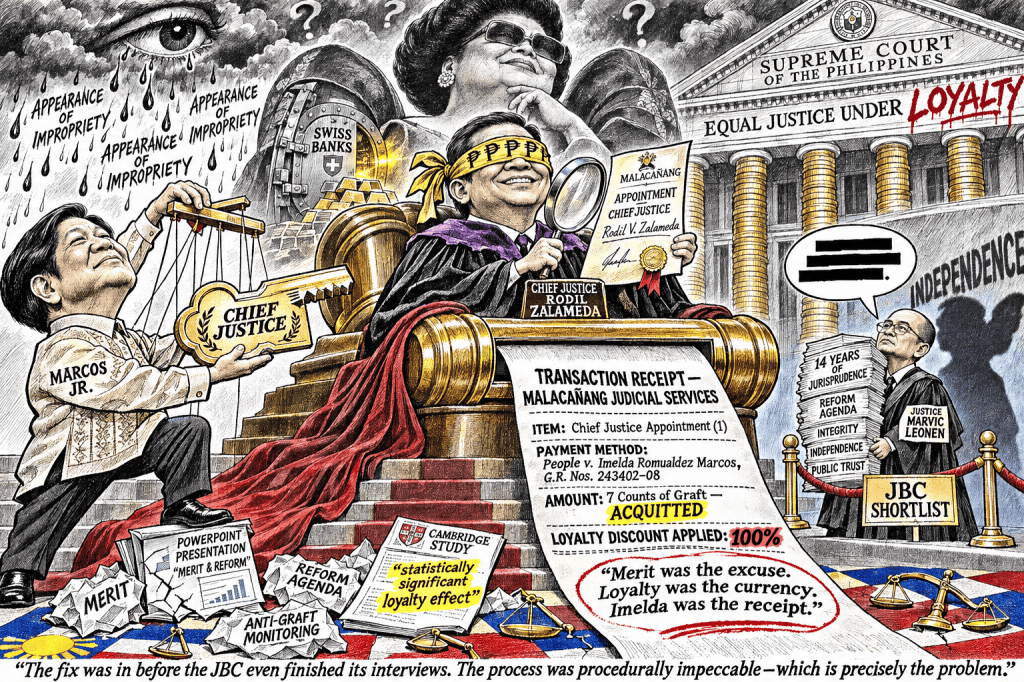
Merit Was the Excuse. Loyalty Was the Currency. Imelda Was the Receipt.
By Louis ‘Barok‘ C. Biraogo | November 6, 2026
Let me save you the suspense, mga ka-kweba: the fix was in before the Judicial and Bar Council (JBC) even finished its interviews.
On November 5, President Ferdinand Marcos Jr. appointed Associate Justice Rodil Zalameda as the 28th Chief Justice of the Philippines. The Palace’s official line, dutifully parroted by the state news apparatus, is that Zalameda was chosen on “merit”—his decades of experience as a prosecutor, his seven years on the Supreme Court, his “phased reform agenda” that sounds suspiciously like every other bureaucratic PowerPoint presentation ever inflicted on a suffering public.
But let us be adults here. We all know why Zalameda got the job. And it wasn’t because of his proposal to create an “anti-graft monitoring group” that would track corruption cases from arraignment to judgment. It was because, in June 2026, he authored the decision that acquitted Imelda Marcos—the President’s mother—of seven counts of graft.
The timing was not a coincidence. The audition was not subtle. And the appointment was not meritocratic. It was a transaction, wrapped in the language of judicial independence and delivered with the solemnity of a constitutional process.
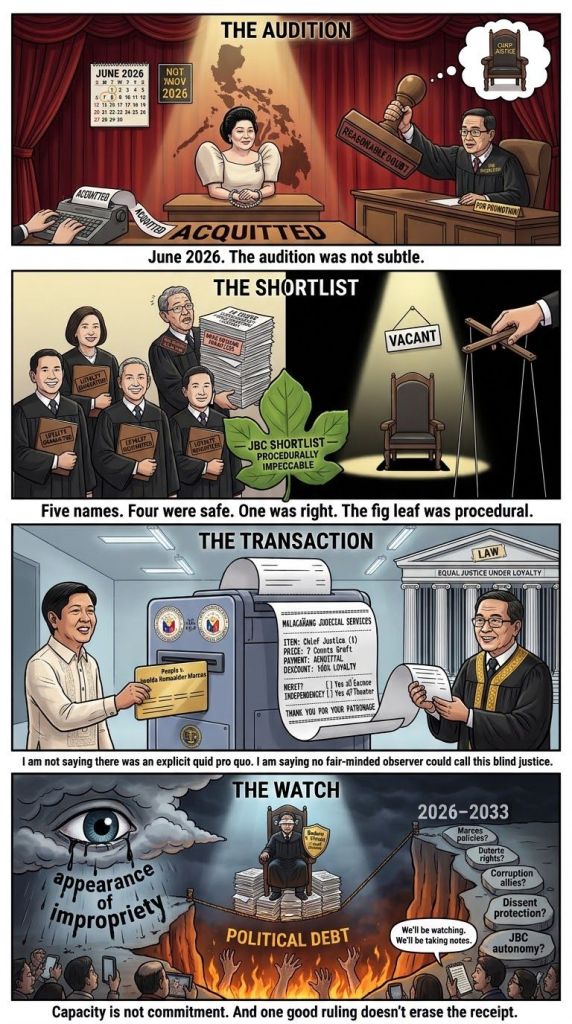
The Shortlist Was a Fig Leaf
Let us dispense with the constitutional theater. Yes, the JBC submitted five names to Malacañang on October 29. Yes, Zalameda was on that list. Yes, the President has the constitutional authority to select any of them. The process was procedurally impeccable, which is precisely the problem—it gives the appearance of legitimacy to what was, in substance, a predetermined outcome.
The JBC shortlisted Senior Associate Justice Marvic Leonen, the most senior member of the Court, a man with fourteen years of jurisprudence, a former dean of UP Law, and a chief peace negotiator with the Moro Islamic Liberation Front (MILF). Leonen was endorsed by former Vice President Leni Robredo, which in the paranoid imagination of Malacañang makes him a political enemy.
He also authored the decision striking down the impeachment proceedings against Vice President Sara Duterte as unconstitutional, and he dissented on the budget issues that the Marcos administration would rather forget.
Leonen was, in other words, the one candidate who owed Marcos nothing and feared him less. And that, dear readers, was precisely why he was never going to get the job.
My previous article argued that Marcos should appoint Leonen—that the only way to prove the appointment was not about loyalty was to choose the man who explicitly refused to offer any. It was a naive hope, I admit. Marcos did what any politician would do: he chose the man who had already demonstrated, through his jurisprudence, that he could be counted on when it mattered most.
The Imelda Decision: A Masterclass in Reasonable Doubt
Let us revisit the decision that made Zalameda’s career. In People v. Imelda Romualdez Marcos, Zalameda wrote the majority opinion reversing the Sandiganbayan’s 2018 conviction of the former First Lady on seven counts of violating the Anti-Graft and Corrupt Practices Act.
The legal reasoning, on its face, is defensible. The prosecution failed to properly authenticate Swiss banking documents. The Informations were defective. The elements of the offense were not established beyond reasonable doubt. These are the sorts of procedural failures that appellate courts exist to correct.
But here is what the decision did not do: it did not exonerate Imelda Marcos in the court of public opinion. It did not answer the question that has haunted this country since 1986—where did the money go? It did not address the fact that the Marcos family’s wealth, documented in countless investigative reports and international court proceedings, remains largely unaccounted for and unrecovered.
What it did do was provide legal cover for the President’s mother. And then, months later, the President rewarded the man who provided that cover.
Let me be precise here, because the Palace’s defenders will accuse me of defamation. I am not saying there was an explicit quid pro quo. I am not saying Zalameda and Marcos met in a smoke-filled room and negotiated terms. I am saying that the appearance of impropriety is so overwhelming that no reasonable observer—no “fair-minded observer,” to use the language of the 2025 Code of Judicial Conduct and Accountability—could look at this sequence of events and conclude that justice was blind.
The Cambridge study on Philippine judicial behavior, cited in my earlier piece, found a statistically significant “loyalty effect” among justices voting on cases involving their appointing presidents. If that study is correct—and its methodology has been peer-reviewed—then appointing Zalameda was not merely a reward. It was an investment.
The Prosecutors’ Endorsement: A Tell
One detail deserves more scrutiny than it received. On November 3, the NCR Chief Prosecutors Association publicly endorsed Zalameda, citing his “extensive prosecutorial and judicial experience.”
I am sure the prosecutors meant well. But let us think about what this endorsement reveals. The Chief Justice presides over a Court that reviews the conduct of prosecutors. The Chief Justice chairs the JBC, which evaluates candidates for judicial positions. A public endorsement from the prosecution service—the very constituency that Zalameda came from—creates an institutional relationship that a Chief Justice must transcend.
Zalameda’s career began as a prosecutor. He served in that role for thirteen years before joining the Court of Appeals and then the Supreme Court, as his official profile details. His professional network is populated with prosecutors, defense lawyers, and judges he has worked alongside for decades. This is not disqualifying in itself—breadth of experience is valuable. But the Chief Justice must demonstrate that his judicial judgment is independent not only of the President who appointed him but of the professional constituency that cheered his elevation.
The 2025 Code of Judicial Conduct and Accountability requires both actual independence and the appearance of independence. The prosecutors’ endorsement, however well-intentioned, muddies the latter.
The Marquez Alternative: What Could Have Been
If Marcos wanted administrative competence rather than political insurance, he had a better option. Jose Midas Marquez, the Court Administrator for nearly twelve years, had proposed a comprehensive Strategic Plan for Judicial Innovations 2.0, with concrete targets for eliminating court backlogs and decongesting dockets by 2032. He was endorsed by the Association of Retired Regional Trial Court Judges, who actually know something about what the judiciary needs.
But Marquez had never served as a trial or appellate judge. His career was inside the Supreme Court apparatus, managing the machinery rather than adjudicating the great constitutional questions. The Chief Justice is not merely an administrator. The Chief Justice is the constitutional conscience of the judiciary, the presiding officer of the Court, the ex officio chair of the JBC, and the person who must, in moments of crisis, determine whether the President has crossed the line.
Marquez would have been a competent manager. He would not have been a Chief Justice in the fullest sense of the office.
What Comes Next: The Tests That Matter
Zalameda will serve until August 2033, assuming he reaches the mandatory retirement age of 70. That is nearly seven years of jurisprudence, administrative decisions, and institutional leadership. The cases that will define his tenure are already on the horizon.
Key questions to watch:
- Will the Supreme Court uphold constitutional challenges to Marcos administration policies?
- Will it protect the rights of Rodrigo and Sara Duterte if the law requires it, regardless of the political consequences?
- Will it hold government officials accountable for corruption when the evidence is sufficient, even if the officials are allies of the appointing power?
- Will Zalameda permit dissenting justices to exercise their independent judgment without administrative retaliation?
- Will he protect the JBC’s autonomy from Malacañang’s influence?
These are not hypothetical questions. They are the minimum standards against which any Chief Justice must be measured. And they are especially urgent for a Chief Justice whose appointment is stained by the appearance of a political debt.
Zalameda’s defenders will point to Deduro v. Vinoya, the red-tagging decision in which he recognized that state vilification can threaten life, liberty, and security. That decision is genuinely admirable. It demonstrates that Zalameda is capable of ruling against the government’s interests when the Constitution demands it.
But one decision protecting an activist does not erase the political context of his appointment. It does not answer the question of whether he can say no to the President who elevated him. It does not resolve the suspicion that the Imelda acquittal was the price of admission to the Chief Justiceship.
The Verdict
Marcos had five choices. Four of them were safe. One of them—Leonen—was right. He chose the safest of the safe, the man whose most consequential ruling directly benefited the President’s family, and then wrapped the decision in the language of merit and reform.
The Supreme Court is not a monarchy. The Chief Justice cannot dictate the votes of his colleagues. But the Chief Justice sets the tone, manages the docket, chairs the JBC, and represents the judiciary to the public. A Chief Justice who owes his position to a decision that freed the President’s mother will be watched, every day, for signs of that debt.
Zalameda may surprise us. He may prove to be a genuinely independent Chief Justice, one who enforces the Constitution against all comers, including the man who appointed him. The Deduro decision suggests he has the capacity for it.
But capacity is not the same as commitment. And the appearance of impropriety is not erased by a single good ruling.
The Kweba will be watching. We will be taking notes. And we will be preparing the next critique.
Key Citations
A. Court Decisions & Official Documents
- People of the Philippines v. Imelda Romualdez Marcos. G.R. Nos. 243402–08, 10 June 2026. Supreme Court E-Library, elibrary.judiciary.gov.ph/thebookshelf/showdocs/1/70586.
- Deduro v. Vinoya. G.R. No. 254753, 4 July 2023, 943 Phil. 498. Supreme Court E-Library, elibrary.judiciary.gov.ph/thebookshelf/showdocs/1/69362.
- Supreme Court of the Philippines. 2025 Code of Judicial Conduct and Accountability. A.M. No. 25-04-04-SC, 11 Nov. 2025, sc.judiciary.gov.ph/sc-approves-a-m-no-25-04-04-sc-the-2025-code-of-judicial-conduct-and-accountability/.
- Supreme Court of the Philippines. “Justice Rodil V. Zalameda.” Supreme Court of the Philippines, sc.judiciary.gov.ph/justice-rodil-v-zalameda/.
B. News Articles
- “JBC Submits Shortlist for Next Chief Justice to Marcos.” ABS-CBN News, 29 Oct. 2026, www.abs-cbn.com/news/nation/2026/10/29/jbc-submits-shortlist-for-next-chief-justice-to-marcos-1440.
- “Zalameda Vows Faster Trials, Anti-Graft Monitoring If Named Chief Justice.” Daily Tribune, 27 Oct. 2026, tribune.net.ph/2026/10/27/zalameda-vows-faster-trials-anti-graft-monitoring-if-named-chief-justice.
- “Metro Manila Prosecutors Endorse Rodil Zalameda for Chief Justice Role.” Daily Tribune, 3 Nov. 2026, tribune.net.ph/2026/11/03/metro-manila-prosecutors-back-zalameda-for-top-sc-post.
- “Marcos Faces Crucial Choice: 5 Shortlisted as Next SC Chief Justice.” Inquirer.net, 29 Oct. 2026, newsinfo.inquirer.net/2332662/marcos-faces-crucial-choice-5-shortlisted-as-next-sc-chief-justice/amp.
- “Former VP Leni Nominates Senior Justice Leonen as Next Chief Justice.” Inquirer.net, 22 Sept. 2026, newsinfo.inquirer.net/2310331/former-vp-leni-nominates-senior-justice-leonen-as-next-chief-justice/amp.
- “Leni Robredo Endorses Leonen as Chief Justice.” Philstar.com, 23 Sept. 2026, qa.philstar.com/headlines/2026/09/23/2558414/leni-robredo-endorses-leonen-chief-justice.
- “NCR Chief Prosecutors Endorse Zalameda for Chief Justice.” Philstar.com, 3 Nov. 2026, www.philstar.com/headlines/2026/11/03/2567575/ncr-chief-prosecutors-endorse-zalameda-chief-justice.
- “JBC Wraps Up Interviews for Chief Justice Candidates.” Philippine News Agency, 27 Oct. 2026, www.pna.gov.ph/article/jbc-wraps-up-interviews-for-chief-justice-candidates.
- “Marcos Picks Rodil Zalameda as New Chief Justice.” Rappler, 5 Nov. 2026, www.rappler.com/philippines/rodil-zalameda-chief-justice-supreme-court-appointment/.
- “From Prosecutor to Top Magistrate: Who Is New Chief Justice Rodil Zalameda?” Rappler, 5 Nov. 2026, www.rappler.com/philippines/things-to-know-chief-justice-rodil-zalameda/.
C. Author’s Prior Work & Official Websites
- Biraogo, Louis ‘Barok’ C. “Four Nominees Bring Loyalty. Leonen Brings a Refusal—and That’s Exactly Why Marcos Should Pick Him.” Kweba ni Barok, 2 Nov. 2026, kwebanibarok.com/2026/11/02/four-nominees-bring-loyalty-leonen-brings-a-refusal-and-thats-exactly-why-marcos-should-pick-him/.
- Judicial and Bar Council. Judicial and Bar Council of the Philippines, jbc.judiciary.gov.ph.
- “Ang Hirap Maging Mahirap”: The PAO Scandal That Proves Government Contempt Is Nothing New

- “Far-Off” My Axx: Malacañang’s Claire Castro Drowns in Her Own Legal Gaslighting
- “Forthwith” to Farce: How the Senate is Killing Impeachment—And Why Enrile’s Right (Even If You Can’t Trust Him)

- “HINDI AKO NAG-RESIGN!”

- “I Know Nothing”: Baste Duterte’s Amnesia Defense Meets ₱33M in GenCorp Contracts

- “I’m calling you from my new Globe SIM. Send load!”

- “Mahiya Naman Kayo!” Marcos’ Anti-Corruption Vow Faces a Flood of Doubt

- “Manageable” Debt, Unmanageable Lies: DBM’s ₱21 Trillion Fairy Tale

- “Meow, I’m calling you from my new Globe SIM!”

- “Natrabaho”: One Word, One Ombudsman, and a Judiciary on Trial

- “No Special Jail for Crooks!” Boying Remulla Slams VIP Perks for Flood Scammers

- “Philippine-Controlled” or Yankee Gas Station? The Davao Fuel Depot Farce Exposed








Leave a Reply