Paglinawan went to the archives and missed the last five decades of treaty practice
By Louis ‘Barok‘ C. Biraogo -+ November 6, 2026
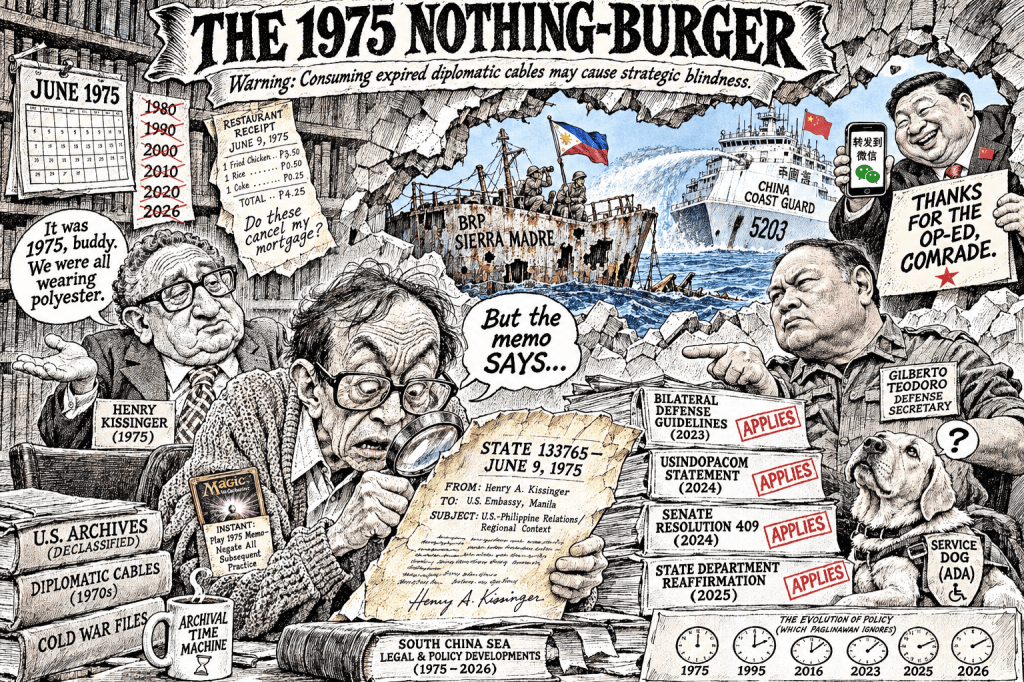
LET’S give Adolfo Quizon Paglinawan some credit. In a country where foreign policy debate usually consists of shouting “China bad” or “America use us” into a Facebook live stream, here comes a former diplomat who actually went to the archives. He dug up a June 9, 1975 memorandum from Henry Kissinger—STATE 133765, for those of you scoring at home—and declared that the United States (US) might not be obligated to die for a rusting World War II tub parked on a reef.
Cute. Very cute.
The Manila Times apparently treated this revelation with the gravity of a Pentagon Papers leak. Paglinawan, vice president of the Asian Century Philippines Strategic Studies Institute, essentially argued that Kissinger told Manila back in ’75 that the Mutual Defense Treaty (MDT) doesn’t cover military deployments intended to establish sovereignty over “openly disputed territory.” Therefore, the BRP Sierra Madre—a ship that hasn’t moved under its own power since Clinton was impeached—might be outside America’s defense umbrella.
This is the geopolitical equivalent of discovering a 50-year-old restaurant receipt and concluding you don’t have to pay your current mortgage.
Dissecting the 1975 Kissinger Memo
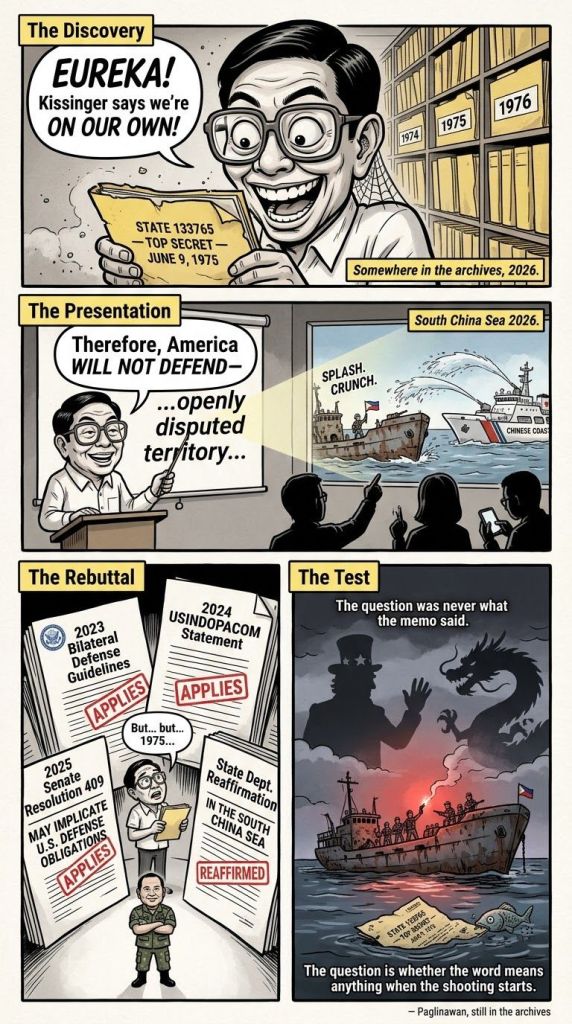
Let’s dissect this with the precision it deserves. First, the Kissinger memo is real. It exists. It says what Paglinawan claims it says. The United States in 1975 was not eager to get dragged into a shooting war over some rocks in the South China Sea that nobody could pronounce. Kissinger, ever the realist, basically told Manila: If you plant troops on disputed territory to stake a claim, don’t expect American boys to bleed for your land grab.
Reasonable then. Potentially catastrophic if applied today.
Treaty Law Is Not a Game of Magic: The Gathering
Here’s the problem with Paglinawan’s argument: it treats international law and treaty interpretation like a game of Magic: The Gathering. You can’t just play a 1975 card and expect it to trump everything that happened afterward. The Mutual Defense Treaty isn’t a static document preserved in amber. It is a living instrument, interpreted through subsequent practice, joint statements, and the occasional strongly worded press release from the State Department.
And the subsequent practice has been… rather explicit.
- In 2023, the US and Philippines issued Bilateral Defense Guidelines stating that an armed attack “anywhere in the South China Sea” against Philippine public vessels, aircraft, or armed forces would invoke MDT commitments.
- In 2024, United States Indo-Pacific Command (USINDOPACOM) essentially said an armed attack on the Sierra Madre “may implicate U.S. defense obligations.”
- In 2025, the State Department repeated this.
- The US Senate passed Resolution 409 reaffirming it.
- Even the US Mission to the Association of Southeast Asian Nations (ASEAN) got in on the action.
So Paglinawan’s argument is that a 1975 memo overrides a 2023 bilateral guideline, a 2024 military statement, and a 2025 Senate resolution. This is like arguing that a 1975 letter from your landlord saying “no pets” means you can’t have a service dog in 2026 despite the Americans with Disabilities Act, three lease amendments, and a court order.
Good luck with that.
What Exactly Is the Sierra Madre Now?
Now, Paglinawan raises a genuinely interesting point buried under the archival dust: what exactly is the Sierra Madre at this point? The ship is a wreck. It has gaping holes. It cannot sail. It is, by any reasonable definition, a permanently grounded hulk with marines living on it. Paglinawan questions whether it still qualifies as a “public vessel” under international law. He raises environmental concerns. He suggests it might be “abandoned.”
This is where the analysis gets spicy. Because if the Sierra Madre is no longer a warship, but merely a rusting environmental hazard, then the MDT’s “public vessels” clause becomes legally murky. What triggers American intervention? An attack on a ship that can’t float? An assault on the marines aboard? The destruction of a navigational hazard?
The Philippine government’s position, articulated by Defense Secretary Gilberto Teodoro, is refreshingly blunt: “The Sierra Madre is a ship of the Republic of the Philippines, and if anything is attempted against it… that is an act of war.” Teodoro then correctly noted that “war” doesn’t mean “state of war”—only Congress can declare that—and that the decision to invoke the MDT rests with the President.
The Political Question Paglinawan Downplays
This is the part Paglinawan seems to miss, or at least downplay. The legal question of whether the Sierra Madre qualifies as a “public vessel” matters less than the political question of whether the United States wants to be seen abandoning a treaty ally over a ship that the ally deliberately grounded. The optics alone would be devastating. If China tows away the Sierra Madre and the US does nothing, every alliance commitment from Tokyo to Canberra suddenly looks negotiable. The credibility cost of inaction dwarfs the legal niceties of whether a grounded Landing Ship, Tank (LST) still counts as a warship.
But Paglinawan isn’t entirely wrong. He’s just… dramatically overstating his case.
“Constitutional Processes” and the Limits of Automatic Defense
His underlying concern is legitimate: the Philippines should not assume that American troops will automatically materialize the moment a Chinese coast guard vessel looks menacingly at a Filipino sailor. The MDT says the US will act “in accordance with its constitutional processes.” That phrase is doing a lot of heavy lifting. It means Congress might need to be involved. It means the President has discretion. It means “mutual defense” is a spectrum, not a light switch.
The 1975 Kissinger memo is a useful reminder that treaties are political documents, not suicide pacts. The United States has never, in its entire history, gone to war solely because a treaty said it should. Every alliance commitment is filtered through national interest, domestic politics, and the question of whether the American public cares enough to send their kids to die.
Does the American public care about the Sierra Madre? Probably not. Most Americans couldn’t find the South China Sea on a map. But they also didn’t care about Kuwait in 1990, and look what happened.
Where Paglinawan’s Argument Falls Short
The real problem with Paglinawan’s intervention isn’t that he’s wrong about the 1975 memo. It’s that he’s using a historical document to argue against a present-day policy that has already been clarified, reaffirmed, and operationalized by both governments. It’s like citing the Nixon administration’s position on Taiwan to argue that the US doesn’t really care about Taipei today. Technically accurate, practically irrelevant.
There’s also the smell test. Paglinawan is affiliated with the Asian Century Philippines Strategic Studies Institute—a think tank whose name suggests a certain orientation toward Beijing. His argument conveniently aligns with China’s preferred narrative: that the MDT doesn’t really cover the Sierra Madre, that the Philippines is on its own, that American promises are hollow. This doesn’t make him wrong. But it does make you wonder whether the research drove the conclusion, or the conclusion drove the research.
The Charitable Reading
The most charitable reading of Paglinawan is that he’s performing a public service: warning Filipinos not to outsource their national security to a superpower whose interests may not always align with theirs. That’s a legitimate and even noble concern. The Philippines should build its own defense capabilities. It should diversify its alliances. It should not assume that Uncle Sam will ride to the rescue every time.
But there’s a difference between “don’t assume automatic intervention” and “the treaty probably doesn’t apply.” Paglinawan blurs that line. He takes a nuanced historical qualification and weaponizes it into a categorical exclusion. He uses the 1975 memo to argue that the Sierra Madre is outside the MDT, when the more accurate statement is that the Sierra Madre’s status is legally contested but politically covered.
Why the Distinction Matters
And that distinction matters. Because if Filipino policymakers listen to Paglinawan and conclude that America won’t come, they might make decisions—strategic, diplomatic, military—based on a misreading of the situation. They might over-accommodate China. They might abandon the outpost. They might signal weakness that invites further aggression.
The Kissinger memo is a relic. The 2023 Bilateral Defense Guidelines are operational. Paglinawan is arguing about what the rules were in 1975. The Chinese coast guard is operating under what the rules are in 2026.
A Rusting Symbol of Philippine Sovereignty
The Sierra Madre is a rusting symbol of Philippine sovereignty, a strategic liability, an environmental disaster waiting to happen, and a geopolitical litmus test all rolled into one. Paglinawan wants us to look at the rust and conclude the treaty doesn’t apply. The better reading is that the rust doesn’t matter. The marines aboard matter. The flag matters. The principle that a smaller nation can’t have its naval vessel towed away by a larger neighbor matters.
And if the United States doesn’t understand that, then the MDT is worth less than the paper Kissinger’s memo was printed on.
Fighting the Last War
But Paglinawan’s real failure isn’t legal. It’s strategic. He’s fighting the last war—1975, when the Philippines was a dictatorship, China was a basket case, and the South China Sea was a backwater. He’s applying the logic of a bygone era to a confrontation that has already evolved beyond his analysis. The US has moved. The Philippines has moved. China has moved. Only Paglinawan, clutching his archival printout, is still standing in the reading room.
The Sierra Madre will eventually collapse, sink, or be towed away. The question isn’t whether the MDT covers a rusting hulk. The question is whether the United States is willing to risk confrontation with a nuclear-armed peer over a treaty ally’s outpost. Paglinawan thinks the answer is no. The 2023 guidelines suggest the answer is maybe. The Chinese coast guard is testing whether the answer is actually yes.
The Test That Matters
That’s the test that matters. Not Kissinger’s memo. Not Paglinawan’s archival diligence. Not the legal status of a ship that hasn’t moved in 27 years.
The test is whether America’s word means anything when the shooting starts.
Paglinawan has raised doubts. The United States has answered them, repeatedly, in writing. The only remaining question is whether anyone in Manila is listening—or whether they’re too busy reading 51-year-old cables to notice that the world has moved on.
Key Citations
A. Reports, Studies & Primary Documents
- Bagares, Romel Regalado. “Nothing-Burger? U.S. Obligation to Defend the Philippines in the South China Sea – Part II.” Cambridge Core Blog, Cambridge UP, www.cambridge.org/core/blog/?p=59299.
- “Nothing-Burger? U.S. Obligation to Defend the Philippines in the South China Sea – Part 1.” Cambridge Core Blog, Cambridge UP, www.cambridge.org/core/blog/?p=59294.
- “Minutes of the Secretary of State’s Staff Meeting, Washington, May 9, 1975.” Foreign Relations of the United States, 1969–1976, Volume E-12, Office of the Historian, U.S. Department of State, history.state.gov/historicaldocuments/frus1969-76ve12/d330.
- “America and the Philippines Update Defense Guidelines.” Foreign Policy Research Institute, 2023, www.fpri.org/article/2023/05/america-and-the-philippines-update-defense-guidelines.
- “Mutual Defense Treaty Between the United States and the Republic of the Philippines.” The Avalon Project, Yale Law School, avalon.law.yale.edu/20th_century/phil001.asp.
B. News Articles
- Chi, Cristina. “Gibo Teodoro: Use of Force vs BRP Sierra Madre an ‘Act of War.’” Philstar.com, 23 Oct. 2026, www.philstar.com/headlines/2026/10/23/2565212/teodoro-use-force-vs-brp-sierra-madre-act-war.
- “China Towing Away BRP Sierra Madre Is ‘Act of War’ against PH — Teodoro.” GMA News Online, www.gmanetwork.com/news/topstories/nation/1006917/china-towing-away-brp-sierra-madre-is-act-of-war-against-ph-teodoro/story.
- “US Renews Warning It’s Obligated to Defend the Philippines after Its Clash with China.” ABC News, Associated Press, abcnews.go.com/International/wireStory/us-renews-warning-obligated-defend-philippines-after-new-111206380.
- “US, Philippines Vow Joint Defense ‘Anywhere in the South China Sea.’” Defense News, 3 May 2023, www.defensenews.com/newsletters/2023/05/03/us-philippines-vow-joint-defense-anywhere-in-the-south-china-sea.
C. Official Websites & Reference Sources
- “US, Philippines Agree to Modernize, Strengthen Alliance.” U.S. Indo-Pacific Command, www.pacom.mil/Media/News/News-Articles/Article/3383992/us-philippines-agree-to-modernize-strengthen-alliance.
- “Henry Kissinger.” Encyclopaedia Britannica, www.britannica.com/biography/Henry-Kissinger.
- “Pentagon Papers.” Encyclopaedia Britannica, www.britannica.com/topic/Pentagon-Papers.
- Americans with Disabilities Act. U.S. Department of Justice, www.ada.gov.



Leave a Reply