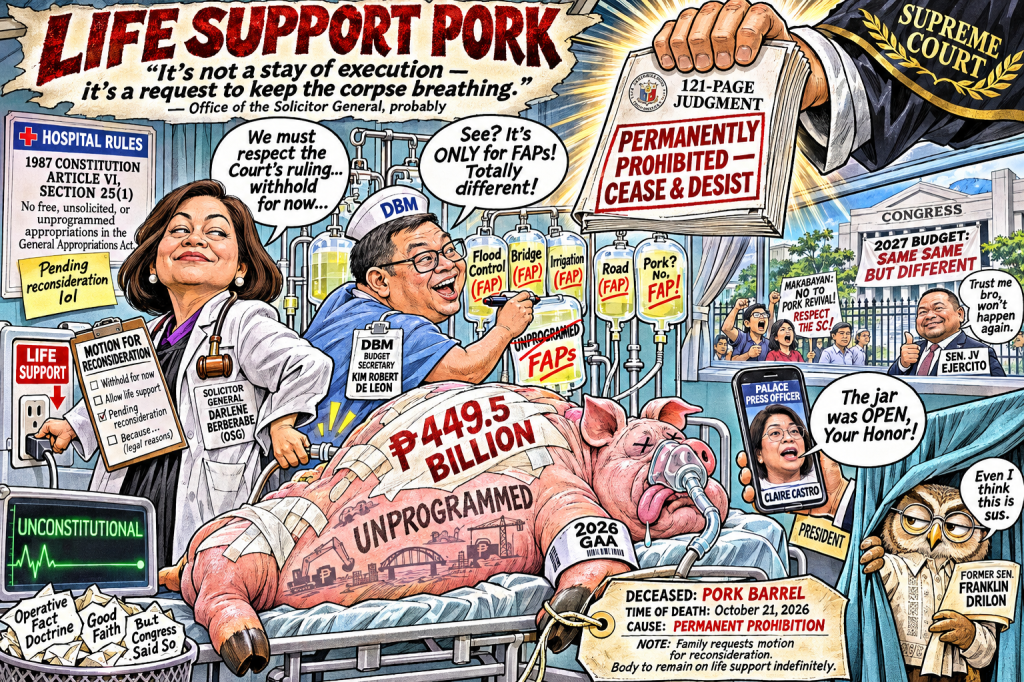
Pork on Life Support: Inside the Legal Maneuver to Keep Unconstitutional Spending Alive
By Louis ‘Barok‘ C. Biraogo — October 23, 2026
MGA ka-kweba, the plot thickens, and the smell of desperation is wafting through the halls of the Office of the Solicitor General (OSG).
Just days after the Supreme Court dropped its 121-page judicial bomb declaring the 2024 and 2025 budgets unconstitutional and permanently prohibiting the implementation of the 2026 unprogrammed appropriations trigger provisions, Solicitor General Darlene Marie Berberabe has executed a maneuver so audacious it deserves its own case study in advanced sophistry. On one hand, she stands before the public and welcomes the ruling, acknowledging that unprogrammed appropriations are not per se unconstitutional.
On the other, she has advised the Department of Budget and Management (DBM) to “withhold for now” certain 2026 programs while the OSG prepares its motion for reconsideration.
Wait. Read that again.
The Supreme Court, in a dispositive portion that is as clear as the noon-day sun over Manila Bay, permanently prohibited the Senate, the House, the Executive Secretary, and the DBM Acting Secretary from implementing Special Provisions 1(a) and 1(b) of the 2026 General Appropriations Act (GAA). There is no ambiguity here. There is no “pending review” clause. The prohibition is operative now.
Yet the OSG’s advice to DBM is not “cease and desist immediately.” It is “withhold for now” while we ask the Court to reconsider. This is not legal strategy. This is a stall tactic dressed in constitutional robes, and it reeks of the same institutional arrogance that created this mess in the first place.
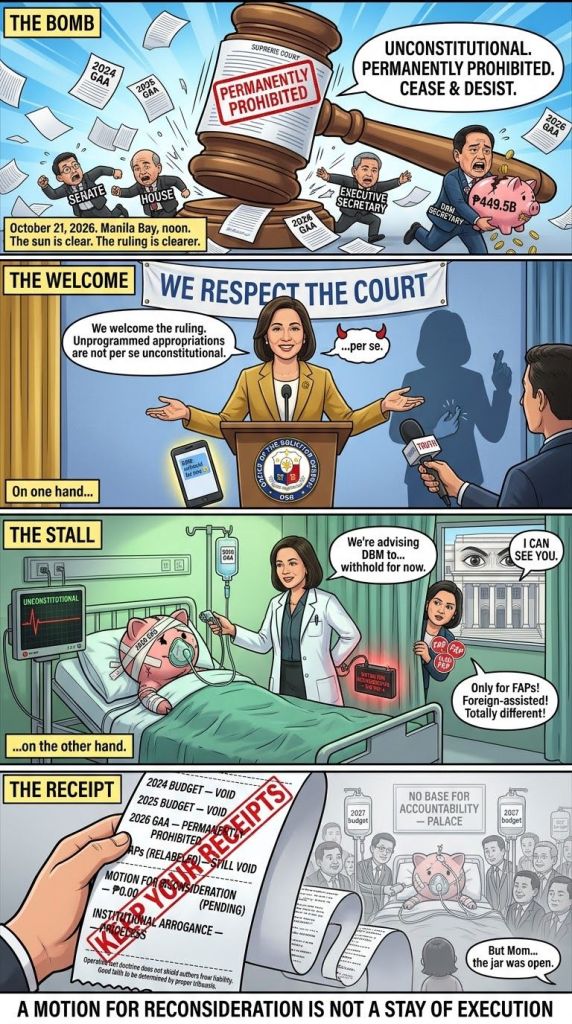
The OSG’s guide to respecting the Supreme Court without actually respecting it. 🐷⚖️
#PorkBarrel #OSG #SupremeCourtPH #BudgetScam #Philippines
Dissecting the Solicitor General’s Public Statements
Let us dissect the Solicitor General’s public statements with the precision of a Commission on Audit (COA) auditor who has just found a ₱449.5-billion discrepancy.
First: Are the “Guardrails” Constitutional or Judicial Overreach?
Berberabe says the OSG will seek clarification on whether the Court’s “guardrails” are actually constitutional requirements or merely judicial overreach into Congress’s power to prescribe the “form, content, and manner” of budget preparation. This is a legitimate question in the abstract. Separation of powers is a real doctrine.
But here is what the Solicitor General conveniently omits: the Court did not invent these guardrails out of thin air. It derived them from Article VI, Section 25(1) of the Constitution, which states in plain English that Congress may not increase the appropriations recommended by the President.
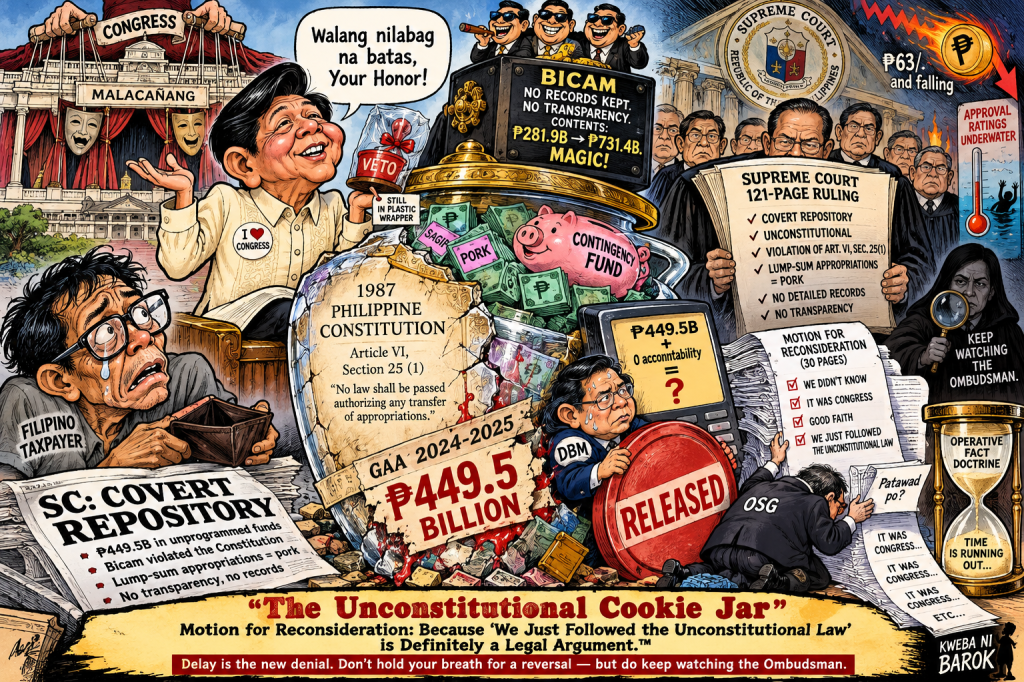
The Court’s “guardrails“—no lump sums, clear differentiation between new income streams, prioritization standards, and consistency with the national fiscal program—are not policy preferences. They are the minimum conditions necessary to prevent Congress from doing exactly what it did: transferring ₱449.5 billion from programmed to unprogrammed appropriations, creating “artificial fiscal space,” and then funneling that space into the pet projects of the Bicameral Conference Committee. The Inquirer’s report on the ruling captures the core holding.
Second: “Constitutional Safeguards” Versus “Policymaking Authority”
Berberabe argues that the OSG needs to distinguish between “safeguards mandated by the Constitution” and those that fall within “policymaking authority”. This is a distinction without a difference. The Court did not say Congress must pass a new law adopting its guardrails.
It said that until unprogrammed appropriations comply with those guardrails, they are unconstitutional. Congress’s “policymaking authority” cannot override the Constitution. If the Solicitor General believes otherwise, she is welcome to argue that before the Court.
But she cannot advise the Executive to continue spending under provisions that have been permanently prohibited while she drafts her motion.
Third: The “Only for FAPs” Misdirection
Third—and this is where the satire writes itself—Berberabe insists that the OSG respects the ruling and that the government is not violating it because no releases have been charged against the challenged provisions. Budget Secretary Kim Robert de Leon has echoed this, telling senators that the releases from 2026 unprogrammed appropriations are “only for FAPs” (foreign-assisted projects). This is a clever bit of misdirection.
The Court did not say “you may continue releasing funds under the invalidated provisions as long as you call them FAPs.” The Court said the provisions themselves are unconstitutional and their implementation is permanently prohibited. Whether the money flows to a flood control project in Bulacan or a foreign-assisted bridge in Samar is irrelevant.
The authority to release is what was struck down. The OSG’s position is akin to a driver caught running a red light who argues, “But I was only turning right.”
The Operative Fact Doctrine Is Not a Prayer for Immunity
Now, let us address the elephant in the room: the operative fact doctrine. The OSG has invoked the operative fact doctrine—citing Araullo v. Aquino III—to argue that projects already underway should continue and that funds already released need not be returned.
But the Court in this case was explicit: the operative fact doctrine covers only irreversible programs whose beneficiaries acted in good faith. It does not automatically shield the authors, proponents, or implementors from criminal, civil, or administrative liability—good faith must be determined by the proper tribunals.
What Is Really Happening Here?
What is really happening here, mga ka-kweba?
The OSG’s motion for reconsideration, due November 4, is not a genuine request for clarification. It is a delaying tactic designed to buy time for the administration to figure out how to unwind a budget structure that was built on a constitutional fiction. The real question is not whether the Court will grant the motion.
The real question is whether the OSG will advise DBM to comply with the permanent prohibition in the meantime, or whether it will continue to hide behind the fig leaf of “pending reconsideration.”
The Palace’s Blame-Congress Response
The Palace has already signaled its position. Press Officer Claire Castro said the administration “respectfully disagrees” with parts of the ruling and believes the Court has imposed conditions that “go beyond those established by Congress”. She also said the President sees “no basis for accountability” because he was “merely complying with the law”. My earlier report on Malacañang’s motion for reconsideration covers the Palace’s position in full.
This is a remarkable statement. The President signed a budget that the Supreme Court has now declared unconstitutional. His DBM implemented releases under provisions that have been permanently prohibited. And his Palace’s response is to blame Congress and claim ignorance?
This is not leadership. This is the institutional equivalent of a child caught with a hand in the cookie jar saying, “But Mom, the jar was open.”
Drilon: The Unlikely Voice of Reason
Meanwhile, former Senate President Franklin Drilon—who argued as amicus curiae that unprogrammed appropriations are constitutional—has emerged as the unlikely voice of reason. Drilon welcomed the ruling but warned that the Court may have overstepped by prescribing fiscal conditions that should be left to Congress. He urged Congress to seek clarification.
This is a principled position, even if one disagrees with it. Drilon is defending the institutional prerogative of the legislature, not the specific abuses that the Court found. There is a difference between saying “Congress should set the standards” and saying “the Executive may ignore the Court while it appeals.”
The Solicitor General would do well to study that difference.
What Should Happen Next?
- Stop the releases. The OSG must advise DBM to cease all releases under the invalidated 2026 provisions immediately, not “withhold for now.” The Court’s prohibition is operative. A motion for reconsideration does not automatically suspend a judgment. If the OSG believes it does, it should cite the specific rule or order that says so. It cannot.
- Keep the motion narrow. The OSG’s motion for reconsideration should be narrowly tailored. It should challenge specific legal conclusions—such as whether the Court’s guardrails are constitutional requirements or prudential recommendations—rather than asking the Court to gut its own ruling. The Court’s finding that the 2024 and 2025 budgets were unconstitutional is not a close call. The numbers are in the record. The Bicameral Conference Committee’s lack of documentation is in the record. The SAGIP program’s function as a “covert repository” for lump sums is in the record. The OSG cannot argue its way out of those facts.
- Congress must act. The 2027 budget is already being deliberated, and the House version reportedly contains provisions similar to those the Court struck down. Makabayan lawmakers have called for the recall of the House bill. Senate Finance Chair JV Ejercito has appealed for calm and promised that “what transpired in past budget deliberations will not happen under my watch”. These are encouraging words, but words are not legislation. Congress must pass a 2027 budget that complies with the Court’s guardrails, and it must do so transparently.
- The Ombudsman and COA must act. The Court has handed them a roadmap. The doctrine of operative fact does not shield the authors and implementors of the invalidated provisions from liability. The documentary trail from the National Expenditure Program (NEP) to the bicameral report to the DBM release orders is sitting in filing cabinets and server rooms across Metro Manila. If no one is investigated, the Court’s ruling will be remembered as a magnificent legal document that changed nothing. The Office of the Ombudsman and COA hold the tools to make sure that does not happen.
The Bottom Line: A Stay of Execution It Is Not
The Solicitor General’s “guardrails” gambit is not about clarifying the law. It is about preserving the Executive’s ability to spend money that the Court has said it cannot spend. The OSG has a duty to represent the government, but it also has a duty to advise the government on what the law requires.
Those duties are not in conflict here. The law is clear. The prohibition is permanent. The only question is whether the OSG will advise compliance or continue to manufacture uncertainty where none exists.
The Supreme Court has spoken. The pork barrel is unconstitutional. The Solicitor General’s motion for reconsideration is not a stay of execution. It is a request for permission to keep the corpse on life support.
Don’t hold your breath for a different outcome. But do keep your receipts.
Key Citations
A. Legal & Official Sources
- Araullo v. Aquino III. G.R. No. 209287, 1 July 2014. LawPhil Project, Arellano Law Foundation, lawphil.net/judjuris/juri2014/jul2014/gr_209287_2014.html.
- Republic of the Philippines. The 1987 Constitution of the Republic of the Philippines, art. VI, sec. 25(1). LawPhil Project, Arellano Law Foundation, lawphil.net/consti/cons1987.html.
B. News Articles and Commentary
- Biraogo, Louis ‘Barok’ C. “Malacanang Files Motion for Reconsideration: We Followed the Unconstitutional Law, Your Honor.” Kweba ni Barok, 22 Oct. 2026, kwebanibarok.com/2026/10/22/malacanang-files-motion-for-reconsideration-we-followed-the-unconstitutional-law-your-honor/.
- Biraogo, Louis ‘Barok’ C. “Supreme Court to Congress: That’s Not a Contingency Fund, That’s Pork.” Kweba ni Barok, 21 Oct. 2026, kwebanibarok.com/2026/10/21/supreme-court-to-congress-thats-not-a-contingency-fund-thats-pork/.
- Bolledo, Jairo. “Supreme Court Declares 2024-2025 Budgets Unconstitutional.” Rappler, rappler.com/philippines/supreme-court-declares-2024-2025-budgets-unconstitutional/.
- Murcia, Alvin. “High Court Voids Spending Hikes.” Daily Tribune, 21 Oct. 2026, tribune.net.ph/2026/10/20/high-court-voids-spending-hikes.
- Ong, Ghio. “SC Declares 2024, 2025 Budgets Unconstitutional.” Philstar.com, The Philippine Star, 21 Oct. 2026, philstar.com/headlines/2026/10/21/2564745/sc-declares-2024-2025-budgets-unconstitutional.
- Torres-Tupas, Tetch. “SC: Congress Can’t Bloat President’s Budget.” INQUIRER.net, 21 Oct. 2026, newsinfo.inquirer.net/2327363/sc-congress-cant-bloat-presidents-budget.
C. Official Websites and Reference Sources
- Commission on Audit. Commission on Audit, Republic of the Philippines, www.coa.gov.ph.
- Department of Budget and Management. Department of Budget and Management, Republic of the Philippines, www.dbm.gov.ph.
- Office of the Ombudsman. Office of the Ombudsman, Republic of the Philippines, www.ombudsman.gov.ph.
- Office of the Solicitor General. Office of the Solicitor General, Republic of the Philippines, www.osg.gov.ph.
- “Amicus Curiae.” Encyclopaedia Britannica, www.britannica.com/topic/amicus-curiae.
- “Separation of Powers.” Encyclopaedia Britannica, www.britannica.com/topic/separation-of-powers.

- ₱9 Billion in ‘Savings’? DILG’s Fire Truck Deal Smells Like Smoke

- ₱8B BBM Pork: CCTV for Every Captain’s Kumpare?
- ₱8.9 Billion, 331 Ghost Police Stations: The TIKAS Scandal Explained

- ₱8.4 Billion, 42,000 Barangays, 1 Election: The “Bawat Barangay Makikinabang” Vote-Buying Masterclass
- ₱75 Million Heist: Cops Gone Full Bandit

- ₱63 to the Dollar: The Only Thing Falling Faster Than the Peso Is the Government’s Credibility

- ₱6.77B Ghost Haunts Duterte: RTC Dismisses Mans Carpio’s Desperate Plea
- ₱6.77 Billion and Zero Cash: The Sara Duterte SALN Math That Doesn’t Add Up

- ₱6.7-Trillion Temptation: The Great Pork Zombie Revival and the “Collegial” Vote-Buying Circus

- ₱58.53B, Zero Receipts: The LGSF Pork Barrel Nobody Wants to Name
- ₱53 Million Man Tells ₱695-a-Day Workers to Stop Being ‘Mayabang’: The Audacity of BSP’s Remolona
- ₱4.4 Billion and a Witness Who Can’t Explain It: The Duterte Impeachment’s Most Expensive Non-Answer




Leave a Reply