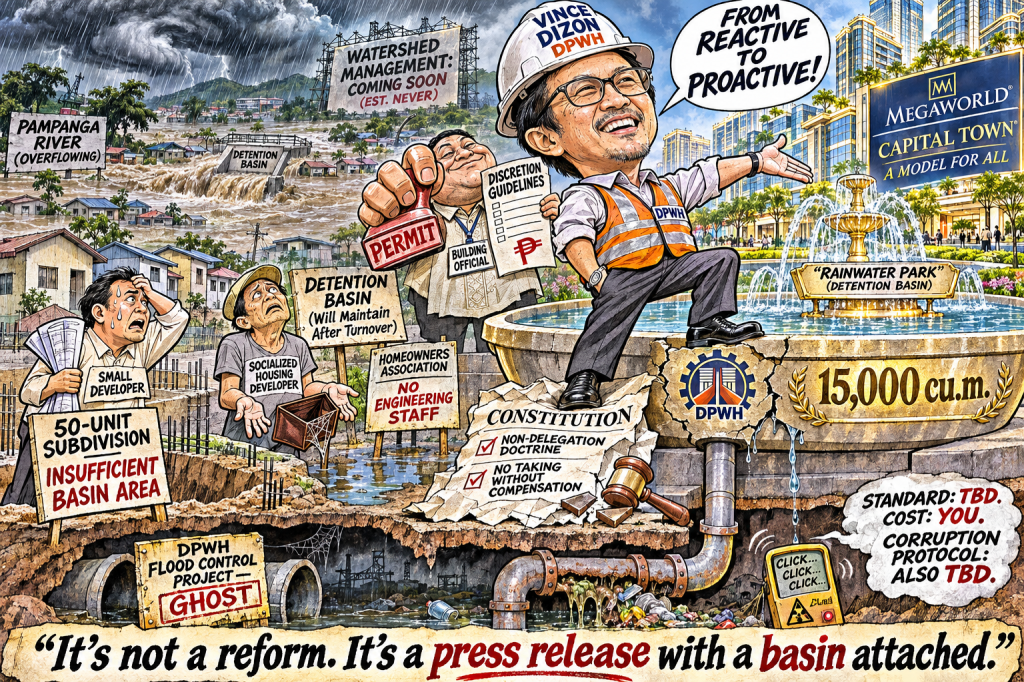
Vince Dizon wants developers to build stormwater basins nationwide. He announced it from a Megaworld project, without published standards, legal basis, or anti-corruption safeguards—what could possibly go wrong?
By Louis ‘Barok‘ C. Biraogo — October 23, 2026
VINCE DIZON is many things—reformist, workaholic, camera-ready—but stupid is not one of them. That’s precisely what makes this proposal worth investigating.
The man walked into the Department of Public Works and Highways (DPWH) on September 1, 2025, inheriting an agency so radioactive its flood control projects could be detected by Geiger counter. He has since fired officials, filed graft charges, and tried to convince the Filipino public that the DPWH is no longer a kickback machine with a construction budget. That deserves whatever credit one can give a man who willingly stepped into a burning building.
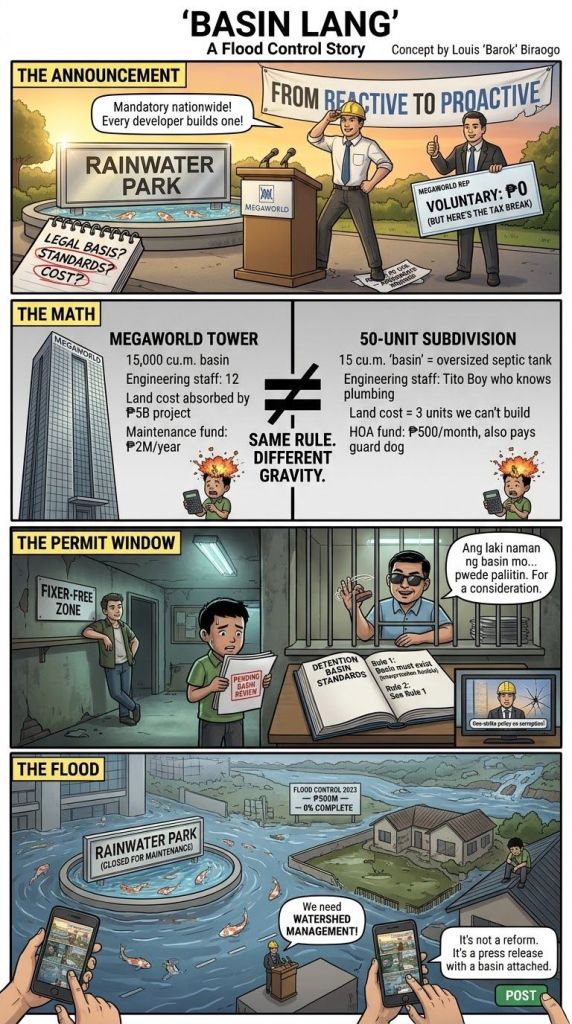
But then, on October 21, 2026, Dizon went to Pampanga. He inspected Megaworld’s 15,000-cubic-meter rainwater park at Capital Town, praised the developer, and announced he would recommend to President Marcos a mandatory requirement for all new private subdivisions, malls, and condominiums to build stormwater detention basins. The policy, he said, would move the country “from reactive flood control to proactive water management.”
It is a beautiful sentence. It is also the kind of sentence that should make every Filipino lawyer, hydrologist, and small developer reach for the nearest bottle of antacid.
Because here is what Dizon is actually proposing: a nationwide mandate, drafted by the DPWH and the Department of Human Settlements and Urban Development (DHSUD), imposed through “updated building and land development codes,” requiring private developers to dedicate land, capital, and perpetual maintenance obligations to a public function—flood mitigation—without a clear statutory basis, without published technical standards, and without any apparent mechanism to prevent the whole thing from becoming the next great Philippine corruption pipeline.
And he announced it from the grounds of a Megaworld project, next to a facility that Megaworld built voluntarily, with a photo op that practically screams “this is what we expect from everyone else.”
Let’s investigate.
The Timing Is Not a Coincidence. It Is a Strategy.
On October 19, 2026—two days before Dizon’s Pampanga announcement—the Philippine News Agency reported that four more DPWH officials had been sacked for various offenses, including extortion and involvement in anomalous flood control projects. Dizon declared a “one-strike policy” and promised more heads would roll.
On October 22, 2026, The Philippine Star reported Dizon’s detention basin proposal.
This is not a coincidence. It is a communications strategy. The DPWH is drowning in the political equivalent of a 100-year flood, and Dizon has decided the best way to change the subject is to announce a bold new policy that shifts the narrative from “government corruption” to “shared responsibility.” Look at the reformist! Look at the visionary! Look at the man who wants developers to pay for flood control instead of taxpayers!
It is clever. It is also potentially illegal.
The Non-Delegation Problem: Dizon Cannot Legislate from the Podium
The Philippine Constitution does not permit administrative agencies to create binding legal obligations out of thin air. Under the non-delegation doctrine, as articulated in Pelaez v. Auditor General and reiterated in countless cases since, Congress cannot escape its legislative duties by delegating the power to make law to an administrative body. The test is whether the statute sets a standard and fixes a policy; if it does, the delegate can fill in the details. If it does not, the delegation is unconstitutional.
Dizon’s proposal, as reported, would require amendments to Presidential Decree No. 1096 (National Building Code) and the subdivision and condominium regulatory framework (Presidential Decree No. 957, the Subdivision and Condominium Buyers’ Protective Decree). These are statutes. They cannot be amended by a DPWH Department Order or a joint memorandum circular with DHSUD. They require congressional action.
Could Congress delegate this authority? Possibly. Could DPWH and DHSUD issue guidelines under existing authority that effectively mandate detention basins for all new developments? That is a much harder question. The National Building Code already requires stormwater drainage, but “drainage” is not the same as “detention.” A detention basin is a specific, land-intensive, capital-intensive infrastructure obligation. If DPWH tries to impose it by administrative fiat, it will be challenged. And it should be.
The Megaworld Problem: A Model or a Moat?
Dizon inspected Megaworld’s facility and used it as the poster child for his proposal. Megaworld, for its part, revealed plans to expand the facility from 15,000 to 20,000 cubic meters. How convenient.
There is nothing inherently wrong with a government official visiting a private facility to learn about a technology or a design. There is nothing inherently wrong with praising a developer that built something useful. But there is something deeply troubling about a national policy being announced from the grounds of a single developer’s project, with that developer’s facility serving as the implicit benchmark for what every other developer must now build.
Megaworld can afford this. Megaworld has the capital, the engineering staff, and the landholdings to integrate a 15,000-cubic-meter detention facility into a township master plan. A small developer building a 50-unit subdivision in Cavite cannot. A mid-sized developer putting up a condominium in Metro Manila cannot. A socialized housing developer trying to keep unit prices below the DHSUD ceiling certainly cannot.
If Dizon’s policy is implemented as announced—mandatory, nationwide, no exemptions mentioned—it will function as a regulatory moat for large developers. The big players will comply, absorb the cost, and perhaps even benefit from the amenity value of a “rainwater park.” The small players will either exit the market, pass the cost to buyers, or find a way to get an exemption from a friendly local building official.
And that last possibility is where the corruption enters.
The Permit Extortion Risk: A New Frontier for the DPWH’s Favorite Pastime
The DPWH’s flood control scandal involved billions of pesos in ghost projects and kickbacks. The mechanism was procurement: contractors paid to win contracts, officials facilitated the payments, and the public got flooded anyway.
Dizon’s new proposal creates a different mechanism: permit conditioning. Under the reported plan, detention basins would become “a condition of getting a building permit.” That means every new development in the country would need approval from a building official who would have to assess whether the proposed detention facility meets the standard.
What standard? Dizon hasn’t published one. How would it be assessed? Unclear. Who would verify compliance? Presumably the same local building officials who are already overworked, under-resourced, and in some cases corruptible.
If the standard is vague, discretion flourishes. If discretion flourishes, extortion follows. A developer who wants a permit fast, or a smaller basin than the guideline suggests, or an exemption because his site is “special,” will find a way. And the DPWH—the agency that just fired four officials for extortion—will have created an entirely new market for the same behavior, just one step removed from its own procurement process.
Dizon has not addressed this. He has not published anti-corruption protocols for the permitting process. He has not proposed an independent verification mechanism. He has not explained how local government units, which have devolved authority over zoning and building permits under Republic Act No. 7160 (Local Government Code), would be prevented from turning the detention basin requirement into a revenue stream.
He has simply announced the policy, smiled for the cameras, and moved on.
The Hydrology Problem: A Basin Is Not a Watershed
Here is the uncomfortable technical truth that Dizon’s announcement glosses over: on-site detention does not solve watershed-level flooding.
A detention basin on a subdivision in San Fernando, Pampanga, can slow the runoff from that subdivision. It cannot stop the Pampanga River from overflowing. It cannot prevent storm surge from flooding coastal towns. It cannot address the siltation of waterways, the encroachment on floodplains, the loss of wetlands, or the fact that Metro Manila’s drainage system is chronically undersized and poorly maintained.
Dizon’s own example illustrates the limits. The Megaworld facility has 15,000 cubic meters of storage, with plans to expand to 20,000. That sounds like a lot until you realize a single strong typhoon can dump hundreds of millimeters of rain on a catchment area of dozens of hectares in a matter of hours. The basin will fill. It will overflow. It will do what detention basins do when overwhelmed: nothing.
The question is not whether detention basins are useful. They are. The question is whether a mandate for detention basins, without a corresponding mandate for watershed-level planning, floodplain management, drainage maintenance, and public infrastructure investment, will actually reduce flooding or simply create the appearance of action while the underlying problems get worse.
Dizon’s proposal says nothing about retrofitting existing developments. It says nothing about the malls and subdivisions built twenty years ago that are already contributing to flooding. It says nothing about the public drainage systems supposed to receive the discharge from these new private basins. It says nothing about who maintains the basins after the developer turns the project over to a homeowners’ association with no engineering staff and no reserve fund for sediment removal.
It is a proposal designed to sound comprehensive while being carefully limited in scope.
The Legal Problem: Regulation or Taking?
There is also the small matter of the Constitution.
Article III, Section 9 provides that private property shall not be taken for public use without just compensation. The Supreme Court has recognized that police power allows the government to regulate property for the public welfare, including flood control. But there is a line between regulation and taking, and mandatory detention basins sit uncomfortably close to that line.
If a developer must dedicate 5 to 15 percent of developable land to a basin that serves not just the development but the surrounding community, is that a regulation or a taking? If the basin must be designed to attenuate flows from upstream areas, not just the project site, is the developer being conscripted into public service? If the basin must be maintained in perpetuity for flood control purposes, is that a perpetual easement that requires compensation?
The Supreme Court’s decision in Equitable PCI Bank v. South Rich Acres addressed a local ordinance that effectively appropriated private property as a public road without compensation, and the Court invalidated it. A detention basin requirement that goes beyond mitigating the project’s own runoff could face similar scrutiny.
Dizon’s defenders will argue the proposal is a valid exercise of police power because flooding is a public welfare concern. They are probably right, if the requirement is proportional, if the standards are clear, if there are exemptions for small projects, if alternative compliance measures are allowed, and if the government can demonstrate that the burden on developers is roughly commensurate with the public benefit.
But Dizon has not proposed any of those safeguards. He has proposed a mandate. And mandates without safeguards are how good intentions become bad law.
What Dizon Should Do Instead
I am not opposed to detention basins. I am opposed to this proposal, announced this way, with this timing, from this location.
If Dizon is serious about stormwater management—and I believe he might be, beneath the political choreography—he should do the following:
- First, publish the legal basis. Identify the specific statutory authority for a nationwide detention basin mandate. If none exists, say so, and ask Congress to enact one.
- Second, publish the technical standards. Before requiring anyone to build anything, tell them what they are required to build. What rainfall event must the basin be designed for? What discharge rate is acceptable? How is the required storage volume calculated? What happens when the basin overflows?
- Third, publish the cost-benefit analysis. How much will this cost developers? How much of that cost will be passed to homebuyers? What is the expected reduction in flood damage, and how was that estimated? What are the alternatives, and why is a mandatory basin better than, say, a stormwater fee that funds regional infrastructure?
- Fourth, address the corruption risk. Publish anti-corruption protocols for the permitting process. Require independent engineering review. Create an appeals mechanism for developers who believe they have been unfairly denied or overcharged. Make the approval process transparent.
- Fifth, start with a pilot. Test the policy in a few flood-prone watersheds with willing developers and independent monitoring. Measure the results. If it works, expand it. If it doesn’t, revise it.
- Sixth, acknowledge the limits. Tell the public, clearly, that detention basins are not a substitute for public drainage investment, watershed management, floodplain regulation, or the prosecution of the officials who stole the money intended for flood control in the first place.
Dizon has done the first part of his job: he has identified a real problem (developers externalize flood costs) and a plausible partial solution (make them internalize some of those costs). He has not done the second part: designing a policy that is legally sound, technically credible, economically fair, and administratively clean.
Until he does, this is not a reform. It is a press release with a basin attached.
And the Philippines has had enough of those.
Louis ‘Barok’ C. Biraogo is a researcher and policy critic. He has never designed a stormwater facility, but he has read enough DPWH press releases to know when the subject is being changed.
Key Citations
A. Legal & Official Sources
- Equitable PCI Bank, Inc. v. South Rich Acres, Inc. G.R. No. 202384, Supreme Court of the Philippines, 4 May 2021, https://lawphil.net/judjuris/juri2021/may2021/gr_202384_2021.html.
- Pelaez v. Auditor General. G.R. No. L-23825, Supreme Court of the Philippines, 24 Dec. 1965, lawphil.net/judjuris/juri1965/dec1965/gr_23825_1965.html.
- Presidential Decree No. 957. Regulating the Sale of Subdivision Lots and Condominiums, Providing Penalties for Violations Thereof. 1976, http://www.officialgazette.gov.ph/1976/07/12/presidential-decree-no-957-s-1976/.
- Presidential Decree No. 1096. Adopting a National Building Code of the Philippines. 1977, http://www.officialgazette.gov.ph/1977/02/19/presidential-decree-no-1096-s-1977/.
- Republic Act No. 7160. An Act Providing for a Local Government Code of 1991. 1991, http://www.officialgazette.gov.ph/1991/10/10/republic-act-no-7160/.
- The 1987 Constitution of the Republic of the Philippines. Official Gazette of the Republic of the Philippines, 1987, http://www.officialgazette.gov.ph/constitutions/1987-constitution/.
B. News Reports
- Ronda, Ranier Allan. “DPWH Proposes Mandatory Water Detention Basins.” Philstar.com, The Philippine Star, 22 Oct. 2026, http://www.philstar.com/headlines/2026/10/22/2564857/dpwh-proposes-mandatory-water-detention-basins.

- ₱9 Billion in ‘Savings’? DILG’s Fire Truck Deal Smells Like Smoke

- ₱8B BBM Pork: CCTV for Every Captain’s Kumpare?

- ₱8.9 Billion, 331 Ghost Police Stations: The TIKAS Scandal Explained

- ₱8.4 Billion, 42,000 Barangays, 1 Election: The “Bawat Barangay Makikinabang” Vote-Buying Masterclass

- ₱75 Million Heist: Cops Gone Full Bandit

- ₱63 to the Dollar: The Only Thing Falling Faster Than the Peso Is the Government’s Credibility

- ₱6.77B Ghost Haunts Duterte: RTC Dismisses Mans Carpio’s Desperate Plea

- ₱6.77 Billion and Zero Cash: The Sara Duterte SALN Math That Doesn’t Add Up

- ₱6.7-Trillion Temptation: The Great Pork Zombie Revival and the “Collegial” Vote-Buying Circus

- ₱58.53B, Zero Receipts: The LGSF Pork Barrel Nobody Wants to Name

- ₱53 Million Man Tells ₱695-a-Day Workers to Stop Being ‘Mayabang’: The Audacity of BSP’s Remolona

- ₱4.4 Billion and a Witness Who Can’t Explain It: The Duterte Impeachment’s Most Expensive Non-Answer









Leave a Reply