
Lacson Wants Answers. Teodoro Wants Understanding. Taxpayers Want Their Money Back.
By Louis ‘Barok’ C. Biraogo — October 22, 2026
LET’S start with the number that should make every Filipino taxpayer choke on their morning pandesal: ₱400 million.
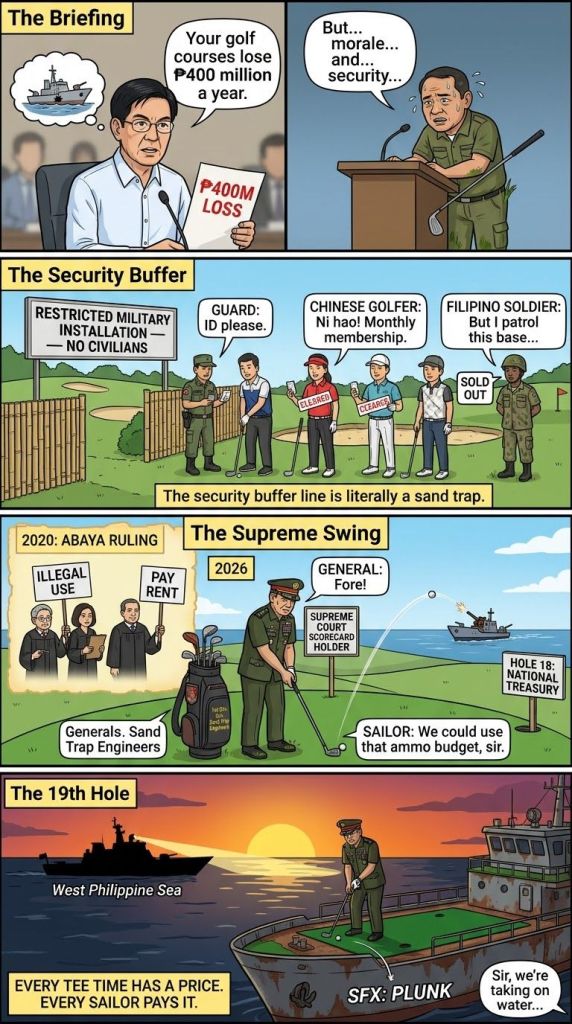
That is not the cost of a new frigate. It is not the price of jet fighters that don’t fly or bullets that don’t exist. That is the projected annual loss from four golf courses run by the Department of National Defense (DND). You read that right. While the Armed Forces of the Philippines (AFP) begs for modernization funding and stares down Chinese coast guard cutters in the West Philippine Sea, the DND is apparently running a hospitality business that bleeds cash faster than a sand trap drains a Titleist.
Senator Panfilo Lacson, playing the role of the angry taxpayer with a calculator, flagged the figures during the 2027 budget hearings: ₱2.5 billion in receipts against ₱2.9 billion in operating expenses. His proposed remedy was elegantly simple: if the golf courses are losing money on irrigation alone, close them.
Defense Secretary Gilberto Teodoro Jr., however, has a different view. The costs fluctuate, he says. Electricity is expensive. And besides, raising fees would upset the retired generals who depend on subsidized tee times for their cardiovascular health.
This is the moment where the investigation should shift from “is this wasteful?” to “what exactly is going on here?”
Because the deeper you dig into the legal and historical record of military golf in the Philippines, the less this looks like a innocent morale-and-welfare program and the more it resembles a land-use protection racket that has been operating in plain sight for decades.
The Supreme Court Already Told Us This Was Illegal
Let’s rewind to 2020. The Supreme Court, in Philippine Navy Golf Club, Inc. v. Abaya (G.R. No. 235619), delivered a ruling that should have ended this entire debate. The Court found that the Navy had occupied land in Fort Bonifacio that had already been awarded to retired officers and veterans. The Navy’s defense? That the golf course served as a “security buffer” and “training ground.”
The Supreme Court was not impressed. Justice Mario Lopez wrote that the golf course did not even exist when the land was classified for public or quasi-public purposes. It was built in 1976 on a unilateral whim, without any presidential proclamation authorizing it. The Court ordered the Navy and the golf club to turn over the lots and pay rent.
Read that again. The highest court in the land has already established that at least one of these DND golf operations was occupying land illegally, using a “public purpose” excuse that the justices found laughable.
And yet here we are, six years later, and the DND is still operating four courses—Villamor, Navy, Army, and Veterans—and still claiming they serve a legitimate military function. The Abaya ruling did not shut them down. It did not trigger a systematic review of land titles. It just became a footnote in a budget hearing while the deficits kept piling up.
The “Security” Excuse Is a Convenient Fiction
Teodoro’s defense of the golf courses rests on two pillars: personnel welfare and security constraints. The second pillar is where the satire writes itself.
According to the Defense Secretary, the DND cannot open the golf courses to tourism because of security concerns. Military installations are sensitive. Chinese nationals might be spying. One cannot simply let civilians wander around a base with a nine-iron and a rangefinder.
Except, as the AFP itself admitted in March 2026, Chinese nationals can and do play at these courses. They just need clearance. Colonel Louie Dema-ala of the Philippine Army confirmed that “may mga naglalaro naman na Chinese nationals”.
The security argument isn’t a wall. It’s club membership policy: airtight on paper, negotiable at the desk. The DND is not protecting state secrets from foreign golfers; it is protecting a membership perk from market pricing.
If the courses were truly security-sensitive, they would be closed to all civilians. If they were truly commercial operations, they would be priced to break even. They are neither. They are a hybrid: public land, public money, private benefit, with a national security fig leaf draped over the deficit.
The Accounting Is Almost Certainly Worse Than It Looks
Here is where the investigative instinct kicks in. The ₱400 million figure is a projection, presented at a Senate hearing, not an audited Commission on Audit (COA) finding. But even taking the DND’s own numbers at face value, they raise more questions than they answer.
What is included in the ₱2.9 billion in “operating expenses”? Are we talking about cash outlays, or does that include depreciation on assets that were acquired with public funds decades ago? Is the land valued at anything? Are the personnel costs of military staff assigned to club management included, or are those hidden in the AFP’s general payroll?
The Senate finance subcommittee did not get a facility-by-facility breakdown. It got an aggregate. That means a profitable course could be subsidizing a failing one, or vice versa, and nobody in the room could tell the difference.
And then there is the question of where the ₱2.5 billion in receipts actually goes. Does it return to the National Treasury? Is it retained by the golf clubs under some special authority? Who audits it? The COA has jurisdiction over government funds and property, but the legal character of golf course receipts—whether they are public funds or private membership dues—has never been clearly litigated in this context.
The Abaya case established that the Navy Golf Club was collecting income from land it did not legally occupy. If the other courses have similar title defects—and there is no evidence they have been independently cleared—then the revenue streams themselves may be legally tainted.
The Welfare Argument Is Real, But It Is Not a Blank Check
Let me be fair to Teodoro. Military personnel, especially retirees, have a reasonable expectation of access to recreational facilities. The morale and welfare rationale for golf courses is not inherently absurd. Armies around the world operate golf courses. The U.S. military does it through a Non-Appropriated Fund model that is designed to be self-sustaining.
But the Philippine model is clearly not self-sustaining. It is losing money. And the DND’s response to Lacson’s suggestion of raising fees was essentially: the retirees will complain.
That is not a fiscal policy. That is a constituency management strategy.
If the government wants to subsidize military recreation, it should do so explicitly. It should line-item the subsidy, justify it against other defense priorities, and make it transparent. What it should not do is hide a ₱400 million annual loss inside a golf course budget and call it operational expenses.
The Abaya ruling was a warning. The Supreme Court told the DND that “public purpose” cannot be manufactured retroactively to justify a land grab. The same logic applies to the budget. You cannot manufacture a “welfare” justification for a facility that operates at a loss, serves a narrow constituency, and occupies prime real estate that could either generate revenue or be returned to its intended beneficiaries.
What Lacson Should Demand (And What the Public Should Watch)
Lacson’s instinct to close the courses is correct in principle but politically premature. The smarter play is not a blanket closure but a forensic audit that forces the DND to answer the questions it has so far avoided.
- First: Title. Produce the legal basis for each golf course’s occupancy of military land. The Abaya case showed that the Navy’s claim was baseless. Are the other three any better?
- Second: Cash flow. Provide three years of actual receipts and expenditures, facility by facility, with a clear accounting of whether public funds are being used to cover operating shortfalls.
- Third: Beneficiaries. Who actually plays these courses? How many are active-duty enlisted personnel versus retired generals versus civilians with connections? If the subsidy is for welfare, the welfare should be measurable.
- Fourth: Alternatives. What would it cost to close each course? What would it cost to lease them? What would it cost to convert them to public green space? The DND has never presented a comparison because it has never been forced to.
The Real Scandal Is the Precedent
The ₱400 million hole is not the scandal. The scandal is that this hole has existed for years, possibly decades, and the only reason it is being discussed is that a senator with a reputation for fiscal hawkishness happened to ask a question during a budget hearing.
The Abaya ruling came down in 2020. It is now 2026. The DND has had six years to rationalize its golf operations. It has not. The Supreme Court told the Navy that its land use was illegal. The Navy is still operating a golf course. The COA has audit jurisdiction over government funds. The golf courses are still running deficits.
If the government can ignore a Supreme Court ruling about land use and a projected ₱400 million loss without consequence, then the budget process is not oversight. It is theater.
Teodoro says the DND will “explore measures” to eliminate the shortfall. That is bureaucratese for “we will do nothing until we are forced to.”
Lacson should force him. The Senate should demand the documents. The COA should open an audit. And the public should remember that every time a general tees off on a course that loses money, somewhere in the West Philippine Sea, a sailor is patrolling on a ship that was funded with whatever was left over.
The golf courses are not the biggest problem in the Philippine defense budget. But they are the most legible one. They are the clearest example of a military establishment that has confused institutional privilege with national interest.
Close them, reform them, or privatize them. But stop pretending they are about national security. The only thing they are securing is a tee time for the people who already have everything else.
Key Citations
A. Legal & Official Sources
- Philippine Navy Golf Club, Inc. v. Abaya. G.R. No. 235619, Supreme Court of the Philippines, 2020. Supreme Court E-Library, elibrary.judiciary.gov.ph/thebookshelf/showdocs/1/66402.
B. News Reports
- Patriarca, Mark. “Lacson Questions P400M Losses from DND-Run Golf Courses, Suggests Closure.” Bilyonaryo News Channel, 21 Oct. 2026, https://bnc.bilyonaryo.com/lacson-questions-p400m-losses-from-dnd-run-golf-courses-suggests-closure/news/.
- Valente, Catherine S. “Lacson to DND: Improvise, Bridge Defense Gaps.” The Manila Times, 21 Oct. 2026, http://www.manilatimes.net/2026/10/21/news/national/lacson-to-dnd-improvise-bridge-defense-gaps/2450021.
- “Lacson Urges DND to Improvise amid Defense Spending Gap with China.” Republika News, 19 Oct. 2026, republikanews.org/2026/10/21/lacson-urges-dnd-to-improvise-amid-defense-spending-gap-with-china/.
- Sadongdong, Martin. “Chinese Nationals Barred from Accessing AFP Golf Courses? Not Really, Says Military.” Manila Bulletin, 6 Mar. 2026, https://mb.com.ph/2026/03/06/chinese-nationals-barred-from-accessing-afp-golf-courses-not-really-says-military.

- “Ang Hirap Maging Mahirap”: The PAO Scandal That Proves Government Contempt Is Nothing New

- “Far-Off” My Axx: Malacañang’s Claire Castro Drowns in Her Own Legal Gaslighting
- “Forthwith” to Farce: How the Senate is Killing Impeachment—And Why Enrile’s Right (Even If You Can’t Trust Him)

- “HINDI AKO NAG-RESIGN!”

- “I Know Nothing”: Baste Duterte’s Amnesia Defense Meets ₱33M in GenCorp Contracts

- “I’m calling you from my new Globe SIM. Send load!”

- “Mahiya Naman Kayo!” Marcos’ Anti-Corruption Vow Faces a Flood of Doubt

- “Manageable” Debt, Unmanageable Lies: DBM’s ₱21 Trillion Fairy Tale

- “Meow, I’m calling you from my new Globe SIM!”

- “Natrabaho”: One Word, One Ombudsman, and a Judiciary on Trial

- “No Special Jail for Crooks!” Boying Remulla Slams VIP Perks for Flood Scammers

- “Philippine-Controlled” or Yankee Gas Station? The Davao Fuel Depot Farce Exposed








Leave a Reply