How DepEd Asked for ₱10.5 Billion, Got a Reclassification Memo, and Called It a Staffing Plan
By Louis ‘Barok‘ C. Biraogo — October 20, 2026
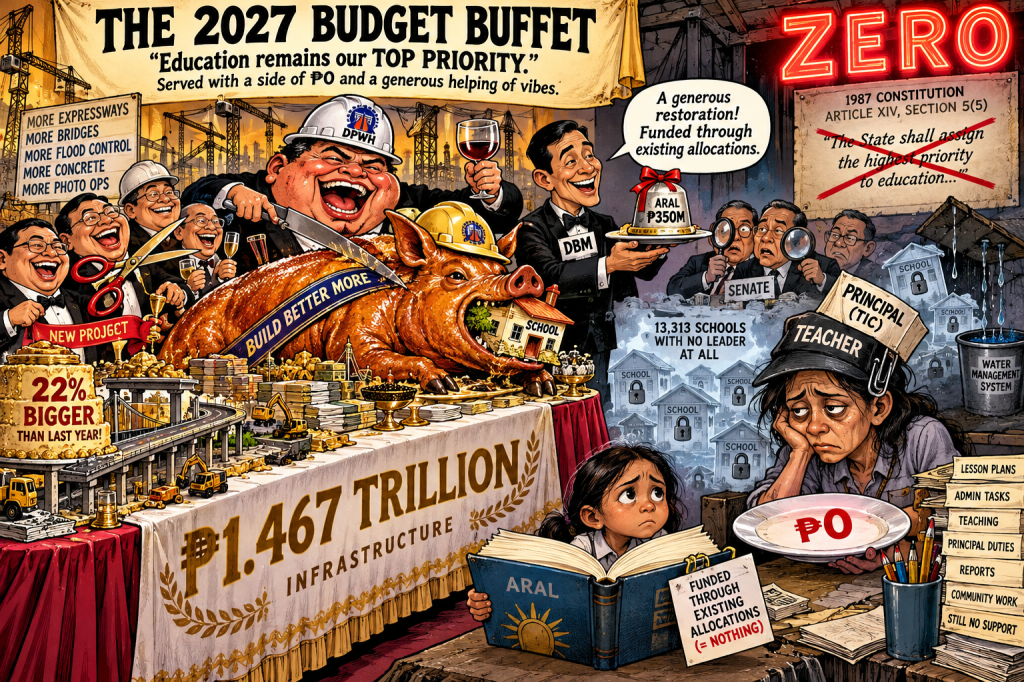
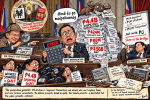
SOMEBODY please explain this to me like I’m a congressman, because here’s the situation: the Philippines has 45,928 public schools. Roughly 23,000 of them—that’s half, for those keeping score at home—do not have a formal principal plantilla item. Thirteen thousand three hundred and thirteen schools have neither a principal nor even a head teacher. And the proposed 2027 National Expenditure Program (NEP) has allocated exactly zero pesos to create new principal positions, despite the Department of Education (DepEd) asking for ₱10.5 billion to fund over 14,000 of them.
Zero.
Not “a reduced amount.” Not “deferred for study.” Zero. The mathematical absence of funding. The budgetary equivalent of a blank stare.
But wait, it gets better. The same NEP also zeroed out the Academic Recovery and Accessible Learning (ARAL) learning recovery program—the one that reportedly moved over three million learners out of the struggling reader category—despite DepEd requesting ₱15.98 billion. The House, in its infinite wisdom, restored a whopping ₱350 million. That’s 2.19% of the request. A rounding error with delusions of grandeur.
The “We Have a Plan” Defense (Spoiler: The Plan Is Vibes)
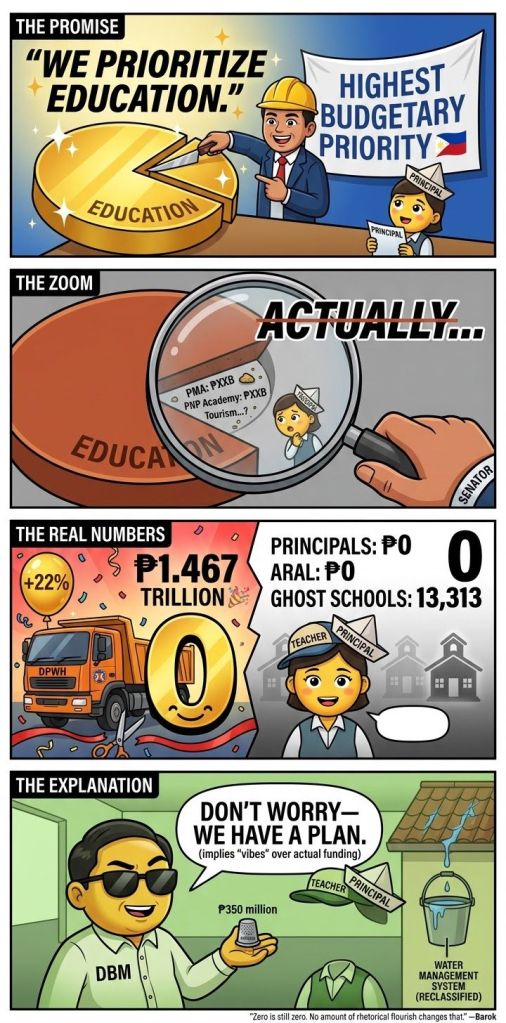
Undersecretary Wilfredo Cabral, presumably with a straight face, told senators that DepEd would instead rely on the ₱12.09-billion Expanded Career Progression allocation to reclassify head teachers and teachers-in-charge into principal positions.
Let me translate that for the non-bureaucrats in the room: instead of hiring new principals, the plan is to promote existing people who are already doing the job without the title, the training, or presumably the pay. This is not a solution. This is an accounting trick dressed up as policy. It’s the educational equivalent of fixing a leaking roof by declaring the bucket already in the attic is now a “water management system.”
Here’s the problem with this sleight of hand. Reclassification does not create a new position. It does not expand the pool of school leaders. It does not address the fact that 13,313 schools have no one—not a principal, not a head teacher, not a warm body with an administrative title. You cannot reclassify a vacancy. You cannot promote a ghost.
And even if you could, the numbers don’t work. The Department of Budget and Management (DBM) approved 6,000 new Principal I positions for 2026. Only about 2,000 were filled. Another 914 teachers-in-charge were reclassified. That’s a fill rate of roughly 33%, which in any other context would be considered a catastrophic failure of implementation. Here, it’s presented as a reason to trust DepEd with more unfunded positions.
The Constitution Weeps
Article XIV, Section 5(5) of the 1987 Constitution is unambiguous:
“The State shall assign the highest budgetary priority to education.”
The Marcos administration’s defense is that education gets the largest slice of the pie—₱975.96 billion for DepEd, part of a ₱1.326-trillion education package. Look at the big number! Be impressed! Ignore the zeroes in the details!
Except the Teachers’ Dignity Coalition already took this argument to the Supreme Court in 2025, pointing out that the “education” figure is inflated by including the Philippine Military Academy, the Philippine National Police (PNP) Academy, and other agencies that have about as much to do with basic education as the Department of Tourism has to do with flood control. Strip those out, and core education agencies got ₱913 billion—a “poor second to infrastructure.”
The infrastructure budget for 2027? ₱1.467 trillion under the Build Better More program, with the Department of Public Works and Highways (DPWH) alone getting ₱644 billion—a 22% increase from 2026. So let me get this straight: the agency that was just at the center of a corruption scandal gets a 22% boost, while the agency responsible for teaching 27 million children gets a 3.87% cut and zero funding for school leaders.
I’m not saying the budget priorities are screwed up. I’m saying they’re an insult to every teacher-in-charge who is currently doing a principal’s job for a teacher’s salary while the government pats itself on the back for “prioritizing education.”
The ARAL Funding Cliff: A Case Study in Willful Amnesia
The ARAL program’s results were, by DepEd’s own account, promising. Struggling readers dropped from 6.7 million to 2.2 million. Grade-level ready learners rose from 3.3 million to 5.8 million. Senator Gatchalian, hardly a bleeding-heart radical, put it bluntly: “Kung ano pa ‘yung gumagana, ‘yun pa yung nawala.” The thing that works is the thing that disappeared.
DBM’s defense is that ARAL can be funded through “existing allocations”—textbooks, personnel services, the Miscellaneous Personnel Benefits Fund. This is the budgetary equivalent of telling someone whose house burned down that they can rebuild using “existing materials,” and then pointing at the ashes.
If the government truly believed ARAL was a priority, it would not have zeroed it out. You do not demonstrate commitment to a program by removing its dedicated funding and then insisting the money is somehow still there. You demonstrate commitment by, you know, funding it. The ₱350 million the House allocated is not a compromise. It’s a punchline.
The EDCOM 2 Cassandra Act
To their credit, the Second Congressional Commission on Education (EDCOM 2) and its executive director, Karol Mark Yee, have been ringing the alarm with the persistence of people who understand that their warnings will be ignored but feel obligated to sound them anyway. Yee’s statement that it is “imperative that the 2027 budget considers this large shortfall, even prioritizing our 13,313 schools without either a school principal or even head teacher” is the understatement of the fiscal year.
EDCOM 2’s analysis reveals something even more damning than the raw numbers. Under DepEd Order 77, series of 2010, schools with at least nine teachers should have a principal. Sixteen years later, 18% of schools with 9-24 teachers have neither a principal nor a head teacher. Among schools with more than 25 teachers—schools that far exceed the threshold—9% still have neither.
This is not a resource problem. This is a compliance problem. A sixteen-year-old policy that was never enforced, never monitored, never treated as a priority by anyone with the power to change it.
And now, when the bill for that neglect has come due, the response is to reclassify some teachers-in-charge and call it a day.
The Political Economy of Ignoring Children
Let’s be clear about what’s happening here. The 2027 budget is the Marcos administration’s last full-year spending plan before the 2028 elections. Infrastructure is visible. Roads and bridges can be cut with ribbons. Principals and reading tutors are not. You cannot inaugurate a functioning school leadership pipeline. You cannot take credit for a child who learns to read if the intervention is invisible to the casual observer.
The ₱10.5 billion for principals and the ₱15.98 billion for ARAL together amount to ₱26.48 billion. The DPWH budget increase alone is ₱114 billion. The math is not subtle. The government has chosen visible, ribbon-cuttable projects over the unglamorous, long-term work of building human capital. And it has dressed up that choice in the language of fiscal prudence and “implementation readiness.”
Implementation readiness. That’s the phrase DBM uses. As if the reason you can’t fund principals is that the schools aren’t ready for them. As if the reason you can’t fund learning recovery is that the learners aren’t ready to be taught.
The 13,313 schools without any school head are not waiting because they lack readiness. They are waiting because the government has decided, through its budget choices, that they can wait a little longer.
The Verdict
This is not a scandal of corruption in the traditional sense. No one is accused of pocketing the principal positions. No one is alleged to have stolen the ARAL budget. The scandal is more insidious: it is the quiet, bureaucratic, entirely legal decision to not fund the things that matter, while loudly claiming to prioritize them.
- The Constitution says education gets the highest priority.
- The budget says infrastructure gets the biggest increase.
- The NEP says principals get zero.
- The DBM says ARAL can survive on scraps.
- The House says here’s ₱350 million, now stop asking questions.
And 23,000 schools will open their doors in 2027 without a formal leader. And 13.1 million learners who need remediation will get a fraction of what was promised. And the teachers-in-charge will keep doing two jobs for one salary while waiting for a reclassification that may never come.
The government’s defense is that education remains the “top priority.” The evidence suggests otherwise. But then again, what do I know? I’m just looking at the numbers. And the numbers have a way of telling the truth that press releases cannot obscure.
Zero is still zero. No amount of rhetorical flourish changes that.
Louis ‘Barok’ C. Biraogo is the proprietor of Kweba ni Barok, where he writes about law, politics, and the occasional budget document that reads like a cry for help. He has been described as “deeply suspicious of people who use the word ‘streamlined’ unironically.”
Key Citations
A. Legal & Official Sources
- The 1987 Constitution of the Republic of the Philippines. Official Gazette of the Republic of the Philippines, 1987, https://www.officialgazette.gov.ph/constitutions/1987-constitution/.
- Republic Act No. 12028. Academic Recovery and Accessible Learning (ARAL) Program Act. 2024, https://lawphil.net/statutes/repacts/ra2024/ra_12028_2024.html.
- Department of Education. DepEd Order No. 77, s. 2010: Guidelines on the Allocation and Deployment of New Teaching, Teaching-Related and Non-Teaching Positions for FY 2010. 4 June 2010, https://www.deped.gov.ph/2010/06/04/do-77-s-2010-guidelines-on-the-allocation-deployment-of-new-teaching-teaching-related-and-non-teaching-positions-for-fy-2010-amended-by/.
- Second Congressional Commission on Education. “Senators Push for Restoration of ARAL Program Funding.” EDCOM 2, https://edcom2.gov.ph/senators-push-for-restoration-of-aral-program-funding/.
- Department of Budget and Management. “Learning Recovery Remains a Priority in the 2027 National Budget.” DBM, 17 Oct. 2026, https://www.dbm.gov.ph/index.php/management-2/4324-learning-recovery-remains-a-priority-in-2027-national-budget.
B. News Reports
- “More Than Half of 45,000 Schools Lack Principals as Most Fail Qualifying Exam—DepEd.” GMA News Online, GMA Network, 16 Oct. 2026, https://www.gmanetwork.com/news/topstories/nation/1006171/more-than-half-of-45-000-schools-lack-principals-as-most-fail-qualifying-exam-deped/story/.
- “DepEd Reports 23K Public Schools Without Principals.” Daily Tribune, 16 Oct. 2026, https://tribune.net.ph/2026/10/16/deped-reports-23k-public-schools-without-principals.
- “ARAL Gets Zero Funding Despite Gains in Struggling Readers; DepEd Seeks P145-B More.” Daily Tribune, 7 Sept. 2026, https://tribune.net.ph/2026/09/07/aral-gets-zero-funding-despite-gains-in-struggling-readers-deped-seeks-p145-b-more.
- “Senate OKs DepEd’s 2027 Budget; P147.93B More Asked for ARAL.” GMA News Online, GMA Network, https://www.gmanetwork.com/news/topstories/nation/1006162/senate-oks-deped-s-2027-budget-p147-93b-more-asked-for-aral/story/.
- EDCOM 2. “EDCOM Pushes for 2027 Budget to Close the Gap in School Principals Nationwide.” EDCOM 2, 17 Oct. 2026, edcom2.gov.ph/edcom-pushes-for-2027-budget-to-close-the-gap-in-school-principals-nationwide/.
- Bautista, Jane. “New petition assails ’25 budget for low priority on education.” Inquirer.net, 30 Mar. 2025, plus.inquirer.net/news/new-petition-assails-25-budget-for-low-priority-on-education/ .

- ₱9 Billion in ‘Savings’? DILG’s Fire Truck Deal Smells Like Smoke

- ₱8B BBM Pork: CCTV for Every Captain’s Kumpare?

- ₱8.9 Billion, 331 Ghost Police Stations: The TIKAS Scandal Explained

- ₱8.4 Billion, 42,000 Barangays, 1 Election: The “Bawat Barangay Makikinabang” Vote-Buying Masterclass

- ₱75 Million Heist: Cops Gone Full Bandit

- ₱63 to the Dollar: The Only Thing Falling Faster Than the Peso Is the Government’s Credibility

- ₱6.77B Ghost Haunts Duterte: RTC Dismisses Mans Carpio’s Desperate Plea
- ₱6.77 Billion and Zero Cash: The Sara Duterte SALN Math That Doesn’t Add Up

- ₱6.7-Trillion Temptation: The Great Pork Zombie Revival and the “Collegial” Vote-Buying Circus

- ₱58.53B, Zero Receipts: The LGSF Pork Barrel Nobody Wants to Name
- ₱53 Million Man Tells ₱695-a-Day Workers to Stop Being ‘Mayabang’: The Audacity of BSP’s Remolona

- ₱4.4 Billion and a Witness Who Can’t Explain It: The Duterte Impeachment’s Most Expensive Non-Answer








Leave a Reply