
The Masukat Template: How Proximity to the First Lady’s Law Firm Became the Only Resume That Matters
By Louis ‘Barok‘ C. Biraogo — October 24, 2026
LET me be clear about something before we wade into this particular swamp: I do not know Elaine Masukat. I have never met her. Based on the public record, I have no evidence she had anything to do with Zofia Canlas’s appointment to the Presidential Commission for the Urban Poor (PCUP). And that, mga ka-kweba, is precisely the problem.
Because in the Philippines, the absence of evidence is not the absence of a network. It is simply the absence of a subpoena.
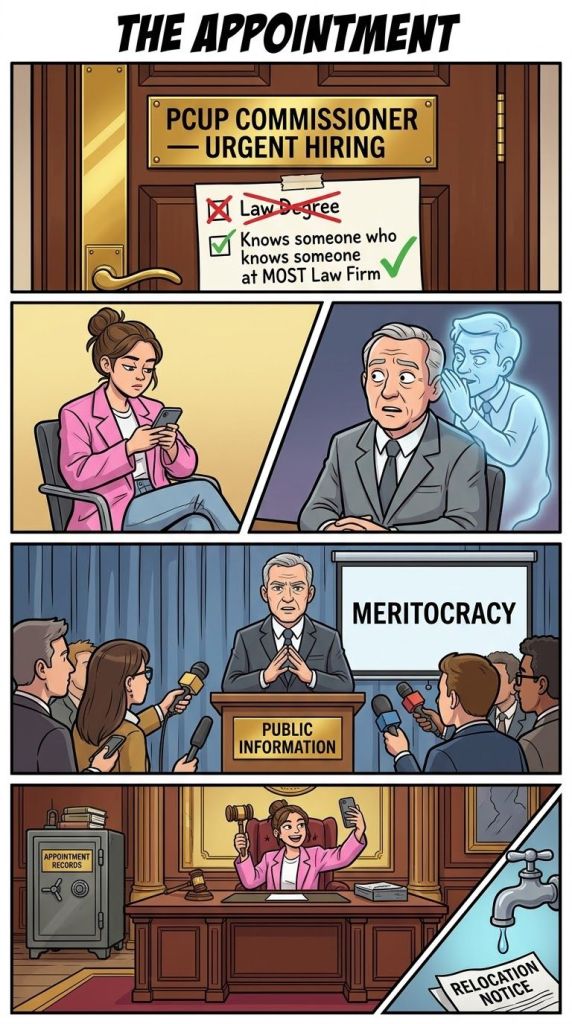
The Palace wants you to believe this is a story about a 27-year-old biology graduate with a nice Instagram feed and a father who happens to be an Assistant Secretary in the Office of the Executive Secretary. They want you to debate her qualifications, her travel photos, her law degree—or lack thereof—and they want you to get tired. They want you to shrug and say, “Well, Claire Castro said give her a chance.”
But the Canlas appointment is not an isolated curiosity. It is a data point. And the line that connects the data points runs through the Presidential Management Staff (PMS), through a law firm founded by the First Lady, and through a woman named Elaine Masukat—who, I must emphasize again, has not been credibly linked to this specific appointment by any document I could find.
That is not an exoneration. That is a red flag about the limits of research in a country where appointment records are treated like state secrets and loyalty is the only currency that matters.
The Canlas Conundrum: A CV Written in Silhouette
Let us review the facts the Palace would prefer you skim past.
Zofia Canlas graduated from De La Salle University in 2024 with a degree in biology, major in medical biology. By July 2025, she was chief of staff to the PCUP chairperson. By October 2026, she was a commissioner. In the interim, she ran as the first nominee of the Batang Quiapo party-list, which finished 87th and won nothing.
Her father, Jose Marcell Canlas, is an Assistant Secretary in the Office of the Executive Secretary. The Palace’s defense is that she “has long been part of the PCUP” and that her prior service as chief of staff somehow makes her uniquely qualified to regulate the lives of the urban poor.
Palace Press Officer Claire Castro—a trial lawyer, we are told—argued that a law degree is not required because the job involves “negotiating” with marginalized communities, not litigation. She also said we should wait until Canlas makes a mistake before criticizing her.
This is a novel theory of governance: appoint someone first, discover their incompetence later, and in the meantime, shut up.
The Masukat Precedent: Proximity as Qualification
Now, let us talk about Elaine Masukat. Not because I can prove she had anything to do with Zofia Canlas—I cannot, and I will not pretend otherwise—but because she is the template.
Masukat is the Secretary of the Presidential Management Staff, a position she has held since January 2023. Before that, she was an associate at the Marcos Ochoa Serapio Tan (MOST) Law Firm—founded by First Lady Liza Araneta-Marcos—from 2006 to 2010. She also served as chief of staff and consultant to Navotas Rep. Toby Tiangco.
In February 2024, Masukat issued a memorandum requiring all presidential appointees to submit updated personal data sheets and clearances within 30 days. Ombudsman Samuel Martires publicly flagged the directive as “highly irregular”. The memo, according to subsequent reporting, essentially vanished—not withdrawn, not enforced, just gone.
Masukat submitted her courtesy resignation in May 2025, along with other officials under the Office of the President. President Marcos rejected it and kept her in place.
So here is the pattern: a lawyer with deep ties to the First Lady’s professional network, a controversial memo that went nowhere, a courtesy resignation that was refused, and a continued perch at the heart of presidential coordination. No one has accused Masukat of corruption in the Canlas matter. But the structural logic is unmistakable: proximity to power is the qualification. Performance is optional. Accountability is a rumor.
The Anti-Nepotism Charade
The Palace would have you believe that because President Marcos is not related to Zofia Canlas within the prohibited degrees, there is no nepotism issue. Technically, they are correct. The Administrative Code prohibits appointments in favor of relatives within the third degree of the appointing authority. Jose Marcell Canlas is an Assistant Secretary, not the President. The letter of the law, as written, does not apply.
But the spirit of the law—the entire point of anti-nepotism provisions—is to prevent the conversion of public office into a family franchise. And here we have a father in the Office of the Executive Secretary, a daughter elevated to a commissionership at 27, and a Palace spokesperson insisting that this is all perfectly normal because the daughter was “already there”.
The Civil Service Commission has classified nepotism as a grave offense punishable by dismissal. But nepotism, as legally defined, requires a formal relationship between the appointer and the appointee. What we have here is something more insidious: a network of relationships that no single provision captures, a patronage ecosystem that operates in the gray space between legality and ethics.
The Real Scandal Is the Deflection
The most revealing aspect of this controversy is not Canlas’s travel photos or her biology degree. It is the Palace’s response.
Claire Castro did not say: “Commissioner Canlas has a demonstrated track record of service to urban poor communities, documented by X, Y, and Z.” She did not say: “Here are the specific programs she managed as chief of staff, and here are the outcomes.” She said: “Give her a chance”.
That is not a defense. That is a prayer.
And when you combine that with the Masukat template—a lawyer from the First Lady’s firm, a controversial memo, a rejected resignation, a continued tenure—you begin to see the architecture. The Canlas appointment is not an aberration. It is the system working as designed. The design is not meritocracy. The design is loyalty.
What Would Actually Resolve This
I am not calling for Zofia Canlas’s resignation. I am calling for something far more radical: transparency.
- Publish the appointment criteria.
- Publish the names of the other candidates considered.
- Publish the documentation of Canlas’s accomplishments as chief of staff.
- Publish the legal opinion that concluded a biology graduate with one year of post-graduation experience is qualified to oversee an agency that holds the fate of informal settler families in its hands.
And while we are at it, publish the full record of Elaine Masukat’s tenure at the PMS—the memos, the directives, the outcomes. Not because I believe she orchestrated the Canlas appointment, but because the public deserves to know how the Office of the President actually functions, rather than how the Palace press office says it does.
The Palace will refuse, of course. They will say the matter is closed, that the President has full confidence in his appointees, that critics are just bitter. They will deploy the same playbook they used for Masukat’s courtesy resignation: reject the criticism, retain the official, move on.
And Zofia Canlas will remain a commissioner. And Elaine Masukat will remain a secretary. And somewhere, a family in a relocation site with no running water will wonder why the government’s face of compassion has an Eiffel Tower selfie and a father in Malacañang.
That is not a scandal about one appointment. That is a scandal about a system that has learned to dress patronage in the language of merit, and to call the resulting outrage a misunderstanding.
Key Citations
A. News Articles
- Bacelonia, Wilnard. “Senate Finance Panel Clears 2026 Budgets of OP, PMS.” Philippine News Agency, 10 Sept. 2025.
- Cabato, Luisa. “Palace Defends 27-Year-Old Biology Major Given High Post in Poverty Body.” Inquirer.net, 20 Oct. 2026.
- Cabato, Luisa. “Palace Defends Giving 27-Yr-Old Biology Grad High Post in Urban Poor Body.” Cebu Daily News, 21 Oct. 2026.
- “More Execs under OP Submit Courtesy Resignation.” Philippine News Agency, 22 May 2025.
- “Ombudsman Hits Clearance Requirement for Presidential Appointees.” Inquirer.net, 11 Feb. 2024.
- “Palace Defends Naming Canlas as PCUP Commissioner.” Manila Standard, 19 Oct. 2026.
- “Palace Defends PCUP Official amid Luxury Travel Backlash.” eClips Senate News Updates, Senate of the Philippines, 20 Oct. 2026.
- “PBBM Retains Key Secretaries in 3rd Wave of Cabinet ‘Reset’.” PTV News, 3 June 2025.
- “Who Picks Marcos’ Appointees? Canlas Appointment Raises Questions.” POLITIKO, 21 Oct. 2026.
- “Who’s Your Daddy? PCUP Commissioner Zofia Canlas’ Palace Ties Fuels ‘Nepo Baby’ Tag.” POLITIKO, 21 Oct. 2026.
- “Why a Gen Z Jet-Setter’s Appointment Struck a Nerve in the Philippines.” South China Morning Post, 20 Oct. 2026.
B. Official Websites and Legal Sources
- Presidential Commission for the Urban Poor. PCUP. Government of the Philippines.
- Presidential Management Staff. PMS. Government of the Philippines.
- Civil Service Commission. CSC. Government of the Philippines.
- Philippines. Executive Order No. 292, Administrative Code of 1987. Lawphil, 1987.
C. Reference Works
- “Elaine Masukat.” Wikipedia, 14 Feb. 2025.

- ₱9 Billion in ‘Savings’? DILG’s Fire Truck Deal Smells Like Smoke

- ₱8B BBM Pork: CCTV for Every Captain’s Kumpare?

- ₱8.9 Billion, 331 Ghost Police Stations: The TIKAS Scandal Explained

- ₱8.4 Billion, 42,000 Barangays, 1 Election: The “Bawat Barangay Makikinabang” Vote-Buying Masterclass

- ₱75 Million Heist: Cops Gone Full Bandit

- ₱63 to the Dollar: The Only Thing Falling Faster Than the Peso Is the Government’s Credibility

- ₱6.77B Ghost Haunts Duterte: RTC Dismisses Mans Carpio’s Desperate Plea

- ₱6.77 Billion and Zero Cash: The Sara Duterte SALN Math That Doesn’t Add Up

- ₱6.7-Trillion Temptation: The Great Pork Zombie Revival and the “Collegial” Vote-Buying Circus

- ₱58.53B, Zero Receipts: The LGSF Pork Barrel Nobody Wants to Name

- ₱53 Million Man Tells ₱695-a-Day Workers to Stop Being ‘Mayabang’: The Audacity of BSP’s Remolona

- ₱4.4 Billion and a Witness Who Can’t Explain It: The Duterte Impeachment’s Most Expensive Non-Answer









Leave a Reply