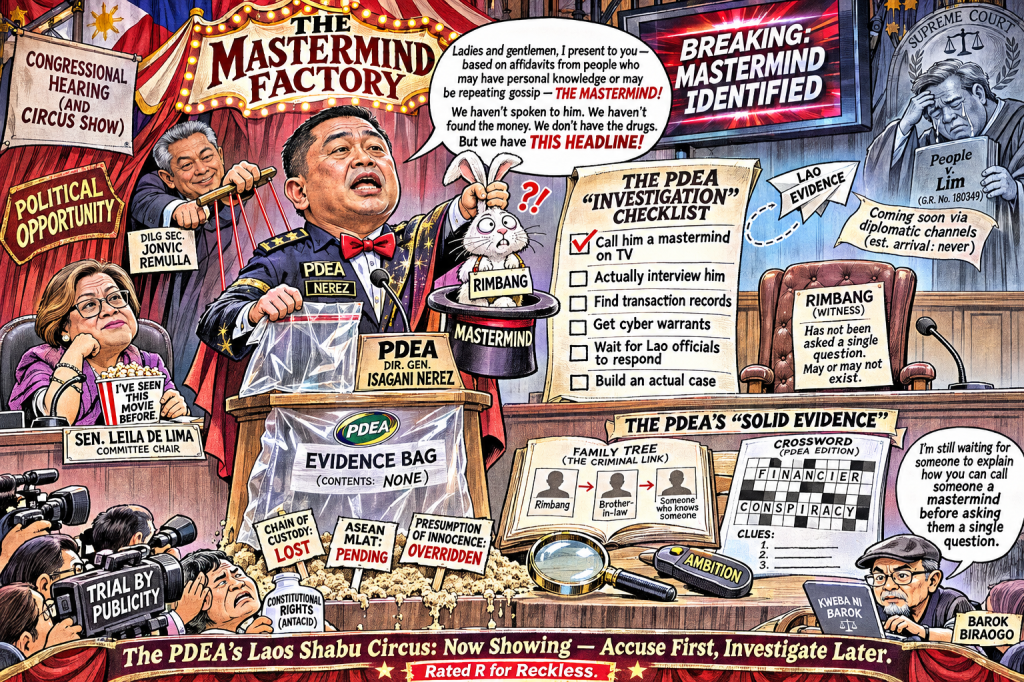
The People v. Lim Nightmare: Why the Laos Case Collapses Before It Even Reaches Court
By Louis ‘Barok‘ C. Biraogo | October 24, 2026
FORGIVE me for needing a moment to process this. Appearing before a congressional hearing, Philippine Drug Enforcement Agency (PDEA) Director General Isagani Nerez confidently identified former Bangsamoro parliamentarian Edriezan Hadji Nasser Rimbang as a “mastermind” of a ₱3.5-billion shabu shipment.
But here’s the part that should make every Filipino taxpayer reach for the antacid: Nerez admitted under oath that authorities haven’t even interviewed Rimbang yet. They don’t have the transaction documents. They don’t have the cyber warrant applications. They’re still waiting for Laos to send official records through diplomatic channels.
In other words, the PDEA has a headline. What it doesn’t have is a case.
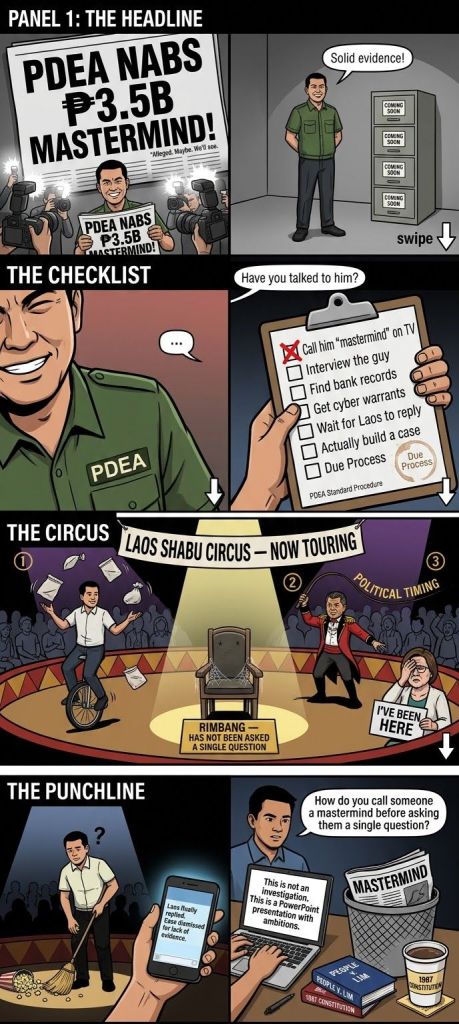
The Anatomy of a Premature Accusation
Let’s review what Nerez actually told the House Committee on Dangerous Drugs, chaired by—oh, the delicious irony—former Senator Leila de Lima, herself a victim of drug-related political persecution under the Duterte administration.
Nerez said the PDEA has “solid evidence” against Rimbang based on affidavits from the Philippine National Police-Criminal Investigation and Detection Group (PNP-CIDG). But when pressed, he acknowledged:
- No interview with Rimbang. The alleged mastermind hasn’t been asked a single question.
- No transaction records between Police M/Sgt. Aileen Jayne Manalo Mendoza and the airline company ALS.
- No documentation between Rioklyn “Boyet” Pizarras Toledo and the Malaysian charter company.
- No cyber warrants filed yet.
- No official Lao investigation records transmitted through proper channels.
This is not an investigation. This is a PowerPoint presentation with ambitions.
The Nerez Doctrine: Accuse First, Investigate Later
To be fair to Nerez—and I use “fair” in the loosest possible sense—he did something unusual: he admitted the gaps. He welcomed Department of Justice (DOJ) assistance for international legal cooperation. He acknowledged the need for proper procedure.
But here’s the problem: You don’t get to call someone a “mastermind” and then admit you haven’t done the basic investigative work.
Article III, Section 14(2) of the 1987 Constitution states that “in all criminal prosecutions, the accused shall be presumed innocent until the contrary is proved.” Nerez’s public tagging of Rimbang as a mastermind—before filing charges, before preliminary investigation, before even asking the man what he has to say—is a trial by publicity that would make Joseph Goebbels blush.
The Missing Evidence: A Guided Tour
Let me walk you through what the PDEA doesn’t have.
1. The Financial Trail
The CIDG reportedly identified ₱11.5 million in alleged transactions, including ₱7 million for the chartered flight. But where’s the evidence connecting these payments to Rimbang? Bank records? Wire transfers? Cash withdrawal slips?
Nerez mentioned the need for “cyber warrants” to access digital evidence. Translation: They haven’t looked at the phones, emails, or messaging apps yet. The “financier” allegation rests on affidavits from people who may have personal knowledge or may be repeating gossip.
2. The International Evidence
The drugs were seized in Laos. The aircraft was chartered through a Malaysian company. The alleged courier, Fahad Mulok Dibarosan—Rimbang’s brother-in-law—was arrested in Laos.
For Philippine courts to consider any of this evidence, it must be authenticated, translated, transmitted through official diplomatic channels, and compliant with the Treaty on Mutual Legal Assistance in Criminal Matters (ASEAN Mutual Legal Assistance Treaty).
Nerez acknowledged this. But until those records arrive, the PDEA’s case is built on sand.
3. The Chain of Custody
Under People v. Lim (G.R. No. 231989, 2018), the Supreme Court acquitted a drug defendant because the prosecution failed to establish an unbroken chain of custody. Deviations from Section 21 of Republic Act No. 9165 (Comprehensive Dangerous Drugs Act of 2002) must be alleged and proven—mere assertions aren’t enough.
Now imagine applying this standard to drugs seized in another country.
Who seized the drugs? Following what procedure? Were they photographed, marked, inventoried? Who handled them? How will they be presented in a Philippine court?
Nerez’s team hasn’t answered any of these questions. They’re still waiting for Laos to respond.
The Political Theater: A Tragedy in Three Acts
Act I: The Timing
Rimbang was appointed to the Bangsamoro Transition Authority by Rodrigo Duterte in 2019. He ran under PDP-Laban in the 2026 Bangsamoro elections and lost.
The Laos shipment was intercepted on October 1, 2026. The accusations surfaced in mid-October. Duterte is at The Hague facing International Criminal Court (ICC) charges. Sara Duterte has been impeached.
Interior Secretary Jonvic Remulla—never one to miss a political opportunity—publicly questioned why Rimbang was never on Duterte’s drug watchlist. This is a rhetorical masterstroke: It simultaneously suggests Rimbang is guilty and that Duterte protected him. Damned if you do, damned if you don’t.
Act II: The Ironic Committee
The House Committee on Dangerous Drugs is chaired by Rep. Mark Anthony Santos, but the star is Leila de Lima. The former senator spent nearly seven years in detention on drug charges she insisted were fabricated by the Duterte administration. Now she’s leading hearings that could implicate a Duterte ally.
You can’t script this. You really can’t.
Act III: The Missing Suspect
As of this writing, Rimbang is “at large.” He hasn’t been arrested. He hasn’t been charged. He issued a denial through the media—which is more than Nerez gave him before labeling him a mastermind.
Authorities say they’re “trying to locate him.” But if you believe someone is a drug kingpin who just orchestrated a ₱3.5-billion shipment, wouldn’t you, I don’t know, find him before announcing his guilt on national television?
The Jonvic Remulla Doctrine: Guilt by Political Association
Jonvic Remulla said Duterte and Rimbang “are more than friends… political allies for the longest time.” He also stressed that there’s “no evidence” linking the Duterte family to the shipment.
So let me get this straight: Rimbang is a Duterte ally. Duterte allies should be investigated for drug ties. But there’s no evidence linking Duterte himself to this shipment. Therefore… what, exactly?
This is the logical equivalent of saying: “The suspect has a friend who once met a guy who knows someone. We’re not saying the friend is involved. We’re just saying it’s interesting that they know each other.”
The Legal Framework: What RA 9165 Actually Says
Section 4: Importation
If Rimbang is proven to be a “financier” under Section 4 of RA 9165, he faces life imprisonment to death (though the death penalty was abolished by Republic Act No. 9346 (Act Prohibiting the Imposition of Death Penalty)) plus a fine of ₱500,000 to ₱10 million. The law explicitly states that the maximum penalty applies to anyone who “organizes, manages or acts as a ‘financier’ of any of the illegal activities prescribed in this Section.”
But here’s the catch: The drugs never entered Philippine territory. They were seized in Laos.
Under Article 6 of Act No. 3815 (Revised Penal Code), an attempted felony requires commencement of execution by overt acts, failure to perform all acts of execution due to a cause other than spontaneous desistance, and the elements of the offense are present.
The prosecution must prove that Rimbang took overt acts directed toward bringing the drugs into the Philippines. Financiers don’t physically carry drugs, so what were his overt acts? Writing checks? Making phone calls? Sending texts?
We don’t know—because the PDEA hasn’t shown us.
Section 26: Conspiracy
Section 26 penalizes conspiracy to commit certain offenses, including importation. But conspiracy requires proof of an agreement and an overt act in furtherance of that agreement.
Under People v. Laurio (G.R. No. 249323, 2023), the Supreme Court reiterated that conspiracy must be proven beyond reasonable doubt. It cannot be presumed from mere association.
So far, the PDEA’s evidence of conspiracy appears to be: Rimbang is related to Dibarosan. Rimbang is a politician with resources. Rimbang knew people who knew people.
This is not a conspiracy. This is a family tree.
The People v. Lim Problem: The Case That Haunts the PDEA
In People v. Lim, the Supreme Court acquitted Romy Lim despite his involvement in a drug transaction because the prosecution failed to establish an unbroken chain of custody.
Now apply this to the Laos case: The drugs were seized by Lao authorities, under Lao law, following Lao procedures, by Lao officials. How will the Philippine prosecution establish that the drugs presented in court are the same drugs seized in Laos? How will they prove that the substance tested by the Lao forensic lab is the same substance analyzed by Philippine chemists?
Nerez admitted they’re still waiting for the official records. Until those arrive—authenticated, translated, and properly transmitted—there is no chain of custody. And without a chain of custody, there is no case.
The Credibility Problem: Who Do You Trust?
The PDEA is asking the public to trust its characterization of Rimbang as a mastermind, but it’s simultaneously admitting that it lacks the evidence to prove this in court.
Why should anyone believe the accusation? Because Nerez says so? Because Remulla says so? Because the House committee invited them to testify?
The Philippine justice system is not a press conference. It’s not a congressional hearing. It’s a courtroom where evidence is tested, witnesses are cross-examined, and guilt must be proven beyond reasonable doubt.
Nerez’s public statements—before filing charges, before preliminary investigation, before even interviewing the suspect—violate the spirit of the presumption of innocence. They poison the well.
The Nerez Paradox: An Honest Official in a Dishonest System
Nerez, by all accounts, is not a political hack. He’s a retired PNP Major General, a lawyer, a graduate of PMA Maharlika Class of 1984. He headed the probe into the Kidapawan dispersal. He was part of the special body reviewing erring cops in the P6.7-billion shabu mess.
He seems like someone who actually believes in law enforcement.
But he’s also a Marcos appointee. His predecessor, Moro Virgilio Lazo, provided information to the House quad committee that implicated Duterte allies. Nerez’s appointment came “amid ongoing investigations into alleged drug ties involving former president Rodrigo Duterte and his allies.”
So is Nerez an honest cop trying to do his job in a politically charged environment? A political operative using his position to damage the Duterte camp? Both, depending on the day?
The answer, uncomfortably, is probably the last one. Nerez may genuinely believe Rimbang is involved in drug trafficking. He may also be under implicit pressure to produce results that embarrass the Duterte network.
This is the tragedy of Philippine law enforcement: Even when officials are trying to do the right thing, the political context contaminates everything they touch.
What Would a Real Investigation Look Like?
Step 1: Secure the Evidence
Obtain official Lao records through the ASEAN MLAT. Authenticate the drugs, the seizure report, the forensic analysis. Establish a chain of custody that satisfies People v. Lim. Translate all documents into English. Certify the translations.
Step 2: Follow the Money
Obtain bank records through proper legal process. Trace the ₱11.5 million in alleged transactions. Identify the source, the recipients, and the purposes. Secure cyber warrants for digital communications.
Step 3: Interview Everyone
Talk to Rimbang (yes, actually talk to him). Interview the arrested courier, Dibarosan. Question the police officer, Mendoza. Question the pilot, Toledo. Cross-reference their statements. Test their credibility. Look for corroboration.
Step 4: Build an Evidence Matrix
For each potential defendant, identify the specific offense, the elements of that offense, the evidence supporting each element, the source and admissibility of that evidence, contradictory evidence, and remaining gaps.
Step 5: File Charges (If Warranted)
Only after completing Steps 1-4 should the PDEA file charges. And only if the evidence supports probable cause.
Step 6: Let the Courts Decide
The PDEA’s job is to investigate and prosecute. It is not to convict. It is not to try cases in the media. It is not to declare guilt before a judge has heard a single word of testimony.
The Missing Pieces: What We Still Don’t Know
- What specific evidence links Rimbang to the shipment? Not “affidavits.” What do they actually say? Who signed them? What is their personal knowledge?
- What was the ₱11.5 million for? Was it for the aircraft? For bribes? For logistics? Where did the money come from? Where did it go?
- How was the police officer involved? Did Mendoza arrange hangar access? Was she paid? By whom? Did she know what the cargo was?
- What did the Lao authorities find? Did they conduct a forensic analysis? Did they identify additional suspects?
- What is Rimbang’s actual defense? He denied the allegations through the media. But what does he say about the specific payments, communications, connections?
- Why wasn’t Rimbang on Duterte’s drug watchlist? Is the answer (a) Duterte protected him, (b) he wasn’t involved in drugs until recently, or (c) the watchlist was politically motivated and incomplete?
The Institutional Crisis: PDEA’s Credibility on the Line
If the PDEA files charges against Rimbang and loses, the agency’s credibility will be shattered. The public will conclude that the drug war is just political theater—accusations without evidence, arrests without convictions, press conferences without proof.
If it doesn’t file charges, the public will conclude that Rimbang is being protected—that the rich and powerful can get away with anything while poor Filipinos rot in jail for possessing a few grams of shabu.
This is the no-win scenario that Philippine law enforcement has created for itself. Decades of extrajudicial killings, fabricated evidence, and political weaponization have destroyed public trust. Even when the PDEA might be doing the right thing, no one believes them.
The Ghost of Duterte’s Drug War
From 2016 to 2022, thousands of Filipinos were killed in “drug operations.” Many were poor. Many were innocent. Some were children. The ICC is now investigating these killings as potential crimes against humanity.
Throughout this period, Duterte maintained a “drug watchlist.” Rimbang was never on it.
This fact can be interpreted in two ways: Rimbang was protected because he was a Duterte ally, or Rimbang was not involved in drugs during the Duterte era.
The PDEA has not resolved this ambiguity. It has simply noted the connection and moved on.
The Silence of the Duterte Camp
Notably absent from this controversy is any substantial response from the Duterte camp.
Rodrigo Duterte is at The Hague. Sara Duterte is facing impeachment. The family’s political machine is focused on survival.
Rimbang has issued a denial through the media. But there’s been no coordinated defense, no press conference with lawyers, no attempt to present counter-evidence.
This could mean the Duterte camp is distancing itself from Rimbang to avoid further damage, preparing a legal defense that will be unveiled later, believes the allegations are true and is cutting ties, or is too distracted by other crises to respond.
None of these options is particularly reassuring for Rimbang.
The Possibility of a Frame-Up
Could Rimbang be innocent? Could this be a political frame-up?
We don’t know. But the possibility cannot be dismissed.
The timing is suspicious—the accusation comes at a moment of maximum political vulnerability for the Duterte camp. The evidence is incomplete—the PDEA has not presented a coherent case. The public statements are prejudicial—Nerez called Rimbang a mastermind before interviewing him. The political context is toxic—the Marcos-Duterte feud has corrupted every institution it touches.
This doesn’t mean Rimbang is innocent. It means the case is contaminated by politics, and it’s impossible to separate the legal from the political.
What Would Justice Look Like?
If Rimbang is guilty, justice requires a thorough investigation, admissible evidence, a fair trial, a conviction based on proof beyond reasonable doubt, and appropriate punishment.
If Rimbang is innocent, justice requires a thorough investigation, exculpatory evidence, a public clearing of his name, and accountability for those who falsely accused him.
In either case, justice requires the same thing: A real investigation, conducted professionally, without political interference.
The PDEA has not conducted a real investigation. It has conducted a public relations campaign.
The Verdict (For Now)
Is Rimbang guilty? I don’t know. The evidence is incomplete.
Is the PDEA’s handling of this case competent? No. Calling someone a mastermind before interviewing him is not competent. It’s reckless.
Is the case politically motivated? At least partially. The timing, the leaks, and the public statements suggest political considerations are at play.
Will this end well? Unlikely. Either Rimbang will walk free because the evidence is weak, or he’ll be convicted based on incomplete evidence—neither of which serves justice.
What should happen? The PDEA should complete its investigation before making further public statements. It should secure the foreign evidence, follow the money, interview all relevant parties, and build a case that can withstand scrutiny in court. Then—and only then—should it file charges.
The Larger Lesson: Why Institutions Matter
This case is a test of Philippine institutions.
Can the PDEA conduct a politically sensitive investigation without bias? Can the DOJ secure foreign evidence through proper channels? Can the courts provide a fair trial despite public pressure? Can Congress conduct oversight without turning hearings into partisan spectacles?
If the answer to any of these questions is “no,” then the Philippines has a problem that goes far beyond drug trafficking.
The drug war destroyed trust in institutions. It weaponized law enforcement for political purposes. It created a culture of impunity where the powerful are protected and the powerless are killed.
Rebuilding that trust requires more than press conferences and congressional hearings. It requires a commitment to due process, to evidence, to the rule of law.
The PDEA’s handling of the Laos drug case suggests that commitment is still lacking.
A Final Word for Nerez
Director General Nerez, I want to address you directly.
You seem like a decent man. You have an impressive resume. You’ve worked in law enforcement for decades.
But what you did in that congressional hearing was not decent. You called a man a mastermind without evidence. You poisoned the public discourse. You made it harder for justice to be served.
If Rimbang is guilty, you’ve jeopardized the case by making premature disclosures. If Rimbang is innocent, you’ve destroyed his reputation without justification.
Either way, you’ve damaged the institution you lead.
The next time you’re tempted to make a public accusation, remember: You’re not a politician. You’re a law enforcement officer. Your job is to investigate, not to opine. Your job is to gather evidence, not to generate headlines.
Do your job.
The Bottom Line
The ₱3.5-billion Laos drug shipment case is a mess.
The PDEA has accused a Duterte ally of being a mastermind without presenting sufficient evidence. The suspect hasn’t been interviewed. The foreign evidence hasn’t arrived. The chain of custody is unestablished. The political context is toxic.
This is not how justice is supposed to work.
If Rimbang is guilty, he should be prosecuted—with evidence, in court, according to law.
If Rimbang is innocent, he should be cleared—publicly, unequivocally, without lingering suspicion.
Either way, the PDEA needs to do better. The DOJ needs to do better. The courts need to do better.
And the Filipino people—who have endured decades of drug war violence, corruption, and impunity—deserve better than another political circus masquerading as law enforcement.
Louis ‘Barok’ C. Biraogo is a political commentator, satirist, and the author of the Kweba ni Barok blog. He has written extensively on Philippine politics, law enforcement, and the drug war. He is still waiting for someone to explain how you can call someone a mastermind before asking them a single question.
Key Citations
A. Legal & Official Sources
- 1987 Constitution of the Republic of the Philippines. Official Gazette of the Republic of the Philippines, officialgazette.gov.ph/constitutions/1987-constitution/.
- Department of Justice. “International Legal Cooperation.” Department of Justice, http://www.doj.gov.ph/international-legal-cooperation.html.
- People v. Laurio. G.R. No. 249323, 2023. LawPhil Project, lawphil.net/judjuris/juri2023/jan2023/gr_249323_2023.html.
- People v. Lim. G.R. No. 231989, 2018. LawPhil Project, lawphil.net/judjuris/juri2018/sep2018/gr_231989_2018.html.
- Republic Act No. 9165. Comprehensive Dangerous Drugs Act of 2002. 2002. LawPhil Project, lawphil.net/statutes/repacts/ra2002/ra_9165_2002.html.
- Republic Act No. 9346. An Act Prohibiting the Imposition of Death Penalty in the Philippines. 2006. LawPhil Project, lawphil.net/statutes/repacts/ra2006/ra_9346_2006.html.
- Republic Act No. 10175. Cybercrime Prevention Act of 2012. 2012. Supreme Court E-Library, elibrary.judiciary.gov.ph/thebookshelf/showdocs/2/50264.
- Act No. 3815. The Revised Penal Code. 1930. LawPhil Project, lawphil.net/statutes/acts/act1930/act_3815_1930.html.
- ASEAN Treaty on Mutual Legal Assistance in Criminal Matters. Supreme Court E-Library, elibrary.judiciary.gov.ph/thebookshelf/showdocs/36/9759.
B. News Reports
- “CIDG Wraps Up Case Buildup in Laos Drug Shipment.” Philippine News Agency, 21 Oct. 2026, http://www.pna.gov.ph/article/cidg-wraps-up-case-buildup-in-laos-drug-shipment.
- “DILG Tags Former Bangsamoro MP as Politician in P3.5B Shabu Smuggling Try from Laos.” GMA News Online, GMA Network, 16 Oct. 2026, http://www.gmanetwork.com/news/topstories/nation/1006132/dilg-tags-bangsamoro-mp-as-politician-in-p3-5b-shabu-smuggling-try-from-laos/story/.
- “Dutertes Not Linked to Foiled Laos Drug Shipment, Says Remulla.” GMA News Online, GMA Network, 20 Oct. 2026, http://www.gmanetwork.com/news/topstories/regions/1006496/dutertes-not-linked-to-foiled-laos-drug-shipment-jonvic-remulla/story/.
- “PDEA Tags Duterte Ally among Alleged Masterminds of P3.5-B Laos Drug Shipment.” Philippine News Agency, Oct. 2026, http://www.pna.gov.ph/article/pdea-tags-duterte-ally-among-alleged-masterminds-of-p35-b-laos-drug-shipment.
- “Remulla Pushes Tighter Airport Cargo Checks after Laos Intercepts 521 Kilos of Suspected Drugs Bound for PH.” Philippine Information Agency, 19 Oct. 2026, pia.gov.ph/press-release/remulla-pushes-tighter-airport-cargo-checks-after-laos-intercepts-521-kilos-of-suspected-drugs-bound-for-ph/.
- Chi, Cristina. “Ex-Bangsamoro Solon Rimbang Denies Bankrolling P3.5-Billion Laos Shabu Shipment.” Philstar.com, 23 Oct. 2026, http://www.philstar.com/headlines/2026/10/23/2565201/ex-bangsamoro-solon-rimbang-denies-bankrolling-p35-billion-laos-shabu-shipment.
- “Ang Hirap Maging Mahirap”: The PAO Scandal That Proves Government Contempt Is Nothing New
- “Far-Off” My Axx: Malacañang’s Claire Castro Drowns in Her Own Legal Gaslighting
- “Forthwith” to Farce: How the Senate is Killing Impeachment—And Why Enrile’s Right (Even If You Can’t Trust Him)
- “HINDI AKO NAG-RESIGN!”

- “I Know Nothing”: Baste Duterte’s Amnesia Defense Meets ₱33M in GenCorp Contracts
- “I’m calling you from my new Globe SIM. Send load!”

- “Mahiya Naman Kayo!” Marcos’ Anti-Corruption Vow Faces a Flood of Doubt

- “Manageable” Debt, Unmanageable Lies: DBM’s ₱21 Trillion Fairy Tale
- “Meow, I’m calling you from my new Globe SIM!”

- “Natrabaho”: One Word, One Ombudsman, and a Judiciary on Trial
- “No Special Jail for Crooks!” Boying Remulla Slams VIP Perks for Flood Scammers
- “Philippine-Controlled” or Yankee Gas Station? The Davao Fuel Depot Farce Exposed




Leave a Reply