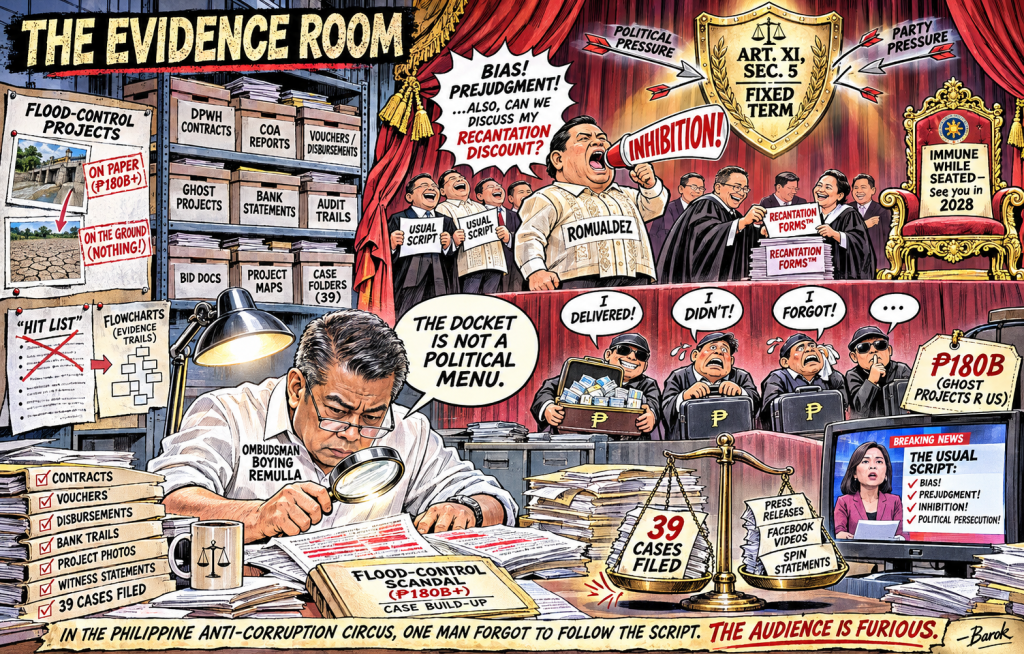
How the Ombudsman Refused to Pretend the Docket Is a Political Menu
By Louis ‘Barok‘ C. Biraogo — October 24, 2026
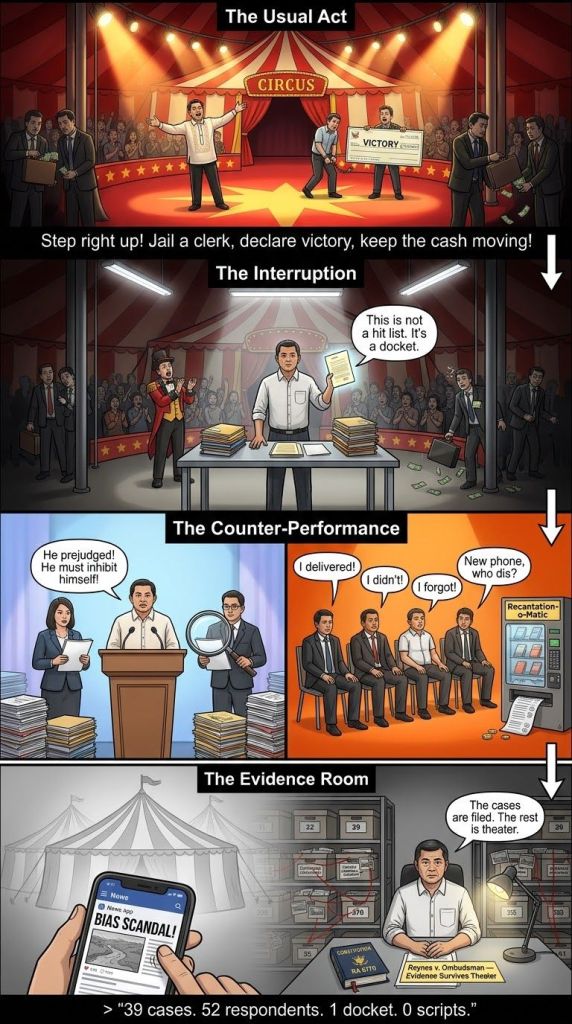
IN THE Philippine anti-corruption circus, the usual act is simple: announce a crackdown, jail a few mid-level bureaucrats and contractors who forgot to share, then declare victory while the real money keeps circulating among the usual surnames.
Ombudsman Jesus Crispin “Boying” Remulla has the audacity to interrupt the performance by insisting his office is not running a targeted hit list but merely following the evidence. The claim is almost quaint. It is also the only legally coherent position available under the 1987 Constitution and Republic Act No. 6770, the Ombudsman Act.
The Cebu Remarks and the Scale of the Scandal
Remulla made the point in Cebu while talking to businessmen about reducing the “hitches” that corruption creates for anyone trying to operate without a suitcase of cash. The flood-control scandal supplies the test case.
Estimates of diverted funds range from Senator Lacson’s ₱180 billion in ghost projects since 2016 to Greenpeace’s trillion-peso figure for the more recent period. The Ombudsman’s office has already filed 39 cases involving 52 individuals—plunder, malversation, and violations of the Anti-Graft and Corrupt Practices Act—mostly before the Sandiganbayan. Arrest warrants have issued. That is not a press release; it is a docket.
Romualdez’s Inhibition Demand
The loudest objection comes from former Speaker Martin Romualdez, whose lawyers demanded that Remulla and his entire office inhibit themselves. Their theory is that public statements—discussing possible plunder charges and an assistant ombudsman’s characterization of Romualdez as a “master plunderer”—constitute prejudgment. The argument is familiar.
It treats ordinary prosecutorial candor as if it were a judge’s premature verdict. Philippine and American due-process doctrine has long tolerated the combination of investigative and prosecutorial functions in agencies unless the probability of actual bias is constitutionally intolerable. Withrow v. Larkin is still the controlling reference; Caperton and Williams do not convert every frank assessment of evidence into a due-process violation. Romualdez’s lawyers want the investigation to be treated as a sham before the evidence is tested in court. That is a litigation strategy, not a legal principle.
Recantations and the State Witness
The recantations make the point sharper. Four of the alleged bagmen who once claimed to have delivered suitcases of cash to Romualdez, Elizaldy Co, and others have walked back their statements. Remulla’s response—that Romualdez is responsible for the men’s actions—was immediately denounced as proof of prejudice.
One can equally observe that recantations in high-stakes Philippine corruption cases have a long and uninspiring pedigree. They are not, standing alone, exculpatory. The same men whose original statements helped build the narrative are now said to prove its falsity. The Ombudsman’s office is entitled to treat the flip as a credibility problem for the defense rather than an automatic dismissal of the underlying documents, bank trails, and procurement records.
Manuel Bonoan’s acceptance as a state witness raises the usual questions about “not the most guilty,” but Rule 119, Section 17 of the Revised Rules of Criminal Procedure supplies the criteria; it does not require the department secretary to be the purest soul in the room before his testimony can be used against those who allegedly directed the scheme.
Political Biography Versus the Record
Critics correctly note Remulla’s political biography: Marcos ally, former Justice Secretary who facilitated Rodrigo Duterte’s transfer to the International Criminal Court (ICC), and therefore an easy target for charges of selective justice. The same critics are quieter about the fact that the highest-profile respondent so far is the President’s own cousin.
Investigating Romualdez while leaving the President himself uncharged is not automatically proof of a protected circle. It is consistent with two ordinary realities: first, that admissible evidence against one person is not the same as admissible evidence against another; and second, that a sitting President is constitutionally immune from suit. Co’s Facebook video and the bagmen’s original stories named the President, but those materials have not, on the public record, matured into a case that meets the threshold for filing—and even if they had, the Office of the Ombudsman could not charge him while he remains in office. Declining to proceed on the basis of contested, partially recanted, and uncorroborated claims is what an evidence-based office is supposed to do. The alternative—filing against the President anyway in order to perform independence—would be the real political act.
The appointment of Amenah Pangandaman to a bank post while she remained “in their universe of investigations” is harder to defend and is the sort of institutional slip that invites suspicion. It does not, however, erase the 39 cases already in court or the constitutional insulation that Article XI, Section 5 and the fixed seven-year term are meant to provide. Carpio Morales v. Court of Appeals and OP v. Carandang remain good law: the Ombudsman is independent of executive control even when the appointing president and the sitting Ombudsman share a political history. Independence is tested by what the office does with the evidence in front of it, not by the résumé of the person who occupies the seat.
The Structural Problem
The deeper problem is structural. Anti-corruption prosecution in a polarized system will always look selective to the side that is losing. Romualdez’s camp calls the probe trumped-up; the Duterte camp can frame any inquiry into confidential funds or other matters as payback for the ICC transfer. Both reactions are predictable.
Neither substitutes for the documents Remulla keeps inviting the public to examine—the contracts, the accomplishment reports that do not match the ground, the vouchers, the audit findings, and the chain of approvals. Those records either support the charges or they do not. Public statements, political alliances, and recanting witnesses are secondary.
Remulla’s insistence that the office follows evidence rather than a target list is the correct legal posture. It is also the only posture that survives judicial review under Reynes and the ordinary rules of preliminary investigation. Whether the probe ultimately produces convictions that stick, or collapses under the weight of compromised witnesses and incomplete financial trails, will be decided in the Sandiganbayan and on appeal. Until then, the spectacle of powerful respondents demanding that the investigator recuse himself for having looked at the evidence is less a due-process crisis than a reminder of how rarely the usual script is interrupted. Look at the cases filed. The rest is theater.
Key Citations
A. Legal & Official Sources
- Official Gazette of the Republic of the Philippines. “The 1987 Constitution of the Republic of the Philippines – Article XI.” Official Gazette, https://www.officialgazette.gov.ph/constitutions/the-1987-constitution-of-the-republic-of-the-philippines/the-1987-constitution-of-the-republic-of-the-philippines-article-xi/.
- Official Gazette of the Republic of the Philippines. “Republic Act No. 6770.” Official Gazette, 17 Nov. 1989, https://www.officialgazette.gov.ph/1989/11/17/republic-act-no-6770/.
- Official Gazette of the Republic of the Philippines. “Republic Act No. 3019.” Official Gazette, 17 Aug. 1960, https://www.officialgazette.gov.ph/1960/08/17/republic-act-no-3019/.
- Supreme Court of the Philippines. “Revised Rules of Criminal Procedure.” Supreme Court E-Library, https://elibrary.judiciary.gov.ph/thebookshelf/showdocs/11/369.
- Withrow v. Larkin. 421 U.S. 35 (1975). Cornell Law School Legal Information Institute, https://www.law.cornell.edu/supremecourt/text/421/35.
- Carpio-Morales v. Court of Appeals. G.R. Nos. 217126-27, 10 Nov. 2015. Jur.ph, https://jur.ph/jurisprudence/summary/carpio-morales-v-court-of-appeals.
- Supreme Court of the Philippines. “SC Affirms President Has No Power to Remove Deputy Ombudsman.” 4 May 2026, https://sc.judiciary.gov.ph/wp-content/uploads/2026/05/20260504-PR-Cases-OP-v-Carandang-FINAL.pdf.
- Reynes v. Office of the Ombudsman (Visayas). G.R. No. 223405, 20 Feb. 2019. Lawphil, https://lawphil.net/judjuris/juri2019/feb2019/gr_223405_2019.html.
- Sandiganbayan. Official Website. https://sb.judiciary.gov.ph/.
B. News Articles and Reports
- Orcullo, Jerod. “Corruption Probe ‘Not Targeted’ but ‘Evidence-Based’ – Ombudsman.” Daily Tribune, 22 Oct. 2026, https://tribune.net.ph/2026/10/22/corruption-probe-not-targeted-but-evidence-based-ombudsman.
- Magbanua, Sean A. “Remulla Reports 39 Flood Control Cases in First Year as Ombudsman.” Daily Tribune, 12 Oct. 2026, https://tribune.net.ph/2026/10/12/remulla-reports-39-flood-control-cases-in-first-year-as-ombudsman.
- Mangaluz, Jean. “P180 Billion Lost to Ghost Flood Control Projects since 2016 — Lacson.” Philstar.com, 3 Dec. 2025, https://www.philstar.com/headlines/2025/12/03/2491635/p180-billion-lost-ghost-flood-control-projects-2016-lacson.
- Greenpeace Philippines. “Flood Control Corruption an Obscene Plunder of Much-Needed Climate Funds–Greenpeace.” Greenpeace Philippines, 28 July 2026, https://www.greenpeace.org/philippines/press/68522/flood-control-corruption-an-obscene-plunder-of-much-needed-climate-funds/.
- de Leon, Dwight. “Romualdez Accuses Remulla of Bias, Seeks to Block Ombudsman from Probing Him.” Rappler, 24 Apr. 2026, https://www.rappler.com/philippines/martin-romualdez-accuses-boying-remulla-bias-seeks-block-ombudsman-investigation/.
- Locus, Sundy. “Zaldy Co: Marcos Jr., Romualdez Took P56B in Flood Control Kickbacks.” GMA News Online, 16 Nov. 2025, https://www.gmanetwork.com/news/topstories/nation/966325/zaldy-co-marcos-jr-romualdez-took-p56b-in-flood-control-kickbacks/story/.
- “Ang Hirap Maging Mahirap”: The PAO Scandal That Proves Government Contempt Is Nothing New

- “Far-Off” My Axx: Malacañang’s Claire Castro Drowns in Her Own Legal Gaslighting
- “Forthwith” to Farce: How the Senate is Killing Impeachment—And Why Enrile’s Right (Even If You Can’t Trust Him)

- “HINDI AKO NAG-RESIGN!”

- “I Know Nothing”: Baste Duterte’s Amnesia Defense Meets ₱33M in GenCorp Contracts

- “I’m calling you from my new Globe SIM. Send load!”

- “Mahiya Naman Kayo!” Marcos’ Anti-Corruption Vow Faces a Flood of Doubt

- “Manageable” Debt, Unmanageable Lies: DBM’s ₱21 Trillion Fairy Tale
- “Meow, I’m calling you from my new Globe SIM!”

- “Natrabaho”: One Word, One Ombudsman, and a Judiciary on Trial

- “No Special Jail for Crooks!” Boying Remulla Slams VIP Perks for Flood Scammers

- “Philippine-Controlled” or Yankee Gas Station? The Davao Fuel Depot Farce Exposed





Leave a Reply