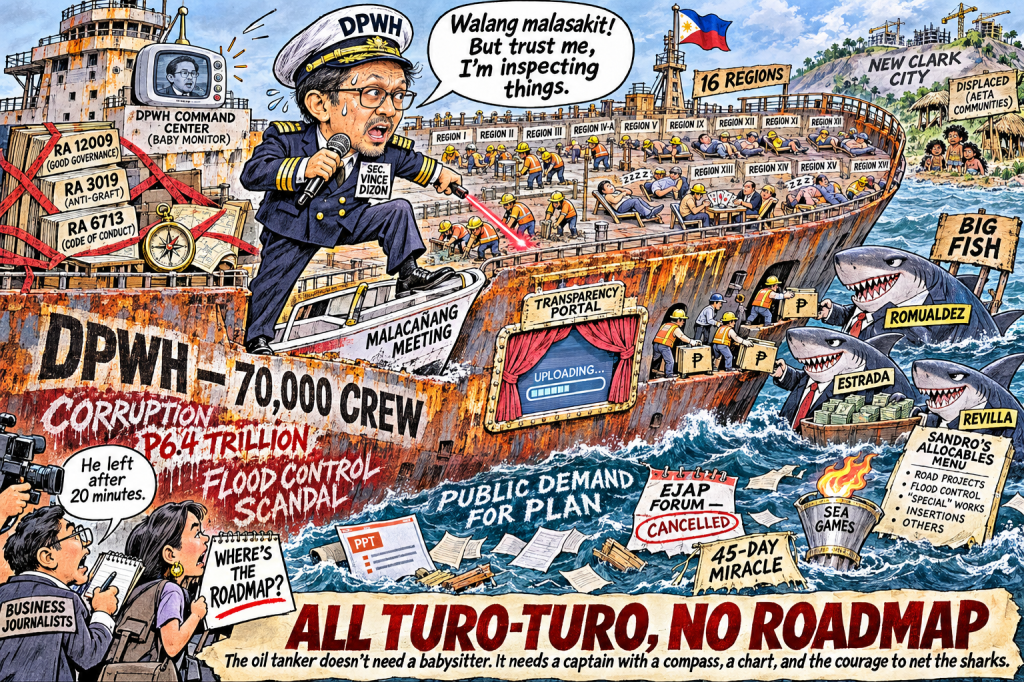
Or: How to Reform a 70,000-Person Agency with a Laser Pointer and Good Intentions
By Louis ‘Barok‘ C. Biraogo | October 26, 2026
Ladies and gentlemen, gather around. The circus is in town, and the ringmaster has a confession to make: he doesn’t actually have a plan.
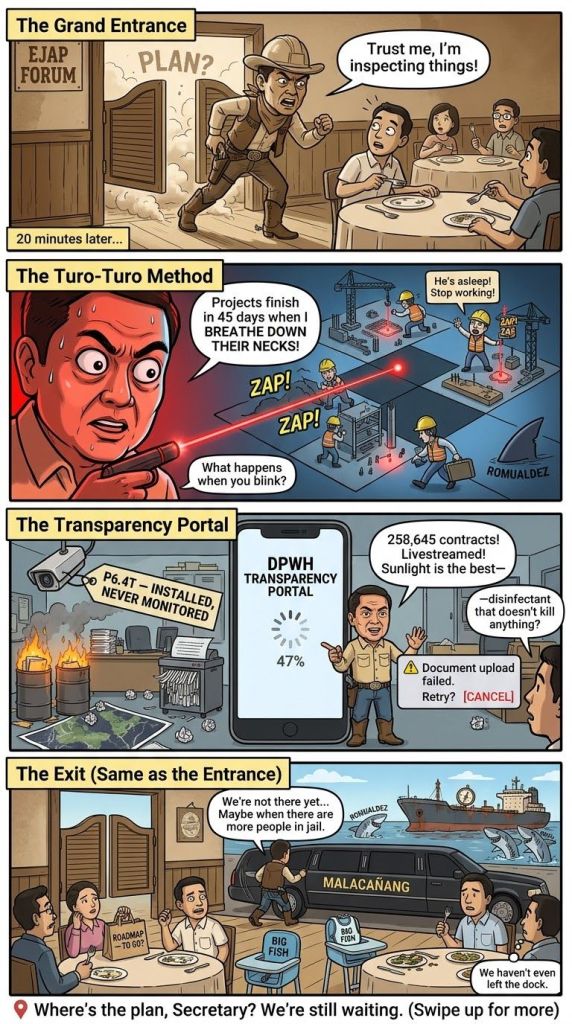
That’s the headline from Monday’s Economic Journalists Association of the Philippines (EJAP) infrastructure forum, where Department of Public Works and Highways (DPWH) Secretary Vince Dizon—the man tasked with cleaning up the biggest infrastructure scandal in recent Philippine history—stood before the nation’s business press and essentially admitted he had nothing to present. Twenty minutes of “trust me, I’m inspecting things” and then he was off to Malacañang for a meeting that may or may not have been scheduled before the event was booked months in advance.
The Philstar headline was diplomatic: “Sec Vince gets defensive.” The rest of us might use different words.
The Man Who Came to Dinner (And Left Before the Main Course)
Let’s set the scene. The EJAP forum took months to organize. Business journalists—the people who actually need to understand where the government is spending P6.4 trillion in infrastructure money—prepared questions. They expected a roadmap. They expected timelines. They expected, at minimum, a PowerPoint presentation with bullet points and a few charts.
What they got was a 20-minute lecture on how hard it is to reform the DPWH.
“Walang malasakit.” No sense of urgency. A culture of apathy. The agency is an “oil tanker” that’s nearly impossible to turn around.
All of which may be true! The DPWH has been a byword for corruption since before most of today’s engineers were born. But here’s the thing, Secretary: we already knew that. The flood control scandal didn’t exactly stay under wraps. We’ve seen the Commission on Audit (COA) reports. We’ve read about the engineers delivering cash in suitcases to lawmakers’ aides in hotel parking lots. We’ve watched the hearings.
What we haven’t seen is a plan.
The Turo-Turo Doctrine
Dizon’s defense of his approach is almost charming in its simplicity: he personally inspects projects, and when he “breathes down their necks,” things get done. Projects that normally take six months finish in 45 to 60 days.
Fascinating. Also terrifying.
If I may translate from bureaucratese to plain English: the DPWH cannot function unless the Secretary personally visits every project site and stares at engineers until they do their jobs. This is not a reform strategy. This is a babysitting strategy. And the Secretary of Public Works and Highways cannot personally babysit 70,000 employees across 16 regions and 200+ district engineering offices.
What happens when Dizon is in a Cabinet meeting? When he’s testifying before Congress? When he’s asleep? Does the entire department grind to a halt, waiting for the boss to show up and point at things?
The “turo-turo” approach—literally “point-point”—was Dizon’s own self-deprecating description of how critics characterize his management style. He acknowledged it. Then he defended it anyway.
Here’s a radical suggestion: instead of relying on the Secretary’s personal presence to ensure projects are completed, maybe—just maybe—the department could implement systems that work regardless of who’s watching. Performance metrics. Independent audits. Real-time monitoring. Consequences for failure that don’t depend on the boss’s travel schedule.
But that would require a plan. And plans, apparently, are not on the menu.
The Transparency Portal: Digital Window Dressing or Genuine Reform?
To be fair to Dizon—and I’m trying to be, despite my natural instincts—the man has done some things. The DPWH Transparency Portal now displays information on 258,645 contracts worth P6.4 trillion. Bidding processes are livestreamed. Material prices have been reduced.
These are not nothing. In a department where “procurement records [are] incomplete or inaccessible,” publishing contracts online is a genuine improvement. Sunlight, as the saying goes, is the best disinfectant.
But here’s the question I can’t shake: how much of this is actual reform, and how much is performance of reform?
The portal itself admits that documents and satellite imagery are “being uploaded continuously.” That means it’s incomplete. A portal that’s missing records isn’t transparency—it’s the appearance of transparency. It’s a Potemkin village of accountability, where you can see the facade but not what’s behind it.
And what happens when the portal exposes a discrepancy? The existence of a portal doesn’t answer that question. You need a process for verifying, investigating, and—crucially—punishing those responsible. The portal may enable detection, but detection without consequences is just… information. Interesting for researchers, perhaps. Useless for reform.
Let me be clear: I’m not saying the portal is worthless. I’m saying that a portal that posts contracts while the department’s culture remains unchanged is like installing a security camera in a store where the owner still lets employees steal. The camera might catch a few, but it doesn’t fix the underlying problem.
The “Big Fish” Problem
Let’s talk about the elephant in the room. Or rather, the sharks in the water.
The flood control scandal has implicated former Speaker Martin Romualdez—the President’s own cousin—as a “central figure” according to the Ombudsman. Senator Jinggoy Estrada. Former Senator Bong Revilla. These are not small fish. These are the biggest fish in the Philippine political aquarium.
Dizon filed graft complaints against 22 officials in Bulacan and removed four officials in Davao and Cebu. Good! Those people should absolutely face consequences if the evidence supports it.
But the “big fish” remain frustratingly un-scaled. And Dizon knows it. His admission that “we’re not there yet… Maybe when there are more people in jail” is about as honest as a politician gets. He’s telling us: the deterrent doesn’t exist yet. The people who stole billions aren’t in prison. And until they are, the system remains vulnerable to the same temptations that created the current mess.
Here’s the uncomfortable question: is Dizon’s approach designed to actually catch big fish, or is it designed to look like he’s trying?
Filing graft charges (instead of plunder) against mid-level officials is strategically defensible—graft is easier to prove. But it’s also safer. Plunder requires proving a pattern of criminal acts and a P50 million threshold. Graft can be established with less. By choosing graft, Dizon ensures a higher conviction rate, but for lower-level actors.
The sharks have been netted—Romualdez and Estrada are in jail, Revilla is out on bail—but the prosecution’s case still has to survive the courtroom. The net is cast. Whether it holds is another question.
I’ll believe it when I see it.
The “Oil Tanker” Metaphor
Dizon’s favorite metaphor is the “oil tanker”—a massive vessel that takes miles to turn around. It’s a useful rhetorical device, and there’s real truth to it. The DPWH isn’t just an agency; it’s an ecosystem of contractors, engineers, local politicians, and bureaucrats who have mutually beneficial relationships built over decades.
But the metaphor has a problem. An oil tanker captain doesn’t stand on the deck shouting at the crew to work harder. She consults navigational charts, communicates with headquarters, coordinates with other vessels, and plans a route. A captain who relies solely on walking around the deck and yelling at the people working below deck isn’t doing her job.
The question isn’t whether the DPWH can be turned around. The question is whether Dizon can turn it around—or whether he’s just rearranging the deck chairs.
The Legal Framework: All Tools, No Action
Here’s what’s frustrating about this whole mess: the legal framework to reform the DPWH already exists.
- Republic Act No. 12009 (the New Government Procurement Act) mandates transparency, competitiveness, and accountability in all procurement.
- Republic Act No. 3019 (the Anti-Graft and Corrupt Practices Act) provides criminal penalties for officials who cause undue injury through manifest partiality or gross negligence.
- Republic Act No. 6713 (the Code of Conduct and Ethical Standards) requires public officials to act with commitment to public interest, professionalism, and justness.
- The 1987 Constitution itself declares that “public office is a public trust.”
On paper, Dizon has everything he needs. The laws exist. The tools exist. The public anger exists.
But there’s a reason the DPWH has been corrupt for decades despite these laws. The laws exist on paper, not in practice. Procurement records are incomplete. Audit findings are ignored. Officials face “preventive suspension” for six months, then return to work. Cases drag on for years until everyone forgets about them.
Dizon’s transparency portal and inspections don’t change the fundamental structure. They work around the broken system instead of fixing it. And that’s the central problem with the “turnaround agent” narrative: the man isn’t fixing the system; he’s an exception to it. And exceptions don’t last.
The Infrastructure Plan That Wasn’t
Let me return to the original sin: the missing infrastructure plan.
The Philippines needs infrastructure. We need roads that don’t flood. Bridges that don’t collapse. Public transportation that actually transports the public. With the Marcos administration’s final two years in office, there’s an urgent need to pump-prime the economy through infrastructure investment.
Dizon’s response? “We’re not there yet.”
The journalist in me wants to ask: not there where, exactly? Not there in terms of prosecutions? Not there in terms of reform? Not there in terms of… having a plan?
Here’s the thing about plans: they don’t have to be perfect. They don’t have to be fully achievable. But they need to exist. A plan shows that you’ve thought about the future. A plan provides a benchmark against which progress can be measured. A plan gives the public, investors, and business leaders something to work with.
Dizon didn’t even try. When the EJAP forum—organized months in advance—was presented to him, did it not occur to his staff to prepare a presentation? A briefing paper? A handout? Could he not have sent an undersecretary to present in his absence?
The answer, apparently, is no. Because the Secretary was too busy… inspecting things. Or preparing for a Malacañang meeting. Or maybe just not bothering.
This isn’t a scheduling problem. It’s a priorities problem. And the priority, apparently, was not to provide the business community with information they desperately need.
The EJAP Snub: A Pattern or a Fluke?
I’ve been writing about Philippine politics and governance for long enough to know that nothing is ever a fluke. When the Secretary skips a forum, it’s not because he forgot. It’s because—for whatever reason—he didn’t want to be there.
Maybe he was afraid of getting tough questions. Maybe he didn’t have answers. Maybe the Malacañang meeting was real and unavoidable. But even if the latter is true, the failure to send a substitute or prepare a written briefing is inexcusable.
The EJAP is not a hostile crowd. They’re business journalists—the kind of people who want to hear about investment opportunities, not expose corruption. They were prepared to be impressed. They were prepared to report on Dizon’s plans for infrastructure development, project pipelines, procurement reform, flood-control priorities.
Instead, they got a 20-minute lecture on how hard it is to change culture.
Culture change, as any management consultant will tell you, takes years. Dizon has been in office for a little over a year. Expecting systemic transformation in that timeframe is unfair. But expecting a plan? That’s not unfair. That’s the minimum acceptable standard for a Cabinet secretary.
The “Defensive” Posture
The Philstar headline—”Sec Vince gets defensive”—captures something important about how Dizon comes across. His speech wasn’t a proactive vision; it was a reaction to criticism. He wasn’t explaining what he would do; he was explaining why it was hard.
This is a subtle but important distinction. Leaders who have plans talk about the future. Leaders who don’t have plans talk about the past—or about how hard their job is.
Dizon’s speech wasn’t about where the DPWH is going. It was about why it’s been hard to get there. And while that’s understandable, it’s not leadership. It’s excuse-making.
The “oil tanker” metaphor, the “culture of apathy,” the “you can’t fix this overnight”—they’re all true, and they’re all convenient. They allow Dizon to acknowledge problems without committing to solutions. They let him say “I’m working on it” without having to show what he’s working on.
The Uncomfortable Questions
Let me ask the questions that the EJAP forum should have asked but didn’t:
- How many projects have been completed on time since Dizon took office? Not inspected. Not visited. Completed on time per original contract schedules.
- How many officials have been dismissed? Not “removed” or “suspended” or “reassigned”—actually dismissed, with administrative penalties imposed and upheld.
- How much money has been recovered? The Anti-Money Laundering Council (AMLC) has frozen P25 billion, but how much has actually been returned to the government?
- How many cases have been filed with the Ombudsman, and what is their status? Not referrals—actual, filed, docketed cases.
- What is the DPWH’s completion rate for flood-control projects compared to last year? Is Dizon’s approach improving outcomes, or just looking busy?
- When will the Big Fish be prosecuted? Romualdez. Estrada. Revilla. The people whose names appear in the Ombudsman’s findings.
These questions have answers. The DPWH has data. The Ombudsman has records. The Independent Commission for Infrastructure (ICI) has findings. But those answers haven’t been presented to the public. And that, more than anything, is the problem with Dizon’s approach.
The 45-Day Miracle
Dizon’s claim that projects finish in 45-60 days when he “breathes down their necks” is either impressive or terrifying, depending on how you interpret it.
If it’s true, it means the DPWH has been deliberately slow on projects—not because of resource constraints or regulatory requirements, but because no one was forcing them to be fast. That’s a culture of deliberate inefficiency, which is almost as damaging as outright corruption.
But here’s the question: if projects can be completed in 45 days, why weren’t they being completed in 45 days before Dizon showed up? What changed? If it’s just the Secretary’s presence, that’s not a reform—that’s a hostage situation. Engineers are doing their jobs because they’re afraid of getting fired, not because the system demands it.
And what happens when Dizon leaves? When he’s replaced—as all secretaries eventually are—will projects revert to their previous pace? Will the “turo-turo” magic wear off?
A real reform would change the underlying incentives. It would make fast, high-quality work the default, not the exception. It would create systems—not personalities—that deliver results.
The Aeta Question
One more thing: Dizon’s record at the Bases Conversion and Development Authority (BCDA), where he was accused of “violent displacement of thousands of Aeta indigenous communities” during the New Clark City project. Dizon denies wrongdoing, and the Ombudsman cleared him of plunder charges related to the Southeast Asian (SEA) Games cauldron. But the Aeta displacement is real, and the criticisms of “business-centric” consultation deserve more scrutiny than they’ve received.
If Dizon’s DPWH is going to claim to stand for transparency and accountability, it should account for its own record. The same man who criticizes the DPWH’s “culture of apathy” was accused of ignoring indigenous rights in his previous job. The same man who promises to stamp out corruption faced plunder charges for his handling of the SEA Games facilities.
He was cleared. That matters. But being cleared of criminal charges is not the same as being innocent of all wrongdoing. The legal standard is “proof beyond reasonable doubt,” not “proof of good judgment.”
The Political Theater
Let’s be honest about what’s happening here: this is political theater, and everyone knows it.
Dizon is Marcos’s appointee, and his job is to protect the President from the fallout of the flood-control scandal. The scandal reaches Marcos’s own cousin, Martin Romualdez, who was described by the Ombudsman as a “central figure.” It reaches Budget Secretary Amenah Pangandaman (who resigned) and other high-level officials. The allocables system—a workaround for the Supreme Court’s ruling against Priority Development Assistance Fund (PDAF)—benefits Marcos’s son Sandro.
Dizon’s job is to look like he’s cleaning house while not cleaning anything too close to the President’s family.
That’s why he filed graft charges against mid-level officials in Bulacan. That’s why he talks about “culture” instead of individuals. That’s why he hasn’t presented a plan—because a plan would create benchmarks, and benchmarks would allow people to measure whether he’s succeeding or failing.
As long as the message is “it’s hard, we’re working on it, corruption is deeply embedded,” Dizon can claim progress without proving it. As long as the “big fish” aren’t in court, he can say he’s trying without showing results.
This isn’t necessarily Dizon’s fault. He’s a political appointee, and his boss has political considerations that extend beyond DPWH reform. But that’s the problem: the DPWH is being used as a tool of political survival, not public service. And the infrastructure crisis—the real crisis that threatens lives and livelihoods—isn’t being addressed with the urgency it deserves.
What Would Real Reform Look Like?
It’s easy to criticize. It’s harder to propose alternatives. So let me offer a few:
- Publish a comprehensive infrastructure plan. Not a vague promise to “continue reforming.” A concrete plan with timelines, budgets, and measurable outcomes. Publish it on the DPWH website. Update it quarterly. Let the public hold you accountable.
- Strengthen the anti-corruption units. Give them resources, independence, and protection from political interference. Make them report publicly on their work. Let them investigate anyone, including the President’s allies.
- Fix the procurement system. The “allocables” system—where lawmakers choose projects from a menu with a 6% kickback—is thinly disguised pork barrel. Dizon can’t abolish it alone, but he can refuse to participate. He can document the pressure he faces and call it out publicly.
- Verify the transparency portal. Commission an independent audit of the portal’s completeness and accuracy. Publish the audit findings. Fix the gaps.
- Publish performance metrics. Completion rates, cost overruns, contract variations, inspection results—all of it. Monthly. In an easy-to-understand format. So that journalists, researchers, and citizens can track progress.
- Hold regular briefings. Not 20-minute lectures on culture change—real briefings with data, Q&A, and follow-up. The EJAP forum should have been a model. It became a cautionary tale instead.
- Prosecute the big fish. Or explain why he can’t. If Dizon lacks the power to prosecute Romualdez, he should say so. If he has the power but is choosing not to, he should explain that, too. The public deserves clarity.
The Verdict (Such As It Is)
So where does that leave us? Is Vince Dizon a genuine reformer who inherited an impossible task? Or is he a political operative who’s using “culture change” rhetoric to avoid accountability?
The honest answer is: I don’t know yet. And that’s the problem.
Dizon has said the right things about corruption and apathy. He’s taken some concrete steps—the transparency portal, the materials price reductions, the administrative actions. He deserves credit for those.
But he has also failed to provide the information the public needs to evaluate his performance. He hasn’t presented a plan, published performance metrics, or explained his strategy for holding the “big fish” accountable. He hasn’t demonstrated that his inspections are producing systemic improvements rather than temporary interventions. He hasn’t shown that the DPWH will function when he’s not watching.
Until he does those things, the criticism will continue. And it will be justified.
The EJAP forum was a missed opportunity. Dizon could have used it to present a vision, to demonstrate progress, to answer questions. Instead, he delivered a defensive speech and left early. That’s not leadership. That’s evasion.
The infrastructure problems of the Philippines are real and urgent. We need roads that don’t flood, bridges that don’t collapse, and public works that serve the public rather than enriching the powerful. We need a DPWH that functions when no one is watching—that has systems, not superstars.
Vince Dizon might be able to deliver that. The transparency portal is a step in the right direction. The administrative actions show he’s willing to use his power.
But right now, I see a man who’s better at explaining problems than solving them. And that’s not enough.
The DPWH is an oil tanker that needs to be turned around. Dizon is standing on the bridge, pointing at the water, and shouting at the crew. But where’s the compass? Where’s the map? Where’s the plan?
We’re still waiting, Secretary.
Louis ‘Barok’ C. Biraogo is a legal researcher, writer, and founder of Kweba ni Barok. His views are his own, his analysis is grounded in statute and jurisprudence, and his patience for “turo-turo” governance is nonexistent. Comments and criticisms are welcome in the comments section below. Views expressed are his own. Nothing here constitutes legal advice—unless you’re the DPWH, in which case it constitutes a warning.
Key Citations
A. Legal & Official Sources
- Belgica v. Ochoa. G.R. No. 208566, 19 Nov. 2013. LawPhil, lawphil.net/judjuris/juri2013/nov2013/gr_208566_2013.html.
- “DPWH Transparency Portal.” Department of Public Works and Highways, Republic of the Philippines, transparency.dpwh.gov.ph.
- Republic Act No. 3019. Anti-Graft and Corrupt Practices Act. 17 Aug. 1960. Official Gazette of the Republic of the Philippines, http://www.officialgazette.gov.ph/1960/08/17/republic-act-no-3019/.
- Republic Act No. 6713. Code of Conduct and Ethical Standards for Public Officials and Employees. 20 Feb. 1989. Official Gazette of the Republic of the Philippines, http://www.officialgazette.gov.ph/1989/02/20/republic-act-no-6713/.
- Republic Act No. 6770. The Ombudsman Act of 1989. 17 Nov. 1989. Official Gazette of the Republic of the Philippines, http://www.officialgazette.gov.ph/1989/11/17/republic-act-no-6770/.
- Republic Act No. 7080. An Act Defining and Penalizing the Crime of Plunder. 12 July 1991. Official Gazette of the Republic of the Philippines, http://www.officialgazette.gov.ph/1991/07/12/republic-act-no-7080/.
- Republic Act No. 12009. New Government Procurement Act. 20 July 2024. Official Gazette of the Republic of the Philippines, http://www.officialgazette.gov.ph/2024/07/20/republic-act-no-12009/.
- The 1987 Constitution of the Republic of the Philippines. Art. XI, sec. 1. Official Gazette of the Republic of the Philippines, 1987, http://www.officialgazette.gov.ph/constitutions/1987-constitution/.
B. News Reports
- Go, Marriane V. “Sec Vince Gets Defensive.” The Philippine Star, 23 Oct. 2026, www.philstar.com/business/2026/10/23/2565035/sec-vince-gets-defensive/.
- Marcelo, Elizabeth. “20 Ex-DPWH Execs, Contractors Face Graft Raps.” The Philippine Star, 12 Sept. 2025, www.philstar.com/headlines/2025/09/12/2472255/20-ex-dpwh-execs-contractors-face-graft-raps/amp/.
- Patinio, Ferdinand. “4 DPWH Officials in Davao, Cebu Sacked; Dizon Says More Heads to Roll.” Philippine News Agency, 19 Oct. 2026, https://www.pna.gov.ph/article/4-dpwh-officials-in-davao-cebu-sacked-dizon-says-more-heads-to-roll.

- “Ang Hirap Maging Mahirap”: The PAO Scandal That Proves Government Contempt Is Nothing New

- “Far-Off” My Axx: Malacañang’s Claire Castro Drowns in Her Own Legal Gaslighting
- “Forthwith” to Farce: How the Senate is Killing Impeachment—And Why Enrile’s Right (Even If You Can’t Trust Him)

- “HINDI AKO NAG-RESIGN!”

- “I Know Nothing”: Baste Duterte’s Amnesia Defense Meets ₱33M in GenCorp Contracts

- “I’m calling you from my new Globe SIM. Send load!”

- “Mahiya Naman Kayo!” Marcos’ Anti-Corruption Vow Faces a Flood of Doubt

- “Manageable” Debt, Unmanageable Lies: DBM’s ₱21 Trillion Fairy Tale
- “Meow, I’m calling you from my new Globe SIM!”

- “Natrabaho”: One Word, One Ombudsman, and a Judiciary on Trial

- “No Special Jail for Crooks!” Boying Remulla Slams VIP Perks for Flood Scammers

- “Philippine-Controlled” or Yankee Gas Station? The Davao Fuel Depot Farce Exposed








Leave a Reply