
Meet the legal strategy that confuses “come back when you have a case” with “please try again immediately.”
By Louis ‘Barok‘ C. Biraogo — October 25, 2026
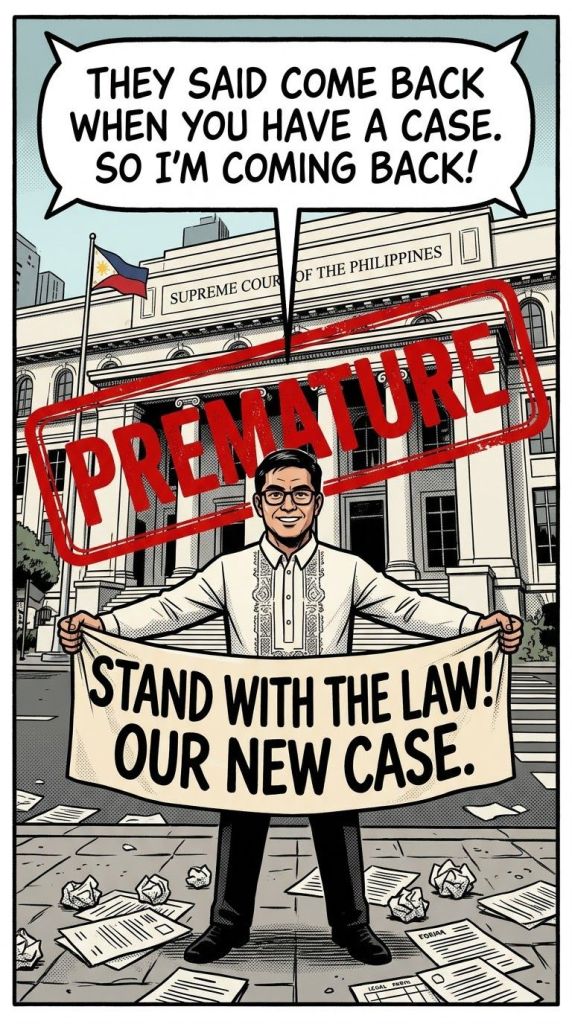
I MUST have missed the memo where “premature” became a synonym for “please try again.” Let me catch up.
Vice President Sara Duterte’s defense team—helmed by the ever-quotable Atty. Michael Poa, he of the Rotary Four-Way Test invocation—is “still discussing” whether to file a Supreme Court petition challenging the Senate impeachment court’s move from 16 votes to 14. They’ve given themselves a polite two-week window. How very considerate of them.
But here’s the inconvenient little fact that Poa’s press releases conveniently omit: the Supreme Court already dismissed three petitions on this exact issue on September 30. Victor Rodriguez, Ernesto Francisco Jr., and Berteni Causing all tried to challenge the moving threshold. The Court said: premature, no standing, come back when you have an actual case.
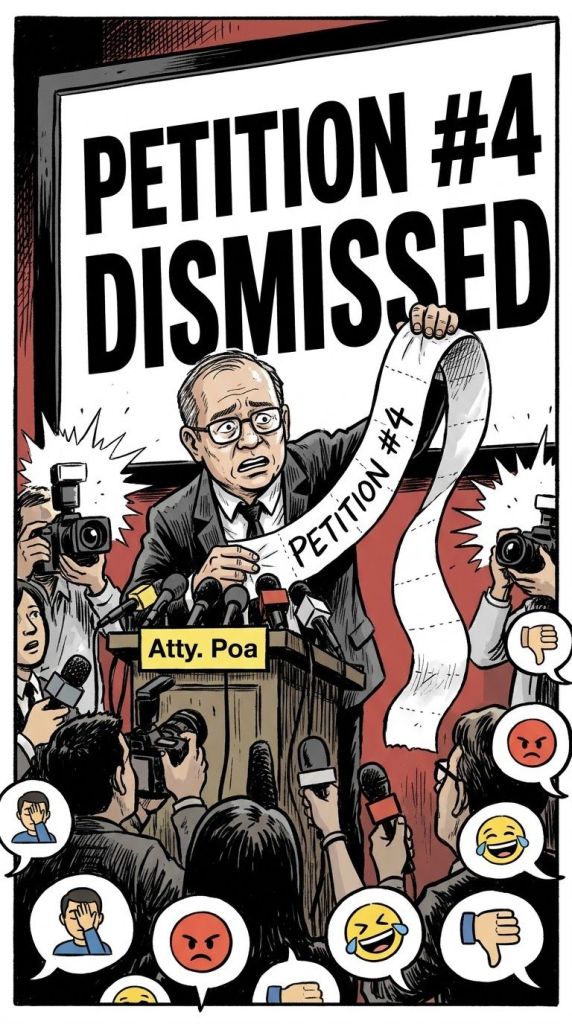
And what did Sara’s crack legal team learn from this judicial smackdown? Apparently, nothing. Because the plan now is to file a fourth petition—this time with the Vice President’s name on the caption—and hope the Justices suddenly discover a burning desire to intervene in a political thicket they just spent an entire en banc session avoiding.
This isn’t constitutional litigation. This is a legal Hail Mary thrown by a quarterback who’s already been sacked three times and is now hoping the referees forgot the rules.
The Math They Don’t Want You to Do
Let’s do the arithmetic the defense wants us to ignore.
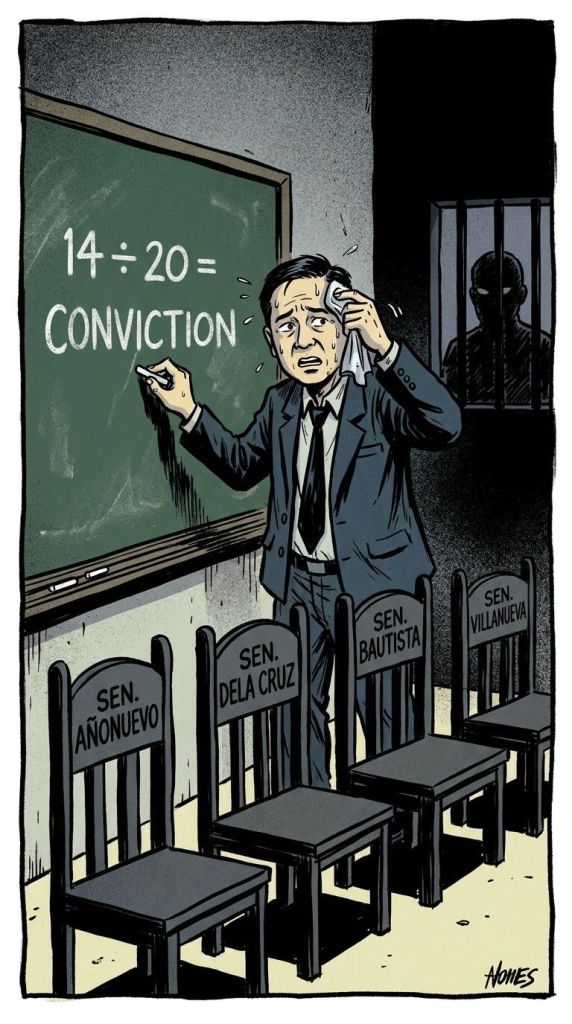
The Senate impeachment court voted 13-1 on September 23 to interpret “two-thirds of all the Members of the Senate” as meaning two-thirds of senators who are legally and factually capable of participating. Six senators abstained. Presiding Officer Chiz Escudero—hardly a Duterte acolyte—cast the lone dissent but accepted the ruling as binding.
Under the old formula: 16 of 24. Under the new formula, if 20 senators are capable of participating: 14.
Four senators are effectively out of commission. Bato dela Rosa is hiding from an International Criminal Court (ICC) warrant. Jinggoy Estrada is detained on plunder charges. Rodante Marcoleta is hospitalized. Loren Legarda is abroad on medical leave.
The defense’s argument is that the 1987 Constitution of the Republic of the Philippines (1987 Constitution) says “all the Members,” not “all the Members who aren’t in jail, hiding, or sick.” It’s a clean textual argument. It’s also exactly the argument that three separate petitioners already made to the Supreme Court—and got shown the door on procedural grounds.
Poa’s response? The Four-Way Test. Is it the truth? Is it fair to all concerned? Will it build goodwill?
Atty. Poa, with all due respect: the Supreme Court doesn’t decide cases based on Rotary Club mottos. It decides based on jurisdiction, ripeness, and standing. And on September 30, the Court told your predecessors they had none of the above.
The Francisco Precedent Is Not Your Get-Out-of-Jail Card
I can already hear the defense brief being drafted: Francisco v. House of Representatives (G.R. No. 160261)! The Supreme Court intervened in impeachment! Grave abuse of discretion! Article VIII, Section 1!
Yes. And in Francisco, the Court struck down the second impeachment complaint against Chief Justice Davide because it violated the one-year bar—a clear, textual, constitutional prohibition that the House had flagrantly breached.
Here’s what the defense conveniently forgets: in Francisco, the constitutional violation was complete and self-executing. The House had already transmitted the articles. The injury was actual. The Court could point to a specific constitutional command—”no impeachment proceedings shall be initiated within one year”—and say: you violated it.
Now compare that to the current situation. Has Sara Duterte been convicted? No. Has the Senate voted on guilt or innocence? No. Has the 14-vote threshold actually resulted in a constitutional injury? We don’t know, because no final vote has been taken.
House prosecutor Chel Diokno—no friend of the Duterte camp, but at least honest about the procedural posture—put it plainly during the trial: the issue becomes ripe only after an actual verdict with fewer than 16 votes. Until then, the Court would be issuing an advisory opinion dressed up as a certiorari petition.
The defense’s response to this is essentially: “But we might be injured! The rule might lead to an unconstitutional conviction! The Court must act now!” That’s not a legal argument. That’s a plea for a preemptive temporary restraining order (TRO) against the laws of logic.
The Four Absent Senators and the Politics of Convenient Absence
Let’s talk about the elephant in the impeachment court. Or rather, the four elephants who aren’t there.
Bato dela Rosa: hiding from the ICC. Jinggoy Estrada: detained on plunder. Rodante Marcoleta: hospitalized. Loren Legarda: medical leave in France.
Are we seriously supposed to believe that all four of these absences are apolitical? That the timing is pure coincidence? That the Marcos administration—which has been accused, credibly, of weaponizing the Ombudsman and the courts against Duterte allies—had nothing to do with the fact that four senators who might vote to acquit Sara are suddenly unavailable?
And yet. And yet. The defense’s argument that these absences shouldn’t affect the denominator is legally coherent but politically suicidal. Every time Poa opens his mouth about “due process,” someone in the Marcos camp gets to say: “The Vice President’s allies are literally hiding from the law, and she wants them counted as if they’re sitting in judgment.”
The Senate’s interpretation isn’t pretty. It’s a constitutional workaround engineered by a majority that wants a conviction. But the defense’s alternative—count the fugitives, count the detainees, count the hospitalized, count everyone, forever, no matter what—turns the impeachment court into a phantom tribunal where votes are cast by people who aren’t there.
Chiz Escudero, to his credit, saw the absurdity of both positions. He voted against the moving threshold but accepted it as the court’s ruling. That’s what institutional maturity looks like. Poa should try it sometime.
The Padilla-Go Petition Is Already Doing Your Job (Badly)
Here’s the delicious irony: while Sara’s lawyers are “still discussing” whether to file, Senators Bong Go and Robin Padilla already filed their own petition on September 29—one day before the Supreme Court dismissed the first batch.
The Padilla-Go petition argues that “all” means all, that the threshold was lowered mid-trial, that the Constitution cannot be amended by a Senate majority vote. It’s essentially the same argument Poa has been rehearsing for the cameras.
But here’s the problem: Padilla and Go are sitting senator-judges. They have standing that Rodriguez, Francisco, and Causing lacked. And the Court still hasn’t acted on their petition. Why?
Because the Court knows that intervening in an ongoing impeachment trial to change the voting rules is a constitutional crisis waiting to happen. Because the Court knows that if it grants a TRO, it becomes the arbiter of Sara Duterte’s political fate—not the Senate, not the evidence, not the Constitution, but nine unelected justices.
Poa’s planned petition won’t change that calculus. If anything, it will make things worse. A fourth petition from the respondent herself, filed weeks after the first three were dismissed on procedural grounds, will look exactly like what it is: a desperate attempt to run out the clock, to delay the verdict past the point where the 2028 campaign season begins, to convert a legal defeat into a political narrative of persecution.
What the Defense Should Actually Be Doing
Here’s the uncomfortable truth that Sara’s lawyers don’t want to hear: the threshold fight is a distraction from the case they’re actually losing.
The prosecution has presented evidence of P817.87 million in unexplained wealth. The defense’s response has been to attack the methodology, to dispute the attribution of business income, to question the witnesses. That’s fine. That’s what defense lawyers do.
But every hour Poa spends on television talking about the Four-Way Test is an hour not spent preparing the evidentiary defense on the one remaining article. Every press conference about the “moving vote” is a press conference not explaining why the Vice President’s Statement of Assets, Liabilities and Net Worth (SALN) declarations don’t match her actual assets.
The threshold issue is legally interesting. It’s constitutionally significant. It’s also not going to save Sara Duterte if 14 senators believe the evidence proves unexplained wealth.
The defense should be fighting the evidence. Instead, it’s fighting arithmetic. And it’s losing that fight too—the Supreme Court already told them, in effect, that they’re not ready for prime time.
What the September 30 Dismissals Actually Mean (And What They Don’t)
Here’s where the defense’s spin machine goes into overdrive—and where the anti-Duterte camp, in its eagerness, overplays its hand too.
The September 30 dismissals were procedural. Lack of standing. Prematurity. That’s the documented basis. The Court did not rule that the moving threshold is constitutional. It did not rule that “all the Members” means “participating members.” It did not reach the merits at all.
A procedural dismissal is not a merits rejection. This is basic. It’s the kind of distinction first-year law students learn and then spend the rest of their careers pretending to forget when it’s politically convenient.
But here’s where the defense’s own spin collapses: prematurity is not a technicality the Court can be talked out of. It is the jurisdictional expression of a substantive constitutional principle—that courts do not issue advisory opinions, do not intervene in ongoing political proceedings absent actual injury, and do not preemptively restrain a coordinate branch based on speculation about what it might do.
The defense will argue that Sara has standing that Rodriguez, Francisco, and Causing lacked. And they’re right. She’s the respondent. Her injury is direct, personal, and concrete in a way that a concerned citizen’s is not. That’s a real distinction, not a rhetorical one. Standing may well be curable.
But ripeness? That’s the wall. Has the 14-vote rule actually been applied to convict her? No. No final vote. No judgment. No concrete injury. The Court can—and by its September 30 logic likely would—say: come back when you’ve actually been convicted by 14 votes instead of 16.
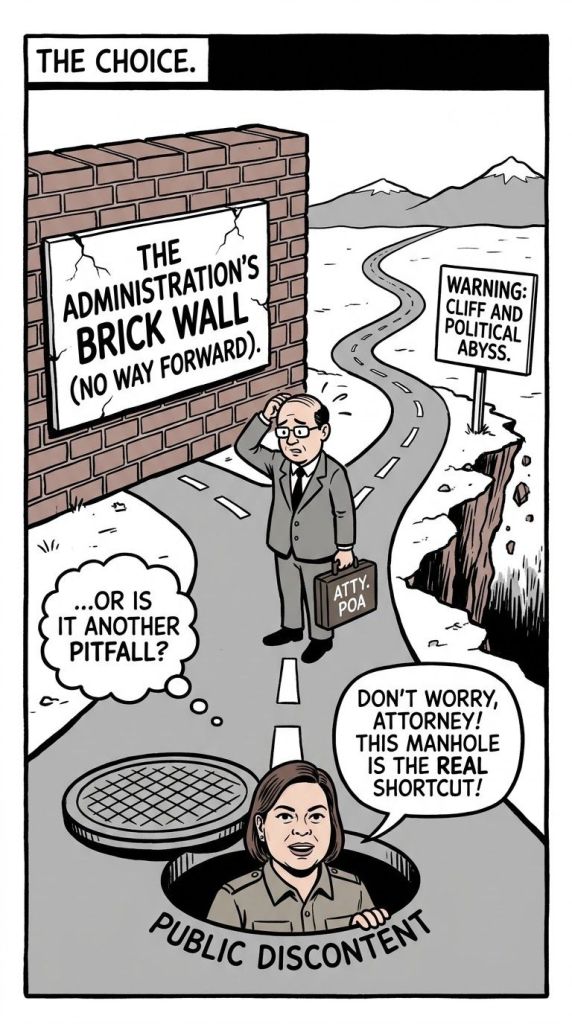
And that’s the trap. If the defense waits for the actual conviction to ripen the case, the preventive relief—a TRO stopping the vote—becomes useless. The verdict is rendered. The political damage is done. If it files now, it runs straight into the prematurity wall the Court just built.
That’s the genuine procedural dilemma. It’s stronger than the “the Court already said no” framing. And it’s the reason the defense is stuck between a premature petition and a moot remedy.
The September 30 dismissals are a procedural obstacle, not a merits rejection. But they’re an obstacle the defense has not yet shown it can clear. And filing a fourth petition weeks after three were dismissed, while the Padilla-Go petition on the same issue is already pending, still looks like a defense running out of runway.
The Bottom Line
Sara Duterte’s defense team has every right to file a Supreme Court petition. The Constitution guarantees access to the courts. The Rules of Court allow certiorari. The Francisco precedent exists.
But rights don’t guarantee wins. And the smart money says the Court will do exactly what it did on September 30: dismiss on procedural grounds, defer to the Senate, and let the impeachment court finish its work.
If the Senate convicts Sara Duterte with 14 votes, then the defense will have a live case. Then the Court will have to decide whether the moving threshold violated the Constitution. Then the Francisco precedent will actually mean something.
But filing now—after three procedural dismissals, after the Padilla-Go petition is already pending, after the prosecution has rested its case on unexplained wealth—isn’t constitutional lawyering. It’s constitutional theater.
And the audience, at this point, is not the Supreme Court. It’s the 2028 electorate.
The defense knows the Court won’t save them. They’re hoping the narrative of judicial persecution will. That’s not a legal strategy. That’s a campaign strategy wearing a barong.
Poa can invoke the Four-Way Test all he wants. But the first question is: is it the truth? And the truth is that the Supreme Court hasn’t reached the merits—and may never, if the defense can’t find a procedural posture the Court will accept.
File the petition, Atty. Poa. The Court will likely dismiss it on the same grounds it dismissed the first three. And then you can go back to the cameras and explain why the Justices are part of the conspiracy too.
Louis ‘Barok’ C. Biraogo is the author of Kweba ni Barok, where he has been documenting the Duterte impeachment saga since before it was fashionable. He is still waiting for someone—anyone—to explain why the defense keeps filing petitions the Supreme Court has already effectively—procedurally, if not substantively—rejected.
Key Citations
A. Legal & Official Sources
- Francisco v. House of Representatives. G.R. No. 160261, 10 Nov. 2003. Supreme Court of the Philippines, lawphil.net/judjuris/juri2003/nov2003/gr_160261_2003.html.
- The 1987 Constitution of the Republic of the Philippines. Official Gazette of the Republic of the Philippines, 1987, http://www.officialgazette.gov.ph/constitutions/1987-constitution/.
B. News Reports
- “SC Junks Pleas vs Senate Impeachment Court’s Vote Threshold.” Inquirer.net, 30 Sept. 2026, newsinfo.inquirer.net/2314245/supreme-court-junks-pleas-vs-senate-impeachment-courts-vote-threshold/amp.
- “Supreme Court Dismisses Petitions Challenging Impeachment Vote Threshold.” Daily Tribune, 30 Sept. 2026, tribune.net.ph/2026/09/30/supreme-court-dismisses-petitions-challenging-impeachment-vote-threshold.
- “Senators Ask SC to Halt 14-Vote Impeachment Threshold.” The Manila Times, 7 Oct. 2026, http://www.manilatimes.net/2026/10/07/news/senators-ask-sc-to-halt-14-vote-impeachment-threshold/2440771.
- Lalu, Gabriel Pabico, et al. “2/3 Threshold Revisited: Fewer Votes Needed to Convict VP Duterte Guilty.” Cebu Daily News, 24 Sept. 2026, cebudailynews.inquirer.net/769273/2-3-threshold-revisited-fewer-votes-needed-to-convict-sara-duterte-guilty.
- Macairan, Evelyn. “Sara to Challenge Moving Vote for Conviction.” Philstar.com, 23 Oct. 2026, http://www.philstar.com/headlines/2026/10/23/2565107/sara-challenge-moving-vote-conviction.
- ₱9 Billion in ‘Savings’? DILG’s Fire Truck Deal Smells Like Smoke

- ₱8B BBM Pork: CCTV for Every Captain’s Kumpare?

- ₱8.9 Billion, 331 Ghost Police Stations: The TIKAS Scandal Explained

- ₱8.4 Billion, 42,000 Barangays, 1 Election: The “Bawat Barangay Makikinabang” Vote-Buying Masterclass

- ₱75 Million Heist: Cops Gone Full Bandit

- ₱63 to the Dollar: The Only Thing Falling Faster Than the Peso Is the Government’s Credibility

- ₱6.77B Ghost Haunts Duterte: RTC Dismisses Mans Carpio’s Desperate Plea

- ₱6.77 Billion and Zero Cash: The Sara Duterte SALN Math That Doesn’t Add Up

- ₱6.7-Trillion Temptation: The Great Pork Zombie Revival and the “Collegial” Vote-Buying Circus

- ₱58.53B, Zero Receipts: The LGSF Pork Barrel Nobody Wants to Name

- ₱53 Million Man Tells ₱695-a-Day Workers to Stop Being ‘Mayabang’: The Audacity of BSP’s Remolona

- ₱4.4 Billion and a Witness Who Can’t Explain It: The Duterte Impeachment’s Most Expensive Non-Answer









Leave a Reply