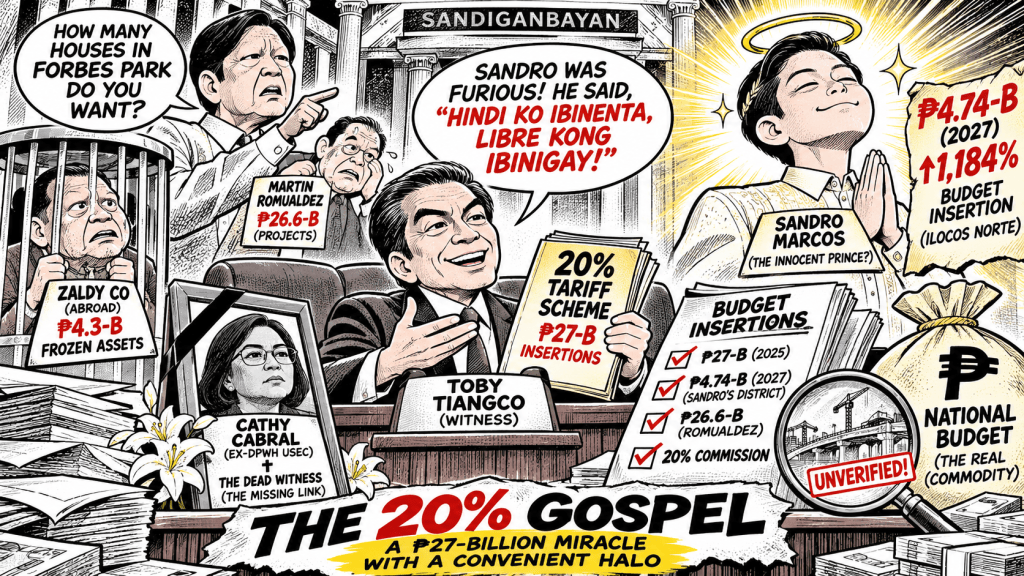
Tiangco Testifies, Co Flies, Sandro Smiles: A Scandal in Three Acts
By Louis ‘Barok‘ C. Biraogo| November 14, 2026
WE begin with the part everyone in the House wants you to swallow whole: Toby Tiangco strode into Sandiganbayan and performed a miracle. He exonerated the President’s son.
Not with bank records. Not with sworn affidavits from bagmen. With a story. Sandro Marcos, we are told, was “furious” upon learning of a 20-percent “tariff” on budget insertions, demanded documents be released, and declared, “hindi ko ibinenta, libre kong ibinigay.” A noble sentiment—and one far more persuasive if it weren’t delivered secondhand, in a bail hearing, by a congressman whose fortunes are aligned with the Palace.
I am not saying Tiangco is lying. I am saying that in Philippine politics, the loudest anti-corruption testimony tends to arrive precisely when it is most useful to the most powerful person in the room.
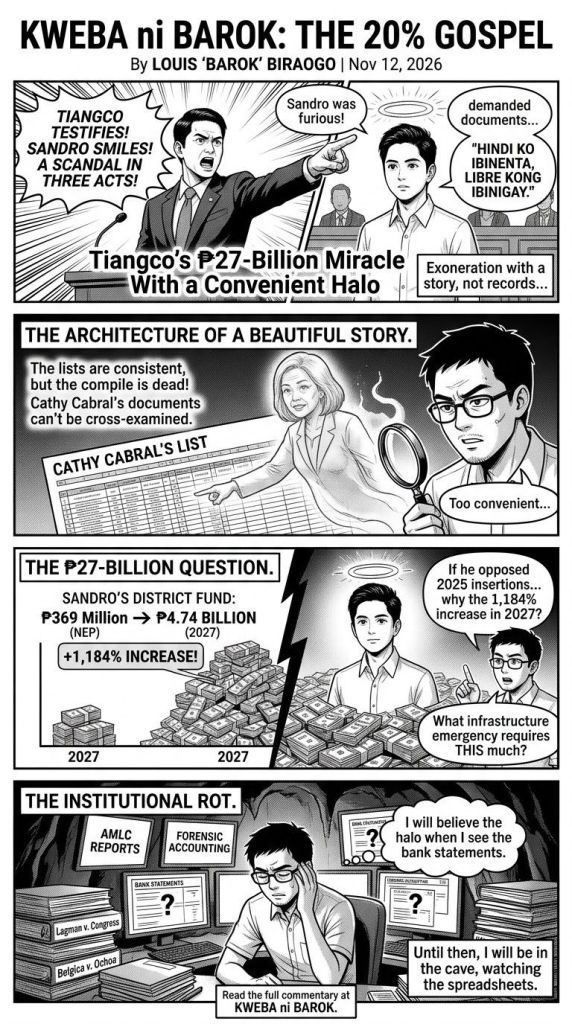
The Architecture of a Beautiful Story
Tiangco’s account has all the elements of a well-produced teleserye: a villain (Zaldy Co, former appropriations chair, now abroad with ₱4.3 billion in frozen assets), a fallen patriarch (Martin Romualdez, with ₱26.6 billion in attributed projects), an incorruptible prince (Sandro), and a brave truth-teller (Tiangco). The script even includes a presidential cameo: Marcos Jr. allegedly scolding Romualdez with “How many houses in Forbes Park do you want?”
It is a narrative so perfectly calibrated to the administration’s political needs that one almost admires the craftsmanship. Romualdez is weakened. Co is exiled. The President’s son emerges with a halo. And the witness? A House member who, by his own admission, was told Co could reduce the commission to 10 percent for relatives and friends.
Forgive me if I ask who, exactly, was supposed to be the relative.
The ₱27-Billion Question Nobody Wants to Ask
Tiangco claims he compared project lists from David Suarez, the late Department of Public Works and Highways (DPWH) Undersecretary Cathy Cabral, and other records, finding his computations matched the Ombudsman’s ₱27-billion figure to within ₱100 million. Suspiciously precise—and it raises a question receiving almost no scrutiny: if the lists are that consistent, why were the Romualdez and Tingog allocations allegedly excluded from the initial release?
The answer, per Tiangco, is that Suarez withheld them because they included projects associated with Sandro—and Sandro intervened to force their release. This is presented as proof of innocence. But think it through. If the complete lists were damaging to Romualdez and Tingog, why would anyone need to withhold them to protect Sandro? Unless the lists were being curated—trimmed, sanitized—so the only politically safe version excluded the most damaging attributions. If so, the release was not transparency. It was selective disclosure dressed as transparency, and the President’s son was its beneficiary.
I do not know this to be true. But neither does anyone else, because the original spreadsheets have not been forensically authenticated, the metadata has not been published, and the man who allegedly compiled the most important list is dead.
The Convenient Corpse
Cathy Cabral allegedly possessed a “special list” of project proponents and had compiled documents on budget insertions. She died before she could testify. Her absence means the single most important independent source for Tiangco’s documentary claims can no longer be cross-examined. Her records exist, allegedly. Her testimony does not. A spreadsheet found in a deceased official’s files does not automatically become admissible evidence because it is politically useful.
In a functioning legal system, this would be a problem. In the Philippines, it is apparently a footnote.
The 2027 Problem
While Tiangco was exonerating Sandro for 2025, the House was quietly inserting ₱4.74 billion in public works funding into the President’s son’s district for 2027—up from ₱369 million in the NEP. That is a 1,184-percent increase. Paolo Duterte’s district received ₱5.2 million, roughly the cost of a nice Makati condominium.
The Palace defense is that insertions are “not inherently wrong” if funds are properly used. Technically true. Also the defense used by every administration since the Spanish colonial era, and it has never once prevented a single peso from being stolen.
So here is the contradiction no one has been asked to resolve: if Sandro was genuinely opposed to the 2025 insertion scheme, why does his district suddenly need ₱4.74 billion in 2027? What infrastructure emergency in Ilocos Norte requires an increase larger than the entire budget of some mid-sized provinces? And if insertions are legitimate because funds are properly used, what precisely was illegitimate about the 2025 insertions Tiangco is so upset about?
The answer, I suspect, is that the difference between a legitimate insertion and a kickback is not a legal category. It is a question of who is doing the inserting.
The Co Defense
Let me say something that will not endear me to anyone: Zaldy Co deserves a defense, and his flight abroad does not erase the evidentiary problems in the case against him. The core allegation rests on Tiangco, who admits he learned of the scheme from former Pampanga representative Aurelio Gonzales Jr.—not a neutral party. It is corroborated by engineer Henry Alcantara, contractor Curlee Discaya, the frozen assets, and Co’s flight. But “corroborated” is not “proven beyond reasonable doubt,” and Co’s obvious guilt in the court of public opinion does not relieve the prosecution of establishing the statutory elements.
This is not a defense of Co. It is a warning about what happens when a country decides due process is a luxury it cannot afford. The same evidentiary discipline that protects Co also protects Sandro Marcos. If the standards are not uniform, the investigation is not an investigation. It is a political operation with a docket number.
The Institutional Rot
The deeper scandal is not the 20-percent tariff. It is that the national budget has become a commodity so thoroughly commercialized that a sitting congressman can testify in open court that lawmakers paid a percentage to access the appropriations process—and the reaction from the House is not shock but damage control. The Speaker’s office responds with procedural objections. The majority leader’s allies emphasize their patron was merely a whistleblower. The administration expresses confidence in the institutions. And the public, exhausted by a decade of pork barrel scandals, shrugs and assumes everyone is stealing.
They are not wrong. The Supreme Court’s October 2026 Representative Edcel C. Lagman et al. v. The Congress of the Philippines et al. (Lagman v. Congress) ruling—invalidating the ₱449.5-billion unprogrammed appropriations increase in 2024, the ₱17.99-billion congressional increase in the 2025 DPWH Special Road Fund, and the SAGIP lump sum as a prohibited post-enactment allocation mechanism—was a legal earthquake. But earthquakes in Philippine governance tend to be absorbed by the same structures that caused them. Belgica v. Ochoa (2013) killed the Priority Development Assistance Fund (PDAF). Lagman (2026) killed its successor. And yet here we are, discussing a 20-percent tariff allegedly operating through the appropriations committee and the DPWH, with a dead undersecretary, a fleeing chairman, ₱4.3 billion frozen, and a presidential son who received a 1,184-percent budget increase.
The scandal is not that the system is broken. The scandal is that the system is working exactly as designed.
The One Genuinely Refreshing Admission
In fairness, Tiangco admitted the limits of his knowledge—no personal knowledge of cash deliveries to Romualdez, no knowledge of how the delivery list was prepared. This is, oddly, the most credible thing he said. A liar would have claimed to see everything. Tiangco is telling us he has documents and hearsay, and that the distinction matters.
It does. Which is why the next phase should not revolve around Tiangco’s testimony at all. It should revolve around the original spreadsheets, the email metadata, the bank records, the Anti-Money Laundering Council (AMLC) reports, and the forensic accounting no one in Congress seems eager to request. Follow the money. Authenticate the documents. Cross-examine the witnesses. And do it with the same rigor whether the target is Zaldy Co, Martin Romualdez, or the President’s son.
The Verdict, Pending
I do not know whether Sandro Marcos is innocent. I suspect he is not guilty of the specific 20-percent arrangement Tiangco described—not because he seems like a man who refuses to profit from public office, but because the evidence does not establish his participation. That is a low bar, and it is the only one the law requires.
I do know his district’s 1,184-percent budget increase is an embarrassment to every claim of fiscal conservatism the administration has made. I know Cabral’s death deprived the investigation of its most important independent witness, and no one in the House has called for an independent forensic audit. I know Co is abroad and his assets are frozen. And I know Tiangco, whatever his motives, has done the country a service by putting the 20-percent tariff on the record under oath.
Whether that becomes a reckoning or another episode of selective outrage depends on whether the Sandiganbayan, the Ombudsman, and Commission on Audit (COA) are permitted to do their jobs. If they are, the President’s son should welcome the scrutiny—his 2027 windfall deserves a public explanation, and his alleged opposition to the 2025 scheme deserves independent corroboration. If they are not, we will have learned something far more depressing than the existence of a 20-percent tariff: that in the Philippines, a scandal is just a budget insertion with better branding.
The ₱27-billion question is not who put the projects in the budget. It is who paid to put them there, who collected, and who decided which names would appear in the spreadsheets and which would be quietly deleted before release. That answer is written in financial records not yet examined and testimony not yet cross-examined.
I will believe the halo when I see the bank statements. Until then, I will be in the cave, watching the spreadsheets.
Key Citations
A. Legal & Official Sources
- Presidential Decree No. 1606. Revising Presidential Decree No. 1486 Creating a Special Court to be Known as “Sandiganbayan” and for Other Purposes. 10 Dec. 1978, lawphil.net/statutes/presdecs/pd1978/pd_1606_1978.html.
- Belgica v. Ochoa. G.R. No. 208566, 19 Nov. 2013. Supreme Court of the Philippines, lawphil.net/judjuris/juri2013/nov2013/gr_208566_2013.html.
- Representative Edcel C. Lagman et al. v. The Congress of the Philippines et al. G.R. No. 271059 (consolidated), 7 Oct. 2026. Supreme Court of the Philippines, sc.judiciary.gov.ph/sc-holds-unprogrammed-appropriations-subject-to-guidelines-voids-congressional-increases-in-2024-and-2025-budgets/.
- The 1987 Constitution of the Republic of the Philippines. Official Gazette of the Republic of the Philippines, 1987, http://www.officialgazette.gov.ph/constitutions/1987-constitution/.
- Republic Act No. 3019. Anti-Graft and Corrupt Practices Act. 17 Aug. 1960, lawphil.net/statutes/repacts/ra1960/ra_3019_1960.html.
B. News Reports
- “Tiangco: House Lawmakers Had to Pay 20% ‘Tariff’ When Requesting Funds.” Inquirer.net, 11 Nov. 2026, newsinfo.inquirer.net/2339197/tiangco-house-lawmakers-had-to-pay-20-tariff-when-requesting-funds.
- “Sandro Marcos ‘Furious’ over 20% ‘Tariff’ Scheme—Tiangco.” Bilyonaryo News Channel, 11 Nov. 2026, bnc.bilyonaryo.com/sandro-marcos-furious-over-20-tariff-scheme-tiangco/news/.
- “P4.74B for Sandro, P5.2M for Pulong.” Daily Tribune, 5 Nov. 2026, tribune.net.ph/2026/11/03/p474b-for-sandro-p52m-for-pulong.
- “Ex-DPWH Undersecretary Cabral Dies in Alleged Fall.” GMA News Online, 19 Dec. 2025, http://www.gmanetwork.com/news/topstories/nation/970117/ex-dpwh-undersecretary-cabral-benguet-police/story/.
- “Tiangco: P26.6-B of P209-B in DPWH 2025 Budget Inserted by House.” ABS-CBN News, 11 Nov. 2026, news.abs-cbn.com/anc/11/11/26/tiangco-p26-6b-of-p209b-in-dpwh-2025-budget-inserted-by-house.
- “Ang Hirap Maging Mahirap”: The PAO Scandal That Proves Government Contempt Is Nothing New
- “Far-Off” My Axx: Malacañang’s Claire Castro Drowns in Her Own Legal Gaslighting
- “Forthwith” to Farce: How the Senate is Killing Impeachment—And Why Enrile’s Right (Even If You Can’t Trust Him)
- “HINDI AKO NAG-RESIGN!”

- “I Know Nothing”: Baste Duterte’s Amnesia Defense Meets ₱33M in GenCorp Contracts
- “I’m calling you from my new Globe SIM. Send load!”

- “Mahiya Naman Kayo!” Marcos’ Anti-Corruption Vow Faces a Flood of Doubt

- “Manageable” Debt, Unmanageable Corruption: The ₱19.66-Trillion Lie
- “Manageable” Debt, Unmanageable Lies: DBM’s ₱21 Trillion Fairy Tale
- “Meow, I’m calling you from my new Globe SIM!”

- “Natrabaho”: One Word, One Ombudsman, and a Judiciary on Trial
- “No Special Jail for Crooks!” Boying Remulla Slams VIP Perks for Flood Scammers


Leave a Reply